Category Archives: Other Writing

Son and Father

tmag

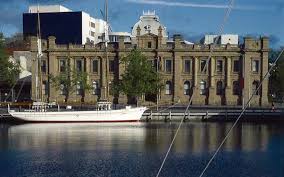
She’s as keen as mustard, is Janet Carding. That was the tone of a feature article on her in our local daily recently. What was once a fusty and in places, woebegone collection of bits and pieces, bibs and bobs, has now been transformed into a happening hub. It’s not quite up there with its newer, flashier, brassier, edgier colleague further up river (MONA), but it’s also not too shabby in comparison, thank you very much. The last time your scribe visited, on a mid-winter morning, TMAG (Tasmanian Museum and Art Gallery) was pumping with people. Ms Carding is newly in the top job. Considering funding restraints – current governments tend to hold such meccas of culture and community activity low on their priority lists – she has a task ahead of her. But she is very determined to maintain standards and patronage. There are plans as big as kunanyi, our city’s stolid overseer, to further expand TMAG, but for the present, it’s a holding process for her until purse strings loosen.

Janet Carding has the view that our local museum is here ‘…to tell Tasmanian stories,…’ and that these will be ‘…forever shifting’. She wants it to be not only the go-to location for tourists to discover much about the island they’re visiting, but somewhere for Hobartians to return to over and over again. She eschews the notion that it be a ‘Night at the Museum’ clone, a ‘…big, stuffy, boring institution full of dusty showcases and uniformed guards saying ‘Shhh…’ That was the old TMAG, not the vibrant new face it displays to its public today – and will continue to do so under her watch.

The first exhibition that came on-line after she took up her tenure, back in April, was ‘The Suspense is Awful – Tasmania and the Great War’. That was what I perambulated down Argyle Street to its site between city and docks that morning to see. By the end of my viewing I was impressed. During the hour or so I spent perusing I had been moved to tears several times. And that is also where I discovered a letter from a father to his son, both personages being intimately involved with another museum. It was a missive, together with its accompanying few words of explanation, that piqued my interest and left me dewy-eyed. It also caused me to take to the ether and to do a little imagining as well.

Launceston’s Queen Victoria Museum and Art Gallery (QVMAG) has had a similar make-over to its southern cousin. It was there that the two men in question spent a very large part of their working lives.

Herbert Henry Scott died on March 1st, 1938. I have no idea whether his son, Eric Oswald made it back for his funeral. He had just commenced some travels in the other hemisphere. I suspect not, given the state of international transport back then – the flying boat service to and from Britain only commenced later that year – see, I’ve done my research. So this is where the imagining comes in. I imagined that somehow he was there to say farewell to his father. What follows is perhaps something akin the eulogy he would have given from a pulpit somewhere in the city on the Tamar, before his father was taken away and laid to rest in Carr Villa Cemetery.

My dear family, my dear friends and friends of my father – I am standing before you, on this sombre occasion, to tell you something of my father – of the man I respected and loved. I will tell you a little of his life and deeds, as well as how a letter from him to me changed the course of my life. You all know his character, you all know how admired he was in this community, particularly in the scope of his preoccupation with the surrounds of this beautiful island that has added so much knowledge of it to the scientific world. You all know the immense contribution he made to our local museum, a place that has afforded most of us assembled here hours of wonder through the many exhibitions he curated. You all know the tireless hours he willingly gave up to enhance that city asset. We also all know, that as I speak, war clouds are again gathering over Europe and that gives me such a heavy heart due to the knowing of what he, my mother and my sister went through during the years of the Great War. Many of you before me also were sorely tested during that period. I will relate to you my own testing time during the last year of that war and how my father was able to prevail on me to take, or rather not take, a certain course of action.

My father was London born, grew up in the United States of America, returning to the UK at age eleven to be apprenticed to a cabinet maker – a trade that would hold him in good stead in later life, building display cases. He was a sickly young man and he was advised to migrate to a climate possessing cleaner air. That turned out first to be New Zealand, but eventually Launceston. After various occupations he was invited to take up the position for which he has become well known and even revered in our city – that of curator of our museum, the Queen Victoria. It was two years after that I came into the world.

Before he took up this position he had been noted by the powers to be as a fine chronicler of the natural environment of Northern Tasmania and he was keen for the Queen Victoria to reflect that. At the onset he found the place, on close inspection, to be in a state of neglect and disarray. He took wholeheartedly to the task of transforming it into the pride of the city it is today. In fact, it would be fair to say he became obsessed by the never-ending tasks he found necessary to complete single-handedly there. My father could be equally seen dusting its various collections as he could be pouring over the books, trying to balance the meagre budget, in his broom-closet of an office. The museum also became a home for his teaching; the passing on of his knowledge of the natural world to students of all ages. He was particularly sort after for his intimate awareness of the native marvels of his beloved adopted island.

The museum expanded during his tenure, adding new galleries and acquiring another building in which to exhibit what previously could not see the light of day due to lack of space. Every new showing he would have to set up himself. He was also busy publishing learned accounts of the natural history of our environs. To my mind, he was a great man; a great man that all who are gathered here will retain positive memories of. He will sorely be missed for his contribution to our community. Of course, as family, we will miss a loving husband and father.

As you are all aware, since 1930 I have worked alongside my father at the Queen Victoria. I am with heavy heart, but nonetheless excited, to be taking over in his role a curator after I complete my travelling scholarship.

In conclusion, I wish to relate to you some of the contents of a letter my dear father wrote to me on the 16th of May, 1918. It was the last year of the conflict and we had discussed the previous evening my desire to do my bit for my country now that I was finally old enough. I informed him that I would be shortly leaving for the front. He was a persuasive letter writer and found it easier to formulate his feelings and arguments in that format rather than verbally. He knew of my mother’s would be reaction to this news and was well aware of the fact that I may not return. Friends of ours had lost loved ones and he determined that I should not be among them. Without that letter there is every possibility I would not be standing here, sending him off, this hour. In part, these are the words he put to paper to me:-

‘Dear Eric
Apropos of our talk last night respecting your keen desire to go to the great war, I wish to pen you a line or two. I have to ask you a very hard thing, namely to put your love for your mother in front of your fixed idea of your duty to State. The decision on your part to serve at the front would end her life with worry so I ask you to spare that life for you and your sister, and also for myself. The law of love for a mother overrules all but the deepest call of state or country.
Always your friend and best chum
Dad’

In the circumstances, back then, he well knew that he was asking me to make the hardest of calls, given the pressure at the time for all men of my age, who were reasonably of sound health, to sign up. He was well aware of how many in the community would brand me with cowardice and I know it was not a plead he took lightly in the making. Such was my respect I acceded to his wishes.

Thank you for bearing with me for these few words. I will continue to dearly lament the passing of my father for some time.

Now as a father myself I have, since that sojourn to TMAG, often thought what a thing it was for that other father, long ago, to make such a request of a son. How much it must of taken out of him to dissuade him from going – and how relieved he would have been that he was successful in that argument. I would imagine there would be some Muslim fathers around the country at the moment suffering in the same way, anxious that their sons not be tempted by the zealots of IS. In those years, though, the anguish of such a great number of parents, fearing a son joining up and facing the likelihood of death in a foreign land, must have taken a terrible toll. I thought on all that after I read that letter in the TMAG that morning.

No doubt Eric used the occasion, to a degree, to set the record straight – and all too soon another war would again sorely test him. He had already been appalled by what he had seen in earlier travels immediately after the first war, especially how the rest of the world treated the German people who were innocent pawns in the games their leaders had played in the years pre-1914. That and the letter would possibly prove instrumental in Eric deciding to become a conscientious objector, on religious grounds, during the next war. For that he lost his position at the Queen Victoria and was imprisoned.

Before he joined his father, Eric was a teacher, plying his calling at such places as Epping Forest, Devonport and Ulverstone. At the latter he met and married fellow chalkie, Freda Lloyd. After the Second World War Eric returned to his teaching career.

In his later years he became, to his own admittance, quite eccentric and reclusive, dedicating himself to a study of sea-life. He co-authored ‘Fishes of Tasmania’, published in 1983. He wrote over eleven thousand quatorzains, a form of verse – one every day. He was fatally hit by a car in 1987. Eric Scott was survived by a son, as well as two daughters, no doubt giving him also a great understanding of the import of that father’s letter he treasured to his dying day – a letter that may have saved a life. But at what cost to son and father?

queen vic

Website for the Queen Victoria Museum (above) = http://www.qvmag.tas.gov.au/qvmag/

Website for the ‘The Suspense is Awful – Tasmania and the Great War’, TMAG = ‘The Suspense is Awful – Tasmania and the Great War’.

VE

For the UK, seventy years ago this week (at time of writing), the long wait was over. Since D Day Allied forces had been pushing east, with other forces fighting up from the underbelly and the Russians heading towards the heartland. Germany was finally done for, an evil regime consigned to history. In the streets of the British nation, on the day the official announcement was made that hostilities had ceased, as well as later in entertainment venues across the country, it was party time like there was no tomorrow. It was VE Day.

Part 1

We know where she was playing that night of VE Day. At the personal request of Field Marshall Montgomery her band had been flown to Berlin to perform at a concert for the troops celebrating that their time in a war zone was soon to end. Christmas that year saw her back in Germany broadcasting, for BBC radio, from Hamburg, to the folks back home. Her girls’ show followed the King’s speech.

We all remember the great entertainers of those dark war years – Dame Vera Lynn and Glen Miller, for instance – but few these days remember her. But back then she was a household name and was arguably the most ground-breaking musician of her time.

When we think think girl bands of our own era, names like the Spice Girls and the Supremes would probably hit our synapses first. But after more consideration, well, they didn’t play instruments, did they? Delving further, then, we possibly would come up with the Bangles and the Go Gos who did – but all-girl bands are, even today in this enlightened age, few and far between. There are plenty of women playing in bands, but an all female gendered one is a rarity. It was the same back in the forties, but Ivy Benson set out to change all that.

1913 saw her emerge into this world atop the Malt Shovel Inn in Leeds. Her father was a musician. Digger Benson taught her the piano and by nine she was a regular performer on the local circuit and on radio in her city. By her teens, under the influence of Benny Goodman, she changed her instrument to the clarinet first of all, then later the saxophone. On leaving school, for a while Ivy worked on a factory floor, but soon music took precedence. She turned professional and left for the bright lights of London. She was quick in establishing herself due to obvious talent and her glamour. It was then she had a radical idea – she would form an all girl band.

Ivy+Benson+

She knew to be successful the members would have to look the part, so she set about designing some alluring outfits. Above all, though, they had to possess the necessary musical chops. From her own territory in the north, with that area’s brass band heritage, she found a ready supply of young misses with what she was looking for – and she did need a steady supply. Many were no sooner up on stage than they were being courted. It was 1939 and the country was at war. Armed forces’ personnel were looking for comfort before they headed off, or later, when on leave. This often blossomed into romance and marriage in these desperate days – which, of course, back then precluded marrieds from continuing on in the band. When American GIs hit town the problem was accentuated. Despite that, shortly after their formation, the band was winning accolades and excellent reviews for their shows, despite the addendum that Ivy abhorred – ‘for girls’. Her band was packing them in in dance halls all around the country and she hit the big time when her troupe performed at the Palladium and Covent Garden. Then in ’43 the BBC came calling and invited Ivy to become one of the broadcaster’s resident dance bands – and the shit really hit the fan. The furore over this became known as the Battle of the Saxes.

It seemed the BBC’s decision was an affront to male musicianship and the Musician’s Union set to work to put matters right by sending a delegation to the top brass of the Beeb in protest. But her popularity ensured that, despite this brouhaha – or because of it, the Ivy Benson All Girl Band remained on everyone’s lips. She personally was receiving over three hundred letters a week in fan mail, mainly from besotted servicemen. As the Allies closed in on their prey after the 1944 landings – Ivy and her girls were close to the front entertaining them every inch of the way

ivy benson band

There were usually around twenty musicians under Ivy’s charge and their signature tune was ‘Lady Be Good’. She led her band, in various guises, until well into the 1980s. It is reported Ivy loved bling in all its forms, was partial to a tipple and that her private life was always in a state of flux. Although she married twice, she couldn’t hold on to a man because of her constant touring – they always had affairs in her absence – or so she said.

Through her bands hundreds of women went on to professional careers in music – and Ivy helped make that not only possible but perfectly respectable for them to do so.

ivy benson poster

In her seventies Ivy finally retired, although she’d still occasionally perform for charity. Her friends were by now actively lobbying for her war efforts to be officially recognised and three months before she passed away, she was informed that she would be made a Dame. Sadly, before she could be invested, death took her. Damehoods cannot be given posthumously.

It is appropriate that today her memory is being championed by another force of nature in the annals of girl power, former Spice Mel C. She wants Ivy Benson to be granted the recognition she so richly earned for the light, colour, hope and glamour she provided in dark times. Those who know Ivy B’s story are hopeful Mel C will prevail, as Ivy did all those years ago.

Part 2

On the 8th May, 1945 – that is, VE Day – around the same time as Ivy Benson was getting ready to lead her all girl band in entertaining the victorious troops in Germany, a large crowd was gathering outside the gates of Buckingham Palace, back home, in the expectation of an appearance by the Royal Family on the balcony. Now, if you believe the hokum hoisted on us by a ‘A Royal Night Out’, the two princesses, Elizabeth and Margaret, nineteen and fourteen respectively at the time, were on the wrong side of those gates, celebrating with the great unwashed.

royal night out

Yes, history tells us that the young princesses did leave the confines of the palace that night and tottered off for some prim levity at the Ritz, heavily chaperoned of course. The premise of this production is: what if they deviously jilted their minders – an unlikely pair whose preference for a jolly time overrode their instructions re the royals – and made a bid for freedom? It then goes on to imaginings of all their adventures. Despite their quite chaste behaviour, given the often tempting circumstances, whilst off the leash they certainly had a hoot – truly a night to remember.

Now do go to this offering in the right frame of mind. Suspend belief and not look at the plot line too critically. There are holes as big as the House of Windsor in logic with the piece from director Julian Jarrod.. Some of the acting is also a tad ‘how’s your father’ – but ignore all that and you’ll be fine. I thought it most delightful.

The recreation of that ‘roll out the barrels’ night of nights around London was terrific with all and sundry letting their hair down after all that ‘stiff upper lipping’ during the war years. There’s a hint of sadness there too for those who didn’t make it back. I loved Rupert Everett as George VI although, as was rightly pointed out to me, he looked little like the real deal. Canadian actress Sarah Gabon was our present Queen back in the day when she was known as Lillibit by her nearest and dearest – and she is charming as the more sensible, the more restrained of the duo. Although Beth Powley has been praised for her depiction of Margaret in some quarters, she just gave me the irrits with her over the top ditziness – as well as the fact that the cove she picked up to be her squire for the evening looked old enough to be her grandfather.

Many have likened this to an old fashioned romp in the manner of the much loved ‘Carry Ons’ of days of yore. I had a ball with this and my lovely Leigh thought it all quiet uproarious. I had constant digs in the ribs to contend with. I can imagine her back on that night – she would be into the spirit of it for all she was worth. That being said, let’s just hope there’s never another.

royal niught out

Ivy B on YouTube = https://www.youtube.com/watch?v=UhUW-hXt8nA

Official trailer – ‘A Royal Night Out’ = https://www.youtube.com/watch?v=oaF-HdgZVU8

Chasing Betty Boop All the Way to Ukraine

I have a penchant for beautiful women. Nothing unusual in that – most men do. But I am particularly interested in beautiful women who, in some way, have imposed themselves on their times and/or communities – and not the ones we all know. I like going into the ether and researching, maybe even writing up, those who are relatively obscure but nonetheless pique my curiosity. I have blogged about an artist’s muse; a writer’s lover; a photographer’s model and sundry women who have broken through the glass ceiling in their own eras. The stimulus for this may be an obscure reference read in book, or broadsheet; it may be a painting or, as in this case a supposed portrait of a cartoonist’s inspiration. And what I can’t discover, I am at liberty to make up!

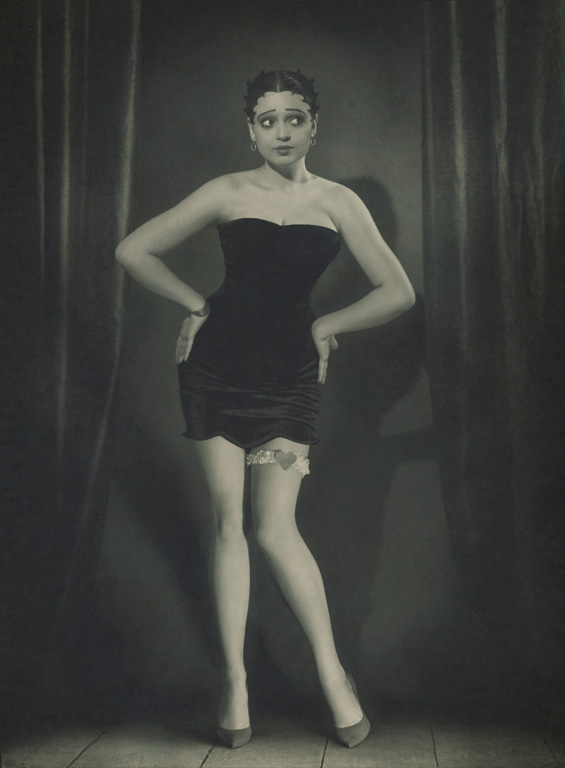
My writerly daughter knows this. BTD (Beautiful Talented Daughter) has taken to sending me images that she feels are worth investigating. The one you espy on this page arrived with the challenge, ‘Here Dad, see what you can do with this.’ On it was attached the caption, ‘Was this black woman the inspiration for Betty Boop?’

ra - bb

Suitably intrigued, I took to said ether – and, yes, it did end up leading me to quite a tale of not one, but four, beautiful women. One was a darling of her age and two certainly gave their times a shake. And the other one – well, we’ll come to that.

Now most of us know Betty Boop – still an icon of popular culture decades after she first emerged from an animator’s drawing board. She initially became a sex symbol for the Depression era and was a bold woman when bold women were decidedly not in vogue. She was conjured in the studio of cartoonist Max Fleischer and first appeared in the Talkatoon series for Paramount in 1930. Initially she was portrayed as a female canine, but was soon morphed into the figure we all recognise. She was appearing in her own cartoons by 1932 – a feisty vision of short cropped hair, big eyes and even larger hoop earrings. And she was decidedly white.

bb

Now the image that came to me, via my BTD, features a lookalike of opposite skin tones, certainly a stunning appearing woman in the vintage style of the flapper age. She is a dead-ringer for Betty Boop. It claimed to be a period portrait of one Esther Jones. So who was she and what evidence is there that this beauty was indeed the inspiration for BB?

Typing the name into Google the sent image certainly appears, but it also doesn’t take long to figure out all is not as it seems here. If we turn our attention to Wikipedia the image it uses for Esther Jones, to my untrained eye, looks much less like an Afro-American version of BB than the one that started this inquiry. What is going on? We’ll investigate further.

baby-esther

Well it seems this lovely Ms Jones invented the Boops. She was a performer at Harlem’s infamous Cotton Club during the Twenties, operating under the moniker of Baby Esther. The Boops, a form of scatting with a child-like voice, later became the Boop-Oop-a-Doop, sometimes referred to as Baby Style. If you are aware of the song ‘I Wanna be Loved by You’, you know what’s happening here – and this style, of course, was part of the package that Betty B presented to the world – thus the connection to the black chanteuse. Esther died in obscurity in 1934 – but, as we shall see, her name resurfaces later in this tale.

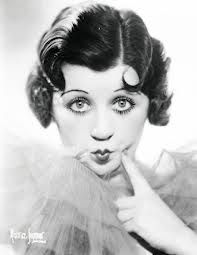
Now the star who hit paydirt with the Boop-Oop-a-Doop was performer Helen Kane, an actor/singer who reached her peak of prominence slightly later than Jones. She went on to make movies in support of icons such as William Powell and Fay Wray – even topping the bill, in her own right, in one Hollywood product. But her ‘fifteen minutes of fame’ was fading just as Betty Boop’s was rising. She quickly realised certain similarities between the animated figure’s looks and voice to her own in those departments, particularly considering the use of the Baby Style. It seemed to her there was more than just a passing, accidental semblance to the Fleischer Studio creation. Kane was, as well, thoroughly white. Surely then Paramount et al were taking liberties with her image and voice, liberties which, after consulting legal people, she came to realise could be more than a nice little earner for her and would set her up for her existence post-celebrity. Kane vowed they weren’t going to get away with it. She sued the studios for the then astronomical sum of a cool quarter of a million green ones. They’d pinched her style and used it for their financial gain – she was therefore deserving of her piece of the action.

helen kane

The rub in all this was that it could be proved that, late in the previous decade, Ms Kane had visited the Cotton Club and caught a song or two from Baby Esther. Several witnesses testified to this effect – so the Boop-Oop-a-Doop was not her creation at all. It didn’t seem she had a leg to stand on. Ms Kane did not own the style so the judge found against her. Kane passed away in 1966, aged 62. In her remaining years she married several times and earned some peanuts appearing on shows such as Ed Sullivan as the Boop-Oop-a-Doop Girl. There is little doubt that BB’s vocalised stylings are based on Kane, but it seems visually Fleischer and his crew were hooked, along with most males in the US, on the surfeit of attractions posed in the one beauteous form that was the twenties ‘It’ girl, Clara Bow. Weight is added to this being the case by the fact that the Tinseltown superstar actually voiced some BB offerings, particularly when she sang ‘I Wanna be Loved by You’. Ironically, Kane’s voice, was also used, but mainly she was voiced by another lookalike – actress Mae Questel.

Clara-Bow

Clara Bow

So now, seemingly, there remains just one question – if the original image was not of Esther Jones, then who was the BB black doppelganger? Again the ether quickly provides an answer – this taking the story all the way to the Ukraine. Here there are a team of photographers who refer to themselves as Retroaletier. As the name suggests, these aficionados of times of yore are, not unlike your scribe, fond of beautiful women thrown up by the past – and use young models to, as accurately as possible, portray them. Of course, back in the Thirties, BB was all about style and non-repressed sexuality (some of her cartoons faced the wrath of the censor). Retroatelier found their BB in Olya, skilfully posing and kitting her out to resemble this ‘…time-honoured archetype of female allure…’ And obviously they were aware of Esther Jones’ role in it all, thus Olya is/became a comely black girl. Now, if you are thinking about checking out the work of Retroatelier for yourselves, just be aware some images are NSFW. They are also the perpetrators, perhaps inadvertently, of a minor internet hoax.

So thank you BTD for passing on the image and leading me, hopefully successfully, to produce an interesting story from the challenge. Pleasingly there is already another image from my daughter waiting for me to investigate. I love it. I so enjoy putting together these retellings.

A Retroatelier Gallery = http://www.modelmayhem.com/696581


Alluring Women 2014

My world continues to be filled with women of allure. There are the constants of family members and gorgeous friends, but then there are some in my world for only an instant. But they leave an indelible impression. Take the example of the stunning young lady in the city Woolworths yesterday. She gave me such a smile when I walked up to her to process my meagre array of product that I felt compelled to state to her, ‘Who’d use a machine when I can have your beaming face to welcome me and light up my day?’ As a reward I received an even more glorious one at close range.

Nothing measures up to, of course, the feminine treasure that is my DLP (Darling Loving Partner), She graces my life in all the ways a male of the species could wish for – but there are many, many more, such as the lovely ladies at my local newsagent who ensure I receive my daily Age. And then there are my mates – beautiful belles of all ages who inhabit the state’s north and south. Many I see only infrequently these days, but I adore them dearly.

But this scribbling is not about those wonderful souls – it’s about those outside of my direct orbit. They light up my life in another way – and this year there’s a new divine list to parallel my one produced in 2013 (see below). These ladies were, to me, the luminaries who made the public spotlight in some way during the last twelve months. And in doing so, turned my head. Some you’ll know, some will be less familiar – but none-the-less they certainly left an impression on me.

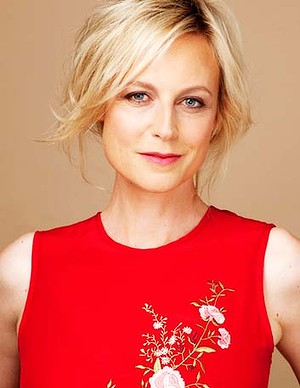
1. Marta Dusseldorp – (Age 41) How irked I was when the Seven Network announced it was culling ‘A Place to Call Home’ from its roster of programmes. This was not because it lacked dramatic excellence – it had plenty. It was not because it was doing poorly in the ratings – it wasn’t. It had a bucket load of fans. No, it was simply because it’s cheaper to buy-in inane, generic US muck than to go to the trouble to put together our own local product – and therefore Seven can sack a load of talented people. In my view it is appalling that Marta D will not continue in her role in this intriguing television vehicle. She was the stand-out performer in the short-lived ABC series on lawyering, ‘Crownies’, with the result being she earned for herself the star turn in ‘Janet King’. Hopefully we’ll be permitted more of her in that. She was also quite revealing as the love interest in ‘Jack Irish’. There is no way this stunning creation, with brains added, would be considered for a role in most of the trash that comes out of the American studios – too old and not fitting the stereotype of their leading ladies where its all about youth and bland, flawless looks. To this punter Ms Dusseldorp is simply the most alluring woman on our small screens – and long may she continue to be.

marta d

And she loves Tassie too = http://www.dailytelegraph.com.au/travel/australia/marta-dusseldorp-star-of-a-place-to-call-home-reveals-her-secret-holiday-spots/story-fnjjuyvd-1226920309481

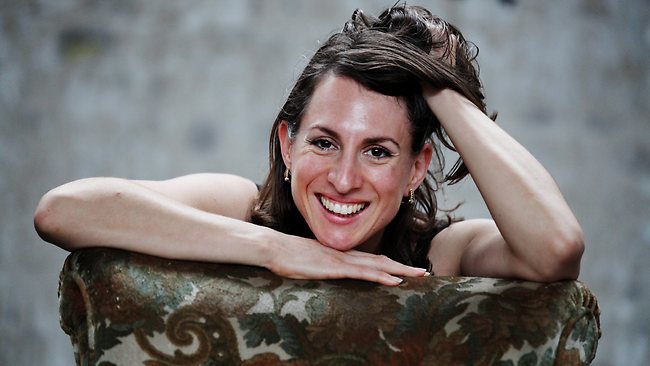
2. Lally Katz – (36) Quirky, even kooky – but downright brimming with talent, Ms Katz ticks many boxes implicit in the definition of ‘alluring’. She writes for film and television (including the recent ‘Wentworth’), as well as penning plays described as ‘…surreal and whimsical.’ She has recently toured a one-woman show ‘Stories I Want to Tell You in Person’. She’s graced the latest offering of Adam Zwar’s ‘Agony’ series for the ABC, ‘The Agony of Modern Manners’. I was lucky enough to catch her in person late last year as a participant in Hobart’s tour stop for ‘Women of Letters’. Her epistle, read to jam-packed room, was a paean to ‘Laura Palmer’s Diary’. In this she pronounced, ‘I used to aspire to being a dead seventeen year old.’ I am so pleased she didn’t go down that route.

lally katz

Women of letters hits Tasmania = http://islandmag.com/a-letter-to-the-thing-i-wish-id-written/

3. Kelly Reilly – (37) This gifted thespian first came to fame for her gameness in ‘Mrs Henderson Presents’ and I have written in previous blogs of her appeal. This year she’s had star turns in ‘Chinese Puzzle’ and the startling ‘Calvary’. This beauteous, freckled redhead can also be espied in her small screen offerings, ‘Black Box’ and ‘Above Suspicion’. She registers highly on the’ allure scale’ for accepting brave roles on stage, as well as screen, to test herself. She also receives points for eschewing the trappings of the red carpet. She is glorious.

kelly

A Huffington Post interview with Kelly = http://www.huffingtonpost.com/elizabeth-luisi/actress-kelly-reilly-lets_1_b_5250071.html

4. Sofia Helia – (42) A beautifully flawed Scandinavian native and she has charmed the world as the socially inept Saga Noren in the Swedish/Danish production of ‘The Bridge’. Nobody does it like her – although an American and a French actress have attempted to in the US/UK versions of the small screen series. Losing her parents at a young age to a car accident, she had misfortune of her own at 24, as a cyclist, causing the facial scars she wears loud and proud for this production – as she should. She is a marvel and it will be interesting how the next instalment pans out without her regular sparring partner of the first two seasons.

sofia

The Guardian goes in depth with Sofia = http://www.theguardian.com/fashion/2014/feb/15/scandi-crush-the-bridge-sofia-helin-saga-television

5. Megan Washington – (28) This Aussie chanteuse is something of a chameleon with her various and vivacious looks since attaining pop fame in her homeland. As well, she is spreading her wings abroad. She first came to mainstream notice as a performer in a Paul Kelly tribute concert, filmed for DVD release. Later Ms Washington’s freshman album was a revelation from an incredibly multi-faceted talent. Many fans, including this one, are eagerly awaiting her soon to be released follow-up. She bravely ‘outed’ herself on Australian Story this year as she felt she could not hide her real self any longer. That version came with a speech impediment. This Papua New Guinea born is just simply it and a bit.

megan w

Megan and that stutter = http://www.abc.net.au/news/2014-07-07/megan-washington-singer-songwriter-embraces-stutter/5573250

6. Elizabeth Debicki – (24) To my eyes she outshone, as Jordan Baker, even someone as luminous as Carey Mulligan in Baz Luhrmann’s fantastic feast for the eyes, ‘The Great Gatsby’. She is one of a coterie of youthful Australian actors making a name for themselves in Hollywood. At present Ms Debicki is filming ‘The Kettering Incident’, the first major television dramatic series to be produced on our island. She has just been cast in the upcoming Guy Ritchie take on ‘The Man From U.N.C.L.E’, alongside Hugh Grant. No doubt he’ll be as impressed as I am.

Elizabeth_Debicki

The Daily Telegraph informs on Elizabeth = http://www.dailytelegraph.com.au/entertainment/sydney-confidential/elizabeth-debicki-touted-as-the-breakout-star-of-the-great-gatsby/story-fni0cvc9-1226654983343

7. Rebecca White – (31) She brings a touch of glamour to our local political scene – but don’t let her looks fool you. Like Natasha Stott Despoja in her heyday, the Member for Lyons is already a mover and shaker on the Labor side. When her team was heavily defeated at the March polls, many hoped a member of the younger brigade, such as Scott Bacon or Rebecca, would take on the leadership to draw a line under the coalition with the Greens, The old guard, in the end, retained the upper hand, but her time will come. She had my vote. Normally, your scribe is a regular Greens supporter, but I was attracted to her as a means of keeping another old dinosaur, David Llewellyn, out of parliament. It backfired as both he and Ms White were successful, with the Greens candidates missing out. She was a poll topper and didn’t require my endorsement in the least. Later that evening, in the studios of the ABC, she demonstrated why she is such an attractive proposition. This articulate young politician went head to head with the execrable Eric Abetz and was certainly not out of her league against his supercilious commentary on events as the count gave the Liberals a clear majority.. Famous for her ‘Pollywaffle’ campaign against Llewellyn in the previous campaign, she is one savvy cookie.

rebecca w

Ms White’s Website = http://becwhite.com/

8. Chelsea Roffey – (33) There is a Facebook page under the appellation of ‘The Female Umpire is Secretly Hot’. For me there’s no secret about it. She certainly is. Ms Roffey has smashed the glass ceiling, entering into the hitherto blokey world of AFL footy, along with the recently appointed St Kilda assistant coach, Peta Searle, as well as Richmond’s President Peggy O’Neal. She has shown herself to be a whiz behind the goal sticks, officiating at the 2012 GF. By trade she is a journalist and she’s already umpired finals this year. Can she make the big one again? Her attractiveness would certainly add colour to it, as well as making a statement.

chelsea

An interview with Chelsea = http://www.thesaturdaypaper.com.au/sport/afl/2014/06/28/knowing-the-score-chelsea-roffey-32-afl-umpire/1403877600#.VB4Nzyi8B4E

9. Celia Pacquola – (15 – or so she reckons) This delightful and extremely funny comedienne is a true jack of all trades, treading the stand-up boards here and in the UK. She’s had numerous television appearances in both countries. Celia P can also pen scripts for the small screen (‘Good News Week’, ‘Laid’). She appeared as AJ in the latter. She is currently on screen in the glorious and prescient ‘Utopia’. Ms Pacquola has been described as – ‘Adam Hills with ovaries’ and will soon grace our living rooms again in a new series of the wonderful ‘It’s a Date’.

Celia Pacquola

Sharing lunch with Celia P = http://www.smh.com.au/entertainment/comedy/lunch-with-celia-pacquola-20140822-104i14.html

10. Samantha Lane – (35) – She gives a feminine take to a Saturday night pre-game footy show – another who’s pushed through into that particular men’s club. She has also blessed us with her words, focusing mainly on sport, as a newspaper columnist and is an Ambassador for Breast Cancer. But it is in the aforementioned ‘Agony’ franchise that she charms us to the max. And there’s a little bit of Tassie in her too, with her old man being that doyen of commentators, Tim Lane.

sam lane

Sam Lane’s show and tell = http://www.showandtellonline.com.au/on-the-couch/sam-lanes-show-and-tell

So there, my list for this year is complete. This lucky man has much to be thankful for, not the least of which is sharing his world with remarkable and alluring women. There are other list makers out there who may wish to contribute, along these lines, as well – be my guest. Do so for either gender, or indeed, both.

For 2013’s list see = http://blueroomriversidedrive.blogspot.com.au/2013/07/women-with-allure.html

Journeys Long, Journeys Short

I jumped at the chance to do it. The invitation to spend six weeks in one of my island’s special places – a seaside village that comes alive during the summer months – was too good to pass on. This location is surrounded by a stunning coastline and across the water from it are golfing links of world renown. I am not in any way into the sport, but visiting them in the past, to dine at the restaurant with arguably the best views of a seascape in the state, well – they are stunning just to observe. I pictured myself on walks, with a beloved canine, along coastal and riverside tracks that abound around the little town – and this certainly occurred to the pleasure of both participants. Summer it was not to be though, but nonetheless Bridport still had plenty of positives about it during the off season. Used to Hobart’s dour, chillsome winters – Bridport sparkled in dazzling June sunshine in my time there – and with the sea mist rising up in response off Anderson Bay as each morning dawned I was favoured by sublime vistas all around. My camera, of course, had a good workout in such photogenic circumstances. As I expected, the local populace was a friendly species, no doubt relishing the slower pace of the mid-year months. They were always up for a chat at their shop counters. On the pavement of the main drag there were always jaunty ‘good mornings’ to greet my regular saunter down to the newsagent for the day’s Age. Next door to my house-sit was a supermarket, with next to that being a bottle-o – so all needs were met within a short stroll. As if my retirement years have not produced quietude enough, there was now even more time to write, read and work my way though DVD box-sets. And at my heels everywhere I went were two dogs, intent on not letting me out of their sight. No matter what opinions I expressed, they always nodded their heads sagely in agreement, giving me a bit of a lick before collapsing to the floor for another slumber under the motes rising up from their sunny spots. Of course, accepting my son’s thoughtful invitation would mean that there would be special people and places back in Hobs to be missed – but a few visits eased this missing – and I coped with that. I figured I’d suffer a tad without my weekly dose of art house fare at the State, but in reality there was only one movie I was, in the slightest way, peeved at not being able to attend – and the newly minted 2JJ, with Myf at the helm, was feasted on, giving me scope for new talent to search out when I was back to access JBs again.

SONY DSC

And back I am now and yes, that’s good too. Rich and his delightful partner Shan have returned to Tassie, with two reportedly very happy doggies a-welcoming them. As yet there hasn’t been the time for tales to tell from the pair, but those will be forthcoming in future weeks as they wind down from their journey long and get back into work mode. But I know a little of their weeks OS due to their communications during. I am so chuffed that they visited a few of the places that certainly impacted on me during my UK and Continental tourings three or more decades ago – Stonehenge and Chartres for example. Rich was also able to follow up on some of his passions – sampling various Irish and Belgian brews, visiting Harry Potter World as well as the Giger Museum in Switzerland. I was very envious of the pair heading off to the Folies Bergère, something that would definitely be on my bucket list if such a beast existed.

SONY DSC

Like all first time travellers, Rich and Shan will now have a taste of what is possible and fatherly fingers are crossed that there will be future occasions to take the three hour journey short to fair Briddy to again bask in such a magic setting. For a multitude of reasons I am so proud of my son and travelling vicariously with him and Shan around Europe has been a joy. The time also proved that something I thought mightily about as a retirement option for me would have been possible in terms of its contentment factor. That I chose another course I have no regrets, as that has been fantastic too – so my thanks go to my son and Shan for that as well. Am I sad that it would seem I will not be repeating, in my dotage, two trips to Europe undertaken when I was far more in my pomp? No, not really. Financially I could up and go tomorrow if I so desired, but that urge has largely deserted me. Besides, every day I spend with my beautiful Leigh, tucked up in our abode by the river, I figure, is equivalent to a northern hemisphere holiday in any case – so no, there’s no real hankering there. We have trips planned together, Leigh and I, to less distant locales and the thought of those more than keeps me happily planning.

Now – about that aforementioned movie. I thought I would have to hold fire and view it eventually on the small screen. It started it’s cinema run the day after I headed north, but to my very pleasant surprise, its popularity had given it an extended stay. It was in its final week on my return. Yay! And on viewing it, I understood why it had struck a chord. It was delightful. The people of Hobart were indeed ready ‘…for seconds’ in response to the query featured on the film’s promo.

‘The Trip’ – in both movie and television format – has become a cult classic, in a similar way to ‘Fawlty’, ‘The Office’ and ‘The Royle Family’. In it we followed the perhaps not so unlikely pair of Steve Coogan (‘Alan Partridge’, ‘Philomena’, ‘The Look of Love’) and Rob Brydon (Gavin and Stacey’, ‘Would I Lie to You?’) on their meanders and musings around England’s Lake District. These two first came together on the set of director Winterbottom’s ‘Tristram Shandy’, obviously striking up a natural rapport over an attachment to fine wine, top drawer nosh and the ability to take the piss out of each other – and they both share delight in impersonating their fellow thespians. They continue to do all that, to treat us, in ‘The Trip to Italy’. Their mutual take on Michael Caine near the start is a classic. So, given a jaunty car, more stunning vistas such as the Amalfi Coast, a slight fictional overlay with the narrative and more posh restaurants, we have all the necessary ingredients for another enjoyable ride. They ruminate on many matters of varying import, not the least of which being their frustration at ageing. They feel they have both reached that milestone in life when the young fillies they espy in their travels now find them invisible – or do they, Rob? There is also pathos and angst in the offering – but mostly it is filled with the good humour involved with just how fortunate they are to be in such a place with such company. Then there is the glorious, glorious tucker. It almost made me want to hop on the next Q-bird to Rome for a bit of la dolce vita myself.

Steve Coogan and Rob Brydon in Camogli, Italy

Hopefully we will again see this gregarious duo off on continued adventurings, under Winterbottom’s guidance, to another exotic spot on the planet soon – and methinks I read that there is a television follow up to this. So here’s to journeys long, journeys short and journeys middling. Long may we be on the planet to indulge in them, even if one does not have to leave one’s home abode to do so.

Website for ‘The Trip to Italy’ = http://www.thetriptoitaly.com.au/

Silent Harold

Google in Marilyn Monroe, then click on ‘Images’ as I did one cruisy retirement day when I was discovering what the ether held for me at that particular point in time. Of course, all the usual suspects were present – the first Playboy centrefold, the effect of a subway updraught vent on a dress, Bert Stern’s last sessions with her nude body thinly covered in diaphanous gauze – captured just before her candle was snuffed out. But then I found one that I hadn’t sighted previously – the sex symbol of my youth adorned in a black peignoir. It was not so much the image that struck me, but the name of the photographer. I’d heard it before, but in a different context. Could it be the one and same person? It was.

marilyn black_penoir_101

Now days, if we recognise the name Harold Lloyd at all, it is as one of the pioneers of the early decades of the movie industry business. Following in the footsteps of Chaplin and Keaton, in non-talkies such as ‘Safety Last’ (1923) and Girl Shy (1924), he had the chops to make an audience stay riveted to their seats in the silent era. By the thirties he had retired from appearing in front of the camera to work on what went on behind it – mainly in production. He also wished to indulge his passions – one of these being, in fact, the camera itself. He was fascinated by the technology of all forms of the apparatus – and that is how he came to be photographing a sultry Marilyn Monroe later in life. Even that wasn’t so straight forward as I discovered. Harold Lloyd was handicapped – a story in itself.

harold lloyd01

In 1919, whilst doing some publicity for a movie he was appearing in, what was meant to have been a false bomb being used as a prop turned out to be not so false after all. The resulting explosion caused the actor to experience flight; the result of which being that he was unable to fully discern the full extent of his injuries He had been rendered blind. Thankfully, after first fearing the worse, his sight gradually improved and was fully restored after eight months. By then he had full awareness of the other injury – he was missing half a hand. For the rest of his life he wore a leather glove protecting his prosthetic digits.

Lloyd was fascinated with all forms of cameras – how they worked and the product wrought from them. What especially transfixed him were the twin lensed varieties producing 3-D slides. By the time he died in 1971, he had a collection of over three hundred thousand of these slides in his estate. An intriguing factor is their subjects. Quite a number were of young women, including many of the era’s starlets. Lloyd, though, was not alone in being enthused by the attractions of the twin image. In 1940 the Hollywood Stereoscopic Society was formed by the old silent movie icon. Its membership included such notables as Dick Powell and Ronald Colman. Was it just a front for ageing men intent on attaining access to nubile young women, such as Bettie Page, prepared to undress for the prospect of some future tinsel town fame? I have no idea – but it is recorded that Lloyd himself was quite anal about his craft. He wasn’t a point and hope merchant – he spent hours fiddling with various lenses, filters and lighting to achieve pre-determined results.

harold lloyd02

His home, Greenacres, was a popular hangout for the Hollywood glitterati. There he took images of such folk as Candice Bergen, Alan Ladd, Mary Pickford, and Jayne Mansfield, as well as a bevy of curvy women who weren’t adverse to shedding their clothing to reveal oft pneumatic nakedness. Still later in life – we’re talking sixties now – there came into being the ‘Happy Seven’. These gentlemen, including our snapper, took off on cross country jaunts, with a couple of models in tow each time. The latter’s task was to posed nude in the great American countryside. What a happy dotage our man must have had. He wasn’t mono-focused on the unclad body alone, though. Lloyd travelled the US and the world documenting, with his camera, what he saw. He has given us an irreplaceable look into the Mad Man period – even snapping the Beatles performing at the Hollywood Bowl.

But back to that original image I espied. In 1925 a director bought a very fresh-faced Marilyn to Greenacres to film some scenes for one of her early features – not the first time his home had appeared in a movie production. The two met and she posed for him by the pool. A short time later another photographer was hired to capture her for the cover of ‘Life’ and Lloyd tagged along with his stereoscopic camera. It was then he photographed her in the sexy night attire of that alluring image I encountered.

Lloyd’s second claim to fame is gaining some traction, with galleries now treating his oeuvre as of some import. Could it be that one day he’ll be more remembered for what he produced in later life, as opposed to the days when his comedic turns lit up the silent silver screen?

To view a gallery of his images (warning – some tasteful nudity) = http://www.photographersgallery.com/by_artist.asp?id=170

Cleo

There is much that is ugly, salacious and downright obscene on the Net and therefore, as a result, it often receives a negative rap. Casting all that aside, there is also much about it worth celebrating; many sites that are worth rhapsodising about – as I’m commencing to do. Such a place, in the ether, is the sublime Musetouch (https://www.facebook.com/MusetouchVisualArtsMagazine). Here much of an exquisite nature can be found – such as sublime photographic mementoes of times long past. There are images of timeless beauty – the fashions, art and luxury items from the end of the Nineteenth Century and the opening decades of the next – as well as the more up to date, reflecting the values of the art/ists/isans of another era. An added attraction are bygone beauties captured for eternity, particularly those of the fin de siècle/Edwardian periods. It is a great source for enriching my own facebook page.

‘MUSETOUCH is a free magazine about visual arts. It has been
created by Maia Sylba out of love and passion for art with
the hope that people will be able to use the publication and
website as a platform to showcase their skills and gain recognition.’

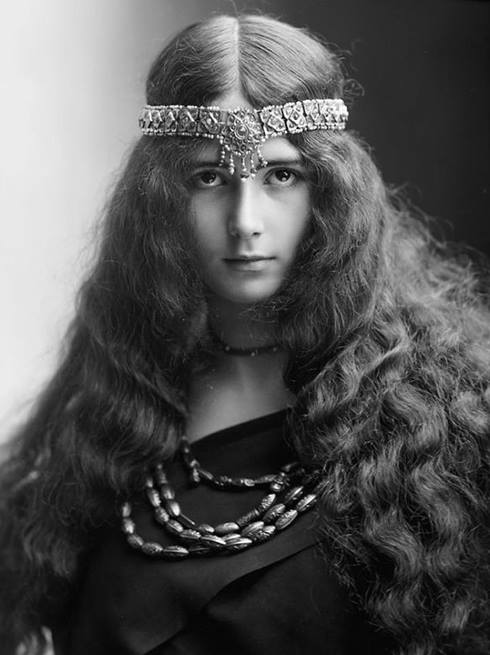
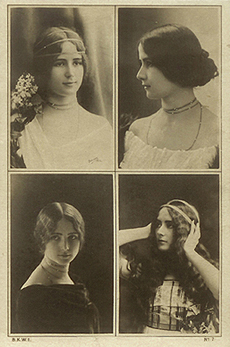
So it was there that I discovered Cléo de Mérode. She had me in raptuous awe from the moment I first lay eyes on her as she stared back at me from the Musetouch timeline. Who was this beautiful young woman with her thick, flowing, pre-Raphaelite locks and visage of alabaster gorgeousness? The girl I had stumbled upon, thanks to the endless facility the internet provides for instant research, turned out to have much more of a story than merely being an unknown subject of a photographer’s camera. Living from 1875 till well into my lifetime (1966), Ms Cléopatra Diane de Mérode is now largely forgotten, but for a time there she was the most talked about woman in the world. It would be a big call to say that because of her our notion of celebrity was invented, but she sure gave it one sizeable kick in the butt. I wasn’t the only viewer to be entranced on first espying her!

cleo

I read of her provenance – and was truly amazed by it. As a result, during one of my bath-time ablutions, I tried to figure out who may be the equivalent to her today. Although not in her thrall as well, the name I came up with was Angelina Jolie. She is a woman who is celebrity because of her class and talent, as well as her looks – as opposed to those trashily tiresome, plastic Kardashians. But for a while there it looked as though our Cléo could have taken the latter route to fame. A nation became obsessed with her love-life and one scandal followed another. Interest in Jolie sells magazines by the squillions with, for our muse – well, she sold something else at around the same amount. For most of her pomp she remained the talk of the town – and that town was Paris. She is buried in Père Lachaise.

She first came to notice as a dancer of the classical, Opéra de Paris variety, before extending her repertoire until she could command the Folies Bergère stage as well. The city on the Seine was captivated. The ladies about ville would emulate how she wore her hair in her latest production – she was the trendsetter for the times. Fandom is no modern incarnation. But her fame went into the stratosphere when Alexandre Falguière sculpted and unveiled ‘The Dancer’, supposedly in her unclad image. It caused a shit storm, Both the creator and subject had to go into damage control, issuing denials in the local rags. Hot on the heels of that, these same presses started linking her to that ancient roué and pillager of the Congo, the sixty plus King of the Belgians, Leopold 11. She was just 22. This blew her now notoriety to fever pitch, even though it is now thought the wily old devil was using the dancing queen as a front for another affair – with a prostitute. It was not long before the great painters of the period came calling. Degas, Klee, Toulouse-Lautrec and especially Klimt, all of whom successfully pleaded with her to pose for their palettes. Nadar pointed his camera at her for stunning portraits.

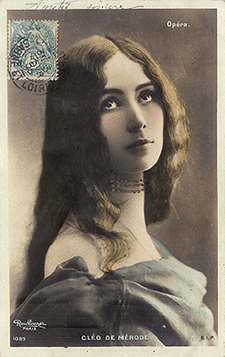
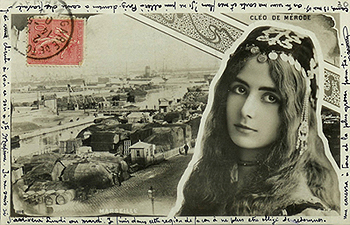
And it was this latter art form, when superimposed on a card, that spread her fame even wider. For this was the golden era of the postcard. It is postulated that during the Belle Epoque de Mérode became the most photographed subject in the world. A new take on her, in the around six by four inch format, was a hot item in the news-stands and railway stations of the Continent. No images were more sort after, by discerning men and women, than postcards of Cléo.

cleo03

They took a while to take flight as a means of communication, as well as for collectors to enthuse over, did postcards They had been around for a while – emerging from the Austro-Hungarian Empire to reach their peak at a world fair, the Exposition Universelle of 1900 in the French capital. Early ones were blank on both sides for writing, but then some canny illustrator or photographer had another idea and they took off. Of course there is a seedier side to the postcard story, but the dancer/celebrity refused to be tarnished with any further despoiling of her name. There was nothing tacky or titillating about her product – she maintained rigorous quality control and the masses adored her for that. She was the embodiment of the ethereal ideal of the modern woman at the time. A glance at any example is enough to convince that she was as pure as the driven snow, being her gender’s ultimate role model. She carried it off perfectly.

cleo05

Google her, click on the images and perhaps you’ll see why I was so taken by my initial glance and had to dig deeper. She was mesmerising and still should be. I wonder if her time will come again, like an Isadora Duncan or Sarah Bernhardt, or will she remain in relative obscurity. She deserves to be up there with them.

cleo02

To see more of this remarkable woman = http://thefrenchsampler.blogspot.com.au/2011/04/cleo-de-morode.html