Bathsheba Everdene

It’s a name to fall in love with. Bathsheba Everdene. Bathsheba Everdene. Say it out loud a few times. Roll it around the tongue a couple more. Magical.

And fall in love, I did, with that feisty miss – one who was before her time. Looking back, I initially presumed I would have given her my heart from the print version, rather than the one projected up there on the big screen. There was, of course, no VHS or DVD back then as the sixties imploded and turned the corner into the next decade. After all, I had spent my uni years working through the remaining Hardy novels after first encountering him via the tragic Tess in Year 12. She also caused, in me, much inner longing – for what, I wasn’t quite sure.

Julie Christie Far from the Madding Crowd

But, having completed my due diligence, the ether told me the film was released in 1967 and therefore the Bathsheba I was first so enamoured of must have been the Julie Christie version. It’s so long ago now that I viewed this film version and read the novel of ‘Far From the Madding Crowd’. I remember the sheep falling off the cliff and the stolid farm hand, played back then by Alan Bates (who else?), treating Miss Everdene’s flock for the bloat. And I could bring back how dashing Terence Stamp looked in his uniform playing the cad, wooing our heroine for a fast shilling to get him out of debt. He seduced her in no time flat despite the worthy Gabriel Oak, the farm hand, having stuck by her through thick and thin – completely besotted. After she pranked unfortunate rich neighbour on Valentines Day, William Boldwood (Peter Finch) was also pursuing her hand and being driven almost insensible by her constant refusals.

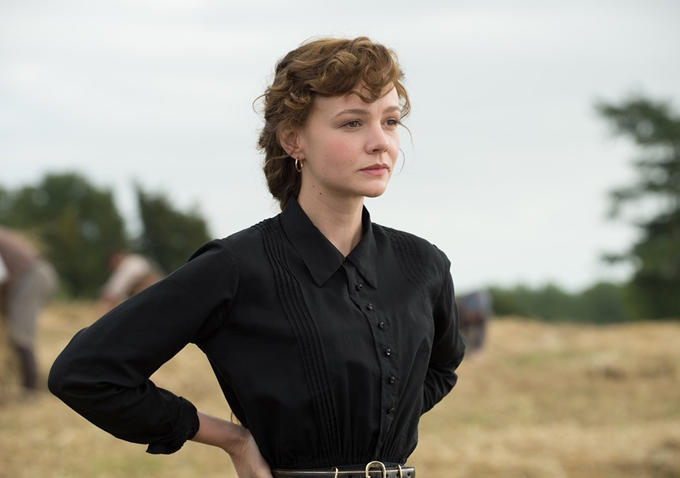
So, with a fond memory of a bygone infatuation, I traipsed off to see the 2015 version of the great work a few weeks ago, optimistically expecting the new Bathsheba, Carey Mulligan, to entrance me as much as her predecessors.

madding crowd

I was not let down. I enjoyed every moment of it – and the story came back to me almost in its entirety, even if I still could not recall how it was all going to pan out. The resurrection of Frank Troy, the slimy soldier-cove was still a great surprise. This time around Tom Sturridge played the execrable, but charismatic, gold-digger to the hilt of oiliness, with the marvellous Matthias Schoenaerts compelling as the faithful Oak. ‘Masters of Sex’ leading hand Michael Sheen ably filled Finch’s shoes as the lovelorn elder suitor. And, as for Carey, if she didn’t win you over as Daisy in ‘The Great Gatsby’, she’s sure to in this. As Bathsheba she takes on a man’s job with steely determination and is the independent woman personified, that is until she’s completely undone by the odious Frank Troy. She would not ride side-saddle, she would not be bidded down for her grain seeds just because she was a woman and she proclaimed she would not give herself in wedlock for gain She’d do it only for love. Ha!

madding crowd01

Starring beautifully, as well, was the lush Dorset countryside, with director Thomas Vinterberg ably recreating the descriptions of landscape that Hardy mastered for the printed page. And if you like the director’s take on this classic, look out for a DVD copy of his chilling tale of what can go wrong in the classroom with his astounding ‘The Hunt’. Mads Mikkelsen steals the show in that harrowing journey, but in it there’s no one to match the sublime Carey Mulligan as Bathsheba Everdene, Bathsheba Everdene, Bathsheba Everdene……

Official trailer = https://www.youtube.com/watch?v=WCm1XNVD_0c

David Bailey

Despite the title, no, this isn’t about the esteemed Brit photographer – what hasn’t been written about him? No, this is about another camerasmith entirely – one whose family nick-named her that because of her obsession for taking pictures from a young age. These days she’s very accomplished at her art, although it would be fair to say she’ll never be in the same league as the great Bailey. But, nonetheless, she is making a splash and she caught my eye.

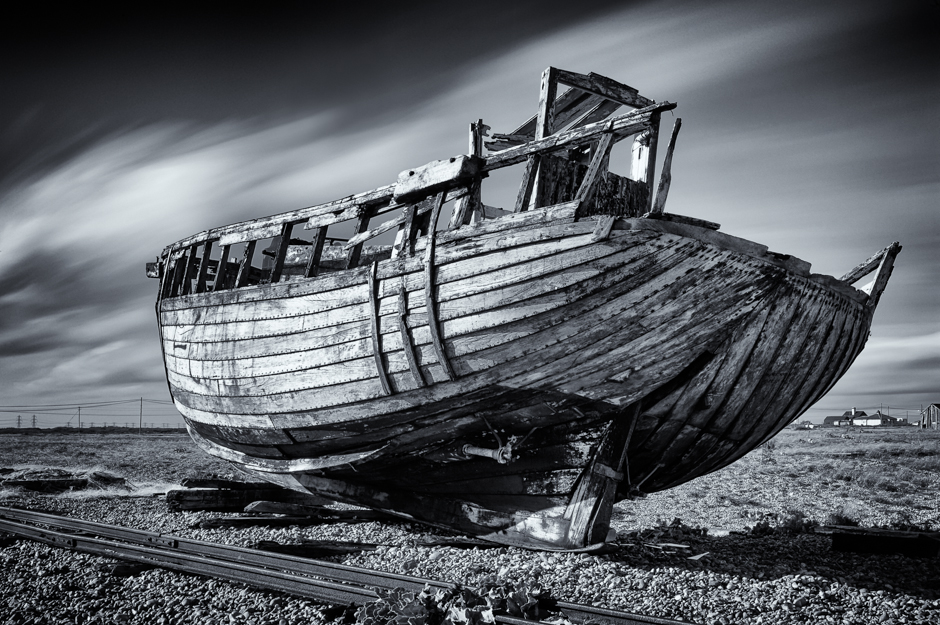
Abandoned Fishing Boat, Dungeness, Kent, England

It was the boat, first of all, that drew me in during a systematic trawl through an on-line photography site – then the head. Both were black and bleak, the former beached on a grassy sward like a wannabe Ark. On a closer inspection it wasn’t that large a wreck of a vessel – it was all in the framing. With the other, the head, broken and distended – well, it just seemed so incongruous. What was it doing there in that desolate location? Most likely it’s a sculptural installation designed to surprise. Perhaps it is attached to something we cannot discern due to a rise in the land. But whatever the case with these two images, I decided then and there there was much, much to admire about this woman’s product.

And, as her family intimated when they accorded her the appellation of the other famed lensman, Dawn Black freely admits she is addicted to capturing images. As she stated in a recent interview. ‘… I delight in the creativity that photography gives me to interpret (landscapes)…in my own way.’

She has this knack for the art in her gene pool, with both her father, as well as his father in turn, keen amateurs with a camera The elder man worked all his life for Ilford, in the now redundant profession of film processing. From an early age Ms Black had a Kodak in hand. She later studied architectural design at university, but her fervour for pointing a camera and snapping re-imposed itself once digital technology arrived. She claims she is not a manipulator of an image, preferring to present what the eye nets via the lens.

"The Light of The Moon" by Igor Mitoraj

It has also helped that she has been a bit of a gypsy in her life. She’s now resident in the Netherlands, but English born Black has lived in Wales, Scotland and Singapore, before finally settling on The Hague to raise her family. Her work also features product from the US, Italy and France. The mother of four has found that she can make a reasonable living selling her prints and since 2009, her offspring apart, this has been the main focus of her world.

Dawn Black has deliberately tried to create her photos in the old style of black and white darkroom production that her grandfather would have been up to his neck in. Her attachment to an older style is perhaps the reason why my focus was so drawn to her. No doubt, if he is still around, Granddad would be awfully proud of his now not so little David Bailey.

dawn s black Dawn Black

Her site’s on line – check her out = http://www.dawnsblackphotography.com/

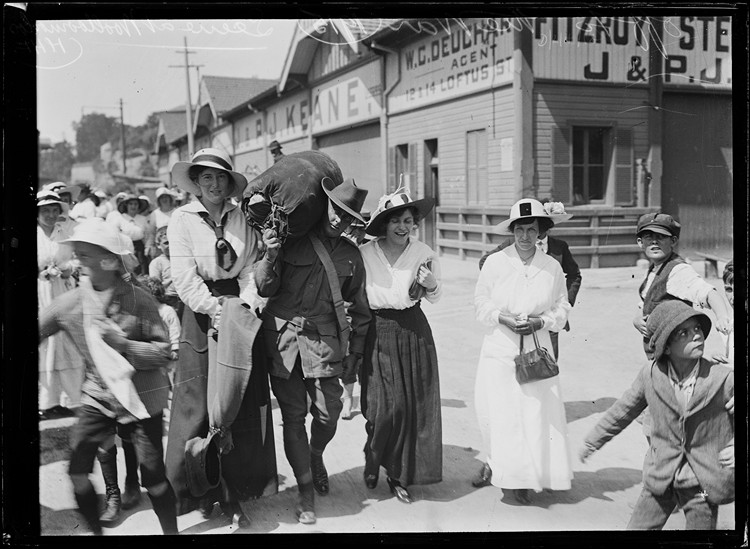
Off to the Great War': Woolloomooloo, 1915 – Peter Stanley, June 1, 2015

off to war

In 1915, more men volunteered for the Australian Imperial Force than in any other year. July was the peak month, with over 36,000 men enlisting—one-tenth of the total number who served in the war.
Herbert Fishwick’s photograph depicts a volunteer walking past the big waterside sheds at Woolloomooloo—today probably waterfront apartments worth hundreds of thousands of dollars—just before he embarks on the transport that will carry him to Egypt, then Gallipoli or Britain and the Western Front.
None of the individuals in the photograph is named, but they stand for the almost 100,000 men who left that year for the war and for those who farewelled them.
The volunteer carries his kitbag on his shoulder. One of the two young women—his sisters, perhaps, or even daughters—carries his rolled-up overcoat, with his service cap dangling from it; he’s preferred to wear his slouch hat. The woman on the far right could be his mother or wife. The women wear white; this may be autumn or spring. The young ones are buoyant. Only the older woman seems to be ambivalent about farewelling him. She might one day be wearing black.
If this is early to mid-1915, the subjects of this photograph have not yet seen the full extent of casualties on Gallipoli. In July 1915, the first wounded from Gallipoli will arrive home, also at the wharves of Woolloomooloo.
The photographer, Herbert H. Fishwick, was born in Britain and became well known in the commercial field in New South Wales and beyond, working for The Sydney Mail and The Sydney Morning Herald. He recorded a wide range of subjects, including the Southern Alps (Fishwick was a pioneer skier and kept skiing into middle age); aerial photographs of towns; boxing matches;  landscape scenes—and sheep. The Pastoral Review and Graziers’ Record noted when he died that ‘in the realms of the stud Merino sheep breeding industry he excelled … outstanding amongst these experts in animal photography’. The National Library holds over a thousand of Fishwick’s images.
See the boys larking about—embarkation for them meant a more interesting day out. The lad on the right is about to be yanked out of the frame, but he has been captured forever—a bystander innocent, for now, of the war that will come to dominate his country and, perhaps, his life.

The Blue Room – I initially discovered the photograph and the above piece about it in the June edition of the National Library of Australia Magazine. To me it was the informality of the photograph that seemed to be its significance in an era where posing was de rigeur. The author makes his own educated guesses about the women around the departing infantryman, but I’d like to imagine, displaying the romantic in me, one of them to be his sweetheart – perhaps the damsel to his right who may well have her left arm encircling his back. That would give him something to think about during the terrors that lay ahead for him. It is, I agree, difficult to deduce exactly how old the soldier may be and we’ll never know if he returned to Oz in one piece or forever lies in foreign soil.
I love the look of the lad in the far right hand corner being taken hold of by an unseen parent, we imagine, in order to calm him down amidst all the excitement. Is it his brother to his rear, in the cap, heading off quick smart to escape those same clutches?
For me there is so much to relish about this photograph from an instant in time in the year 1915. Adventure was thought to be over the horizon on the other side of the globe for the unknown soldier captured for all eternity by Fishwick’s lens. All too soon, in a few month’s time, both will know that such send-offs will be little cause for jubilation. That then had to wait till war’s end.

fishwick armistice_photo_

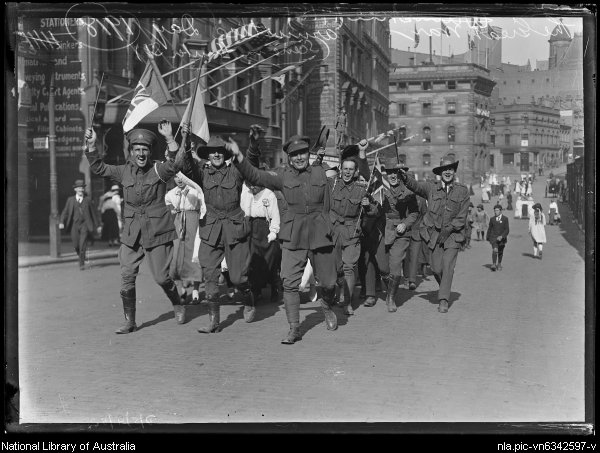
Fishwick – Armistice Day

Summer Sound

Word somehow reached him that ‘real’ surfers hated his music. How would anybody know that? Did those ‘real’ wave-riders phone into radio stations to diss his hits; to slag off how trite and trivial they all were? Surfies I knew back then would be far too laid back for that – but maybe the US variety were different. ‘Back then’ was fifty or so years ago now – no internet, no social media. Could it be that pollsters were paid to walk around SoCal beaches to ask surfer types their opinion as they came in from hanging five out on the break? I don’t think so, but somehow he was told that those guys out on their boards all summer long didn’t dig what he was putting out there – and so he went into another one of his funks because of it.

He didn’t surf himself – although he spent a fair amount of time in a sandpit. Only brother Dennis occasionally hit the swells. But it mattered not. At around the time I was entering my teens they were the sound of summer. They sang of hot cars and surfer chicks, but mainly they sang that ‘…the beach was the place to go.’ And I did, summer after summer – here in Tassie when weather permitted, or when I escaped to Mangoland (where it permitted it all the time). But it’s not this early stuff (‘Surfin’ USA’, ‘California Girls’, ‘Fun, Fun, Fun’, ‘Help Me Rhonda’) that had me hooked, but more the tunes coming out around the time I had my first automobile. Can you remember ‘Sloop John B’, ‘Barbara Ann’, ‘Wouldn’t It Be Nice’, ‘Then I Kissed Her’, ‘Do It Again’, the iconic ‘Good Vibrations’ and what many, in the know, consider his greatest, ‘God Only Knows’? Later, in my uni years, I kept following him through such albums as ‘Surfs Up’, ‘Holland’ and ‘Sixteen Big Ones’. Although critical successes, he struggled to capture the same commercial profit for those with his band, the Beach Boys, as he did for their isolated singles – the public had moved on.

Sadly, for most of his life, this consummate songsmith, Brian Wilson, was a train wreck of emotion. The movie, ‘Love and Mercy’, tells of his time in the depths of the sandpit – so to speak. It informs us, as well, how he’s come back to us as a survivor – well enough to give the world his performances again. But still, obviously, he’s greatly shaken and stirred. And ironically, he is the only Wilson still standing of the three brothers forming the nucleus of the eternal Beach Boys. They will be forever associated with their Southern Californian musings of what made life so magic and simple before it all went so belly-up with complexity and stress – and perhaps BW contributed to that as well.

love and mercy

It is, as critic Philippa Hawker describes it in her positive take on the movie, a ‘Clever biopic…’ It’s split in two, with Paul Dano playing the younger Brian W as he starts the downward spiral. The second half features John Cusak as the musician at his nadir, following him through his journey back up the slippery slope. At this stage Wilson is in the clutches of his Svengali, Eugene Landy, joyfully and oilily played by Paul Giamatti. Here we follow his attempts, in the eighties, to clumsily woo the woman who will be his ultimate saviour – his now wife, Melinda.

Dano was masterful in bringing the younger version to the screen. He certainly looks the part, unlike Cusack whom, if you’re familiar with the muso-dude, struggles to carry off the role convincingly as there’s no resemblance. Just to emphasise this, the man himself puts in an appearance as the credits roll. But, if you can put all that aside, Cusack, in his aping of Wilson’s mannerisms, goes some way to make that distraction not detract so much as to ruin one’s appreciation of what Brian was up against.

There is much to intrigue with ‘Love and Mercy’ and the way novice director, Bill Pohlad, interweaves the two narratives. As well, he organises it so we go right inside Wilson’s head – both visually and aurally. There is also the joy to be had as we watch the members of the band put together some of their best known music product in the studio. Many of these are mini-symphonies as they try to quench Brian W’s fixation on out-Beatle-ing the Beatles.

love-and-mercy

Not much screen time is given to his brothers Carl and Dennis, with Mike Love coming out of it as an insensitive tool. More emphasis is placed on the two demons in Brian’s world, Landy and his fruitcake of a father (Bill Camp). Together these two characters well and truly made the remarkable singer/songwriter a blathering wreck, that is, until he meets his own gorgeous, feisty Californian girl, played by Elizabeth Banks.

Thankfully these days he’s back up on stage playing his back catalogue for us, as well as his newer material. But he still so obviously carries the legacy of his trials. At seventy-three we trust he will be around a while longer, for ‘god only knows’, what he created is timeless.

love-mercy

Official trailer for ‘Love and mercy’ = https://www.youtube.com/watch?v=lioWzrpCtGM

Katz and the Cashews

danny

Dear Danny
I am a fan. Admittedly I am not the fan I used to be – but there you go. You have been off the boil for quite some time now. Your move to Saturdays has not, it seems, done you any favours. Back in the day, when you were a mid-week regular of the former broadsheet that runs second to the Murdoch press in Yarra City, you were the highlight of my newspaper reading week You outshone all other columnists. You made me laugh – so much so that on occasions I took the paper to school and read your contribution out to my students – making them also chortle with glee, giving them something of joy to remember as they plodded through the hours to freedom.

And now I am going to be brutally frank, Danny. On Saturdays you have come back to the pack – not so bad, I guess, given the quality of my other favs – Flanagan,, Wright and Squires. But even worse, once in a blue moon you also write total drivel. Once upon a time your shtick was consistently delightful – now, not so much. Why, sometimes I do not even bother to complete your contribution. I turn to the other ‘Insight’ columnists, mentioned above, instead. They rarely let me down. But, Danny, even if you have lost your edge, I will never completely forsake you. Each week I do return and on occasions, you still richly reward me to the degree I think, that perhaps, you are back on song.

I suspect doing it for as long as you have it must be supremely difficult to come up with something fresh and original to riff about for each deadline, thus your waning. Some of your fellow regular wordsmiths have now departed – I’d reckon for similar reasons. I lament the passing of Kate Holden still and I now also miss Bob Murphy. I live in hope that’s only because he’s ascended to the captaincy of the Doggies and will return once he’s hung up his boots. But I diverge…

Now I’m about to congratulate you on last week’s effort, Danny. Your rumination on the delicious treats of your youth, when growing up in the sixties – yes I did check on your vintage – was a sparkling gem, brightening a wintery Saturday. It spoke of what you could look forward to being treated to, as a child, when there was some excess money available for such luxuries. You were almost Pythonesque in this memory piece and you inspired me to do similar. Well done.

For you, Danny, in that golden age when the world turned on its head momentarily, before righting itself again, your treats took the form of cashews, mangoes and smoked salmon.

My dear darling Leigh loves cashews too – but unlike your scribe, she is very strong. I’ll often buy her a packet for a treat too – although, in your recollection, they came to you as single units. And you also reported to us that these days, even while composing the very column under examination, you now stuff them down en masse – just as I would if I was let loose on them. No, my Leigh can just allow herself a handful a day and leave it at that. She is an inspiration to me that I can never live up to, so when she offers me the packet to partake of a modicum of its contents, I always decline. A couple are never enough. I truly love cashews, macadamias and pistachios but, as it is no doubt for you too, Danny,once I sample I am then invariably overcome by that dreaded disease from which there is no escape – the munchies. Once I start I can never stop until the receptacle containing the blissful offering is empty.

I am a fifties child, my friend, so therefore I cannot remember cashews ever being around the shelves of our corner grocery shop – supermarkets were a long way off appearing in my regional corner of Tasmania. Peanuts would be there I would think – and mixed nuts, but they were reserved as a Yuletide only attraction. As for mangos and smoked salmon – they were exotica beyond imagination. For the former read a whole pineapple rather than the tinned variety; for the latter a good feed of couta, locally caught, so devoured more or less straight from the sea.

So what were the special treats of my childhood. My parents were by no means rolling in pounds, shillings and pence but we did okay. Here are some of my recollections – not only of the stuff that made me salivate, but of general tucker as well.

Roast chook. Yes, roast chook. Back then the fowl itself came from backyard coops, its flesh a rich yellow in hue. It was served biannually – at Christmas and Easter, wrapped in brown paper and aromatically cooked in the electric frying pan. Just the smell alone tantalised the taste buds beyond belief. Accompanying it on the table were fizzy drinks, originating from a small factory run by Cooee Cordials. Initially they were for only birthdays and other special occasions. I always chose the green – that colour didn’t send me troppo as did the red invariably selected by my mini-mates. There were also the joys of Choo Choo and White Knight bars, as well as the marvellous Cadbury Snack assortment. And clinkers, don’t forget clinkers. But don’t get me stated on the glory years of lolly treats.

These days scallops are a rare treat and crayfish beyond this scribe’s budgetary means – but back in the day they were common fare – albeit still incredibly delicious. Whitebait patties were a regular when in season, as was the greasy, but delectable, mutton bird. Rabbit was either stuffed and placed in the oven for and hour or so, or stewed with a flavoursome bacon gravy. Roo and wallaby were not unheard of either on the table – an acceptable patty could be made from them as the meat was considered rather strong and gamy.

For desserts, Danny, my mother was a dab hand at trifles and sago plum pud and I adored them. Ice cream was generally home-made from condensed milk, but the commercial variety came in cardboard bricks, rather than tubs. We all jostled for the chocolate part in these Neapolitan confections. Jelly contained fruit and I also treasured junket. Rice and macaroni were also considered as sweets, served with copious sugar and milk.

There were Sunday lamb roasts and lamb’s fry with bacon. Much could be done with Belgium sausage, even fried – as was the afore-recalled pineapple. I can remember the first icy poles putting in an appearance, a more sophisticated version of the fruity ice blocks we produced ourselves, or so we thought. I recall the first frozen peas and best of all, the arrival of potato crisps. My father produced from his work case the first I ever laid eyes on – a packet a Samboy barbecue flavoured. I though I’d died and gone to heaven and that taste sensation was probably the cause, for me, of the contagion that is the munchies.

And for breakfast – what else but dripping on toast.

All those memories came back to me, Danny, as I read ‘Remember when Cashews were a Special Treat’ – so thank you for returning me to my own days of yore, in culinary terms. And you are forgiven, Mr Katz, for any past loss of zing – as long as you can still come up with such excellent content, now and again.
Your Still Fan
Steve from the Blue Room

Danny’s column that Saturday = http://www.theage.com.au/comment/precious-childhood-treats-lost-in-bulk-bin-buy-now-any-season-world-20150626-ghx5s1

Harry King of the Posters

One of the joys of summer in Hobart, for me, is to wander around the CBD, or down in Salamanca, when a cruise ship is in. Both locations are abuzz with folk sporting lanyards around their necks, often communicating in foreign tongues and on occasions, asking yours truly for directions or tapping into my local knowledge. I always ask after their provenance and how they are finding us. The word on all their lips seems to be MONA.

Tasmania, particularly down here in the south of our state, is receiving a spike in visitor numbers – not only are more and more ocean liners plying their way to us but airlines are lifting their flights in to cope. Even in winter the recently completed Dark MoFo had the joint hopping and filling hotel beds in the off season. All this is on the back of one visionary man, David Walsh, who is giving our city an edge over its rivals. He continues to plan as big as kunanyi to enhance the burb of his birth.

kelly 02

I remember another time when similar occurred and that was in the early days of Wrest Point, opened in 1973, during my uni stint. As the only casino in Oz the punters flocked in and our former backwater came alive. Then other places caught on and we returned to our slumber.

We are on the cusp of something special, or so it seems. Yet there are also a small group of the well heeled and/or rabid environmentalists who oppose any fresh, innovative ideas to keep the ball rolling. The Battery Point elite, ten in number I believe, have successfully prevented community and tourist access to part of our glorious foreshore because they have cash and therefore, they believe, rights above the rest. Arguments over a cable car to Mount Wellington and a light rail drag on. Even Walsh’s newly proposed tower had its naysayers. All this in tough economic times when our young cannot get jobs!

Ours is a very special place and so alien to the rest of Oz which can focus on beaches, sun, large cultural hubs and the wide open outback. There have been a long line of state government campaigns to attract national and international audiences – some have worked, some have been abysmal.

kelly

But let us go back to more innocent times and the first concerted effort on the part of our isle in the southern seas to lure the mainlander to the sublime attractions here. It seemed a no-brainer that the natural wonders to be discovered should tease numerous souls to sail across the Strait. Of course, back then, there weren’t the millions to sink into the multi-media campaigns of today – it was all done on a smaller scale. But it was still seen that our enticements needed to be given a helping hand.

So was it Governor Sir James O’Grady, back in 1926, who set it all in motion with these words?:- ‘I sometimes think that Tasmanians – living in their beautiful surroundings, enjoying their ideal climate, revelling in beauty upon beauty until some of them forget that it is beauty at all – do not realise the bountiful gifts that they have.  I can tell them – and I am glad to do so – that Tasmania is a scenic wonderland without rival, a tourists’ paradise without peer, a holiday Island that has no equal in the Southern hemisphere.  Let your friends of the other States know about these things.’

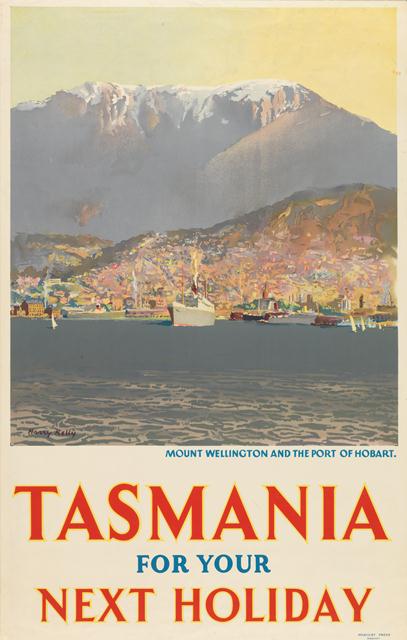
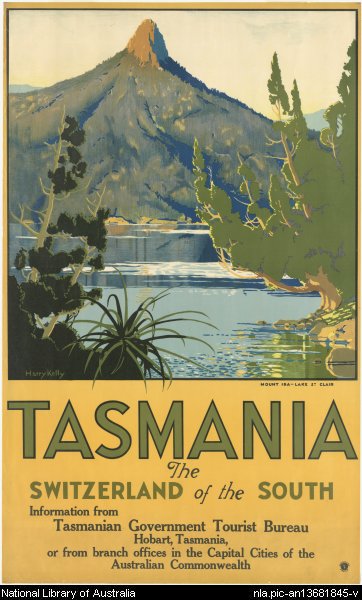
His comments appeared in the Mercury in September of that year. By November, ET Emmett, head of the Government Tourist Bureau, had commissioned one Harry Kelly to design a series of posters to spruik our island as a serious destination for the Australian tourist pound. What Harry produced are treasured as a pinnacle of advertorial art, with his product having a serious impact in an era way before television and the World Wide Web.

Harry K was a Gallipoli veteran, a resident of Kempton and prominent in local artistic circles. Because of his talents Cadbury at Claremont came to employ him as their art director. Later on he was prominent in producing recruitment posters during the war years, as well as garnering other advertising work.

kelly01

For his efforts in promoting our Tassie, he was duly praised in an edition of the Hobart newspaper in 1929 – the island was about to find out that it needed every penny it could muster from whatever source:- Tasmania is to be congratulated on the excellent posters that are being designed and printed within the State at the present time for the Tourist Bureau.  The one-sheeters advertising the tourist resorts are works of artistic merit.  The London underground railway has become noted for the series of artistic posters produced to advertise its various lines, and these have been so constantly sought for framing purposes that they are now sold to the public as well as used on hoardings. Two recent paintings by Harry Kelly, the Hobart artist, showing Lake Marion and a trout-fishing scene are worthy artistically of inclusion in such a fine series as that produced by the London underground. Among the Australian States Victoria has produced by far the most striking series of tourist posters but if Tasmania maintains the standard of its recent posters Victoria’s supremacy will soon be challenged.

Gaze on his work promoting the city under Wellington, the wilderness and the lure of the trout – it is still impressive, even in this era of digital complexity.

Recently I was able to view a selection of them in the flesh at the State Library – I refuse to address it under its new branding – and it can still be found around the traps as souvenir items in the form of post cards. Harry Kelly was a pioneer in the promotion of our beloved island and should not be forgotten by history.

She Said No…He Complied

I pass all my hours in a shady old grove,
But I live not the day when I see not my love;
I survey every walk now my Phyllis is gone,
And sigh when I think we were there all alone,
Oh, then ’tis I think there’s no Hell
Like loving too well.

But each shade and each conscious bower when I find
Where I once have been happy and she has been kind;
When I see the print left of her shape on the green,
And imagine the pleasure may yet come again;
Oh, then ’tis I think that no joys are above
The pleasures of love.

You would think his reign would be a goldmine for the BBC, HBO, Netflix or some other media heavy of that ilk to take on – much in the same way that old Henry VIII has been done to death. In recent years alone there’s been ‘The Tudors’ and ‘Wolf Hall’. Yet, despite having arguably the most hedonistic court in the history of the English monarchy – a time of scuttlebutt and scandal, of perfumed dandies and plunging necklines – it has only been bought to screens, large and small, around the fringes. The Restoration saw Charles II throw out the puritan drabness of Cromwell’s Commonwealth and bring back colour and social (read sexual) freedom to his domain. His court was full of Machiavellian intrigue, usually associated with the royal bedchamber and the parade of wantonly women who made their way to it. Hollywood, etc, has only skimmed the surface of this fecund period – it’s time a more detailed light was shone on it, methinks.

With the possible exception of Wallis Simpson, perhaps the most famous of all mistresses popped her head up to be savoured by the royal personage, to seduce or be seduced, at this time. Most with a modicum of knowledge of the Brit narrative will know of this apple of the King’s eye who emerged from a dank, festering East End, as an orange seller, to become the top banana in his boudoir. She was probably the only woman in his life to have truly loved him and she was Nell Gwynne.

But the delicious Nell was only one in a long list of promiscuous misses to court the favour of randy Charlie. For twenty-five glorious years this ruler gave his subjects plenty to gossip about after he threw off the grey stays of the religious zealotry that preceded him at the top. He lived the life of a rake to the full, fitting his duties of state around dalliances with a long list of mistresses, some serving up their wares to him concurrently. He regarded his long-suffering queen as just another duty he had to endure before he could indulge throwing the royal seed about. He didn’t care about their station in life, these gold-diggers. Just as long as a woman was comely and not pock-marked too badly by the pox, she was fair game.

charles

We know of fifteen official mistresses – but as to the unknowns, it’s anybody’s guess. This is the case, as well, for the number of bastards his endless bedding of the fairer gender produced – there are fourteen recorded as part of the royal lineage.

Let us take a closer gander at some of his conquests. His first, to the best of our knowledge, was Lucy Walter, his constant companion in exile from the age of eighteen until he received the call to return from The Hague to the throne. Once he had his ascendancy sorted he went back to Holland to fetch her, only to find her in the arms of a soldierly rival. He dumped her on the spot. She ended up a prostitute ravaged by venereal disease.

Charles found Nell Davis on the London stage, a bountiful source for spirited wenches. Samuel Pepys’ wife termed her ‘…the most impertinent slut in the world’. She came undone when the other Nell, who followed her onto the scene, stuffed her full of laxative which caused her to disgrace herself whilst the royal person was in the saddle. The King was mortified.

Then there was Squintabella, a nickname Nell G gave the haughty Louise-Renée de Kéroualle, whose baby face and Frenchiness intrigued the monarch, despite her lazy eye. He was in her thrall until she got above herself and started demanding that he came out of the closet as far as his preference for the Catholic religion was concerned. The second Charles had better sense than to put his head on the block in such a manner, so soon dispensed of her services. But she stayed around long enough, fighting off all pretenders to usurp her prominence in the King’s bedchamber, to have him declare her the ‘maitresse en titre’ (the official one) – for a time.

Barbara Villiers was heavily pregnant to Charles when Catherine de Braganza arrived from Portugal, in 1662, to take up her arranged station as queen of the realm. Barbara was a married woman and a very feisty customer who had such a hold over her lover that after a spat, and they were very frequent, he could be found down on his knees grovelling for forgiveness. But she was forever giving her favours to lesser mortals and eventually he wearied of his high maintenance courtesan.

There was Hortense Mancini. She dressed as a man and was ‘wedded’ to another royal conquest, Barbara Palmer, whilst the latter was with child – his of course. There was nothing Charles liked better than to sit by their shared bed and watch these two beauties sleeping in each other’s arms.

If all that’s not enough to build a compelling bodice ripper around, I’ll eat my hat. But now let’s turn our attention to another Restoration beauty who was of a completely different disposition and was perhaps the only one of the women in his life that he, in turn, truly adored with all his heart. Her name may not be recognisable to us, but we all know of her in another way. This unique individual was Frances Stuart – in court she was awarded the appellation ‘La Belle Stuart’. Mrs Pepys’ husband described her as ‘The finest sight to me…that I did ever see in my life.’ So how did this undoubted stunner of flashing blue eyes and golden brown tresses fit in amongst all the other goings on in the royal household. What was her story?

Frances_Teresa_Stuart_by_Lely

She grew up in exile too – in France this time – her family chose the wrong side in the Civil War. As her name would suggest, she was also a distant relative of his majesty. When Charles was setting up his court in 1660, with due emphasis on gaiety and frivolity, he put the word about that he was on the lookout for pretty women, of worthy parentage, to populate it. His sister recommended Frances after watching her bloom across the Channel, so she was summoned. At fourteen she was bought to England and became a maid of honour to Charles’ new queen. The very instant the monarch laid eyes on her he was smitten – her beauty, the way she dressed, her gentility and her conversation enthralled. She excelled at dancing, wasn’t a meddler and flirted outrageously with him. Her decorous kisses were akin to sweetmeats on his lips Why, she even laughed with pleasure at his lame jokes. Even at so youthful an age, she was the complete package and he desired her almost beyond reason. Even though, verbally and in action, she gave every indication that she shared his affection for the other – there was a line she would not transverse. At a time when one’s virginity was used as a tool to make it to the top of the heap, Miss Stuart was determined that she would sacrifice hers for nothing short of true romantic love. Charles used every trick, every ounce of praise, every cajolery too at his behest to entice her into his chamber – but she was immovable. To his credit – he always took her ‘no’ as the final word – that is, until the next time he asked. Now, with all the temptation he had at hand, you would think he would soon lose interest. There’s no doubt his sexual needs were being fully catered to by more compliant minxes – but it seems his ardour for her continued to climb to boiling point the longer she withheld the ultimate prize. But every step of the way she managed to waylay him, yet did enough to convince him that one day she would be his for the taking. She remained his constant companion at many a courtly function and when the Queen appeared to be on her deathbed in 1663, it was assumed the throne besides his was hers. Unfortunately for Frances, Catherine rallied and so the game of cat and mouse continued. When the plague struck the capital and functions of state were transferred to Hampden Court Palace, the king was becoming decidedly more insistent in his wooing. Something had to give. The beautiful one started to realise that, as patient as his majesty had been to this point, there was a veiled threat now involved. She would either have to gift him her virginity or find someone to marry. That latter option would work to put her legally, if not entirely realistically, beyond his reach. What to do? What to do?

As luck would have it, into the court in exile strode her knight in shining armour. Coincidently, his name was Charles Stuart, a distant relative to both herself and the royal house. He was also loaded up with titles as the Duke of Richmond and Lennox and she was soon completely smitten with him. He seemingly reciprocated and they were quickly wed, but in secret – neither wanted to face the royal displeasure, before they had to, by making it open. Frances was no fool and soon realised her husband was very flawed – he was a philanderer, a drinker and a compulsive gambler – but he did extricate her from her fix so she settled in for the long haul with him. Of course, when he discovered her deceit our lusty monarch was livid and vowed never to set eyes on the pair again. They departed the scene and he kept his word. But in 1669 the King displayed his ongoing affection when he rushed to her beside on hearing she had caught the dreaded smallpox. He lavished her with all the care he could muster and as Nelly G was now foremost in his thoughts, there was no ulterior motive on his part for his compassionate actions on her behalf. Frances duly recovered and soon found the King had transformed himself into something of far more value to her than a frustrated suitor – he became her friend for life. She returned to court as Lady of the Queen’s Bedchamber and to counter her feckless spouse, became an astute business woman. On the death of her wastrel hubby the King awarded her a substantial pension. In the end she used it to return to Scotland, the land of her birth, living there in comfort till her own demise in 1702.

So how come the vast majority of us are familiar with her – despite no inkling of her tale? Well, in 1664 the British defeated the Dutch at sea and Charles decided to have a medal struck in celebration. He envisaged a figure of Britannia, contemplating her victories, as the motif. With Frances at that stage, in his opinion, being the most beautiful damsel in the land, it was by decree that she was to model in the role for the casting. When he later decided to then have new coinage struck, her pose for the medal had a fresh use – gracing one face of the new design. Her portrait has thus appeared on British pennies right up till the introduction of decimal currency in 1971. So Frances Stuart is our notion of Britannia.

There has never been another Charles on the throne since Frances’ would-be lover. Is this because of the licentiousness of his life style? It will be interesting to see if our present Charles, if he ever gets to ascend to kingship, retains the name. After all, his story has not entirely been free of shenanigans behind a wife’s back either.
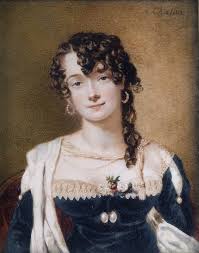
Frances Stuart by alfred chalon

But, in closing, let us return to the soppy versification the earlier King Charles scribed when he was lovelorn, pining for the fair Frances, a woman not afraid to say no to a king:-

While alone to myself I repeat all her charms,
She I love may be locked in another man’s arms,
She may laugh at my cares, and so false she may be,
To say all the kind things she before said to me!
Oh then ’tis, oh then, that I think there’s no Hell
Like loving too well.

But when I consider the truth of her heart,
Such an innocent passion, so kind without art,
I fear I have wronged her, and hope she may be
So full of true love to be jealous of me.
Oh then ’tis I think that no joys are above
The pleasures of love.

britannia

Between Us – Words of Wit and Wisdom edited by Marieke Hardy and Michaela McGuire

This fourth compilation of epistles in the ‘Women of Letters’ franchise (the editors may well hate that term) is now not only an Australian phenomenon, but is spreading its wings internationally as well. Hardy and McGuire sold out NYC, which now has monthly performances, with a tour of their concept also completed of the UK. What started out as a small time effort to raise a bit of dough for a local animal welfare charity has captured hearts all around the nation. I was in a Hobart audience a while back and the duo had the format down pat. It was a night of laughter and tears. If one of their live performances comes to a venue near you, do make the effort to attend.

between-us-

The volume in question – there has been an international edition since – has all the faults of its predecessors – there are still the try-hards and still some drivel. But overwhelmingly most letters contained within speak from the heart, some even quite intimate in nature. The editors have by now reached the conclusion that part of the reason for the success of these books, as well as their live source, is that, in letters, there is a sense of safety not present on social media. The shows have a rigorous no recording policy and the readers involved all need to give permission for publication. The audience for both would not be the milieu for trolls in any case, I would have thought.

The edition in question is bookended with poignancy. First cab off the rank is the magnificent Stella Young, composing a letter to her octogenarian self – ‘By the time I get to you I’ll have written things that change the way people think about disability. I’ll have been part of a strong, beautiful movement of disabled people in Australia.’ And arguably, along with the marvellous ‘The Last Leg’, she, at thirty-two, already has. Sadly a few weeks after publication of this book our gorgeous advocate for crips – her word, not mine – died suddenly. Very early on in the history of ‘W of L’ she had forthrightly stated that the organisers had better find a wheelchair-friendly venue for the live version or face her wrath. The two convenors did so immediately and the spirited Stella became a firm friend of the pair.

stella

The closing letter was by former Greens senator Christine Milne. Once upon a time I was a friend during her uni years and for a time we shared a school staffroom on Tassie’s North West Coast. Her letter was to her former students at Devonport High School and it centred on a book that is very close to my family’s heart – Paul Gallico’s classic ‘The Snow Goose’. My beautiful sister Frith derives her name from that tale.

snow goose

There was much else to enjoy, such as Chrissie Swan’s encounter with a woman breast feeding in a suburban shopping mall. She was dressed in a bear suit with a flashing neon sign attached to her head warning, ‘Boobs Ahoy’. I love Spiderbait’s drummer Kram’s relating of how the ‘House Husband’/’Play School’ host, Rhys Muldoon, came to be pashing Axyl Rose’s girlfriend at a Melbourne concert of the Gunners. Leading the way for Muslim women in their fight against sexism and for their right to be heard, Susan Carland writes emotively about her love for her son now and into the future. Columnist Amanda Blair, whose mother once tried to match her up with Martin Bryant on a blind date, muses on how much simpler life was for women back in the day – or was it? Angie Hart’s letter to her unborn child is a heart-breaker and I found out two facts about Poh that I didn’t know. One is, would you believe, she’s almost forty. The other is that she is not beyond dropping the f-bomb (but it’s okay, she uses it in describing some cretinous troll). Jess McGuire writes of her totally ‘annus horribilis’, but in doing so demonstrates how even the most dire of circumstances can have an upside. Guitarist for our beloved Go-Betweens, Adele Pickvance, writes engagingly on the difficulties involved for a Brit adjusting to life in Oz. And lastly, in my resume of ‘Between Us’ highlights, is the story of how Sommer Tothill’s life was turned around by the true narrative of her Uncle Rolly’s demise.

There is much, much else to recommend this penultimate addition to the ‘W of L’ list of titles and I bet, once you’ve devoured this glorious omnibus, you’ll be hankering for the other four. Now I think I might take up my pen and write a snail mail missive of my own to my good mate….

Women of Letters website = http://womenofletters.com.au/

Yoli's Cards

I am enamoured of cards as much as I am of writing letters. And of course the two can be combined – I love sending off missives to my mates. I probably somewhat swamp them with my predilection, but my friends are a tolerant mob and hopefully I am forgiven. Out and about I keep a whether eye open for greeting cards that enchant the senses – but, dear me, they’re getting expensive these days. They are now around the seven dollar mark for many of the nature that I prefer. That price is difficult to justify when they are purchased in the number that I like to. Some of the best can be found in our local book emporiums – Fullers, Dymocks and the Hobart Book Shop. Not so long ago I was down in Salamanca, enjoying autumn sunshine, when outside the doors of the last listed store I espied arrayed a number of boxes of cards – good cards – some at three dollars a hit, others at a wonderful single dollar. I was soon into them like a moth to the flame. Since then, each time I am in that part of the world I pay the bookshop a visit and to my delight find that those boxes are regularly refilled with fresh designs – although, now with the chill winds of winter blowing, they are housed inside. Even more to my budgetary pleasure a new sign has appeared. They have been further reduced in cost. One can now choose ten beauties for the former cost of one, a mere seven bucks!

And that’s how I discovered artist Yoli Salmona. Occasionally one finds an image that particularly captures the attention and holds it. And rifling through the described boxes one Sunday morning, I found such-like from her.

Yoli-pic

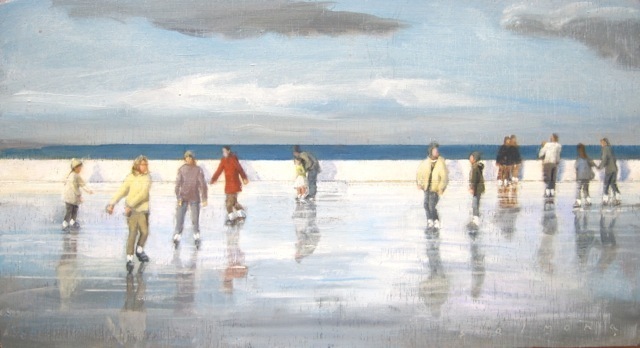
The card featured a summery-clad gentleman gazing out across a yacht-splattered Sydney Harbour, from a colonnaded balcony, towards the Bridge and Opera House. On returning home I endeavoured to track down that image on-line to no avail, but I did discover a little about the card’s producer and some more of her offerings. One that intrigued, from talented Yoli, was entitled ‘Bondi on Ice’. This was mainly because it was so at odds with the usual images we get, in spades, of the iconic strand. It’s a winter scene. Instead of golden sand and a dazzlingly azure sky, we are confronted with muted pastel heavens and a shivery, silvery beach. Instead of bikinied gals and budgie-smuggled lads, we have have a line of figures clad more for the bite of winter here on my island in the southern seas. And – look closely – are there skates on their feet?

Bondi_on_ice_study_-1349670291m

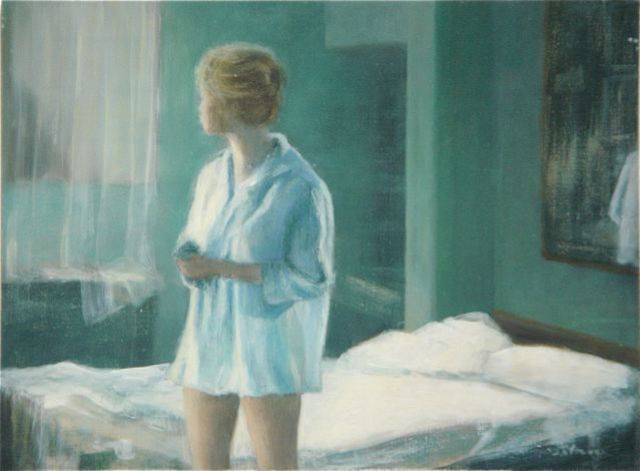
Like many of our best daubers, Ms Salmona hails form foreign shores too. In her case it’s France. Her initial training was in the field of fashion design and before the relocation to Oz, in 1986, she had plied her craft in Los Angeles and Tunisia, as well as Paris. A new country bought a change of tack as the markets for her previous oeuvre dried up with the tough economic times in the nineties. She turned to oils as her new medium and was soon garnering success. Many of her works continue to be taken up by card companies world-wide and she exhibits frequently. Yoli S has also won several prestigious awards. She teaches portraiture in Sydney and the latest string to her bow are what she terms ‘floor canvasses’ – having her product printed on rugs. So I invite you to check out what Yoli Salmona offers on-line and if you share my predisposition, you may even find her on a local card-of-quality rack at a vendors near you. I agree with her sentiment that art, such as hers ‘…can enhance the experience of everyday living through pleasure addressing our senses or a particular aesthetic, and our sense of humour.’ She did that for me one morning down at Salamanca.

Yoli Salmona - Rendezvous_avec_B

A gallery of Yoli’s works = http://www.absolutearts.com/portfolios/s/salmona/

Wave

The surfing miner felt unfulfilled. Sure, there was great money to be had underground digging out what is so vital to the nation’s financial health, but now he was grounded from both his passion and his work place – one on the sea, one in the bowels of the earth. He needed something to take his mind off the damage done to his right knee that would leave him incapacitated for six months. His brother and sister were both fortified with their engagement in artistic pursuits, so he looked to that area for inspiration. He picked up the expensive camera he had treated himself to a while ago, then had put aside due to time constraints – now he had no such excuse. Gradually an idea took hold and he clicked on to the ether to see if he could make it pan out.

ray collins

That was back in 2007. Fast forward to to the present day and the thirty-two year old, on the basis of what he taught himself to do back then, has seen his skills taking him all over the world – even to dipping his toe in minus twenty degree water off the coast of Iceland. He now combines his first love with this recently discovered expertise to win accolades and awards world-wide, as well as a handy amount of pocket money.

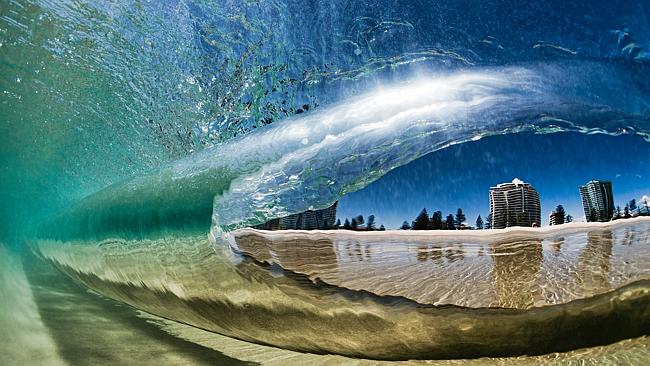
I initially encountered Ray Collins one Saturday morning, earlier this year, on opening the Weekend Magazine supplement of the Oz. Within there was a quite stunning photograph that took me away from a disappointing Tasmanian summer to a place where I know the weather is blissful in all seasons. Fusing glistening water and a bright blue-hued sky, the snapper had captured a gloriously perfect wave in the instant before breaking. And through its tubular pipe we get a glimpse of a coastline fringed by sand, pine trees and Coolangatta towers. I took to my laptop to find out more about the obviously talented creator of such an image.

ray cillins coolangatta

During his time away from the coal seam and riding the white horses of the sea, Ray discovered that he was quite the camera-smith once he mastered the intricacies of his rediscovered purchase. But now it came time to find out if the theory of his nub of an idea could be put into practice. Maybe in doing so he could match his siblings and produce works of beauty too. He has done that in spades, but it wasn’t easy. First he needed to outlay some cash, not a small ask when he was on half-pay, to see his vision realised. For three thousand dollars he purchased himself a housing unit – all to take his camera to sea.

The tough going didn’t end there. Although technically he was the match for any other surf-snapper, there was nothing in his photos that stood out from dozens of other practitioners. He needed an angle. He decided to break away from the convention of man’s (and woman’s) mastery of the breaking swell. He resolved to focus on the wave itself – its ‘…textures, colours and purity.’ He wanted ‘anticipation’ in his product – and he worked at it till he achieved that aim. He attained his goal. Surfing magazines more readily came to pick up his depictions and eventually he came to the notice of the guru of his art in the States, Larry Moore, who took him on by awarding him one of his prestigious mentorships – the first Australian to be thus honoured. He was set.

ray collins

Following on from that, he has won just about every gong going in his field and he services a list of international brands as long as your arm with pictures for their advertising – Qantas, Red Bull, Apple, United Airlines just to cite a few. Each day he has to sort through several hundred emails, all clamouring for permission to use his work for a multitude of purposes.

Attached to this, though, there are two rubs. The first is that he still works away at that coal seam. Despite his international repute, income from his output with the camera is still fluky and he needs the stability of a regular wage in his life. He is not one to go simply where the waves take him.

Rub number two? He will never see his images the same way as you and I do. Ray Collins is colour-blind.

Ray Collins website = http://raycollinsphoto.com/