First Berlin, then Paris

It must be every parents’ nightmare. Parents would seem to have so much to worry about in this fraught age we live in without that. Seeing ‘Berlin Syndrome’ put me in mind of the Graeme Connors song, ‘Louisa’, a later highlight of his career –

Lying in bed drifting in and out of a late night talk back show
I hear this live cross news reporter coming over the radio
seems a bomb’s gone off in a train somewhere on the London Underground
with unconfirmed reports there are several Australians among those who can’t be found
and of course I thought of you my dear
that’s why I’m here on this phone
Louisa come on now I want you here with me
it’s a crazy world these days I need to know you’re somewhere safe
Louisa darlin’ please why don’t you take the next plane home
it’s not the time to see the world I’m worried ’bout my little girl Louisa

A father, worrying himself sick over a daughter travelling in Europe, imagining all those ‘crazy bastards out there‘, willing to take innocent life in the name of crackpottery. And in the film offering, the travelling girl sure meets one crazy bastard in Andi (Max Riemelt). He, despite outward appearances, is completely off the show. Thankfully my own daughter’s travels in Europe were in the company of her good man. If your own footloose treasured one cannot be convinced against soloing it through Europe these days, you’d be wise to not go and see this – or, perhaps even better, get her to view it.

Andi has seriously nasty intent towards Clare (Teresa Palmer). Normally an offering about a guy lording it over a girl he’s trapped in a room, preparing to do dastardly acts to her, is not one I’d rush out to see, particularly as the esteemed DS – we all know who that is – dissed it in no uncertain terms. As well, there were plenty of other films beckoning at my art house around the time. But it captured the attention of my lovely lady’s equally lovely daughter, after she’d watched a promo of it on the tele, so she sweetly nagged me to add it to my list. For all her admirable talents I find Ilsa someone it’s hard to say no to, so off I toddled.

Now I cannot pretend I thoroughly enjoyed it, but with director Cate Shortland at the helm – after all she did give us the very worthy ‘Somersault’ – it was somewhat more subtle than what I would take to be the norm for this sort of thing ie, a fantasy project for male auteurs. Does Clare get a dose of the Stockholms, or is it just a matter of taking the course of less resistance as she tries to find a chink in her captor’s armour and seemingly inescapable digs? This is as far away from ‘Fifty Shades…’ as it is possible to get. It’s Berlin in wintry and dun-tones; our heroine’s confines being in the grottiest of neighbourhoods; with this being essentially a two-hander between the leads. We have a largely pointless sub-plot involving Andi’s father – set up, I presume, just to allow for a tender moment between captor and victim. Andi is also making eyes at one of his students – he’s an English teacher, you see – but this goes on to have much, if confused, relevance for the climax of the piece. The movie is stretched out to a long couple of hours and I wasn’t too sure about its eventual ending, but it’s certainly a brave performance from Palmer. Clare displays plenty of Aussie grit and determination in her attempts to get through her ordeal and ultimately it does possess much to recommend it.

I must be missing something. She’s good, no doubt about that. But ‘World’s Greatest Actress’, as she’s spruiked for this film – well, there’d be a few English dames who’d have something to say about that, not to mention Streep, Blanchett and I could go on. And in no way was ‘Things to Come’ ‘One of the Best Films of the Year’ nor was it ‘A Stunning Achievement’ and it sure wasn’t ‘Perfect’. ‘A Quiet Jewel’? Well, maybe, as long as it was a lesser stone. It’s certainly not a diamond.

It isn’t that Isabelle Huppert doesn’t have acting chops – she does, in abundance. She’s brave and does French sang froid very well. In this she showed more nuanced emotion than is usual for her. But it’s boring. The film is simply boring. I struggled to see it through and in the end was thinking about my bladder far more than what was going on up on the screen.

‘Things to Come’ is from the producer of ‘Rosalie Blum’ and the director of ‘Father of My Children’ – both excellent. But here, together, they have come up with something far less than the magic of those two. And, sorry if I let the cat out of the bag here, but the ‘romance’ that watching the trailer led us to believe was going to happen between younger man/older woman just didn’t occur – apart from a couple of meaningful looks.

Parisian teacher of philosophy (Huppert) gets high from intellectual discussion and is quite stunned when she discovers hubby (Andre Marcon) isn’t going to love her forever for it. She wants to know, in typical French fashion, why he simply couldn’t keep his dose of the Peter Pan’s, resulting in an affair with a younger woman, a secret from her. But he was forced to spill the beans by their not so understanding daughter. He soon departs, around the same time as she is dropped by her publisher – her texts are no longer flavour of the month with the student cohort.. Her mother, compounding her woes, is starting to lose the plot, leaving her with a moggy she definitely does not want and needs to quickly find a home for. Trips away from Paris to the Brittany Coast and into the mountains abound Grenoble – the latter with that spunky young hunk, who has his girl friend in tow, help to clear her mind.

Gradually she accepts her situation and moves on, but I really wanted more bang for my buck with this. I was sucked in by the hype and the full page ads for it in a certain Melbourne newspaper. But, sorry Isabelle World’s Greatest Actress, your film comes up way short here for this punter.

Trailer ‘Berlin Syndrome’ = https://www.youtube.com/watch?v=tbq44I_nSRg

Trailer ‘Things to Come’ = https://www.youtube.com/watch?v=UhErAqJ8HGE

The War We Can't Let Go Of

At an early stage, in the film ‘Denial’, a young legal eagle asks, ‘What is there about this war that we can’t let go of?’ – or words to that effect. He was greeted in the chambers by stony silence and stern looks, surrounded, as he was, by souls who realised there was a Jewess in their number.

There were three films, set in the second great war of the previous century, on at the State in the week I ventured out to see this offering – indicative that we can’t let go. They were ‘The Innocents’, ‘Their Finest’ and this one. The ‘Zookeepers Wife’ was slated to arrive soon after. I also viewed the second listed. I am not a fan of any supposed entertainment involving the heroics of American GIs slaughtering enemy forces and saving the world. That was a part of my upbringing – ‘Combat’ on the tele, John Wayne et al on the big screen. Today, thankfully, even Hollywood has become somewhat more subtle and sensitive and the two offerings here had something special as an added enticement to attract me.

I love a good courtroom drama and that is essentially what ‘Denial’ is. It’s roots are, though, in the shock to humanity that was the Holocaust. There are none of the harrowing imagery of mass-extermination here, but, at one stage, the main protagonists visit Auschwitz where they stand on the roof of what was once a gas chamber. That was chilling enough as they contemplated what once occurred beneath their feet during those years..

The movie details a court case involving a Holocaust denier. How can such people exist? It features the odious David Irving who is still spruiking his noxious views to the sort of people who maybe voted for Trump and Le Pen. American Scholar Deborah Lipstadt – the aforementioned Jewess in the room – sets out, along with the publishers of one of her books on the topic, to prove, not that these events occurred (that would further stress the survivors of the death camps), but that the man, Irving (Timothy Spall), is a liar. He is suing Lipstadt (a feisty Rachel Weisz) for his defamation in one of her publications. This takes us to an intriguing quirk of British law that sets the scene and brings into the picture Richard Rumpton QC. In the role Tom Wilkinson steals the show as the unshakable stickler for principle which, at first, doesn’t go down well with the Yankee brigade, aghast at the archaic vagaries of UK law.

Spall also thrives as the denying villain. One critic describes his presence in this as all ‘… courtly manners masking a snarling junkyard dog beneath…’. I also particularly liked ‘Sherlock’s’ Andrew Scott as solicitor Anthony Julius. Written by David Hare, the movie has much to commend it, even if we know how it all ends. That this case savaged Irving’s reputation, yet he still manages to go on putting out his falsehoods as gospel – the ultimate fake news – is quite obscene. At times the world is a weird place.

Age reviewer Sandra Hall claims there was a time when she ‘…couldn’t see the point of Bill Nighy.’ That was during his television years, usually playing a womanising rogue. Well, it was one of those series where he was cast as a philandering university academic, of the most disreputable kind, that first attracted me to one of my favourite actors. And then along came ‘Still Crazy’ in 1998. Hall reassessed him, I became even more enamoured and thus have remained ever since. For most he’ll be always remembered for that unlikely hit, ‘Love Actually’ – but, for my money, his best performance came with 2005’s ‘Girl in the Cafe’.

‘Their Finest’ is a take on the old chestnut of making a film within a film – this one’s mainly set in the London Blitz. The inner movie is a ‘based on true events’ incident, during the Dunkirk evacuations, whereby two Norfolk sisters rescued soldiers in their father’s fishing boat. Nighy plays a once well recognised actor, now down on his uppers, cast as a drunken uncle for the propaganda effort, aiming to lift local spirits. Scripting it (or providing the slops, as a woman’s perspective was evidently termed back then) is Catrin Cole (the versatile and beauteous Gemma Arterton). Sam Caflin – the death wish quadriplegic from ‘Me Before You’ – is Cate’s fellow writer who becomes the love interest. Richard E Grant and Eddie Marsan get a look-in as well.

Really, apart from the two leads, this film has not a great deal going for it – even if it was granted an extended run at the State. The look of the offering is meant to be redolent of the period as it tries to capture the stiff upper lipness of the times – and it was interesting to see how they devised special effects in the era before digital technology. It’s all a tad twee, but even in second rate material Nighy and Arterton are class acts worth watching.

It’s seven decades on from the end of World War Two, but I am sure there are many, many stories have yet to be milked from those tumultuous six years of conflict – but we never learn from them, do we? There’s a mad man again loose, this time in North Korea; a Syrian leader prepared to slaughter children in their schools and a guy in the White House fully a few threads short of a jumper.

Trailer – ‘Denial’ = https://www.youtube.com/watch?v=yH7ktvUWaYo

Trailer ‘Their Finest = https://www.youtube.com/watch?v=mMh1EvAQOQ8

Tram Mayhem – Melbourne Vignettes – Winter '17

‘Come here Sahs! Come here quickly. There has been an incident. An incident on this very tram. This very tram, Sah! My tram in fact. I am very distressed. Very distressed but I will be all right. I will be okay. Come on …come in, if you please, Sahs.’

Always a joy travelling around on Melbourne’s trams – but sometimes things can go awry. But we’ll be back to this incident later.

I shouldn’t have been ear-wigging – I really shouldn’t, but the following conversation tickled my fancy. And, being packed into a No.11, making slow progress up Collins, it was hard not to overhear as the pair were pressed up against me. But he, well, he was more than pressed up against the young lady in question. He, of swarthy Med/Middle Eastern appearance, was decked out in full St Kilda regalia, obviously off to Etihad Stadium to witness the Saints demolition of an inexplicably lacklustre Tigers outfit later that night. She was a slim brunette, dressed in mufti, white-bread white in contrast to her partner – but obviously infatuated by him. They fondled, they caressed, they gently pashed with, as he nibbled her on earlobes, it going something like this after a quick reference, between nibbles, to his hand-held device.
‘Guess what, Babe. GWS have just drawn with the Hawks!’
‘Sweet – well that’s, like, rad. Really rad.’
Yeah Babe – it might even be some sort of record, having two draws in a row (It wasn’t. Carlton also did it back in 1921). How incredible is that?’
‘Amazing. That’s, like, just so amazing.’
You could tell she wasn’t really interested, but she was trying for his sake, in between planting sweet kisses all over his face. But, well, there’s nothing like the romance of tram travel to warm the cockles, but more about adventures on the city’s transport system later.

Van Gogh, to be honest, despite being the main focus of the trip, was something of a let down. Through a variety of events the trip was later in the year than I intended, it coincided with Victorian school hols and the exhibition at the NGV St Kilda Rd was in its last days. Taking all this into account, my goal was to be there on the dot of ten, opening time according to the gallery’s web-site. I achieved that, only to find people had been pouring in for a good hour – special opening times you see. Poop. Hundreds, thousands maybe, were lining up and once eventually in, it was difficult to get close to any of the works. It would have been fascinating and engrossing had there been less of a throng, so I contented myself taking pictures of those who could peer at the sad master’s works. So many starry, starry nighters were determined not to miss out that the only consolation for me was that the line up was even longer as I exited the show.

Making up for that was the excellent Aardman exhibition at ACMI – Wallace & Gromit and Friends. As well, there was the examination of the world of creepy-crawlies at the Melbourne Museum, Bug Lab. Looking at the enthralled faces of the children of all ages viewing these, I cannot but highly recommend both to anyone travelling to Yarra City, with kiddies, in the near future. The pair of attractions sure bought out the inner kid in me. The creators of the first, with their claymation, have set a new standard for the entertainment of young and old alike – and the display at Fed Square was brilliant in conveying their artistry. I took in the atmospheric images of the controversial Bill Henson, also at the NGV I, as well as the retro photographic installations of Patrick Pound at its Federation Square mate. I also did my usual trip up Swanston Street to take in the interesting offerings at the Ian Potter Gallery, University of Melbourne.

It was such a treat spending time with my beautiful sister Frith and gorgeous niece Peta. I took the former to a couple of my favourite haunts around the market at South Melbourne. We basked in the balmy winter sunshine to the tasty soft-bunned delights of the Goodegg (303 Coventry Street). Be warned, here the hipster coffee is only trendily luke warm, but the tucker made up for it. I took Frith to the duck shop, Licorice Home (8 Union Street – off Coventry). There was an array of cute and cheap wooded animals on display but sis went for the ducks, as you would. She came away with three. Peta drove us with zing and elan through the ‘burbs to ‘Little Saigon’, in Richmond, where I thoroughly relished my prawn rolls and stewed duck soup at Than Ha2 (120 Victoria Street). It was jam-packed with an ethnic cross section of Melburnians enjoying it’s fare – intestine soup anybody?

I wonder if some think that the taggers’ overlays make it a more authentic experience – to me it’s just plain ruinous. Hosier Lane is always a must on any trip over to Yarra City, sitting as it does opposite Fed Square, between Flinders Street and Lane. There are invariably new and beguiling-to-the-eye street art to be found on each occasion – but this time the taggers seemed to have outdone themselves in defacing those works with any semblance of artistic merit. I can’t comprehend the logic. Do those perpetrating it need to stake out their territory like a dog? Do they do it to big note to their ilk? If my opinion is shared and given this lane-way is in the epicentre of the arts precinct, drawing hundreds each day to snap away with camera and mobiles, surely, for the city’s reputation, something needs to be done. A night-watchman perhaps? Now that wouldn’t be too much of an impost on the rate payers there, would it?

The Kino (45 Collins St) brings to the CBD the best of the new releases, both from Hollywood and the world of art house. In 2017 it is celebrating its thirtieth year of doing so, so late Saturday arvo I had the choice of sitting in a pub over a few ales watching the footy or taking in a film. I chose the latter, with a couple of beers at the Kino’s bar either side of ‘My Cousin Rachel’. With Rachel Weisz as the cousin, she’s the older woman who first marries a young man’s ailing guardian and then, after his demise, presumably sets her sights on his ward (Sam Caflin). She’s after his inheritance, no doubt. But is this temptress all she’s cut out to be? Sam’s character falls for her big time and is soon handing over the dosh, but in the end does not know quite what to believe about her. Does he make the right call before it’s all too late? Set in Poldark country, it possesses the same vibe as the tele series, is based on a Daphne du Maurier novel and is directed by Roger Michell. I did not regret my choice.

Now the trams. The plaintive cries I started this account with were part of the first of several happenings that occurred to me journeying the network over my four day stay. The plea for assistance came from the driver of the one taking me out to visit Brother Jim in Camberwell. Pulling up to a stop, this agitated driver leapt out of his compartment and yelled his complaint to two approaching safety-vested fellows about to board. One of these took control of the tram, the other sat the poor guy down a couple of seats ahead of me. He kept repeating that he’d be all right, but he obviously had had a scare sometime prior to my embarkation. I presume the burly person sitting next to him was a counsellor or an official sent to debrief. I couldn’t hear much of the conversation, but nurses and pharmaceuticals were mentioned. At one stage the bigger fellow chuckled, only to be rebuked by the smaller stating that clearly, for him, it was not a matter for laughter. I suppose it is a credit to the poor driver that he had continued on his journey given his distressed state without any hint of something amiss, at least to this passenger. Yarra Trams, the next morning, presented me with a breakfast bar as a way of apologising for my trip along St Kilda Road being interrupted by roadworks – very thoughtful of them. Two nights in a row journeys on the three-carriaged No 96 were diverted, this due to bingles between trams and pedestrians, both requiring the attention of first responders and road blockages. Then, travelling down Fitzroy Street one night, back to my home away from home in the world’s most liveable city (personally I wouldn’t swap Hobs for it), the Cosmopolitan Hotel, I heard a tapping on the tram’s window whilst it was still in motion. I turned and looked into an anguished male face, thirty-odd in years I’d say, peering back in at me mouthing, ‘Let me in. Let me in.’ Now, even if I’d wanted to, I could not have opened doors programmed not to do so until a stop had been reached. As I turned away, the conveyance suddenly shuddered to a halt between said stops, the driver alighted and the tram-surfer disappeared. But what beats me is how he managed to cling on. There is a narrow running board outside, under the doors, but on the sleek chassis nothing I could discern could have given any purchase for one of his hands, allowing the other to tap frantically. Quickly our driver re-entered unperturbed at events and we continues our trip, but the mystery plagued my mind for the rest of my stay.

But all too soon that was over and I was jetting my way back to home. After we touched down, a few seats ahead of me, I heard a little cherub ask, ‘Have we landed in Bali Mum?’
‘No, darling, I did explain. Tasmania is an island, just as Bali is. Don’t you remember? I didn’t say we were going back there. I’m sorry sweetheart. I though you understood.’
‘Oh dear, Mum. I thought we were going to Bali.’
I hope Tassie didn’t disappoint the little one too much.

Trailer for ‘My Cousin Rachel’ = https://www.youtube.com/watch?v=2n_KOgXMSyA

Ditzy Jenny and Rosie

She called it her funk. Some days were better than others. She was determined she wouldn’t let it beat her; it wasn’t in her nature. Not now anyhow. But, golly-gosh, it was hard. She’d tried topping herself once and found it definitely not to her liking – so she threw herself back into her charity work as a substitute – something she hoped the kids in her native Hungary would one day thank her for. It gave her a purpose. If only she could prevent herself dwelling on all that she had lost she felt she could make it through to the inevitable that lay up ahead. Dwelling on it, well, it only made her feel funkier – and if she gave into the bleakness, god knows where it would lead her to again. No more Irving, no more Jenny, thinking back to the occasions she nearly died. Why, sometimes she even thought of Harry, gone now for almost two decades. Harry, she knew, only had eyes for Miss Jenny – but she liked Harry a lot too. More than liked him, if she was honest with herself. That, at one time, made her appallingly green-eyed towards her Jen. That girl in turn dangled herself before and flirted outrageously with the man, but, despite his most becoming entreaties, usually revolving around money – money he couldn’t afford – she just would not commit. She, herself, would have been his in an instant had she been given the same chance. And, as to her cursed funks, she knew exactly the day they first came to her.

In a small way I was proud of myself. It was only a tiny win, this victory of sorts, in a game they try to play with us for reasons beyond me. I rarely watch programming on the commercial networks, apart from the footy and cricket. The ads are enough to drive me bananas and mainstream American television doesn’t do much for me, with the exception of the exceptional ‘This is Us’. There are a few Aussie staples, as well, we regularly commit to our hard drives to watch at our leisure – ‘House Husbands’, ‘800 Words’ and ‘Offspring’ for instance. I’ve witnessed my lovely lady, until the advent of our own T-Box, being regularly frustrated trying to follow some of her favourites on Ten, Nine and Seven. Shows would disappear without notice, not adhere to the tele-guide times or turn out to be repeats when a newly minted episode is advertised. Others would be shunted off to the subsidiary channels and often, trying to find them there, was like searching for a needle in a haystack. No wonder viewers are turning away from free-to-air in droves to other platforms. Occasionally, though, on these networks there would be a Brit show I’d be particularly keen to watch – the venerable ‘Downton’ being a case in point. Not that they would have dared tamper with that behemoth. But, unfortunately, that was not the case with ‘Mr Selfridge’. I really was partial to this show – and sure, the first couple of seasons rated well enough, for whichever network it was on, to keep it stationary with a regular time slot. But once Series 3 and 4 came along, with ratings presumably dropping or the need to find room for some of their crass reality dross, ‘Mr Selfridge’ disappeared from sight. Then it suddenly reappeared on one of the additional channels. There it would chop and change time-slots and days willy-nilly. It completely disappeared for a while, mid-season, only to, you guessed it, reemerge much later to finish off the remaining episodes. My victory was that I managed not to miss an episode – I persevered to catch every one, free-to-air. Of course I stacked them up on the hard drive so I didn’t have to sit through endless inane ad-breaks. But I had my victory over those pesky programmers who seem to make it their business to take every bit of enjoyment out of viewing their particular network by endlessly playing their little sport with any less than signature show. I didn’t succumb to the temptation of rushing off to JB’s to buy the final series or ask for it from rellies proficient at downloading from various maybe not quite legal sites. Yes, it’s a trifling thing, but it gave me a degree of satisfaction.

During her later decades she took to researching the special connections that exist between twins for, you see, she’d been born one of a pair. She had now survived her twin sister by a long shot. It was hard to imagine that, once upon a time, she could not have contemplated existing without her look-alike. It seemed, too, that her sister was of the same opinion. During their time in the spotlight her sibling had countless marriage proposals. The excuse to reject them was, invariably, ‘I couldn’t marry that man, sis! Have him take me away from you. No! No! No!’ The bond between the two of them was special but, back then, she wasn’t so aware of her feelings; she had no inkling her almost second sense concerning her twin was not commonplace. But she also knew that, whilst they were together, they offered the world something that was unique and something that was in high demand. For a lengthy period of time they had the planet at their feet, slavering for more. They were the chosen pair, dancing their way into the hearts of thousands – and breaking many of those same hearts. Men fawned after them on two continents; their ‘champagne and caviar’ lifestyle being broadcast to the world in the print media. Now she watched the Marilyn Monroes and the Elizabeth Taylors of her present day take on that mantle and be fêted globally. Her most melodramatic of sighs, back then, would have male pulses racing – these days the same would be considered the hammiest of acting. Nowadays men wanted so much more. She knew this as she kept an eye on the popular entertainment in the newspapers and magazines she took. Sometimes what she read made her blanch. It was an effrontery to her sensibilities the wanton titillation that was going on – in her very own city too. Even at their height, they would be out of their depth in modern times. She smiles wistfully as she recalled their era on Broadway; of the gay abandon of their frolics in Paris, Cannes and Biaritz – or wherever the glamour set hung out. And then, of course, there was Irving, the love of her life. He left her far too soon. But as well, for a time and well hidden, or so she thought, her heart, too, had belonged to Harry.

‘Mr Selfridge’ told me the tale of the founder of the eponymous department store and tracked its ups and downs from its genesis in 1909, through the Edwardian years, the Great War and into the Jazz Age. American Jeremy Piven played Gordon Selfridge across the four seasons; Australian actress Frances O’Connor his wife, Rose. There were many other characters I particularly enjoyed – Miss Mardle (Amanda Abbington), a self- made woman attempting to break glass ceilings; Mr Crabb (Ron Cook), the fastidious accountant who gave his heart and soul to his boss; the extremely odious Lord Loxley (Aidan McArdle) who hated Selfridge to his core and Mr Grove (Tim Goodman-Hall), the store executive with a tortured personal life. It was a great show – a period soapie the Brits do so well.

Rózsika and her identical twin sister, Janka, were born in Hungary on October 25, 1892. With their parents, Julius and Margaret, they migrated to the USA in 1905. As children they trained to be dancers, getting their first gigs, for small change, in the beer halls of NYC; debuting on the vaudeville circuit in 1909. They were soon hits, making their first foray into films in 1915. At their peak, in the US, they were pulling in $2000 a week, unheard of for those times.

After the war the sisters moved to France, purchasing a chateau as a base for their tours of the Continent. Their popularity kept them in plenty of coin and their crowning moment was an invitation to perform at the Moulin Rouge. They received $1200 a night for that!

Looking back, looking back. She was always looking back. It didn’t help her funk, she considered. She was almost a septuagenarian, but despite the dangers going back to those times, contrarily, her old face now creased into a smile. Memories.

It was sunny in the apartment. A few tipples had made her feel nostalgic. She could look back at Diamond Jim, surely, without coming over all funky. He was their early champion. Diamond Jim Bundy – now there was a hell of a man. Business man, financier, philanthropist (and it has to be said, glutton). He loved jewels, once loved the great Lillian Russell, too, but the instance the twins battered their eyelids at him, he loved them as well. He was in his last years then, but he regaled them with tales of how he once owned the first automobile in New York City, bragged about the huge meals that made him legendary and of his adoration of Miss Russell. He showered her sister, in particular, with gifts; from diamond rings to a Rolls Royce, presented in ribbons and bows. They were mere slips of in those days, not fully adults, having just turned twenty. But they played to his vanities and, boy, did they stir him up – they knew which side of the bread to butter. He was their sugar daddy and wanted nothing in return apart from their company.

As for their act, they were fairly chaste. They didn’t flaunt themselves on stage like the outrageous Josephine B and her ilk – no siree. They left it all up to the imagination of their audience. She knew that a wink with a few come hither posturings and beckonings could work magic on the male gender. And as for her sister, well, she was a little more provocative – but nothing tasteless, that’s for sure. No doubt the green genie would arise in the female dates out in the audience. But the menfolk adored them. They were a class act – nothing too tawdry. That was the way to win affection. Keep ’em guessing

One of the many aspects of Mr Selfridge I savoured was the introduction of actual historical figures into the show. There was Serge de Bolotoff, the Russian Prince. Selfridge was not happy when his precious daughter, Rosalie, fell in love with this chancer. Even if he was an aviation pioneer, he was also a notorious scamp. It was all sure to end in scandal and tears – and more than likely some monetary loss for her Pa. Edward VII visited his department store, as did Louis Blériot – it was all great publicity. Antarctic explorer Shackleton had a cameo and Anna Pavlova graced the first series with her presence, taking refreshments in the store’s tea room. Rose was her hostess who, by this stage, knew of the secret premises hubby kept in the city for his dalliances. For Selfridge these icons of his age, coming to his premises, was a masterstroke. Having the famous ballerina sip tea there, for instance, why, the papers were full of it for days. Later, in the same season, came Arthur Conan Doyle, at this stage of his life deeply into seances and talking with the dead. Mack Sennett visited the retailers, as well, in Season 2. In the episodes of the fourth and final offerings we find the great shopping magnate ageing and in danger of losing control of his empire, due to his extravagant ways. Rose was long gone and he was again being seduced by other temptresses.

In the Big Apple she often wondered, usually during her battles to prevent herself being submerged in the funk, if her life may have been easier if she had not been so keen to throw money around on the gambling tables of Europe. Sometimes it was from her own funds, not always being somebody else’s dosh. Those casinos and gambling clubs had been so much fun – but she could now do with some of what she frittered away, with so much panache and so little thought to the future, back in that era.

An element of the retail tycoon’s lifestyle was getting out of hand towards the end too. It was Selfridge’s own penchant for gambling. The London clubs had a hold over him too and gleefully fleeced him of his money. Just like that old woman sitting in a NYC apartment, decades into the future, he would be also adversely affected by the Wall Street Crash; it ending the good times for both. For Selfridge a new era was dawning, the shop’s colossal profits were in the past and now it was so wildly irresponsible of him to toss away his hard earned on the roll of a dice or fall of a card. He lived to a ripe old age – but he also died in penury.

Rózsika recalled that Diamond Jim, as well as showing them a fabulous time, frequently took them to the track, encouraging her and her twin to bet on the ponies. Of course he picked the horses and they were invariably, as well as mysteriously, first past the post. On their tours for Zeigfield and whilst on the continent, their various beaux would always provide the wherewithal to have a flutter. The great casinos of Biarritz and the Riviera became their domain. She recalled a frequent companion, back then, by the name of David. He liked a good time and had a habit of bobbing up wherever they were. They became fond of him for a while. She knew there was much speculation in their circle as to whether it was all just coincidental – or was he, in fact, bedding one or the other, or both. For her part, she knew his minders never allowed him too much leeway for things to get ‘serious’, but she couldn’t vouch for her sister. She had her suspicions but kept stum. She was most taken back when, fifteen years down the track, his retinue failed to keep him away from a certain Mrs Wallis Simpson.

There were others – of course there were others. King Alfonso of Spain was always hanging around as if he didn’t have a country to rule. She remembers such gay fun with the Aga Khan and Prince Esterhazy of Hungary. She recalled the night when Janka took all comers for around half a mil – in today’s money, mind you, at chermin de fer. That was the best night, but they splurged and it was soon gone. She had a couple of great evenings at the tables too, surrounded by all the glitterati – a pretty vacuous lot, she now realises, in hindsight. They were so keen to help her spend her winnings too. Well, a girl had to be popular. But her sister had the bug worse than she did and once Harry came on the scene, the rot really started to set in.

When the two look alike sisters swept into Season 4 of ‘Mr S’ I thought that these good times gals were entirely fictional. I’d never heard of them, this pair of almost identical twins – Jenny and Rosie. But, as is usual these days with such matters, I was on-line and came across an old sepia image of a pair of showgirls and thought nothing of it until I espied the appellation underneath – ‘The Dolly Sisters’. As it turned out, from my later reading of other info in the ether on the sisters, the series followed historical fact pretty closely. Harry Selfridge – yes, everyone called him Harry – was smitten. They were marvellous creatures, these girls. They were the epitome of Roaring Twenties flappers – and so willful, so glossy. They were flirtatious; always teasing of what could, just might, happen if he wooed hard enough – but he was never able to quite grasp the nettle and push the point for fear of losing them. Or losing Jenny. She was the one. She was the one he had his eye on. She was the one, he figured, most likely to fall to his charms; his persistence; his money. But deep down he knew he was just another old man throwing away his ever decreasing resources on them, providing the means to keep the girls in the lifestyle they didn’t want to let go of. And nor did he. But at 69, though, Harry was well past it. He soon discovered he was in no physical condition to keep up. But the poor guy was in love and Jenny, the habitual gambler of other people’s wealth, had to be satisfied.

Selfridge’s owner could often be found sitting behind Jenny (in the tele series played by Zoe Richards – Emma Hamilton was Rosie), peeling off notes in large amounts each time she ran out. He bankrolled her for a decade or more, covered her in expensive jewelry and she had carte blanche in the London store. Some have even speculated it was Jenny Dolly, more than anyone else, who ruined it all for him. But despite all his largesse; despite all his entreaties; she refused to wed him.

From the tele-series Mr Selfridge’ – the Dolly Sisters

Back then, though, Jenny’s survivor, sitting in a ray of sunshine as the dust motes rose in her NYC apartment, reflected she would have had Harry in a heartbeat. Maybe she could have influenced the ultimate outcome. After all, she was capable of restraining her own extravagance – or that’s how she remembered it. But then there was Irving. He became the real love of her life. How she misses him so terribly now. Just when she thought the zing was disappearing, along he came and reinstated all her old zest for life in the fast lane. Admittedly, she’d been to the altar twice before – but those marriages hardly appeared on her radar anymore. Those men were mere triflings compared to Irving. She was initially drawn to him because, like Harry, he was a retail baron, owning a department store in Chicago. It was he who took her away from Jenny to his home in Illinois. Eventually she found her quieter life, a little way out of the Windy City, suited her.

She’d had her near death experience in ’28, spending a great deal of time in hospital until recovery. At one stage they were packing ice around her to keep her going, so high was her fever. Appendicitis it was – a terrible, terrible time for her. She knew she’d never return to the stage after that. And around that time she also received word that her sister’s behaviour was becoming more and more erratic. Jenny had adopted two homeless orphans from Budapest, but really her sister was in no condition to adequately look after them. Rosie guessed their sole purpose was to keep her company – that she was incredibly lonely. The ’29 crash hit her twin hard, then, on top of it all, she got herself into trouble with the French authorities over some jewelry. Rosie felt great remorse over her own actions, or lack of them, on behalf of her sister. She was so smitten with Irving, so comfortable in her own existence and still not entirely well, so she didn’t speed to the rescue. She was too blinkered to see how Jenny was struggling. Then the silly girl became mixed up with that gangster fellow. He was seven years younger and saw Jen as a ticket to something or other. Her unsettled sister should have known better. The ravages of time were catching up with Jen, with some assistance. Her face, her once beautiful face! It was that that took Jenny to the brink more than any other factor Rosie, looking back, assumed. The losing of her looks. It was enough that she was getting old – but it must have been so tough to do so with a shredded face from that shocking accident. That idiot man was driving too fast. Rosie shook with sobs over her guilt – but decided she had better set to and pull herself together or the funk would settle back in and she’d be down in the abyss for days. She shouldn’t think of her sister’s final days, but as the light dimmed in her abode, it was difficult not to. It was that invitation, or lack of it, that was the final nail in the coffin for Jenny. That long ago holiday weekend, with war looming, back in ’41, Jenny should have been with her and Irving. She could picture her sister waiting and waiting to be invited across to them in the Mid-west, but she waited in vain. Rosie never sent it. But then they had other matters on their mind. Irving’s business was starting to appear if it would go the same way as Harry’s, so just looking at that face would be so hard to take at a time when Rosie needed to be carefree and loving for her man. Oh dear! Oh dear! When it was obvious Rosie had now disowned her dear Jenny took the sash from her dressing gown and hung herself in her own living room. Her poor Janka. Her poor, poor Jenny……

Rosie always attributed her attacks of the funk to her sister’s unimaginable demise on that day as another great conflict loomed. Irving died in 1943 of a heart attack – he was only 53. They were together for only eleven years. After that Rosie sank from public view. She devoted her remaining years to her charitable work, mainly to do with the children of her native land. She too, when she was at her wit’s end due to the funk, attempted suicide, but she lived on till 1970 when she passed, aged 77. Of course the television series in which, for a while, she was a character, was still decades ahead. But she did live to see the Dolly Sisters come to the big screen in an eponymous 1945 movie. The soldiers’ sweetheart, Betty Grable played her sister, June Haver was Rosie. It played out as a musical comedy and was quite forgettable.

The old lady collected up her memories on this day as the sun was about to set on her own existence. Razzle dazzle, she ruminated, can only count for so much. Now she was at last aligned with her sister’s dark thoughts as she battled away against the funk in her own living quarters. She’d beaten them off each time though. They didn’t completely overwhelm her. But the thoughts of Harry, of Irving and the good she would still do will keep her going for a little while yet. Good thoughts and doing good. If it were only so simple. Jenny often said, ‘Pinch me, I’m dreaming.’ during those good times when they were the toast of New York, London and Paris. Maybe that was all it was – just a dream.

Rosie and Irving

YouTube trailer for ‘Mr Selfridge = https://www.youtube.com/watch?v=UHt3Xi2rkfE

Ove, Ozon and the Country Doctor

The lead was beautiful – quite exquisite in fact when you looked closely. There was a porcelain fragility to a face that was markedly luminescent up there on the big screen. I felt I could look at that face forever – and his co-star was reasonably fetching to the eye as well. But, really, it was no competition. He, Pierre Niney, was Ozon’s trump card in ‘Frantz’ – and he delivered. For this scribe to be attracted to the male star, rather than the female lead, says something.

And to think I debated about going after reading Jake Wilson’s review for the offering in the Age. 113 minutes is a long time for an old fella to sit through if he’s bored brainless. Jake obviously didn’t enjoy the experience one bit and I didn’t want to repeat that. But, thankfully, the other more positive evaluations in print; the trailer and the director’s track record tempted me to the cinema for it. Apart from being quite mesmerised by Nimey’s portrayal of the tortured Adrien, it was a tale that took off in all the directions that I didn’t expect – adding to the treat. It has a secret at the core that explains Adrien’s wretched mental state for much of the film – and it’s a secret that is revealed early enough to get full mileage from it.

It is a chaste feature compared to some others from François Ozon. ‘Swimming Pool’ is one of my favourite French movies and he’s also been responsible for ‘8 Femmes’, ‘In the House’, ‘Young and Beautiful’ and the amazing ‘Under the Sand’ – one of the great visual takes on loss and grieving. The only aspect of ‘Frantz’ that irritated me a little was the fading into and out of the dominant black and white to colour at significant moments. One or the other please – preferably the former as it seemed more in keeping with a Germany and France immediately following the Great War.

Anna (Paula Beer) finds she’s not the only grief-stricken visitor to her fiancé’s empty grave. A mysterious stranger, it turns out, also loved Frantz, presumably buried somewhere on the Western Front. But Anna and Adrien are drawn to each other in their sorrow and the latter’s presence is some salve for Frantz’s father – guilt ridden at having convinced his boy to go to war. When Adrien disappears, Anna, conflicted in her feelings towards a combatant from the former enemy side, as Adrien has revealed himself to be, sets out to track him down. More surprises ensue, but, like me, she’s obviously smitten.

Ove too is grieving – firstly for his departed wife and secondly, for his job. After four decades of loyal service to the Swedish Railways, he is unceremoniously sacked by a couple of suits from head office. As a result of these two wallops to his well being, he becomes the stereotypical curmudgeon and at the point of entry to the film he is taking his grief one step further. He is actively trying to kill himself. At this, he finds, he is a spectacular failure. Gradually, though, as the film moves on from these futile attempts, he is embraced by members of his community. They combine to show him that the modern world – a world that has caused all his pain – might just not be such a terrible place to continue living in. And in lovingly drawn episodes from director Hannes Holm, we get his back story, demonstrating that his wife was a gem worth every iota of his grief. Rolf Lassgård is superb as ‘A Man Called Ove’ – and this endearing rendering was a nominee at this year’s Oscars. Like Ove’s wife, it too is a jewel.

François Cluzet’s Gallic features have graced many recent features of European cinema. These include 2015’s ‘One Wild Moment’ and one I particularly appreciated, ‘Little White Lies’. But he is best known for his wheelchair-bound performance in ‘The Intouchables’ (2011). He’s a dependable operator and matched with the gorgeous – no chance of the male lead stealing the limelight here – Marianne Denicourt, we are in for another diamond. That duly comes to pass in ‘The Country Doctor’.

Cluzet plays a physician out in the what is obviously considered the boondocks – but, by our standards, pretty close to civilisation all the same. Still, there are plenty of rustic denizens to add quirky humour to the piece and the good doctor is one of the very few gels that hold his small rural community together. On call day and night, he is fast wearing out, with this being intensified by a prognosis from a colleague that is about to rock his world. The local authority, as a result, deems he is in need of an assistant and along comes Nathalie, fresh out of training. But being a woman of a certain age – and stunningly so – she’s no pushover as Jean-Pierre (Cluzet) is about to find out. Initially ambivalent to her best attempts, the rural doctor soon finds he is forced to be very reliant on her obvious attributes in the job.

In the hands of a Hollywood director this would all soon morph into a cheesy romance, but there’s only the merest hint of deeper feelings here. One of those occasions is when J-P stares wistfully at her naked and vulnerable neck, giving a clue as to what may be bubbling away under the surface. It’s a tender moment in an offering rightly described as ‘… a beautiful movie with a big heart’ and ‘…a film of humanity and optimism.’

The director, Thomas Lilti, is himself a former doctor and it shows. An operator like Jean-Pierre would seemingly be an increasingly rare product these days. I’m lucky I have one of his breed to attend to what, on occasion, ails me.

Each of these three productions are worth seeking out, even if you are somewhat sub-titled adverse. The latter two, in particular, will have you feeling uplifted from the experience in a way no comic book derived franchise mush could even go close to.

Trailer for “Frantz’ – https://www.youtube.com/watch?v=UBt7nqrp1rE

Trailer for ‘A Man Called Ove’ – https://www.youtube.com/watch?v=rNe371HykY8

Trailer for ‘The Country Doctor’ -https://www.youtube.com/watch?v=6pDbTS4UHlA

Life in a Fishbowl – Len Vlahos

Wasn’t sure about this one. It’s a novel where one of the main characters, Glio, is an anthromorphised (whatever that means) high grade glioblastoma (thus the name) multiforme. In layman’s terms, a brain tumor. He’s (?) feasting on Jackie’s dad’s memories, eradicating them as he goes. Nope, it didn’t seem my cup of tea at all reading the back cover blurb. But, as my Katie recommended it – and she’s usually correct when it comes to what I will and won’t like in YA, I gave it a go. In the end I didn’t find ‘Life in a Fishbowl’ either ‘acidly funny’ or ‘heart-breakingly sad’ as said blurb promised I would, but my beautiful writerly daughter was right again. I did enjoy it, was through it in no time (for me) and that’s a sign of a good read.

And I’d like to say that I am quite jealous of this tome’s author. It’s not for being an American (he’s from Colorado actually) these days. Certainly not, but Vlahos not only has won kudos as an up-and-coming wordsmith for late teens, he runs a bookstore to boot – these are the bits that turn me green! Perhaps that’ll be how I’ll come back.

Now a review of ‘Life in a Fishbowl’ would seemingly give a great platform to rail and fume against the dire state of our respective nation’s reliance on the reality genre for much commercial television network programing. It requires the viewing public to become hooked on the humiliation, misery, stupidity or simply the lack of decency in others. It’s cheap and can be nasty. But I’ve riffed on that theme more than enough in recent times. In this book an unscrupulous tele-exec, Ethan, is at the centre, turning Jared Stone (Jackie’s father) and his final cancer-ridden days into television fodder for the masses in the most reprehensible manner. Jared, his mind unable to work too far into the implications of his decision to cooperate, does it to give his loved ones future security. Said family members reluctantly sign on too – they soon wished they hadn’t. Feisty Jackie immediately proves herself more than a match for the odious Ethan – he, for a time, bathing in the glory of producing America’s top rating show. But we all know he is going to come a cropper. In causing this, Jackie’s assisted by a Russian nerdy whiz-kid who soon transforms her into a darling of social media.

One review I read reckoned Glio was the character in this that ‘...shines through most vividly’ as he provides the family’s back-story whilst chomping away on the memories Jared treasures the most. To me this device was so far beyond reality I found it mostly annoying, but not to the degree it detracted from an otherwise engaging tale. There’s much to recommend Vlahos’ effort here, not-the-least of which is that it gets us pondering on the dilemma of assisted death. This is an issue our nation is well behind the eight ball on compared to other more humane and compassionate societies. Books like ‘Life in a Fishbowl’ could help direct change.

The penny dropped for author Len V, struggling to write a novel for his own generation, when his wife asked why his obviously very worthy YA manuscript had a forty year old main protagonist. His re-drafting of it produced ‘The Scar Days’ and its follow-up ‘Scar Girl’. For his next publication, working on how Trump has divided the US, he’s re-inventing the Civil War, moving it to the near future where the coastal states battle it out against Middle America – the east and west littorals voted Hilary, the centre the Trumpster. Fingers crossed it doesn’t happen in reality as Donald seems intent in causing enough mayhem elsewhere in the world.

The author’s website – http://www.lenvlahos.com/

Mr Salt Poses a Few Questions

Bernard has posed a few queries. A couple of them caused me to cast my mind back into the dim distant. And all because he reckoned he’d like to do a survey of centurions – no, not cricketers, but those who’ve reached a century of years. He has a series of probings he’d like to ask them. Reaching one’s hundredth birthday would be truly remarkable, but Salt states that one in a thousand of us do it. My physical health is okay, so I figure I am in with a chance. Maybe I’ll join the club – but would I want to? Well that’s another matter. But at this point in life, with thirty-five years to go, I’m already reckoning that my brain is turning to mush. Many, many memories are already lost to me – how many more will be gone after those three and a half decades? So, in case I do not get anywhere near it, I thought I’d respond to a few that he posed – the ones I’d mulled over in the days since his column appeared in the Australian’s weekend magazine insert. Maybe, if you also have the time to read this, you may also have the time to ponder on those questions as well – that is, if like me, you too have attained a goodly age. Or, on the other hand, maybe you may think that this silly old retired person has too many hours on his hands.

First Kiss? That’s clear as a bell in my synapses – even though it occurred an incredibly long time ago now, but then, it was my coming of age so to speak. I wish my mind was as clear about some of the other significant moments in my life. I had a youthful body once upon a time that had been thirsting for just that first kiss moment. Sandy, sweaty, salty – and it was totally, totally delicious. It set off all sorts of reactions. The local strand, two beach towels close together, a girl in a bikini wet from the sea. Bells and whistles. Fireworks.

Then there was another first kiss – decades further on and just as magically life affirming. Not a beach this time but a kitchen. That kiss has taken me to a very contented place in life in my autumn years – the opposite end of the journey I guess. The effect was just as the same as that very first time, but so very much more came of it.

Wedding Night? Now I am assuming, perhaps naively, that Mr Salt isn’t interested in any of the between the sheets stuff – but it did get me thinking. In recent years I’ve attended a goodly few weddings and they’re invariably magical events, none more so when my dear Kate and Rich made the commitment to their wonderful partners. It was at such an event that my brother seemed taken aback when I commented that I had only the very haziest of memory of his wedding many, many years ago now. It remains the case too with my own, as well as those of my other siblings. Numerous mates have been similarly wedded over the decades and there’s nothing there of those either. It’s as if, from the seventies to the nineties, my memory banks were in lock-down mode. That being said, I cannot conceive of my son’s or daughter’s ever disappearing for as long as I remain. And I had a ball at those ceremonies of my nieces and nephews in the new millennium, as well as those of some of my teaching colleagues. But maybe these will fade too. It saddens me that I’ve lost so much that’s clearly worth recalling.

Caused the Most Pain? There’s a simple answer to that. Death. Not only of those I’ve deeply loved in a personal capacity but, these days, it’s also the demise of many heroes of my generation – especially those of the musical variety. I’m rendered tearful, speechless and in need of time to get my emotions back in order.

The Best Decade? Well, that’s easy Mr Salt. This one. And it’s for the opposite of above – birth. This sexagenarian is incredibly blessed to be able to be around to see his granddaughters come into the world. A couple of days ago I was in Bridport, my second favourite place in the whole world, peering into the stunning blue eyes of Olivia, only a couple of months old, giving her her bottle. She fixated herself on me, her jaws working away at the teat, unwaveringly regarding me as if trying to work out where exactly I fitted in her ever expanding orb. She will work it out soon enough. My adored Tessa Tiger tells me in so many ways that I am important to her world and I feel so chuffed. My lovely lady’s two lads are descending on us for a few days over the Easter period and it will be such fun having them fill the house by the river with their zest and many, many charms. My Leigh is at her happiest when she is with those two little men. I find myself regarding babies and toddlers when I am out and about in Hobs, smiling at them, making eye contact. Maybe I’ll even pass on an appreciative comment to a parent about his or her tiny cherub. So yes, my old body isn’t what it used to be and clearly my mental acumen has gone down a notch or two, but having these four aforementioned small people around in my dotage – well, I wouldn’t be dead for quids. And how I’d love to live on and on to see their worlds unfold.

Happiest in my Life? Reading the above surely it is obvious. It really has to be the here and now, doesn’t it? As well as the love of those I hold most dear, I have our spot by the river here, my man cave, time and a gorgeous city to frequent. There’s a cruise beckoning as well as other trips beyond hazily forming, a ton of good books, DVDs to peruse and not even the woes of the Hawks can take away the pleasure of another footy season up and running. Man, am I ever lucky.

There are other questions that Bernard S requires answers to – but those will have to wait for another day. And the point of the exercise has been, as if I need reminding, that for all the awfulness on this planet, it is mainly filled with good people and they give to me far more than I could ever repay.

Bernard Salt’s column = http://www.theaustralian.com.au/life/weekend-australian-magazine/beam-me-up-grandma-learning-from-centenarians/news-story/7a5611e099c0a40d1838d96de704a417

Winter's coming and I'm up for it

SAD. I used to discuss it with a wise and lovely woman who was once my boss, but is now my beautiful friend. We came to the conclusion that I had it – seasonal affective disorder – not badly, just a small dose. She advised me what to do about it. Winter weighed me down. Winter ate into my joints and my summertime sunny self struggled to get out. I became flat in the classroom. When the sun was shining in through the windows I’d bounce around, engaging with wackiness and unpredictability. It was so much harder in the cloudy chillsome months to get myself up, in both senses of the word, for a day fronting my cherubs.

But then I cruised on up the coast of Mangoland, retired and moved south with, as a result, the SAD in my life dissipating. Where once I dreaded the turning of the leaves, the cranking up of another footy season and moving from white to red in my wines, they became something to take to with some relish. Now the air off the Great Southern Ocean, if brisker, seemed lighter than when the westerlies blew in on northern environs – and don’t even mention those from the direction of the Tasman. It’s as if the Bass Strait salted brine was gathered up, on the air currents, to make the air thicker, coarser – seemingly confining my world and hunkering me down. Down here there’s a more nuanced tone to the winter atmosphere – it’s discernibly colder, but more alluring to the senses in spite of that.

I see now there is much to celebrate as autumn hands over to the darker days. Salads and spritzers are retired and replaced with roasts, hearty stews and darker ales. There’s a wood fire when I am on house sitting duties at Bridport and around this seaside ville there’s nothing quite as bracing as a beach walk to make one feel alive. Back home, one day we might have the Bridgewater jerry embracing the city in its whispy Siberian fingers, with the next seeing the atmosphere crystal clear, exposing a heavy layering of snow on kunanyi. If there’s icing as well atop Dromedary, out the back, then I know it’s going to be a four layer day rather than three – and that’s fine too. There are snugs in pubs where I can savour craft cider and beer, as well as my favourite cafés for a caffeine hit.

For a time, not so long ago, it seemed Hobart only came alive for the summer, remaining a backwater the remaining three seasons. Now, with the advent of Dark Mofo, a heady mix has been added to the numerous warmer weather festivals. I don’t think I’d ever freeze my goolies at the soltice nuddy swim or parade around an art gallery starkers, but there’s plenty for the less adventurous too. So all year round we, these days, find the CBD, the docks and Salamanca alive with activity. And I am out and about, too, at the time when the puffer jacket is king. With my favourite beanie pulled down low, my Mack boots – too stingy for Blunnies – replacing my treasured crocs and four layers adorning upper body, I may not be fashionable, but I’m ready for action – at a sedate pace, mind you. These wintry days, with single digit temps and exhaling frostified breath, I’m as happy as whoever Larry was.

And now that I can afford it, there’s an excursion, around the time the winter sun signals the solstice, to look forward to. It’s across the Strait to annually take in some Yarra City offerings. Usually I’m keen for the NGV Winter Masterpiece. Can’t wait for this year’s – Van Gogh. There’s footy at the ‘G or Etihad and there’s just wandering the streets, taking in the hipsters and the rest of the cosmopolitan mix, forever pointing my camera at something of interest. It’s no wonder that this city is considered by experts to be the world’s most liveable – and I cannot but agree with Clare Boyd-Macrae’s declaration that her city is at it’s most comely in the winter months.

But I have my own theory on liveability. Sorry Ms CBM – sure Melbourne’s great in winter, but thanks to Hobs, I’m not SAD anymore.

Clare Boyd-Macrae’e column = http://www.canberratimes.com.au/comment/good-riddance-to-summer–now-its-melbournes-time-to-shine-20170411-gvilma.html

City of Friends – Joanna Trollope

For 76 year old Ms Trollope it must be akin to an older woman hard at work with her knitting needles, constructing yet another sweater for one of her umpteen family members or friends to see him or her through another winter. It’s done with love, but she’s been doing it for so long, that old darling, now into her own autumn years, that it’s almost rote. But, such is her skill, no two sweaters are exactly the same – there’s enough to differentiate this one from the countless others. There’s no pattern book spread out in front of her, it’s all done in the mind and it is always genuinely welcomed by its new owner, as have all those that have come before it.

For this reader and fan, delving into this title, Joanna Trollope’s twentieth, is akin to enveloping oneself in that knitted sweater for the first time. The reader/wearer knows it was put together with immense affection for him/her and despite being of the same basic material, it is known it will be of immense comfort during the days that lie ahead until winter, or indeed the novel, is finished with. Trollope tomes are brim full of that comfort and are never a demanding read by any stretch – sorry, there’ll be a few puns en route here. There are always underlying issues to be mulled over, but nothing too taxing as her characters, give or take a few foibles here and there, are usually pleasant people to be with. Why, they could be me or you.

There’s not a wide variance, therefore, between Joanna T’s best and worst. ‘City of Friends’ would sit somewhere in the middle and yep, it is exceptionally snug and congenial. It is one that will welcome you back into its pages, keeping you happy and content as you make the journey from cover to cover.

The titular city is London. The friends are Stacey, a high flying exec with an equity firm; Gaby, an investment banker; Melissa, a management consultant and Beth, an author and expert on human relations in the business world. And it’s very much work that defines these ladies. But having known each other since they were trail blazers, entering the hitherto male domain of studying economics back in the day, they are starting to find that, just when life should be going swimmingly for them after all the hard yards, their forties are not exactly turning out to be all beer and skittles. One has to cope with a hubby receiving a promotion on the very day she’s given her marching orders. She is fired for requesting more flexible working conditions. Another of our ladies is about to encounter stormy seas in her relationship with her younger same sex partner. One, partner-less, has to cope with her son reuniting with his birth father. The fourth major protagonist has a crisis of conscience at the situation one of her mates finds herself in, the other being reliant on this pal to exit her from potential penury

As we have come to expect from this seller of over seven million copies of her books over the years, Trollope manages to weave it all together so seamlessly there’s not a stitch out of place. The world will change for several of the quartet as they spread their wings to embrace new directions, once various crises have been averted or even succumbed to at first, but then conquered.

Despite the massive strides women have made for their betterment last century and into this one, we all know it is still hardly a level playing field. No matter how well educated or successful, they still have to struggle, whereas the male of the species sails through. The sewing together of career, marriage and motherhood remains fraught and few manage to do it all without some personal cost to one at least of those areas of life. This is the plight that is at the nub of Trollope’s oeuvre. Given that, the males involved here are also mainly sympathetic beings, despite one in particular being a really silly drip. The only truly odious personage is female – a manipulator trying to drive one of our career girls out of her home.

Twice divorced Trollope has plainly had her own tangles in life, but we trust she can continue to ply us with these sweaters of novels as they are generally purlers. She has, for decades, been casting them off, these darn good yarns (I know, cringe-worthy puns she would never stoop to) for many years to come.

Ms Trollope’s website = https://www.joannatrollope.com/

Loving 'Loving'

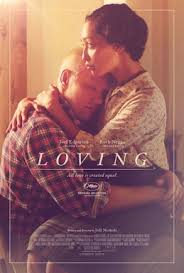
He was the unlikeliest of civil rights heroes. For a start he was white – a taciturn bullfrog of a man, with little education and few words. Long gone now at the hands of a drunk driver, Richard Loving was what many would consider to be white southern trash, hailing as he did from the Commonwealth of Virginia. Loving adored cars, rot-gut whiskey and his Mildred. Only problem was, Mildred was black. In fact, back in the fifties/sixties, Loving was more at home in the company of her fellow coloureds than he was with his own people. Colour just wasn’t an issue for Richard. His own family had a ramshackle property down the end of a tobacco road and when Mildred announced to him, in trepidation, that she was pregnant, he knew what he had to do. He wasn’t dissuaded that it was illegal in his home state – he resolved to marry her and build her a new home on some land he’d been saving up for. He’d wed her in Washington where it was within the law and bring her back to their new love nest. Simple – or so he thought.

And they chose an Aussie to play him. I’ve heard that the reason for the current popularity of our actors in Hollywood is that they come to town ready to roll due to their solid grounding in the home grown industry; that they’re not prima donnas; that they’re never fazed by what’s required of them and they do accents well. Joel Edgerton had worked with director Jeff Nichols previously, in ‘Midnight Special’, so the guy at the helm was well versed in his capabilities. Joel did not let him down, earning a Golden Globe nomination for his portrayal. His co-star did ditto, but went one better in winning. Many felt the Aussie’s performance was up there with Casey Affleck’s in ‘Manchester by the Sea’. I’d beg to differ, but nonetheless it was darn good. His gorgeous Mildred was played by Ruth Negga, an Ethiopian born Irish actress.

Soon after the start of ‘Loving’ we know that Richard has miscalculated – being legally married elsewhere does not change the law locally. The couple are quickly arrested and sent to the clink. They discover that, to avoid a lengthy sentence, they must move back to DC, something that rankles Mildred in particular. She writes to the Attorney General, Robert Kennedy, to plead the wrongness of their situation, setting in motion a process that leads all the way to the Supreme Court. And the rest is history.

It’s Mildred who is eventually the proactive one of the pair; Richard remaining a reluctant partner in the proceedings and refusing to participate in any of them. He also forbids his wife, against her wishes. All of it is left up to the lawyers. It’s during the course of this journey that their humble home, which they have returned to on the quiet, is visited by a photographer from ‘Life’ magazine. Played by ‘Boardwalk Empire’s Michael Shannon, he bonds with the couple and the resulting spread in the magazine goes a long way to pricking the nation’s conscience on the issue. The actors re-enact the informal session – and as the end credits appear, we receive the original up on screen. Its impact is palpable.

Nichols doesn’t over-egg his story; he lets it unfold slowly with Mildred growing in stature along with her confidence. But nothing changes Richard. The scene when he’s overwhelmed by the enormity with what’s occurring with him at the centre is one of this nuanced movie’s highlights. The only drawback for this viewer is that, at times, the distinctive southern drawl is so pronounced sub-titles are almost required. With some of the characters I missed whole slabs of conversation.

It seems that, as they weren’t in the public view as the various court cases in their name took place, history, until this film, has largely forgotten about the Lovings. It’s sad that neither survived to see it reach the big screen, as at least one member from the women who made up the concurrent ‘Hidden Figures’ managed. ‘Loving’ is a tale of a simple love story having profound implications – of ordinary people, through their stubbornness and resilience, changing our world for the better.

Official Trailer = https://www.youtube.com/watch?v=zRXuCY7tRgk