Category Archives: Uncategorized

The Father/Daughter Thing

‘The Soldiers Curse’ ‘The Unmourned’ – Meg and Tom Keneally

Monsarrat is a ‘special’ when we first meet him. He’s a convict who, because of a much required talent, is bestowed upon with special privileges denied his cohorts in chains. Monsarrat possesses a thorough knowledge of legal matters, due to his UK background; has a way with words and a fine copperplate hand – in the days when that counted for something. In Port Macquarie he has aspirations, but before he gets ahead of himself there are those who make sure he never forgets his all too lowly station in life – even if, perhaps, they would be lost in that life without him. But, all in all, his existence there isn’t too bad. There’s Mrs Mulrooney, the camp commandant’s cook, who’s a good mate; as well as there being, somewhere up ahead, the possibility of a ticket-of-leave, but only if he can continue to keep his nose clean. ‘The Soldier’s Curse’ is supposedly the first of twelve planned novels revolving on Monsarrat’s adventures sleuthing around in early Oz. It’s set in the first half of the Nineteenth Century. And the combination of esteemed writer Tom Keneally and his daughter Meg are, with this initial one, off to a ripper start.
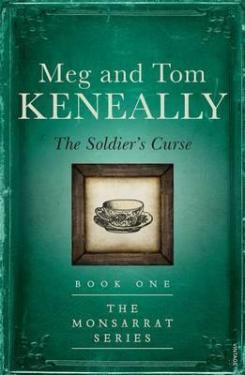
Now I’ve never been a huge fan of the senior writer. I’ve read a few of his output over the decades, but a new release from him is never a must-have. But I had perused some good notices for ‘The Soldier’s Curse’ and with the early years of our founding always fascinating, I decided, when the cheaper paperback version appeared, to give it a burl. I knew, once I started, that I was onto something a little different for me, but it was also something that was going to keep me thoroughly engrossed for the duration. I was soon out buying ‘The Unmourned’, not the least interested in waiting for a cheaper edition further down the track. I am now eagerly awaiting the third in the series. But back to the first.
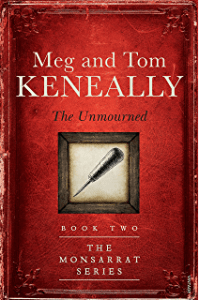
There were very few women amongst the 1500 free and not so free souls at the Port Macquarie settlement during Monsarrat’s time, but of course the most prominent was the wife of the man in charge, our hero’s ultimate boss. But the seemingly virtuous and beauteous young woman is ailing – and there’s more to her mysterious illness than meets the eye. Of course the good (seemingly) and privileged felon and Mrs M are soon on the case, especially after her demise. Perhaps, they discover, she wasn’t so lily-white after all, but why do her in? There are soon a number of suspects with, of course, eventually our dynamic duo sniffing out the real culprit. As a whodunnit, it’s about as far away from airport fare as one could get. The two investigators are also far from daringly heroic and the pace is leisurely, making it all the more to savour. The suspects take some sifting through. Best of all though, this tome and its follow up bring to life what life must have been akin to in early colonial times for all levels of society. We have vicious floggings and violent stabbings in eye sockets as well as sadistic officers. These are countered by a fair share of do-gooders. The system, at its lower level, still provided a modicum of hope that there was a chance to better oneself in a way that wasn’t possible back home in England. There is more of the same in ‘The Unmourned’ with, as a reward for his efforts up on the northern coast, Monsarrat, along with his sidekick, returning to Sydney. Now the focus switches to the plight of female convicts. Just who was responsible for the aforementioned skewering of notoriously evil overseer Robert Church at the Paramatta Female Factory? It all points to Grace O’Leary, a sparky rabble-rouser who, with her guile, has emerged as a leader of sorts amongst those in an olden days ‘Orange is the New Black’ situation. The authorities want her to swing as soon as possible, but they don’t count on a feisty, dogged pair having other ideas.

The Keneallys, in their interviews, have suggested their lead character is based on one James Tucker who, like Monsarrat, was a cut above the average transportee. After successfully applying for his ticket he wrote ‘Ralph Rashleigh’ in the 1840s, giving a fictionalised account of convict ordeals.

I’m excited that the makers of ‘The Doctor Blake Mysteries’ are keen to work their magic on the product of the father/daughter act for the small screen. I am also excited that, at the end of ‘The Unmourned’, Monsarrat is informed that he is again being moved on. Where to, you might ask. Why to our very own once upon a time not so fair island.

Interview with Meg and Tom K about the Series – http://www.abc.net.au/radio/melbourne/programs/afternoons/meg-and-tom-keneally-commit-to-12-books-in-the-monsarrat-series/8388996

Drought in Oz, Drought in Maine The Dry – Jane Harper The Stars are Fire – Anita Shreve

Australia is the land of drought, but one doesn’t usually associate the far north-eastern state of Maine, in the US, with that climatic affliction. But a dry spell, with serious consequences, occurred in the autumn, or should I say fall, of 1947. The land became tinder arid, seeing forest fires break out, soon raging beyond control. 200,000 acres of the state burned, whole towns and half of Arcadia National Park were lost, as were the lives of sixteen souls. 2500 were rendered homeless. The events at Shreve’s Bar Harbor, in ‘The Stars are Fire’, put me in mind of the happenings at Dunalley, in the south of my island, only a few years back. In fact, the scenario the author conjures of the ’47 conflagration with the Holland family sheltering on the beach bought back the iconic image of a mother and her children, attempting to escape from the flames in armpit deep water, under the little Tassie town’s jetty. That family survived; as did Grace Holland and her little ones, but only just. The effects of the drought and the resulting wildfires are, though, the main focus of the novel. Throughout we wonder what happened to her ‘difficult’ hubby. He was on the other side of the town fighting back the flames. Gene was last seen walking towards them as his colleagues fled. Naturally everyone assumes he perished, but no body was found. So Grace gets on with her life as best she can. A caring doctor and a mysterious piano man enter her orb as romantic possibilities – and then the unthinkable happens.

As with all Anita S’s output, ‘The Stars are Fire’ is immensely readable – it should be, she’s been successfully at it for long enough. It’s just not one of her best – it does stretch for plausibility as we wait for what most suspect will come to pass – and it does. That doesn’t mean it rings true.

Sadly Shreve is battling cancer and not for the first time. She trusts she will again beat it, but she was unable to travel to promote this, her latest work. She has been a reading staple of mine for decades so fingers crossed she survives to write on.

Jane Harper, in contrast, has just one novel to her name – but what an impact it has had. It’s won awards, been optioned by Hollywood and published (or about to be) in, at last count, twenty overseas countries. It’s truly a rip-snorter. It is perhaps not the greatest example of wordsmithery going around, but it is a yarn this reader couldn’t put down from get-go to last paragraph. One reviewer likened it to Peter Temple’s ‘The Broken Shore’ or Garry Disher’s ‘Bitter Wash Road’ as this country’s great crime novel of recent times. As I haven’t read these, I’ll throw in Craig Silvey’s ‘Jasper Jones’ or, another stunning debut, Holly Throsby’s ‘Goodwood’. Both are set, like ‘The Dry’ in parched and thirsty country towns.

In Harper’s offering it’s Kiewarra, ravaged by an endless drought, with the local men and women on the land at their wit’s end about how they’re going to make it through till the rains come. One, Luke Hadley, guns down his wife and all bar one of his kids before putting a rifle to his head in a paddock. It’s thought to be a cut and shut murder/suicide – that is until city cop, Aaron Falk, turns up for the funeral of his childhood friend. He starts digging and it all doesn’t quite add up. As far as the locals are concerned he already has a cloud over his head. You see, he too was once a local and left town after another of his former mates, this time a girl, disappeared in mysterious circumstances. It again is a presumed suicide. Before long there’s a whole range of motives and possibilities concerning the two, perhaps in some way, linked events. Our jaded (aren’t they always?) returned policeman tries to nut his way through it all and eventually a culprit emerges, but it’s an enjoyably convoluted process. Just when you think he’s nailed it, up pops another prospective murderer. I must admit I didn’t pick it – but looking back there were clues dotted along the way.

This is a story well told and in Aaron Falk Harper has a protagonist worth a few more whodunits. Her sophomore publication, ‘Force of Nature’, due October ’17, again features Falk investigating the disappearance of a whistle blower. As for Harper, I reckon she will become a real force of nature herself on the Australian writing scene.

Anita Shreve’s website – http://anitashrevebooks.com/

Jane Harper’s website – http://janeharper.com.au/

Kate/Chrissy Willowdean/Julie

Two new gorgeous women have come into my orb – Kate, as portrayed by Chrissy; Willowdean, as conceived by Julie. What links them is the larger side of life. Kate/Chrissy, on the show that has taken America by storm, have rightly emerged as pinup queens for many battling so hard against societal perceptions and the odorous trolls of this world. Now that her series, already scheduled for another two seasons, has commenced in Oz, hopefully she will do the same here. Willowdean/Julie Murphy does the same for a younger and arguably, even more vulnerable demographic, in the wonderfully feel good ‘Dumplin’ – a YA novel recently optioned by Disney with Jennifer Aniston on board. So where Kate is a heroine of the small screen now, hopefully Ms Willodean Dickson soon will become a big screen super-heroine. These two provide one of the upsides of what life can be for those with weight problems and the issues that often come with it – health, both mental and physical; not to mention the difficulties in finding clothing in a popular culture obsessed with the smaller sizes. What’s terrific about ‘This is Us’ on the tele, as well as ‘Dumplin’, is that, whilst the negatives are not shirked, there is proposed the definite possibility of not only keeping one’s head above water, but of finding acceptance and real happiness too.

Chrissy Metz is a marvel. Already a successful talent agent, she yearned to be that person attending auditions, not facilitating them. The 36-year old wanna-be star had already taken on some roles, most notably in ‘My Name is Earl’ and ironically, being asked to don a fat suit for ‘American Horror Story Freak Show’. But with ‘This is Us’ she has really hit the big time.

The product of the US networks has never formed a large part of my home viewing habits, at least in their free-to-air guise. Their generic shoot-em-ups and car chases simply bore me, as do the equally generic ideal types that have the major roles in them. I prefer the more realistic approach of the Brits and to a lesser extent, our own programme makers. So a new American series would be not at all on my radar, but alerted by a critic in the Age as to this being something different and of quality, Leigh and I decided to give it a burl. It’s carried by WIN and both my lovely lady and myself have been hooked on ‘This is Us’ from the get-go – and Kate is one of the many reasons why.

The actress herself, Chrissy Metz, claims to have been, once upon a time, a Kate, ‘…but now I am far removed from that.’ She was, unfortunately and predictably, bullied at school, suffering from panic attacks. Now divorced, she is dating one of the show’s crew, who was her escort during the recent awards season – including to the Golden Globe where Metz and the show both received nominations. She now finds herself in high demand for fashion shoots and whilst Chrissy M accepts who she is, her character Kate still has a way to go. During the show she looks to booking herself into a fat farm and undertaking gastric bypass surgery as solutions. Metz herself states, ‘I am on this journey to inspire people, and to encourage them. We are all deserving of happiness; so (playing Kate)…is much more than just acting…You’re changing lives and opening discussion.’

And she certainly does inspire, as does Willowdean. She, I guess, is somewhat Metz in reverse, accepting herself and her plus-sized body for most of her youthful years, until she came to the roadblock that can be boys. With the complications they bring she loses her perceived confidence and is no longer prepared to take on the world so feistily.

We’re not far into Murphy’s novel when the first of these lads enter her domain. Bo’s one of the school jocks and our Willowdean is so disbelieving at first that he could be attracted to her. She’s turned on by their ‘making out’, but completely shuts down when he tries a little fondling, deducing that her body must be a complete turn-off. It’s clearly not, but so conditioned is she to the fact that the opposite gender would only go for the school’s beautiful, slim types, she starts putting up barriers to his ardour. Somebody should whisper in her ear that there’s no rule of thumb to what young men – or men of any age for that matter – like. Curves and ampleness have just as much attraction to many. Then, to complicate matters, Bo soon has a rival for her affections. Two boys! What is going on?

Before these guys the loves of her life were Dolly Parton, whose advice she tries to live by; her recently deceased, obesity-afflicted auntie and her best mate, Ellen. But when the latter experiences sex for the first time and confides in her, Willowdean, who hasn’t opened up about her beaux, loses the plot in terms of the life she expected to continue living.

Her own mother, although clearly loving her, is nonetheless embarrassed about the daughter she calls Dumplin’. Mum’s a former winner of her small southern town’s Miss Teen Blue Bonnet Pageant and now is running the show. When Willowdean signs up for it, with some other fellow hitherto outsiders from her school, her mother is in a bind. They have to confront their respective attitudes to each other.

It’s such a nice, nice, nice book. We know exactly how it is all going to pan out. But the fact there’s no surprises in store and that the ending is pure saccharine does not detract one iota. It is really the only way the novel can fufil what it set out to do when you think about it. To see Willowdean plough on, largely following Dolly’s advice to ‘Find out who you are and do it with purpose.’ is as inspirational a story as is Metz’s. ‘Dumplin’ is a terrific read for any age-group or gender – but especially for Murphy’s target audience.

Julie Murphy

As actress Ms Metz says in a ‘Harpers Bazaar’ interview recently, ‘There’s room for all of us now – no matter our sexuality, race, body size, gender or whatever else.’ You go girls.

‘This is Us’ on Rotten Tomatoes = https://www.rottentomatoes.com/tv/this_is_us/s01/

Mickey's Trilogy

‘...I loved his smile…I love the fact he never grinned huge cheesy grins, he had a special Elvis grin, and I borrowed that for Patsy in ‘Absolutely Fabulous’ – a little tribute to Elvis

One of the first records that English rose bought when she was growing up was ‘Hound Dog’. The star of ‘The Avengers’ and the anarchic ‘Ab Fab’ has remained a fan till this day. And it was she that had me thinking about Mickey; she who sent me off looking for that CD I knew I had somewhere.

In recent years Joanna Lumley has taken to being a tele-traveller and we have accompanied her on a trip riding the Trans Siberian, partnered her to the Arctic Circle to see the Northern Lights and journeyed alongside her through the islands of Japan from Hokkaido to Okinawa, And due to her love of the guy, last year she invited us to Graceland, too, ‘… on a very personal journey for an intimate insight into Elvis Presley, the man behind the legend.’ This was a one hour documentary screened on Auntie – and very enjoyable watching it was. But this scribbling isn’t about Joanna or Elvis, it’s about Mickey – but the doco, nonetheless, is worth checking out.

As Joanna talked to Priscilla; to the King’s best mate during his school days and to his first girlfriend, the interviews were interspersed with clips of the Royal Philharmonic Orchestra in Abbey Road Studios. They were putting their lush sounds behind the Presley’s vocals for a new release, ‘If I Can Dream’. I suspect the Lumley helmed doco was just a puff piece to publicise yet another rehashing of the great rock ‘n’ roller’s hits. But, whatever the motivation for it, one of the musical inserts in it I knew in an instant because of its bombastic opening orchestration. It was an Elvis classic – a song now forever associated with him. But the tune had its start with someone else, a singer-songwriter by the name of Mickey Newbury.

Fast forward a few months after the airing of JL’s ‘Elvis and Me’ and I’m at my son’s home in Bridport for a quick visit. Richard was proudly showing me his ‘man’s world’ that he is putting together as a bolt hole downstairs. It has a pool table and a large screen television for those games he loves to play to unwind. He was called away and as I poked around I came across my old LPs. Since our respective departures from Burnie, Richard has been the temporary keeper of the vinyl for me – the remnants of a record collection I’d built up before the digital revolution that was once in its thousands. I had retained what I though to be the gems of what I once possessed. A few, such as my original Sgt Peppers, have been passed on to my music-loving daughter, but there they were – Woodstock, all my Jimmy Buffetts, John Prines and surprisingly, a number by Mickey Newbury. They took me back to quite a while ago now when I considered Newbury to be almost the pick of the crop; when I purchased every release of his available in Oz. I loved the sound of his rich voice and the quality of his songsmithery. And I wasn’t the only one who had him up there on a pedestal. Prine himself once stated that ‘Mickey Newbury is the best song writer ever.‘ Flipping through, I soon came across my favourite of his, 1971’s ‘Frisco Mabel Joy’ – that again taking me back to the opening strains of ‘American Trilogy’.

The song was a staple in Elvis’ concerts throughout the seventies, but we owe the song to Mickey. Now if you are familiar with the tune you would realise that it’s not penned by MN but is an amalgam of three traditional tunes – ‘Dixie’ (a black faced minstrel song and an anthem of the Confederacy); ‘All My Trials’ (originally a lullaby from the Bahamas) and ‘The Battle Hymn of the Republic’ (the marching song of the Union Army). So, he had both bases covered then. For ‘Frisco Mabel Joy’ he took the three songs and integrated them – is that what is called a mash-up today? It made a perfect whole.

Obviously Elvis, or one of his acolytes, picked up on it, realising how suitable it would be for his voice, so he recorded it too. But his single only reached 66 on Billboard – Newbury’s had gone all the way up to 26 in ’72.

Of course Elvis, by that stage, had already been a legend for more than a decade – still is today (perhaps even more so). Newbury’s name has faded into obscurity – even doing so in my mind till it came hurtling back recently. It took ‘Elvis and Me’ and a trip to Bridport to make that happen.

It was not only his knack with lyrics that marked the Houston born (1940) troubadour’s contribution to the American music – particularly alt country. Here are a few random facts that help to indicate his sizable legacy;-
1.Very early on in his career he felt stifled by the formulaic recording practices of Nashville, where he had relocated to in the mid-sixties, thinking it was detrimental to his musical output. So he decided to go looking elsewhere – taking the unconventional approach of moving to Madison. It wasn’t so long after he set the precedent that Willie, Waylon and the whole soon to be Outlaw crew did the same – except they headed to Austin. Of course for W and W it was a terrific career move – for Mickey, well he just chugged along on a far lower level.
2. In 1980 he was the youngest artist to be inducted into the Songwriter’s Hall of Fame.
3. He convinced Roger Miller to record Kris Kristofferson’s ‘Me and Bobby McGee’, thus kick-starting KK’s career – another who reached the heights poor Mickey could only dream of.
4. He also convinced both Townes van Zandt and Guy Clark to move to Nashville to hone their songwriting skills – presumably before it jaded him. What pleasure both those guys have given me down through the decades. Both have now passed, but are fondly remembered – can we say the same for Newbury?

Apart from ‘Trilogy’ – which he obviously didn’t really compose from scratch, his songs, with the exception of the Don Gibson hit ‘Funny, Familiar, Forgotten Feelings’, didn’t chart highly, whether recorded by himself or others. But he was a go to man for competent album filler. It’s been estimated that, over the years, about 1500 versions of his songs have been recorded.

But in many ways Newbury was his own worst enemy. Despite thumbing his nose at Nashville he refused to be aligned with the Outlaws, stating that label was ‘… just categorising again, making a new pigeonhole to stick somebody into.’ He had a penchant for linking the tracks on his albums with sound bites thus rendering them unsuitable for radio airplay. And like his disciple, Van Zandt, he was afflicted by depression and addictions.

Until his death in 2002 he made occasional forays back into music, producing stuff that received critical praise but very little in the way of sales. There was no later-life comeback for him, as there had been for others; nor was his name elevated by death. Truly, though, he was an unsung – sorry – hero.

So, thinking of those albums up in Bridport, one recent morning I took to the shed to make a search for the compilation CD I knew I had somewhere. I also intended to do some serious searching for my birth certificate, needed to apply for a passport. The latter eluded me, but pleasingly not the former. I have now played it again, enjoying his marvellous songs all over again.

But there is one way you may have heard of him. One of Waylon Jenning’s best know songs is ‘Lukenbach Texas’. Listen carefully – there’s a line that goes ‘Between Hank Williams pain songs, Newbury’s train songs’. Well, that’s Mickey he’s referring to. He’ll never be completely forgotten while that song lives – but he should have amounted to so much more.

Newbury singing ‘American Trilogy = https://www.youtube.com/watch?v=RiTjElq5Xjs

Newbury’s website = http://www.mickeynewbury.com/

I Don't Like Cricket, I Love It

‘Selection Day’ – Aravid Adiga and ‘The Rules of Backyard Cricket’ – Jock Serong

Once upon a time a tranny had a different definition – short for one’s transistor radio. In days of pimply yore I’d take my tranny with me everywhere. Usually it was tuned into Melbourne radio station 3UZ as it supposedly had the very latest in hit music. On Saturday arvos it would be the local 7BU when the game from West Park would be called, even if I was actually present at the ground. I often was, even in the foulest of weather, with sleeting rain and a gale blowing in from the west. But during the summer months the dial would be on 7NT, the Launceston ABC broadcaster, because 7NT had the cricket. At the beach, playing tennis or down the wharf fishing, the background would be McGilvray telling my mates and myself, in his authoritarian tones, about the action from the WACA, the ‘Gabba or the ‘G. Of course, back then it was only test match cricket. Did NT carry the Shield? I cannot recall, but probably not, as Tassie was still a long way off participating – and also it was well before the Packer schism that introduced ‘hit and giggle’. And don’t get me started on the travesty that is twenty20 – but I guess they both serve the purpose of introducing fresh punters to the game, some of them, hopefully, rising above the short attention spans required for those formats to the more cerebral world of the real game. Of course I jest, but back then I was addicted to test cricket. I have no idea why. My family weren’t remotely interested. Maybe it could have been from the enthusiasm of a pal, but I think it more likely it was the fact that, even as early as those far away days, I was an avid newspaper reader. For half a year cricket would dominate the back page of the Advocate, the local footy for the remainder of the year – yes, local footy, the VFL relegated to somewhere inside.

What ever the cause, by the time Simpson and Lawry were opening for Australia, I was hooked. I subscribed to a monthly cricket mag, purchased books on the history of the game and when not out and about with my tranny, I was fixated on a grainy black and white small screen of the ABC’s very primitive coverage of the tests – that is, compared to today’s whizzbangery and ultra-analysis). Yes! The ABC! Imagine cricket without the ads – what bliss.

So let us fast forward to today then. It’s all changed. It’s not that I have completely lost my love of it, it’s just the time it takes out of one’s life to watch a complete test as used to be the go for me. As my life span becomes shorter and shorter, it seems reprehensible to give up all these hours to focus on a game. My lovely Leigh is no fan, so it would never be a shared pursuit – me valuing so much my time spent with her. Now I simply follow it on a hand held device at intervals, turning to the tele if there’s an Aussie century or hat trick in the offing. Even my former habit of devouring the cricket reports in the Age has lessened. I always loved Peter Roebuck’s assessment of a day’s play, but now he’s gone. And on the airwaves, no more do we hear Kerry O’Keefe’s chortle. It all just doesn’t seem quite the same.

So when I was alerted (firstly by Leigh, secondly by said Age) to that fact of not one, but two, fictional tomes being published with cricket at their centre, off I went to Fullers to make purchases. Maybe, deep down, I was hoping they might reignite the spark in me.

Synchronised publishing dates were not the only aspect the two books had in common. Aravid Adiga’s ‘Selection Day’ and Jock Serong’s ‘The Rules of Backyard Cricket’ both featured the tales of two brothers, the first Indian, the second pair home grown. These cricketing wizards had immense talent as potential stars for their respective countries, but only one brother was seemingly in it for the long haul – the other being too wayward to knuckle down. The Indian book is very, well, Indian, putting the committed sibling to the fore; the Australian one focuses very much on the larrikin brother. Both publications had a fair bit going for them, but as to which won the test, it was the Aussie effort hands down.

And I’m not the only one to hit on the notion of casting my opinion on the two novels in the one piece. Katharine England had the same idea, writing in the Mercury’s Saturday Magazine. She describes ‘Selection Day’ as the ‘messier’ of the two – and I can only concur. She is one-up on me, though, as she has read the author’s other works, most notably the Man Booker winning ‘White Tiger’. She reckons this one is his least ‘coherent’ to date.

Both books start off with the cricketers as children, relaying their battles in the dusty parklands of Mumbai or the backyard of an Altona home. Manju and elder brother Kumar are motherless and dominated by their driven father. He insists that everything else should be secondary to perfecting their prowess with the willow as a means of escaping the poverty cycle. Eventually the boys are ‘sold off’ to an unscrupulous mentor who is attempting to produce India’s next Gavaskar or Tendulkar. The elder of the duo, although perhaps the most prodigious talent, eventually falls by the wayside, but Manju presses on in an attempt to be the chosen one come selection day. But he has another tedious issue to contend with and that is the nature of his sexuality. Will his attraction to another star in the making, this one of Muslim persuasion and attracted to the wilder side of life, be his undoing? And can he wriggle out from under the thumb of his dad and the shady business men who hope to make copious coin if success comes his way? And as in the case of Serong’s tale, somewhere on the periphery is the modern day cancer of the game that will not go away – match fixing.

In ‘The Rules of Backyard Cricket’ it is the younger brother who is at the core of the work of fiction. As it opens he’s trapped in the boot of a car heading, he presumes, to an isolated place of execution somewhere down the Geelong Road. The novel alternates between Darren Keefe’s improbable attempts to escape his predicament with a review of his career to show how he eventually came to be in that dire situation. I suppose, if you combine the more outlandish boganisms of Shane Warne and the talent unfulfilled of Glenn Maxwell, then you have some idea of what the younger Keefe is all about, that is, sex drugs and some rollicking good times. For older brother Wally, perhaps read AB or Steve Waugh – more stodgy at the crease, seemingly able to do what Darren cannot for all his gifts – to dig in in all aspects of life. Wally gets to wear the baggy-green and rises high – but tragedy strikes both brothers. Darrren loses part of his anatomy, which restricts his game, but Wally’s loss is far, far worse. As we follow this tale it seems both brothers are getting what they deserve – but there’s a twist. Hints to it are given sparingly by the author, it is true; but how the mighty fall.

Serong’s first publication was the award winning ‘Quota’. He’ll perhaps never reach the stratospheric heights of Adiga, but it was his rip-roaring yarn I far more enjoyed. It was also my first book of a mint new year whereas the Indian’s was like so many I read in ’16 – plenty of promise but ultimately disappointing – a bit of a slog. Serong’s I eagerly digested in a few sittings as I raced to see how it would all pan out.

So sadly the tests have finished for another year and the Big Bash is in full swing (poor pun – sorry) with the hit-and-giggle about to commence – ho hum. But battling those magnificent Indians in tests on their home turf is another matter. The Aussie won this little affair of the cricket books – I have my doubts whether our lads will do the same on the tour – but bring it on.

Sweet Caress – William Boyd

Biarritz worked its charms on me, as it did on Amory and her lover, Charbonneau, even further back. My visitation was in the winter of 1981, hers in the immediate post-war. I have no recollection of the hotel where I stayed, but I remember theirs, the du Palais ‘…perched on its rocky promontory at the end of the gentle crescent sweep of the grande plaige.’ And I remember, as her lover stated, that Biarritz had ‘…surf, real ocean – not lapping Mediterranean wavelets (but)… spectacular foaming breakers in endless succession.’ It was here Charbonneau took Amory, away from a Paris, still in aftershock from its wartime privations, to tell her he was about to marry another – but, of course being French, that was certainly no reason to end their liaisons. Amory, though, had a secret all her own too. And what of Biarritz for your scribbler? I loved its winter coat; its wild weather, the Atlantic stretching away towards infinity. I made a metal note to go back some day to see it in its summer guise. Three decades and some on that hasn’t happened. I suspect, now, it never will.

sweet caress

William Boyd’s sixteenth novel is a ripper and he’s on song, delving into the life of one of the great photojournalists of last century. Amory Clay is up there with Dorothea Lang, Lee Miller and Martha Gellhorn in recording the momentous events of their times. Amory covered the exotic erotic cabarets of the Weimer Republic with her camera – and got herself into very hot water – as well as the rise of Mosley’s fascist thugs. This resulted in great personal injury, with serious repercussions for her future well-being. She was embedded in the US army as they pushed towards the Rhine after D-Day and was with the GIs as they fought off the Tet Offensive in Vietnam. Here she fell in love with an Aussie war correspondent. She had her final fling with this larrikin.

In ‘Sweet Caress’ we have a goodly number of her photos reproduced, including ‘The Confrontation’ which garnered her the prestigious Matthew B Brady award for war photography.

clay-1

The Controntation

Boyd’s imagining of her life is revelatory. We have her early years, dominated by a war-damaged father who tried to end it all by driving his jalopy into a lake, taking her along for the ride. He writes of her relationship with her other family members – the brother who did not survived WW2; her famous sister, Dido, a concert pianist. As well there were her own progeny – twins, who unexpectedly came along later in life. Boyd illuminates on the reasoning behind her self-imposed exile to a Hebridean island. He uncovers the men in her life and the wherefores of how she ended, by her own hand. her existence on this planet.

Mystery over 'face' of new William Boyd novel as writer reveals star of book is based on photograph of unknown woman found at bus stop.
The Young Amory

Although Clay had never really been on my radar as one of the greats, possibly because, unlike her more famous contemporaries, she never sought the limelight. So we have Boyd to thank for bringing her back into the light. And in doing so he is quite masterful in spinning a darn good yarn along the way so that perhaps one day her name will be as recognised on the same plane as those other female luminaries of the art of photography. But, at the end of the reading of ‘Sweet Caress’, there is still that one lingering question to set one googling.

The author’s website – http://www.williamboyd.co.uk/

The Legacy – Kirsten Tranter

You remember where you were when you heard of them – events so momentous you just know the world would never be the same again. For the Kennedy assassination I was asleep, woken by a teary mother with the sad news. For the death of Elvis, on my birthday I might add, I was enjoying a celebratory sudsy bath, but that soon changed when the radio told me of his untimely passing. With Whitlam’s dismissal, I had just come off class for the morning break when a teaching colleague, heading out to playground duty, imparted the news on passing. For this one, though, I was away from home, helping out on a school trip to the big island across the water. Someone had turned the tele on that morning in the staff quarters just as we were about to go out and wake up the students in their cabins at the Canberra camp-site. That was delayed as we took in the events and the repeated shocking images of the towers collapsing. As we eventually did the rounds, waking up the troops, we imparted the tragic tidings to our charges. I remember on the bus heading south to our next destination, Echuca, the driver had the wireless on a news channel so we could keep abreast of what was happening. Soon the students started ya-yaing for their music tapes, so I was in blackout till we reached the Murray. I felt as though my throat had been cut. Had it occurred today I’d be rivetted to some hand device en route.

So she was obliterated, wasn’t she, on that day? Ingrid had an appointment with her accountant during those fateful hours, either somewhere in the Twin Towers or nearby. After that date, she wasn’t seen or heard from again by those who loved her back in Oz. No remains were found. Gay and ailing Ralph, nonetheless, still yearned for her touch as he had been transfixed by her. He was appalled when she headed Stateside to marry the much older, super-sleek gallery owner, Gil Grey. Too ill to travel, he sent off Julia to do some sleuthing for him. He wanted to know every last detail about her life in NYC before the catastrophic event. What our heroine gradually discovered initially unsettled and confused. Then she really started to smell a rat. As she collected evidence Julia came across some very interesting, if flawed, companions of Ingrid’s during her final days. There’s the decipherer of writing who thinks he knows who that rat may be. There is one of Ingrid’s professors, noted for bedding students and colleagues, who succeeds with Julia as well. And what does the mysterious Trinh, another academic, who moonlights as a dominatrix, know about it all? Finally we have Fleur, Ingrid’s stepdaughter who, at four, was a child prodigy with a paintbrush, only to chuck it all in for the camera during her teen years. The more Julia delves, the more she discovers all is not how it seems.

The-Legacy

‘ Days of Our Lives’ soap it would seem on the surface, but Kirsten Tranter’s ‘The Legacy’ is in another realm completely compared to that mush. To come by the book I was actually reading a review of her latest, ‘Hold’, which seemed intriguing. It began to niggle me that the author’s name rang a bell. I checked on Goodreads to see it I had read anything by her in recent times, but nothing came up. Then, perusing my bookshelves, I discovered ‘The Legacy’ waiting patiently for me to get to it. So, before I shelled out on her third novel, I decided to see if she had potential by reading this her first, published in 2010.

I found ‘The Legacy’ quite masterful. It’s almost impossible to put down as the mystery of Ingrid’s departure deepens. The pacing is deliciously unhurried, all minutiae examined closely. Therefore it’s a slow-burning thriller and all the better for it – a cut above airport fodder I would imagine. Tranter is far more pre-occupied with the inter-relationships between the characters than she is with the bells and whistles of the genre. As Peter Craven, writing in ‘The Monthly’, opines, it also is ‘…full of suave and stunning evocations of Sydney and Manhattan.’ and as an added bonus, he continues, ‘…, this sparkling and spacious novel captures the smell and sap of young people half in love with everyone they’re vividly aware of, and groping to find themselves like an answer to an erotic enigma.’

kirsten t

I am now in possession of ‘Hold’, as a result, as well as seeking out Kirsten T’s sophomore effort, ‘A Common Loss’. They will not linger on my shelves as long as ‘The Legacy’.

The author’s website = http://www.kirstentranter.com/

Young Odessa

Talk about a mutual admiration society. Writing in the Oz, venerable reviewer/’The Movie Show’ host David Stratton opined, ‘I don’t usually like to make predictions…But for once I’ll stick my neck out…Odessa Young will be an international star.’ On radio, during an interview for the ABC, the tender-yeared Ms Young told of her time at the Venice and Toronto film festivals last year. She reflected on the fact that she met and chatted with some of the world’s best known film celebrities, but when Stratton approached her she became tongue-tied in awe. Here, in real life, was the man she grew up with during her fixation on hearing his opinion on the latest of moving-picture releases.

odessa01

Attending two film festivals with her first two movies – what an amazing experience for a mere seventeen year-old. But the actress is no ingenue when it comes to acting. She has had a long apprenticeship in the television industry, most notably as a lead in Auntie’s adaptation, for teens, of ‘My Place’.

The two local products being showcased at the aforementioned exotic locales were both competently made – one considerably more worthy of a film festival than the other, in this humble scribe’s view.

The lesser offering was ‘Looking for Grace’, the better ‘Daughter’. In both Odessa Y could be said to have upstaged more seasoned old hands, such as Richard Roxburgh, Radha Mitchell and Terry Norris in the former. In the latter there was an even more stellar cast including Geoffrey Rush, Sam Neill and Miranda Otto. But whether she’ll be our next Nicole Kidman/Cate Blanchett remains to be seen. But she’s certainly off to a flyer.

odessa02

Sadly, neither of her newly released vehicles seem to be setting the world alight at the box office, although ‘Daughter’ is still in the cinemas and may pick up through word of mouth. It would be a pity for it to not get the bums on seats it deserves.

‘Looking for Grace’ came to us from Sue Brooks, who presented with the marvellous ‘Japanese Story’ back in ’03 – still one of my favs of the local product. Paul Byrnes, Age film critic, awarded ‘Looking for Grace’ a high rating of 4.5 stars, claiming it was as good, if not better, than ‘JS’. Wrong Paul. ‘Looking for Grace’ isn’t within a bull’s roar. Saying that, it was watchable and did have its moments of pleasure – Roxburgh doing his almost, by now, compulsory rumpled/addled shtick, as well as when Norris was on screen. But it lacked the magic ingredient of ‘Japanese Story’ that audiences responded to. It lacked heart. Still, it was Young’s debut and if Stratton is correct about her, that may be enough for it to be remembered and revisited.

‘Daughter’, on the other hand, is a different beast entirely. Novice director Simon Stone, as the great David S also predicts, is destined for greater glory based on the quality of this offering. It’s very much an Aussie take on Scandi-noir – chilly landscapes and life-battered characters. And it’s based on Norwegian playwright Ibsen’s ‘Wild Duck’ – somewhat loosely. The drama is taught, tight and bleak. In a high country timber town, populated by brittle denizens, the local saw mill closing down impacts majorly. As well, some are carrying deep, dark secrets that come to the fore when wretchedly self-centred and alcoholic Christian (Paul Schneider) returns to Oz to attend the wedding of the town squire (Rush). His bride is a much younger woman, his former housekeeper in fact. It’s an engaging turn from Anna Torv. His arrival sets in motion a series of revelations that will tear lives asunder. The climax is almost unwatchable; the ending not at all happy-ever-afters, nor are strands tied up neatly in a bow. This, though, unlike ‘Looking for Grace’, will stay with the viewer.

The-Daughter-AU-Poster

So David Stratton and I will watch Ms Young’s future career with much interest. I suspect he’s right. Obviously he’s made a mark by being mostly right about such matters. And she is very at ease on the big screen, with her performances, particularly in ‘Daughter’, very brave. Worth seeing the movie for that alone. And she is still so very, well, young. If ‘Daughter’ does go the way of ‘Looking for Grace’ maybe Hollywood will come calling and will place her in something to make the wider world sit up and take notice. Odessa Young is the future.

Trailer -‘ Looking for Grace’ = https://www.youtube.com/watch?v=7KboDXLZM3o

Trailer – ‘Daughter’ =https://www.youtube.com/watch?v=TaC-SrFdRZg

BJ and the Scallop Pies

BJ came and stayed awhile. Initially he was a salve to my loneliness as I had missed my lovely lady too much in recent times. We made it a habit to go out and about each day, sampling Hobartian fare and buying up a modicum of its wares. We watched the cricket on the tele, delighted in the adventures of Matthew Evans and his manly mates as they circumnavigated Tassie on DVD and we chatted. With both having had longish lives we had stories to tell – and possibly retell as BJ has camped in the blue room on previous occasions, soothed by the river just across the way. And then Leigh returned to double the joy.

BJ is a monk. Previously, before the knowing of this kindliest of men, I saw such an existence as his quite exotic, foreign and somewhat ascetic. With the knowing of BJ; the tales he tells of it – well, my notions have changed. He passes his years wrapped in adventure and happiness. He possesses a bounteous love of his God and the characters that also inhabit his rich and rewarding life. Like myself, he is also in love with the trams of Melbourne and possesses a copious knowledge of their routes and destinations. He is also friends with my gorgeous daughter. And our little Tessa is besotted with him.

In turn, BJ is besotted with Tasmania’s culinary delight – the curried scallop pie. So together we two, sometimes three, amigos set out to find the best of the delicacy that our city, as well as its environs, has to offer. The quest took us far and wide.

According to the good monk, the not so humble pie has to have:-
1. Good pastry, flaky and golden.
2. A curry gravy that is smooth and not glutinous.
3. Tender scallops – nothing worse than over-cooked ones.

We started our search at the little Frenchified patisserie in Claremont’s Village Shopping Centre and concluded it at Franklin’s Petty Sessions Café. In between were offerings from the Bakery in Salamanca Square, the Magnolia Café in Moonah as well as from purportedly the home of the scallop pie, if somewhat incongruously, the Ross Bakery. At the latter, the sky was foreboding over the village, the wind icily chill for late spring so it was perhaps this pie that was the most welcome of those that were sampled – but was it the best? For a time there BJ thought it had won the day, but he had yet to taste that offered by the eatery on the Huon River. At Petty Sessions the proud waitress, who was a great spruiker for her establishment, beamed as my friend pronounced it was the superior treat – the best to be had to date. According to our peruser of fine pies the pastry top was superb, the curry as smooth as could be and the accompanying relish the perfect adornment. Just quietly, my warm duck salad went down a treat as well.

SONY DSC

BJ claims that, when he attempts to describe the joys of the Tassie creation to his big island associates, he receives reactions ranging from a shaking of the head in bemusement to outright open-mouthed aghastment akin to one’s first reaction on hearing of the existence of Adelaide’s pie floater. And he has even rung a radio station to defend our little pie’s honour after a shock jock had dared to diss it to the world; to decry that it was such a travesty it must be urban myth. Yet word is spreading. Droves of mainlanders are seeking these crusty temptations out in the alleyways of Hobs and the surrounding byways.

But BJ’s time with us was not just centred, food wise, on the pie. The crumbed variety of the shellfish at the Crown Inn, Pontville also received his accolades as did the generous scallop kebabs at the Island Markets. Outside of the molluscs, with the ploughman’s lunch at the Coal River Farm, Cambridge Road our roving gourmand rediscovered the seductive runny thrills of our local brie. Above Granton, at Stefano Lubiana’s new osteria, our man tried a rustic lunch of smokily home-cured deli meats and fruit loaf – it was as delicious as it was engagingly arranged on the plate. We celebrated that evening with a bubbly from the establishment purchased at the cellar door – it was divine. Oh! And yours truly would like to mention a pie too – of the delicious wallaby variety to be had at New Norfolk’s Patchwork Café.

SONY DSC

‘Why does he have to go home, Mummy? Why?’ asked the little one with trembling chin. Indeed why? Now a day later it feels that part of the furniture is missing. There’s a hole there that will take a time to fill. Whether it’s the berating of the Kiwis in their callousness for aiming at an injured bowlers broken foot, the praise heaped on the more humble fare offered by our abode’s two chief cooks, the pleasure taken by the many ‘likes’ he receives on FB for a culinary snap or his delight at the overly inquisitive nature of MONA’s resident duck, BJ, we are missing you. Your visitation was thoroughly enjoyed by all. And the lasagne and paella BJ? Heavenly.

Come February the little family, accompanied by a grey ageing grandfatherly figure, will journey to the city across the water and we will meet up again with Brother James. Your scribe is hoping for a few extra days of travel on some of those tram routes, yet to be investigated, in the knowledgeable one’s company. Brother Jim is my Leigh’s cousin and my valued friend. We know it’ll be another year or so till he visits our shores to continue his search for the holy grail of scallop pies. He will again bring to us so much love. And he brings with him the goodness of a true man of his calling.

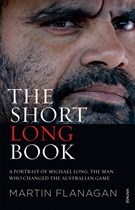
The Short Long Book – Martin Flanagan

I think of him during another year of tribulation for his club – blessedly not my club, but any club that has had to go through what this one has damages the game I love so much. This individual I think about is as competitive as they come. He crossed over just before the shit hit the fan. Deep down, I wonder what he thinks now. He knew the window had closed at his previous club – one that had come so close, but yet had fallen short at the final hurdle. Soon it was headed for a stint of cellar-dwellering, despite his best efforts. He wanted so much for the ultimate. It looked a seriously stronger list where he opted to head to. Guided by a canny coach, a former champion of the outfit, they were on the up and up, starting to look the goods – or so he reasoned. Now, a couple of seasons in, there is no let up from the pain some might say that this mighty club has inflicted on itself. It just goes on and on. The players, for the most part, have been stoic and loyal, despite the testing times. The captain, as courageous and straight-talking as they come, has admitted that a recent injury, seeing him off the field for the long haul, came as somewhat of a relief. There is debate as to whether he will continue on carrying the load, such has been the pressure of the messy affair. And the player I am thinking about, looking at his old team, under a new coach who is building them back up and now possessing a list full of talent, in his more reflective moments, must be shaking his head. Yet he will suit up and go into battle week after week for his new employer, still giving his all because that is the way he is made. But along with his colleagues, be must wonder if there will ever be an end to it – will it all eventually be too much and the grand old club will be bent and beaten. He says the right adages to the media and works frenetically on the field to paper up the ever widening cracks, but how long before it all comes tumbling down around him? It’s another bitter winter for the Bombers. There is no greater test of his or the club’s character.

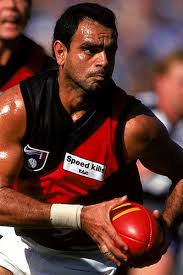
And then there’d be Longie. He is a hero from another football age – and still a hero today, even if his playing pomp is far behind him. His era was a time before footy became a corporate game, massaged to suit the big end of town and the demands of a voracious media. Some claim the core fans have been forgotten and the spectacle is but a mere shadow of its former self – but I would disagree vehemently with the latter at least. Longie knows that it has all changed, but for him, a servant of Essendon in his playing days still with strong ties, he had a different battle to fight. In many ways he is still fighting it. He is inscrutable, but he too must be bleeding for his beloved club, as well as for a coach/father who is back there to lend a hand; to see if a wise old head can help drag it back from out of the mire. It’s not his fight though – Sheeds can have it on his own. It’s not that he is not up for a job, but he has stood tall in the past on another issue and that particular journey is the one he feels he needs to see to the end. And as we have seen in recent times, with all the brouhaha over the Adam Goodes debacle, there is still much to be done off the field. Back in the day, with Sheedy at his side, he changed attitudes and made our indigenous game a safe haven for indigenous sportsmen, a place where they can display their magic for our collective wonder. We are all in thrall of what the Jettas, the Franklins, the Ryders and the Riolis bring to the table for our fantastic sport.

One of our leading writers on Aussie Rules, Martin Flanagan, took Michael Long on and has devoted a fair amount of time over the last decade trying to pin him down so as to construct a linear biography. It hasn’t worked. He failed. It was impossible from the get go – as impossible as it seems to be for Longie’s team to extricate themselves from the bogey-man that envelopes them today.

short long

What we have, instead, is ‘The Short Long Book’ – a lovely play on words to describe an equally lovely product. And it is that perhaps with this factual novella-sized work we get to the touchstone of the man better that a more traditional hagiography would ever do – for that is what a biography of this man could not help but be. For what he’s done and continues to do he is universally admired – including by Flanagan, such a capable renderer of words. Nicky Winmar may have provided the photographic symbol, but Long provided the story and the grunt to get it done. He was a black man who took that long walk to change perceptions – and he took the nation along with him. At its termination he told a nay-saying Prime Minister a few home truths.

In telling the yarn of how he failed to pin his elusive quarry down, the author has come up with a mini-gem. There are yarns within the one great tale too, dominated by the time Michael L took Flanagan into the desert lands and the Top End of his people so he’d understand more. It is also the saga of how MF became the Great White Hunter to Longie and his mob. In such tales, tall but true, we are given a hint of what makes such a mesmerising subject tick – one that, despite his elusiveness, is an out and out hero.

Flanagan, Martin

Martin F tells of how a Longie would relate to him a story, but the telling could take several years to complete as he would deliver it one sentence at a time. The book is brim full with tellings of these wonderful stories. There’s the young Longie sleeping regularly on his mother’s grave. At a similar age he found all his belongings on the family lawn when he dared to float the idea that his future lay with basketball rather than Aussie Rules. He got the message loud and clear on that one. And there’s………well there’s plenty more, but it is a short tome. Better you go out and purchase your own copy. But, just to pique interest a little more, in it you will find a hilarious description of the great footballer’s running style, another of Dermie’s infamous shirt-front of Paul Van Der Haar and best of all, there’s the magpie goose.

The nation will remember the Essendon star for his ‘Mandela’ year, 1995. To his credit, the villain of the piece, Collingwood’s Paul Monkhurst, now stands alongside Michael Long as an advocate for racial tolerance. At that time, when the black man he targeted with his racial tirade reacted by standing up for a principal and telling us all it would, from now on in, definitely not be left on the field on that day nor any other. He pointed out where we were all failing; he pointed us towards a better tomorrow.

long01

Unlike many commentators, I refuse to concede that our game has lost its soul. In recent days we have only to look to the footy family’s coming together over the death of a coach who went before his time; as well as for a champion’s sister passed before hers. I also know that the great club of Michael Long, Kevin Sheedy, James Hird and countless other legends, as well as now a player who seeks grand final glory for himself, will rise to the top again

long02

The Long Walk website = http://www.thelongwalk.com.au/Home