Category Archives: Photography

Wave

The surfing miner felt unfulfilled. Sure, there was great money to be had underground digging out what is so vital to the nation’s financial health, but now he was grounded from both his passion and his work place – one on the sea, one in the bowels of the earth. He needed something to take his mind off the damage done to his right knee that would leave him incapacitated for six months. His brother and sister were both fortified with their engagement in artistic pursuits, so he looked to that area for inspiration. He picked up the expensive camera he had treated himself to a while ago, then had put aside due to time constraints – now he had no such excuse. Gradually an idea took hold and he clicked on to the ether to see if he could make it pan out.

ray collins

That was back in 2007. Fast forward to to the present day and the thirty-two year old, on the basis of what he taught himself to do back then, has seen his skills taking him all over the world – even to dipping his toe in minus twenty degree water off the coast of Iceland. He now combines his first love with this recently discovered expertise to win accolades and awards world-wide, as well as a handy amount of pocket money.

I initially encountered Ray Collins one Saturday morning, earlier this year, on opening the Weekend Magazine supplement of the Oz. Within there was a quite stunning photograph that took me away from a disappointing Tasmanian summer to a place where I know the weather is blissful in all seasons. Fusing glistening water and a bright blue-hued sky, the snapper had captured a gloriously perfect wave in the instant before breaking. And through its tubular pipe we get a glimpse of a coastline fringed by sand, pine trees and Coolangatta towers. I took to my laptop to find out more about the obviously talented creator of such an image.

ray cillins coolangatta

During his time away from the coal seam and riding the white horses of the sea, Ray discovered that he was quite the camera-smith once he mastered the intricacies of his rediscovered purchase. But now it came time to find out if the theory of his nub of an idea could be put into practice. Maybe in doing so he could match his siblings and produce works of beauty too. He has done that in spades, but it wasn’t easy. First he needed to outlay some cash, not a small ask when he was on half-pay, to see his vision realised. For three thousand dollars he purchased himself a housing unit – all to take his camera to sea.

The tough going didn’t end there. Although technically he was the match for any other surf-snapper, there was nothing in his photos that stood out from dozens of other practitioners. He needed an angle. He decided to break away from the convention of man’s (and woman’s) mastery of the breaking swell. He resolved to focus on the wave itself – its ‘…textures, colours and purity.’ He wanted ‘anticipation’ in his product – and he worked at it till he achieved that aim. He attained his goal. Surfing magazines more readily came to pick up his depictions and eventually he came to the notice of the guru of his art in the States, Larry Moore, who took him on by awarding him one of his prestigious mentorships – the first Australian to be thus honoured. He was set.

ray collins

Following on from that, he has won just about every gong going in his field and he services a list of international brands as long as your arm with pictures for their advertising – Qantas, Red Bull, Apple, United Airlines just to cite a few. Each day he has to sort through several hundred emails, all clamouring for permission to use his work for a multitude of purposes.

Attached to this, though, there are two rubs. The first is that he still works away at that coal seam. Despite his international repute, income from his output with the camera is still fluky and he needs the stability of a regular wage in his life. He is not one to go simply where the waves take him.

Rub number two? He will never see his images the same way as you and I do. Ray Collins is colour-blind.

Ray Collins website = http://raycollinsphoto.com/
Joe and Douglas

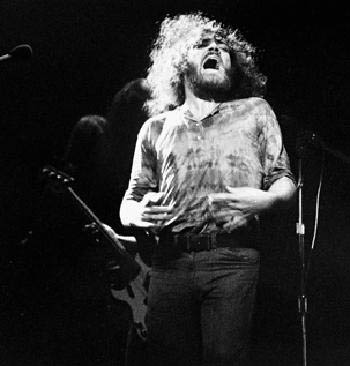
He’s gone now – but he has been captured for all eternity a thousand times over – in voice, the moving image and in photographs. It is Douglas Kent Hall’s take of him with the latter I love. It’s of Cocker in his prime, his mouth open in guttural growl, his hands poised in the spasms that came to be the idiosyncrasy most associated with him – his stage paroxysms. Of course we cannot see his jerking in all its glory – in Hall’s image they’re inferred, just as the monochrome infers all about the man in his pomp – the Woodstock Cocker, the ‘Mad Dogs and Englishmen’ Cocker, Cocker in the period he used to confess he could never remember, so strung out was he in his golden age. So legend goes, during this time his mother, in sorting his laundry, found a cheque in his pocket for a cool million or so. When she asked the obvious, he had no recollection of the person it was from nor what service he had rendered to earn it. Sadly Cocker and that voice was lost to the world last year.

hall cocker

And what of the man responsible for this image, as well as so many other memorable ones of the gods and goddesses during rock’s wild years– what of him? Well he preceded Joe to beyond the silver lining by six years, but he too has left us with an indelible legacy.

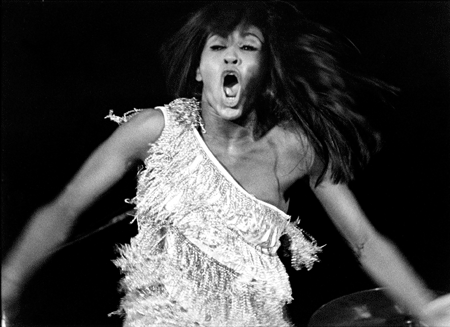
Of course, for me, it is all about those rock photographs. They include multiple takes of the Lizard King, Jim Morrison, some of which are legendary. But none the less atmospheric are his stills of Hendrix, Tina Turner, Daltry, Jagger and so on – you name them – he snapped them.

tina

To Americans Hall is also revered for his shootings of ‘real cowboys’ – those that, ‘…as opposed to urban cowboys, drug-store cowboys, rodeo cowboys, or movie cowboys, stay on horseback all day long working cattle.’ (Mark Strand). But Hall himself didn’t knock the rodeo cowboy. – in fact he lauded them, both in word and image in publications such as ‘Let Er Buck’ and ‘Rodeo’. He had a love of this form of ‘entertainment’ since his childhood days growing up in Mormon territory, Utah – although he didn’t abide by that latter persuasion. In the eighties he finally settled down in one place – that place being a small hamlet in northern New Mexico. Prior to that he had roamed the world on assignment once he’d established his credentials. These took him on photographic journeys that were outside the realm of music and cowpokes. He travelled the West pointing his camera at the US’s indigenous tribes. Then there were the body builders such as Lou Ferrigno, Lisa Lyon and Arnold Schwarzenegger when they were in peak condition. After his constant wanderings were over and he was finally semi-stationary with his second wife, he took to photographing the churches of his local region, before travelling to South America for two iconic portfolios – the miners of Minas Geras in Brazil and Peru’s Zen ghost horses. He also had a spell in St Petersburg, capturing Russian life.

bert_ancel

As if all this wasn’t enough, Douglas KH was an exponent of various martial arts and a well read novelist – his first employment on leaving college being a teacher of creative writer.

But it’s his early photographs, his rock oeuvre that I am fascinated by. He commenced these way back in 1968 with a move to London, continuing his own fascination in NYC in the early seventies. These images he published in collections such as ‘Rock: a World Bold as Love’.

As with Hall and his photography, Cocker took his music into the new millennium. He’d had sporadic hits later in his career such as ‘Up Where We Belong’ and ‘You Are So Beautiful’, but nothing to match his earlier Beatles covers, ‘Delta Lady’ and ‘The Letter’. He had some great later albums too, such as the gloriously evocative ‘Sheffield Steel’, but could they match ‘Mad Dogs…’ or ‘Cocker Happy’? Joe, though, for this punter will forever be that belter of songs that Hall perfectly captured, sweat and spit flying, face and body contorted – gravelling it out from some repository deep inside with every ounce of effort his mistreated body could muster.

joe_cocker_close

A portfolio of Hall’s images = http://www.photographersgallery.com/by_artist.asp?id=173

Florence, Maude and Camille

Florence. I didn’t think chasing this image through the ether would end up causing me to run slap bang into Florence – but there you go. We all know Florence – Florence Nightingale, the Lady with the Lamp, the heroine of the Crimea, the godmother of nursing. Most of us, with only the merest knowledge of history, would know those details of her. But delve a little deeper and there is much more of interest. She was an early advocate for feminism, but not quite in the way one would suppose in these modern times. She believed that it should be male driven, rather than being championed by her own gender – women, such as those pesky suffragettes, had no business meddling. Still, she used her influence to improve the lot of her gender. She was also a dab hand at the old mathematics and experts have concluded that she was almost certainly a virgin till her dying day in 1910. From her time tending to wounded troops till the day she passed she was invariably in fragile health – and as she aged, so the amount she was bedridden increased. At the end she was glued to her London bedroom, but before she left this world an unlikely event occurred – an event that links her with that photograph sent on to me.

This image also led me to Maude. What a stunner! Even by today’s standards she’s a head-turner, an exquisite beauty. Look at her face, framed by the voluminous locks popular at the time. Wow! This gorgeous woman was born Maude Mary Hawk in Memphis, Tennessee – a long way from the Crimea or London, in 1883. Her folks had a theatrical bent. It wasn’t too long before she became better known to the world as Maude Fealy – star of the stage and for a time, the silver screen. She featured in eighteen silent movies between 1911 and 1917. But treading the boards was her first love. As well as performing in plays she also scripted them. There is evidence she also invented the first wheeled travel luggage – but even all this couldn’t save her from a troubled marital history and she bore no children.

Maude_Fealy_by_Lizzie_Caswall_Smith,_ca._1901

But let’s take a step back to Fealy at the turn of the century. Now look again at the accompanying sumptuous image of her. It happens that between 1901 and ’05 Maude made several tours of the UK. She acted for companies that were prominent at the time, such as those under the auspices of William Gillette (for whom she performed in an early production centred on Sherlock Holmes as hero) and Sir Henry Irving. And it is during this period her paths crossed, indirectly, with Florence and Camille.

The latter was born two years later than Maude in another faraway location, Antwerp. And it was her image that started this whole process. This was dispatched to me by my writerly darling daughter with the words, ‘Here Dad, see what you can do with her.’ And she certainly piqued my interest – just look at that hair! Her investigation resulted in the coming across of that other damsel, as well as the redoubtable Florence. I do wonder if Ms Fealy and Camille crossed paths – perhaps they even knew of the other.

In the early 1900s Camille managed to win $2000 in a magazine contest. This, in turn, led her, by 1902, to also becoming a popular actress, performing tours of the US – and later the UK. And here comes the rub – the linkage. In London she paid a visit to the same establishment as our Maude.

But first things first – back to that couple of grand – a tidy sum in those days. That takes us to a gentleman by the name of Charles Dana Gibson – his surname may give you, dear reader, a clue to her claim to fame. If we add that this gentleman was also an illustrator may help enlighten as well. Gibson loved drawing the women of his era – women with largish bosoms, slender waists and ample posteriors – and disporting thems in the latest fashions. The woman thus portrayed would be calm in a storm, sporty, independent and confident – and of a mental make-up that definitely would not lead her to embrace the suffragette movement. These creatures, both on the page and in real life, became known as Gibson girls. Gibson himself felt that his creations should be equal partners in any relationship with the male – but always a teasing, coquettish equal. She would be inspired by such luminous beauties of their times such as Evelyn Nesbit and Mary Astor – but soon, in the public’s eyes, all others would be overshadowed by our statuesque Belgian delight – Camille Clifford. With her high coiffure and elegant gowns, wrapped around an hourglass figure, once she attracted the judges’ eyes and won that competition for the best real-life miss to represent the ideals of a Gibson girl, she became the model for their creator’s vision. In this Camille was in two-step with Mary Pickford. What esteemed company.

camille clifford

So sometime, in the period under discussion, both Maude and Camille, during their Old Blighty tours, were chaperoned into the Gainsborough Photographic Studios at 309 Oxford Street to have their beauty captured for all time by its proprietor, Lizzie Caswall Smith. From her sessions with this talented duo, and numerous others, hundreds of post-cards would be produced – huge money-spinners for above and below board professional camera pointers in their day. Lizzie was one of the best in a game – a game largely dominated, as in most areas, by men. Celebrities of those Edwardian days flocked to her premises. Lizzie was a woman ahead of her era, but, contrary to the ethos of the Gibson Girls, was also a strong supporter of suffrage. So there’s the tangible link between Camille and Maude – but what of Florence?

In 1910, for a very rare occasion, Lizzie left her studio for an assignment. And with it our tale comes full circle. She travelled a short distance from her base and set up her equipment in that afore referred to bedroom of the now close to death Florence Nightingale. We are not sure why this came to pass, given the subject’s hatred of posing for the camera. She was also, in her later years, gun-shy of publicity. The resulting images have only recently come to light, having remained all the intervening decades in the care of Lizzie and her descendants. The camerasmith, having retired in 1930, died in 1958. Lizzie once confided to a friend that her time with Florence was so remarkable that, ‘I shall never forget the image.’ And now this photograph has become famous in its own right, be it as it was taken just a few days before the iconic figure’s last breath.

flo-bed_

So my gratitude goes once again to my dear Katie for her supply of another enticing image, leading me to a fascinating journey of discovery through the ether. The only disappointment in the whole process was that, about Lizzie herself, I only encountered scanty information and no portrait. I guess back then selfies had not been thought of. It’s left me wondering ever since.

YouTube tribute to Camille Clifford = https://www.youtube.com/watch?v=XmdJvyuCWIc

The Story of the last photograph of Florence = http://www.telegraph.co.uk/news/uknews/2776782/Rare-photograph-of-Florence-Nightingale-for-sale.html

Snapper in the Age of Mad Men

He thought to himself as he entered Romanoffs, a noted hangout for Hollywood’s acting elite, camera at hand, that he’d recognise those four backs anywhere. It was New Year’s Eve, 1957. One of the quartet, the dark debonair one with the signature ‘tache, swung around to face the door and spotted him; then beckoned him over with the words, ‘Hey Slim – just saw your latest movie. I wouldn’t give up taking photographs just yet old friend.’ On that, the other three also turned away from the bar to see who their colleague was joshing at. They soon broke out into broad grins when they espied the butt of the good-natured barb. Of course Slim wasn’t going to miss the opportunity to take a snap of the four men at their sartorial best for a night on the town – these four gods of Tinsel Town.

‘Let me buy you a drink fellas, down payment for that photograph I just took. You never know, if my editor likes it, you might see it in next week’s new issue. What’ll it be? The usual?’

And yes, his editor did like what he saw. It was duly published – now it’s synonymous with the name Slim Aarons. It was filmdom’s old guard in their pomp. Their lustre would shine on for a little while longer, but a new decade would see them dead, or usurped by the young Turks Slim’d go on to photograph as well. The planet was on the cusp of change and it would come roaring down on the industry, taking away the old studio system, liberalising censorship. Dressed in white tie, in the late Fifties these were the ‘Four Kings of Hollywood’, as the iconic image became known – Clark Gable (the joker), Van Heflin, Gary Cooper and James Stewart. There were none bigger in the business than these dudes.

Kings Of Hollywood

There was a reason for Gable’s jibe. Slim was always hanging around film sets, hoping for another of those magic moments that fed his career. Everyone of note knew Slim. He was one of the good guys. The stars regarded him as one of themselves and treated him as such. They knew he was discreet in an age before our own one of paparazzi and minders. He’d look out for their interests and they trusted him. Occasionally, when someone was needed for a small part at the last minute, well, as Slim was on set, he’d often volunteer. After all, that’s all he wanted to do as a kid. He’d always imagined himself in front of a camera, not behind. His bit parts were never credited, but his actorly friends would recognise him in this film or that and rib him. And he didn’t look like a total idiot, nor did he ham it up hoping to be noticed. He just said his few words and went back to the sidelines. Some of his pals reckoned he was the dead spit of his mate Jimmy Stewart – at parties, where both attended, Stewart would often fend off unwelcome attention by claiming he was just a photographer – that there was the real Jimmy S (in fact Aarons) just standing over by the wall. ‘Why don’t you go on over there and introduce yourself? Say Slim sent you.’ Slim liked Jimmy immensely, despite that.

And he was, very slim – thus the moniker. He was born George Allen Aarons in the Big Apple, in 1916. He had his start, so the story goes, when he was given a Box Brownie. He’d take to staking out stage doors, snapping the stars as they left. He’d then send the images in to their agents, ask them to get the subject to affix autograph, then return it to him. Most didn’t bother, but some did and for a while he had a nice little earner going. He so wanted to be them, to have his name up in lights, but then came the war and that changed everything. He inveigled his way into picturing the conflict for the folks back home, by way of a Life magazine contract. This carried him into contact with other greats in his artistic vocation of the period – men such as Man Ray and Cartier Bresson. Despite winning a Purple Heart for bravery, Aarons is reputed to have quipped, ‘Combat taught me one thing – the only beach worth landing on was one decorated with beautiful semi-naked girls browning themselves in a tranquil sun.’

After the war Life kept him on and he soon found his niche taking images of the rich and famous in their natural habitats, usually awash in said sunshine. He travelled everywhere, following the jet-set from Palm Springs to Monaco. He didn’t take too many shots that were posed – his were usually ‘in situ’, or made to look thus. There’s the favourite one of mine, featuring the most photogenic woman of the era. No need for a name – we all know her. She’s in black lace stockings and red, satiny night attire. There are twin beds featured – a double might suggest unhealthy connotations – and the whole room is covered in piles of her fan mail. Slim professed to love her. Many did. She had that special something – still does.

Fan Mail

It is recorded that when he’d arrive at a pool party or a beach, young women, on recognising him, would immediately remove their tops to expose their breasts. They figured if they were ‘noticed’ in one of his photos, then someone in a high place may ask certain questions and they’d be on their way. Sometimes he’d snap them, sometimes he wouldn’t.

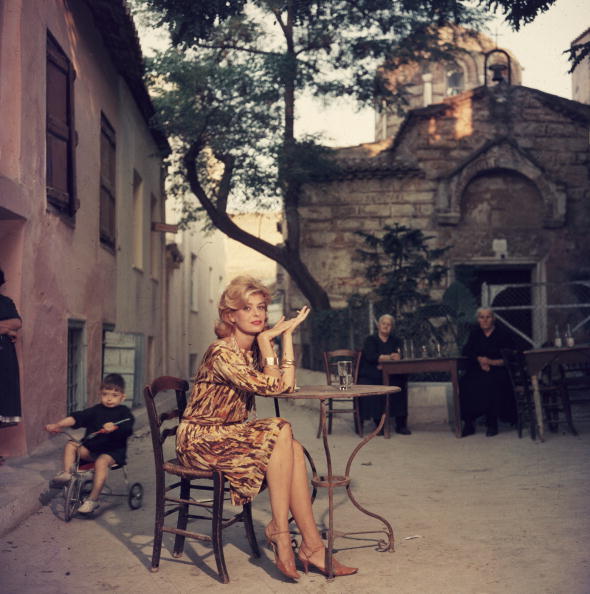
He liked his product to convey a story. There’s the yarn about the photo he captured of a sultry Melina Mercouri, sitting at an outdoor cafe. There is a child about to pass her, pedalling on his tricycle. On showing her the image before sending it on, the Greek goddess pouted to him, ‘Does the boy really have to be in it?’ Slim’s response was that the lad was the important feature of the image, not her – for with the young fellow there was a the story. There was none with her alone

Melina Mercouri

Eventually, as the sixties wore on, the old ways gave way to the new, but the photographer moved with the times and remained relevant. If we look at his portfolio from this later era we are reminded so much of the television series about a certain advertising agency that has so captured the public’s attention for the last decade or so. We could quite easily imagine Don Draper or Joan Harris disporting themselves in Slim’s oeuvre. Sadly ‘Mad Men’ is preparing to leave our screens, but the show has bought Aarons back into vogue. New books are being published about him, exhibitions of his classics are being held. There are plentiful examples of his work online as well – do check them out.

But in this day and age the like of a Slim Aarons no longer exists – the paparazzi have changed the notion of celebrity photography forever. The ease that existed between him and those enveloped in fame belong to yesteryear – but his work is still as fresh as tomorrow.

Slim Aarons’ On-line Gallery = http://www.photographersgallery.com/by_artist.asp?id=2&per=40&i=9

More Aarons =  http://www.gettyimagesgallery.com/collections/archive/slim-aarons.aspx