Category Archives: Book Reviews

A Blue Room Book Review – Sarah Thornhill – Kate Grenville

.SarahThornhill

Whereas Henry Reynolds and James Boyce are in the process of putting the meat on the bones of the factual storyline for the Frontier Wars of this country, it is novelist Kate Grenville who attends to the fictional counterpart. The conflict’s earliest incarnation, the Hawkesbury/Nepean Wars, formed the background to her first book in her trilogy, ‘The Secret River’. ‘Sarah Thornhill’ is the third instalment. Presumably the ‘goings on’ referred to in this, the tome under review, was the Bathurst War. Grenville’s latest publication pales somewhat in comparison with the remarkable ‘The Secret River’, as well as being less satisfactory than ‘The Lieutenant’ – the second volume. How could it be otherwise? ‘The Secret River was quite ground-breaking as Grenville thrust the issue to the fore of something that we in Oz, for a hundred years, preferred to sweep under the carpet. There have been some failed attempts to turn her opus into a film, but more successful has been an adaptation for a stage production. Funding for a television mini-series was announced last year, to be made for the ABC. I’ll eagerly await that. ‘The Lieutenant’ was a thought-provoking embellishment of a verifiable relationship between a young British officer and a First Australian girl.

‘Sarah Thornhill’ adds another layer to the black versus white trajectory of the early days of European settlement; that being how those first born of mixed parentage fit into the narrative. To some degree these inter-racial offspring were the result of the initial tolerance, from both parties, that existed for a brief period after the arrival of the invaders. Overwhelmingly, though, it was caused by the forced sexual activity white men, deemed as right, expected from the ‘native’ women. This was our nation’s American Deep South travesty as reflected through ‘Roots’, ‘Mandingo’, ‘Twelve Years a Slave’ et al.

William, the ‘hero’ of ‘The Secret River’ has, by the time Sarah emerges from childhood, remarried to the loving but domineering Ma, finely tuned to the social mores of her day. Those tainted with the stain, including the senior Thornhill, as befits their past, could be somewhat more inclusive – to a point. William is haunted by his actions in the first of the printed threesome, set on the Hawkesbury, during the first genesis of the conflicts after white occupation. He is reasonably considerate of Jack Langland, a pioneer in the early cross-Tasman trade and the forging of links with the New Zealand tribes, despite his parentage – that is, until Sarah, blossoming into womanhood, decides he’s the one for her. Ma comes down like a ton of bricks, with Pa thinking it is best not to rock the boat where his wife is concerned. During this period the family suffers double tragedies. With Sarah forcibly convinced to realise that Jack is a non-starter, she turns her attention to what is ‘correct’, settling for second best. All through Grenville’s pages are mutterings of dark happenings beyond the ranges where the governmental ‘line in the sand’ is drawn. Beyond this whites are forbidden to penetrate. Naturally hat that notion was unable to be policed, as Boyce in ‘1835’ so ably draws our attention to. Settlers were hungry for land, the First Australians desperate to repel their inexorable advance, so our own version of the Indian Wars of the Old West soon ensue. As Tim Flannery recently inquired, why are not the Aboriginal resistance leaders held in as high esteem as their First American counterparts?

That ‘Sarah Thornhill’ does not measure up to its two predecessors in no way tarnishes Grenville as her usual skill is present in putting together a sustainable, easily devoured page-turner. It brings to life a once neglected period when a few isolated coastal communities began to spread their wings and contemplate excursion into the interior. The only major quibble I have is a truncated denouement, a seemingly cursory winding up which could, in turn, signal there is more to be told of the Thornhills. As a title ‘Sadie Daunt’ has a good ring to it Kate!!!!!!. I, with no doubt many others, would hope that the journey into our now distant, in white bread Aussie terms, past continues on.

GrenvilleKate1

Kate Grenville’s website = http://kategrenville.com/

Tim Flannery speaks out = http://www.smh.com.au/national/tim-flannery-in-call-to-honour-aborigines-killed-in-land-wars-20140117-310dg.html
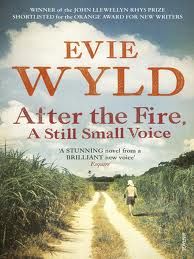
A Blue Room Book Review – After the Fire A still Small Voice – Evie Wyld

wyld

Women. Will they ever be understood by the male of the species? They’re mysterious, beguiling creatures – so easy to love, with most of my gender in complete inadequacy when coming to grips with their feminine psyche – with this only adding to their allure. I am permanently in thrall of the women in my world. I find them easier to talk to than most men as they have endless topics of conversation, not just footy, cricket and when at a loss, the weather. I love being in their company. My own special one is a gem, but even after all these years of being hopelessly besotted with her she can still surprise. Could I write a fictional account centred on one? I have my doubts. From memory, in all my scribblings, there’s only one that has a woman at the centre – (http://blueroomriversidedrive.blogspot.com.au/2013/04/the-white-bikini.html) – and I doubt if I came anywhere getting it right with her!

I write stories. I love the process of it. There really isn’t much of a point for doing so apart from the fact that a few people I love read them and seem to enjoy my efforts. I doubt if any will see the light of day in terms of being published, but that doesn’t overly concern me. It’s become an essential (to me) retirement pre-occupation. It was only reading Evie Wyld’s most praiseworthy first novel that I realised how sexist I have been. I write about men – I suppose how they work, or at least this one, is what I know best, even if relating to them I often find hard yakka. Women, on the other hand, are far more open about their lives and I love to pry. It’s given me the basis for some of my scribblings, even if they’re not told from their perspective.

Conversely, Ms Wyld’s debut effort was almost entirely male-centric and she really has us pegged. She was able to delve beneath the skin of her ‘strong, silent types’ and get to the nub of their tortured souls, particularly with in the ones who are her main protagonists. She captured the essence of those who have fought for their country and came home angry, not understanding why. One was violent to his partner-in-life without understanding why. Some had to escape their demons into the desert, or the sub-tropical north, to try and give it all meaning. There was one war-blitzed character who found, as I have, perfect contentment in later life – at least he in part understood why. As with us both, in the famous words of Jimmy Buffett ‘There was a woman to blame!’ It was a bravura accomplishment, even if there were bits that annoyingly jolted. I have no problem with her having one of her ‘men’ as a born again Christian, but to locate him in an Aussie town entirely populated bysuch-likes seemed to me somewhat surreal. Would motels in the seventies turn away Vietnam vets – I doubt it, despite the high feelings at the time. I think also there were a few factual inconsistencies that gave me the irrits, but these are minor matters when the big picture of what this Australian born, UK resident has produced. Her two main men, Frank and Leon, operating forty years apart and in very diverse locations, eventually have their lives entwined. Frank takes off from the nation’s capital to steamy Mullaburry, on the north coast, to flee. Leon also has connections to this hamlet. The latter’s demons are Vietnam induced and need to be exorcised elsewhere. Will these seekers of redemption entirely ever become at peace with themselves?

The book has won awards and the author has been recognised as one of the most promising talents of her generation – so who am I to quibble. But quibble I will with her denouement as I felt there was still some teasing out to do to make this a wholly five star experience. There is no getting away from the fact, though, that this book took me on a journey I found immensely rewarding.

Evie Wyld has a newer release – ‘All the Birds Singing’, a tome revolving around a country type born in Oz, but, like her, now resident in Old Blighty. Its hero, Jake, is woman. Can she write as well on one of her own gender? Its premise is intriguing. ‘After the Fire A Still Small Voice’, about flawed men, aims at flawlessness and almost succeeds. Has she conquered the curse of the sophomore novel? I intend to find out.

evie w

Evie Wyld’s web-site = http://www.eviewyld.com/

A Blue Room Book Review – Coal Creek – Alex Miller

coal-creek

As another drought starts to bite across the Outback vast herds of cattle are being shifted out of those areas affected to better pasture further south. Most of the owners of the mega-acred properties, many bigger than European countries, now use the thundering automotive road trains to get their beasts from A to B. Others see the advantage of using the tried and true method of the cattle barons of the days of yore, the Duracks and Kidmans et al – the ‘long paddock’. Currently eighteen thousand head, split into nine mobs, are advancing down the continent from Winton to Hay – over two thousand clicks of hard travelling through the hinterlands of two states. Seventy drovers are pushing them along and it started some six months ago, with the first steers expected to reach their destination around the turn of the year. As the drought inexorably follows them further south, this massive undertaking may have to move on into South Australia, heading for the most luscious of grazing land still viable for that number – around the Coorong.

I am sure if he is still around today for this, Bobby Blue would be in his element – Bobby being the central protagonist of Alex Miller’s latest offering, ‘Coal Creek’. He is a magnificent creation, rivalling Richard Flanagan’s Dorrigo Evans as 2013’s nomination to the roll call of our country’s seminal fictional heroes. Both are men of immense substance, although in vastly different senses. Both are also flawed, as all great literary heroes need to be.

I have listed Miller’s ‘Journey Into Stone Country’ as only behind a couple of Winton’s efforts and Craig Silvey’s ‘Jasper Jones’ as my favourite home grown novel. It is, as with ‘Coal Creek’, a book of ‘forbidden’ love, albeit of a totally different nature. Here the socially unacceptable relationship is between a man/boy and a girl/woman, the latter just scraping into her teens. The tale is a slow burner, taking its time to build to its shockingly tragic climax. The author cagily leaves hints en route that what will eventually befall our ‘innocent’ couple will not be for the faint hearted. As with ‘Stone Country’ this is ultimately a work of redemption, with most, but not all, wrongs being righted.

Billy Blue is a country lad, illiterate when we first meet him, but well schooled enough to read the hard-knuckle bindee country, his natural environment inland from the Townsville coast, like a primer. The ranges of Billy’s domain hide the secretive and the fugitive, as well as the being the domain of the semi-wild scrub cattle Billy musters. The events take place in the decade or so following the last world war.

The town of Mount Hay, where Billy learnt the ways of the bush from his now deceased father, is a sun-blasted hamlet where torpor is enshrined and the law administered at arm’s length. Into this cauldron comes the Collins family. The father is the town’s new cop, a stickler for protocol – a trait sure to raise the hackles of those previously largely left alone to sort out their own affairs. His wife is determined to bring some coastal culture to this woebegone place. It takes a while, but for both it all goes horrendously belly-up. The couple’s eldest daughter, Irie, takes Bobby under her wing almost as soon as he is taken on by Daniel Collins as his assistant. At first she is his tutor, but obviously they come to mean far more to each other. All are on a collision course involving Bobby’s best mate, the local ‘black sheep’. The novel is enhanced by the fact that it is Billy’s plain speaking voice that narrates, the sustaining of which is perhaps Miller’s greatest triumph. He illuminates and beguiles with his character’s simplistic vernacular, despite his mouthpiece struggling to have words for the profound events that befall him.

The only disappointment with this wonderful opus is the denouement. Its brevity weaned this particular reader away from Bobby and Irie long before he desired to be. A sadness enveloped when I finally put the book down. I wanted to be part of their world for longer – to follow their course onwards through time for as long as it took.

There is much to ponder with this fine publication from one of our best. He demonstrates how quick we are to pass judgement on our own, how the media feeds this tendency and asks whether sometimes, when it comes to information, if not less is more? Billy was a man of few words but intense in his feelings. Back then, as now, this can be viewed as a failing. Miller demonstrates, once and for all, that ‘still waters run deep’.

Today’s outback stock-men are as likely to be steering helicopters as they are horses. But those of Billy Blue’s ilk are national treasures, no matter their hue.

Miller_-Alex-.

Alex Miller’s website = http://www.alexmiller.com.au/

A Blue Room Book Review – The Light Between Oceans – ML Stedman

.light-between-ocean.

Have you heard the news out of Canada? For us Luddite inclined traditionalists it’s the harbinger of what’s to come. Canada now, it seems, is replacing its postmen and women with something called community mailboxes. No longer will the mail come to the householder – Canadians will have to go fetch their post! This, of course, is a response to the decline of paper items going through the system, caused by the lazy alternative of various forms of electronica – and without question the increasing greed for mega-profits in order to pay ‘those on high’ even more obscene bonuses for making social responsibility the victim of yet deeper cost cutting and price gouging. Mark my words – Auspost will go down the same route before too long. Despite the best efforts of myself and Marieke Hardy, with her crew, the days of the letter are numbered. Unlike parcels, enveloped communication has become increasingly unprofitable. Canada further intends dismaying its throwbacks, still of the view that putting pen to paper to record one’s news or thoughts for the pleasure of another, by increasing the cost of its postage stamps by almost double. It’s win/win you see – a great dip in the wages payout bill with a parallel increase in charges – the way of modern business. Bugger the poor beggars who will have to find new work, the elderly: the public in general!

Here in Oz it seems the demise of our mail deliverers, tootling around on their dinky little motor bikes in their hi-viz canary outfits, will be consigned, like so much else, to the trash cans of history. It was sad enough when the postmaster general forced them to eschew their whistles. Does my memory serve me correctly in that, during my lifetime, we once had twice daily deliveries, with a Saturday one thrown in as well? For this to disappear completely, what is the world coming to???

Believe it or not there is a tenuous link between this rant and the book under review. The occupation of the main protagonist in ‘The Light Between Oceans’ has already gone the way the fine cohorts of men and women who deliver us our daily post seem destined to as well. His job is now no longer required by the modern world, but well and truly existed during my earlier decades as being vital to the safety of those at sea. Yes, lighthouse keepers for decades and decades spent months, even years, perched on rocks around or off our coastlines, ensuring that shipping didn’t end up smashed into the same location. My island alone is renowned for the sagas of those public spirited men and their families who gave up so much to attend to the lights at places such as Eddystone Point, as well as Tasman, Deal and Maatsuyker Islands. In this novel we meet the keepers and women of Janus Rock, a precipitous outcrop straddling the divide between the Indian and Southern Oceans off the coast of Western Australia.

Stedman has come up with a ripper yarn of the several Sophie choices that befall one self-reliant couple entrusted to the maintenance of the beam on Janus (there is much significance in the author’s selection of name for this site of the novel’s core event) Rock. The man was mind-wounded by his experiences in the Great War – his missus a lass of stoic, strong-willed stock. Much shared happiness, despite their isolation, is chiselled away by a decision foisted on them by some flotsam washed up on their tiny island. The book has a strong start recounting the tale of the wooing by the feisty maiden who is salve to her war-damaged intended beau. This was bookended by an ending that produced a pair of misty eyes for this reader at the unfairness of the hand that can be dealt. The saga does flag somewhat in it’s middle stages, but as the guilt starts to play on the minds of our isolated, in both senses of the word, duo, the author really hits her straps.

‘The Light Between Oceans’ was generally well received by critics around the land, a tribute to the skills of this fresh writer with no back catalogue. For her longevity, the proof of the pudding, as always, will be the sophomore publication. With this engaging first try it augurs well. But for a novelist today, as with car makers, milk deliverers, small farmers and business people – and posties – a future in anything is no given.

M.L. Stedman

News article on Canadian Postal Service = http://www.usatoday.com/story/news/world/2013/12/12/canada-mail-delivery/3995481/

An interview with ML Stedman = http://www.smh.com.au/entertainment/books/interview-ml-stedman-20120322-1vkty.html

A Blue Room Book Review – The Cookbook Collector – Allegra Goodman

cookbookcollector

Who makes these decisions??? Who on earth in Obama’s administration would have had the ‘bright’ notion that it would be in the national interest to ‘eavesdrop’ on the personal mobile phone of the head of state of a friendly nation, in this case Germany’s Angela Merkel . Did the official responsible really presume she’d use this mode to air her country’s ‘secrets’. Did Obama okay it personally? I’d like to think not as he comes across as an eminently sensible, measured man – and he was sure quick to apologise and promise rectification. Are there still cold war warriors in the deep recesses of the Pentagon, or from wherever this was done, who would suspect that Merkel, in instructing hubby on what to pick up from the supermarket on the way home, would yield insights into the dangers lurking in the psyche of, from all appearances and actions, another thoroughly worthy statesperson? It beggars belief! Perhaps such are the insecurities of those who make these lousy decisions for the world’s sole remaining superpower that even bosom buddies are fair game. At least, though, the German matron was informed her American allies would not be so crass again. Obama would see to that.

No such language from the execrable Abbott after our country, acting way above our station as a relatively minor regional power, felt it necessary to bug the mobile phone of the leader of our nearest and extremely populous northern neighbour. Not satisfied with our infringement on Susilo Bambang Yudhoyono’s personal space, some moron felt it was in our ‘national interest’ (there’s that term again) to bug his wife’s as well. This all occurred under the shambolic auspices of Abbott’s immediate predecessor in his first term as PM. But the ‘mad monk’ seemed to agree that we are so important we have every right to piss off a neighbour we had spent decades trying to get into the good books of – let alone someone he was trying to cultivate as an ally in his war against the poor wretches who use that country as a stepping stone en route to ours in the hope of escaping certain harassment, even death, in their own. Not satisfied with the job he’d done on Indonesia, our Tony and his cohorts then turned their attention to the affairs of our number one trading partner over a matter we had no business sticking our nose into. Why should we give a rats who owns those rocks in the South China Sea! Of course East Timor is small fry, but we still felt we had to gather information from the cabinet room of one of the world’s most destitute countries so we were in more of a position to assist giant multi-national Woodside Petroleum bully then out of their Timor Sea petroleum rights for an unfair price. Of course, that too, under Downer, was in the ‘national interest’.

So what has this rant to do with Goodman’s quite engaging book? Well her tale, in part, examines the fictional personnel of those early dot com start-ups that eventually came up with the idea of giving governments the means to gather masses of digital data from ‘private’ sources. This technocretin is not exactly sure just what a ‘start-up’ is, but it seems in the early nineties any organisation with the prefix of ‘e’ or suffix of ‘com’ engendered much interest and millions of dollars on the stock market – till the ‘bubble’ burst early this century. Many involved became paper millionaires, but most went belly up soon after. These included the book’s Veritech and ISIS companies. The former was run by Emily Bach and it did not survive the ‘bubble’ bursting, but nonetheless came up with the idea for the means to reap the data off all on-line communications, with opportunities for government purchase thereof. The latter company hung in there and reaped the rewards of that idea as it just so happens its messianic CEO, Jonathan, was in a relationship with Emily. Then 9/11 happened to put paid to all his plans. I must admit that this narrative thread lost me in places, but I became enamoured of the parallel story line. It involved Emily’s sister, Jessamine (just quietly, I was also enamoured of the name), who involves herself with yet another messianic figure, this time a venerated tree-hugger. This was much to the chagrin of the man who truly loved her – her much older boss at the antiquarian book shop of her employment. This plotline is a tale of following what one’s heart desires, even though the odds are stacked agin. As a sideline George, Jessamine’s would be suitor, is angling to purchase a fantastic collection of first edition cookbooks (thus the title), currently in the care of one very odd woman.

Goodman’s novel takes a while to grab hold, but once one is in the web there’s no way out till a follow through is conducted to the very last page. I didn’t particularly care about all the nonsense with the dot coms, the book’s intrigues involving’ Jewishness’ or whether or not George wins his quest for the cookery tomes – but I found myself enthralled as to whether or not the bookseller’s quest for affection and more from his Jessamine would be successful. Was it a Hollywood ending? Well you’ll just have to find that out for yourselves, but what would one expect?

Allegra – another appellation with allure, particularly when attached to the handsome woman who appears on the dust jacket – Goodman, we are informed, is a New York Times’ best-seller. Her book’s not great literature, but it paces along at a fair clip. It is just a tad overloaded with some personnel who, really, are superfluous to needs. In an ideal world I’d investigate her other offerings, but the un-perused pile alongside my bed is not diminishing to a marked degree. There’s a way to go before I have that luxury. Those who chance by this scribbling, though, could do worse.

allegra-goodman.

Ms Goodman’s web-site = http://www.allegragoodman.com/

A Blue Room Book Review – Eyrie – Tim Winton

eyrie

Anson Cameron, a regular Age scribbler, obviously knows a thing or two about hangovers. He constructed a ripper column this last weekend, just as I was completing Winton’s latest. Anson reckons at his age (and Winton’s, as well as certainly mine) a heavy night on the turps is not for the faint hearted when ‘…your alimentary canal is a Babylonian reticulation, your liver has come unlaced at the seams and your brain has shrunk in your skull like a bladder in a wine cask.’ Great similes/metaphors – almost Wintonian.

Alcohol is lovely, lovely stuff – either in the form of a pale ale, a jaunty shiraz or the juice of the peat – I just adore it. There is so much delight in seeking out the next big thing in craft beer or cider, or being attracted by an artistic label on an affordable bottle of wine – to me labels are as important as the quality of the stuff inside (silly, I know). The joys of the grape and hop I can share with my son and son-in-law. They are not lushes – just genuine students of decent brews and fruits of the grape – they appreciate the finer points. I also pace myself. Four days on, three off. On ‘wet’ days I am also circumspect in intake. Although on occasions I can transform into Mr Wobbly, its been decades since I have been royally drunk out of my skull – to me there’s no fun in that any more. I don’t think I’ve been on a bender since I turned thirty half a lifetime ago!

So the sulphur-yellow hued mornings that the author’s Tom Keely confronts, day after day, are unknown to me. In any case, the cooler climes of my island would perhaps be kinder than the frying pan of a Fremantle summer. Here Keely resides in a residential tower, the Mirabel, that has seen better days. In this novel Winton does what he is great at – spitting out the adjectives that fully, exactly express the flint hard glare of such brain addled awakenings after having, yet again in Keely’s case, being written off the night before – a writing off that erases memory of large chunks of his solo debauchery, aided by copious pill taking. It is about as seedy as it can get with the novel’s opening seeing our bloated, despondent hero contemplating a large, mysterious and wet stain on his top storey living room floor. My God! What is it – is it urine? If so, whose? Surely not his own!!!

This former eco-warrior has humiliated himself on national television, bringing his world crashing down – gone are his missus, his job and his McMansion. He is at ground zero of a deep abyss, with ‘Eyrie’ charting how he climbs out – or attempts to, often one rung up followed by two down. On his way back to self respect he is abetted by a cast-out kid, the grandson of a fellow Mirabel resident, a woman who once upon a time shared a little of his past. The deeply life-scarred Gemma is a double edged sword. She gives him a tad of womanly tenderness but, just as he feels he is making progress, she drags him down into Freo’s dark underbelly – and what a shit-heap that underbelly is!

It’s not Winton’s best. It won’t measure up to the remarkable ‘Cloudstreet’ or my favourites, ‘Dirt Music’ and ‘The Riders’. As for the Miles Franklin – well in my view it is behind Flanagan’s ‘The Narrow Road To The Deep North’.At his local launch here in Hobs, Winton even seemed to concede this. It’ll be interesting how it also stacks up against Christos Tsiolkas’ and Alex Miller’s latest, which I’ve yet to read. For my money though, these four are at the apex of our literary tree, at least as far a the male of the writerly species is concerned.

Some reviewers have remarked on the ending, and sadly I concur with them. To my mind it was in the form of a literary cliché that is akin to ‘…and then I woke up and it was only a dream.’ It is a cliché that a writer of Winton’s class didn’t pull off very well either. It is almost as though he’d written the number of pages he’d set himself and decided at that point it was time to pull up stumps. I would have liked to have seen it wind down a little more. As Winton has done in the past, he has dashed readers’ hopes for his characters –otherwise, though, is Hollywood, not the real world. Winton only deals in the real world, with perhaps a little magic realism thrown in for good measure.

In the second chapter Winton let’s fly with a killer rant, through his mouthpiece Keely, railing at all that is amiss in the post-digital age – his home state’s propensity for digging itself up and rampant greed being only two of the topics. He lets out a verbal barrage of bile on bogan street life, harassing charity workers on corners, buskers, bland shopping, rat-tailed infants and the lattefication of Freo. It is a cracker – it is Hillsian in class this invective-ridden fusillade. It was my favourite bit. Perhaps it should of come further in for it was all a bit downhill after that.

Am I being too harsh? It is still a beaut read. If you want someone to go for the jugular in wordsmithery to describe the resulting impact on the human psyche of repeated nights of cellar-dwellering, then this is the book. Winton is a living national treasure and this tome does nothing to wipe any of his sheen off!

Tim Winton.

An interview with Tim Winton = http://www.smh.com.au/entertainment/books/interview-tim-winton-20131010-2v99d.html

A Blue Room Book Review – Five Bells – Gail Jones

five-bells-

The start of my timidity came that day on the beach; it marked the time from which my reduction had its beginnings. At least it does in my mind. Perhaps it was also age creeping up on me, but the surety I had prided myself on slowly started to dissipate from that event on, gathering momentum markedly in my last few years. But it could have been so much worse – it could have turned out as with James in Gail Jones’ remarkable ‘Five Bells’.

By that time I was in my fifties – and the final decade of my teaching career. The camp to that point had gone smoothly – only a few minor hiccups to be expected when a large group of students are in each other’s company for three days and two nights. I had an experienced crew with me and after having led so many during my previous thirty years, my organisation was down pat. In the back of my mind, though, was always the law of averages. I’d done so many without major incident, would my luck continue to hold. As it turned out – it didn’t.

It was the last morning. We’d packed up the students at Detention River and took the buses to Boat Harbour Beach for a swim, lunch and culminating in a return to school by three – a laid back day to wind down after the frenetic activity of the previous two.

Camps have a pattern – or at least mine did. We were dealing with students on the cusp of teenagehood – youngsters with the juices of adolescence already flowing, for the most part – always extremely pent up about being away from families and with their mates for such a period of time. Some were new to the school, being understandably nervous about the new cohort they found themselves in. The aim of the first day was to push the students reasonably hard in their activities in daylight, as well as keeping them up as late as reasonably possible before bed to cut down on the amount of post lights out misdemeanours. Sometimes it worked, invariably it didn’t – but generally tiredness prevented much that was untoward from occurring. We would have them up very early the next morning as well, ready for another full day. By the end of that second day, usually finished off with a social, the campers were well and truly out on their feet and the second night was a doddle. But still, all of this took its toll on the supervisory staff as well, but at least a better night’s sleep was had. I was starting to feel the pinch after all these camps – I wasn’t getting any younger. The weekend following usually was a write off and I struggled to be fresh come Monday, the start of another teaching week. I was already thinking of pulling the plug. The events of that last day gave me the excuse – at least to myself.

Boat Harbour Beach is one of the most beautiful on the island. A narrow road wends its way down a steep decline to its dazzling white sand and when Bass Strait is blue, its little cove is a glorious vista – as it was that Friday morn. It is also notably safe – a constant venue for school events. I had the usual arrangements in place – a senior member of the local surf club to oversee, the other staff changed and ready, just in case. Being a non-swimmer, I excused myself from that role and attended to other duties.

Soon after we arrived Bruce, the life saver, bought his surf-ski out from where it was stored. A little later he moved it down onto the beach. Just before I started to get lunch ready for the horde, I noticed he had moved it to the water’s edge. I found out later he was reacting to changing conditions, imperceptible to the untrained. He was deeply attuned to wind and tide, with his prescience being one of the reasons I never became a ‘James’. The second was the lunch siren which I rang shortly after. It bought the bulk of the students out of the water where they were having a ball – but when tucker is in the offing all else for most becomes secondary.

It was then the rip hit. Unbeknown to myself, whilst I was serving up, Bruce and the other staff had gone into the sea, urging out the stragglers to shore quick smart. Still a few became caught and Bruce used the ski to get them in. One lad was a fair way out and starting to panic. Bruce was onto it in a flash and retrieved him before he was in any real danger. Still he was in shock and we rang the school to get his parents, as well as those of a few others who seemed somewhat affected by the scare, to come and retrieve them. It was whilst I was comforting that lad, in the warmth of the club rooms, that it finally hit me how lucky I’d been, how fortunate for us all we had Bruce and the lunch siren. There was no going back for me after that. I didn’t want to push the odds any further.

Claiming age and the intrusion into staff’s family life, the following year I changed tack to a series of day excursions for the students under my care – and that seemed to work just as well, without the risks. Boat Harbour still cast its shadow over me as annually the school picnic was held at the beach. As part of the management team I often found myself on these days again responsible for large numbers of swimming students as other senior people would find reasons to keep themselves at school on picnic days. It gave me the heebie jeebies. I began to dread that day. I came increasingly insistent that when large numbers left the school for excursions etc, more than one management person went along. As time went on and I more and more reflected on that day at the beach, the more the wind was put up me when it came to student safety – particularly when a nearby school actually lost a student to drowning on an excursion. Reading of James in ‘Five Bells’ bought it all back to me in the ‘safety’ of retirement.

At just over two hundred pages, Jones compresses much into a day in the life of Sydney’s fulcrum – Circular Quay. I recently stayed in a Rocks hostelry, just across the road from the Museum for Contemporary Art, which features in the book but was sadly closed whilst I was there. I can attest to the vibrancy of this sweep of urban, harbour fringed land around from the Coat-hanger to the Opera House. Jones zeros in on four visitors to the hub, relays to the reader their back stories, then uses a fifth, a missing child, as the lever to bring the disparate quartet together at the one point in time. It is so beautifully done, with glowing prose. This is, as one would expect, a story of love and loss, as well as of reconnecting. Also featuring are the Cultural Revolution, Victoria Guerin and Kurt Cobain, The lovemaking between the youthful James and Ellie is lyrically wrought – ‘He could feel her own breathing like it was lodged in his own chest; the union had not broken but there was the warm pounding of their hearts, almost pressed into each other, like a new organ shared.’

Of course there are parallels to Slessor’s iconic 1939 elegy on the 1927death of his mate Joe Lynch. His fate is similar to one of the novel’s foursome, without giving too much away. I am sure a discerning reader will nut others out as well. This somewhat (hopefully) discerning scribe couldn’t find a false note in this engrossing read and was sorry he had waited so long to get to it on his bedside pile. He just thanks She up in heaven that a man wise to the sea and a screeching siren prevented the James thing afflicting his later years too. ‘Five Bells’ is terrific.

gailjones


The Sydney Morning Herald on the author = http://www.smh.com.au/entertainment/novelist-gail-jones-explores-tacky-tourist-traps-20110204-1agdg.html

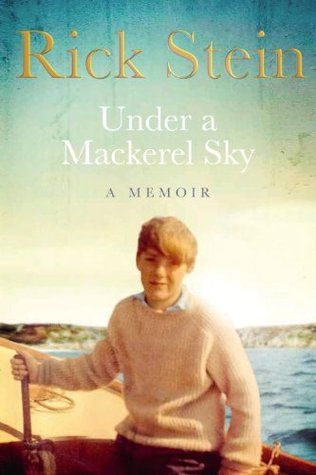
A Blue Room Book Review – Under a Mackerel Sky – Rick Stein

under a mackerel sky

I am so blessed. One of my DLP’s (Darling Loving Partner) many talents is the fact the she is a kitchen goddess. She produces delectable meals, always thoughtfully presented. She has a knack for turning fridge leftovers into flash tucker with, unlike your scribe, not being a slave to a recipe. I am no match for DLP in the culinary stakes, although I enjoy putting together a meal and I do have to force myself to not buy endless cooking books/magazines.

Another aspect of my darling lady is that she likes the same type of foodie programmes on the tele as I do. Neither of us are into the hoopla of Master Chef or MKR – no, we delight in great cooks telling us mere peons how it is done. Keith Floyd was the first I personally took a shine to; it being a tad saddening reading of the pretensions of his later years in ‘Under a Mackerel Sky’. Nick Nairn, The Hairy Bikers and Two Fat Ladies have also been favs in the past. I cannot abide swearing for swearings sake so Gordon Ramsey has largely past me by, but in those shows where he moderates that predilection he can be quite entertaining. Nor am I a huge fan of Heston Blumenthal’s excesses, although I admire his ‘out of left field thinking’. My current preferences largely reside in the SBS stable – Maeve O’Meara and her Good Food Guide, Peter Kuruvita, Luke Nguyen, Shane Delia and the Gourmet Farmer, Matthew Evans. I am also partial to the enthusiasm of the ‘Two Greedy Italians’ – Gennaro Contaldo and Antonio Carluccio. Then there’s Poh – very delicious herself (can’t wait for a new show) – and the ‘River Cottage’ guy Hugh Fearnley-Whittingstal. The only difference DLP and I have in all this is that we do not see eye to eye on the attributes of Nigella.

Both of us are attracted to the work of Rick Stein, perhaps I marginally more so than DLP. I enjoy his style on the small screen, the relationship he has with the camera and therefore, by definition, his viewers. He seems very human, with human foibles like all of us – foibles he is not afraid to leave unedited. Whereas Floyd liked to quaff a fruity red whilst he taught the world to cook, Stein is just as likely to recite poetry or quote the classics. He is as attached to Cornwall as I am to my beautiful island in the southern seas, particularly to ‘Padstein’ (Padstow). His commentary on any part of the world he finds himself in for a series is always worthwhile – naturally there is always something to enthuse about with the local tucker – something he can adapt for his own purposes back in his own kitchens. He is now getting on a bit, but he’s one of these people you hope that, in a Cohenesque manner, can keep going on forever – as with the likes of David Attenborough, Clive James, Willie Nelson – those that make our globe so much the richer for their presence. How I’d love to visit his Cornwall. Once upon a time I nearly got there. I guess it will not happen now – but a man can dream.

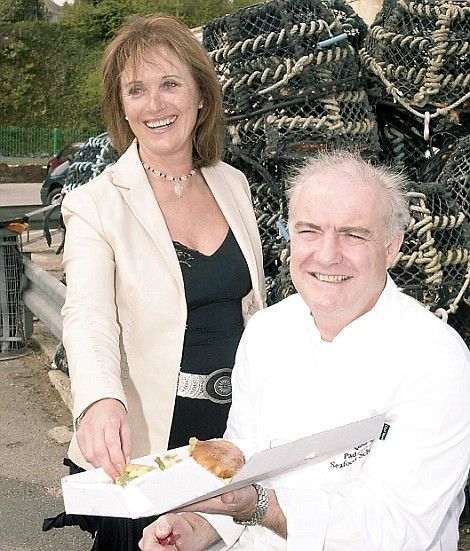
‘Under a Mackerel Sky’ is Stein’s evocative memoir – the word ‘evocative’ apt for those early chapters on his upbringing in post-war UK and his formative years in Oz. Now he is almost one of us, marrying an Aussie lass later in life and living for as much time as he can squeeze in on the southern New South Wales coast where he owns an eatery with his partner.

rick and sass

I found the book to be largely delightful. He is not a great wordsmith, but is as earnest in his scribing as he is expounding the glories of regional cuisine in France, Spain or anywhere that has a coast and a fishing boat. It is a given that a familiarity with his television work is a prerequisite. This gives his grand tales a context. Like most who look back on their earthly endeavours in written form, this is largely a vanity project and Stein is no exception. He is not backward in coming forward and quoting those who sing his praises. In his own words, though, he seems a genuine, genial enough fellow who possesses mundane doubts and insecurities despite his success in building his culinary brand. It is refreshing to know he does have a temper – seemingly that goes with the territory – and for Stein to be an exception would be a stretch.

His writing is at its best when describing his Cornish coast and its people – a populace he clearly adores, reserving a special place for the original and fast disappearing Cornishman (and woman). Then there is Chalky – his beloved canine who became an integral part of so many of his adventures. No Stein series was complete without the feisty terrier stealing a scene or two, being a natural in front of the camera. We all felt for Stein when he announced Chalky’s demise to the world. A mini-review of the book in the Age describes it as being somewhat melancholic in tone. Certainly his father’s supposed suicide casts a constant pall. His self doubt is emphasised – although it is hard at time to match this with the larger than life man on our screens. He writes of his early sexual exploits with an innocent frankness, but once he met the right woman, in the form of Jill, his career spiralled ever upwards.

rick and jill

She does seem to be the loser in all this – but then we can never be privy to the inner workings of a marriage and the author understandably is not overly forthcoming in what went wrong. He never disses her, but one suspects that in his effusiveness for how gloriously happy he is with his Aussie Sass would not be music to Jill’s ears – but who knows? Reading on-line, it seems Jill was initially very incensed about the new woman in her man’s life. Hopefully she has now moved on to a similar state of ecstasy to his as well.

The added photographs are charming as well as revelatory. I especially enjoyed his forthcomings on the goings on behind the scenes on his shows, particularly when applied to his good mate/producer David Pritchard. With so many years behind him, he has so many stories – they all being eminently readable. Let’s just hope the story itself doesn’t end for some time yet.

My beautiful DLP is doing one of her signature dishes for our evening meal. She weaves magic with a piece of Atlantic salmon. I am salivating at the thought. I doubt if even the great Rick Stein could match what DLP will soon be doing with that piece of fish!

Jill’s take on the breakup of the marriage = http://www.dailymail.co.uk/femail/article-1082231/Why-I-hit-woman-stole-husband–gave-slap-Rick-Steins-wife-reveals-truth-split.html


A Blue Room Book Review – The Secret Alchemy – Emma Darwin

secret_alchemy

I remember the book. I cannot remember the title, nor the author – but I remember the book. I recall the dominant colour on the cover was red, and it featured a medieval king – maybe it was a Henry. It could have been a William, an Edward or even a Richard. I doubt if it would have been my namesake, Stephen – a short, embarrassing reign. If I said that what I found in between the front and back covers fascinating, firing my love for the post-1066/pre-Tudor period of British history, I would have been telling a porky. I remember nothing of what was in the publication, I just remember it was turgid, dense and I had nary a clue of what was going so convoluted were the machinations of the major players. Their constantly shifting allegiances completely lost me – it was all a confused muddle in my mind. No doubt I would have been reading the torturous tome for a university course. I suspect any examination question on the era would have been dodged to go to Henry VIII or the Stuarts where I possessed a firmer grasp. But I was nothing if not a conscientious student. I did read the thing, but to no avail. To this day the Wars of the Roses have been a mystery, that is, until this book. Thank you Emma for helping me out. A fictional account has made the period clearer in my mind, but still far from crystal.

I was mightily impressed with Ms Darwin’s other semi-historical saga, ‘The Mathematics of Love’, a novel part set in the immediate post-Napoleonic Wars period – my Goodreads review of it is below:-
https://www.goodreads.com/book/show/702512.The_Mathematics_of_Love
‘A Secret Alchemy’ is also very worthy, although not as much to my taste as its predecessor. It did, though, markedly enhance my knowledge of the conflict via the voices of Elizabeth Woodville and her brother Anthony, major participants in the confusing events. Richard III is still the bad guy, but with some redeeming features in line with modern non-Shakespearian notions on the notorious hunchback. It is instructive that gays still had a rough time of it back then too. Just in case we didn’t get it from the storyline, Ms Darwin helpfully includes family trees and a precis of the factual events. The latter was placed at the end which is when I discovered it. It would have been of greater assistance to this reader had it been placed at the beginning.

Parallel to the Middle Ages goings on is a contemporary story involving bibliographer/historian Una. She has just returned to the UK from Oz to settle her affairs after the death of her hubby. Here she encounters the subject of pre-nuptial unrequited love. Eventually the twosome embark on a journey retracing the sites that featured in the book’s other narrative. As it turns out all rather neatly, she is researching the written output of Elysabeth (sic) and Antony (sic). Of course there are linkages between the two story threads – otherwise what would be the point – in what the book’s blurb describes as a ‘daring’ fashion. For me it was all a tad forced. The ‘finding’ of the significant letter, around which so much hinges, was particularly contrived. The paralleling is far more successful in ‘Mathematics of Love’.

Ms Darwin also invokes a sort of pigin Olde English-speake for the tales of Elizabeth and Anthony and for me this was one of the rewards of the book. At times a glossary would have been useful as occasionally meaning wasn’t always conveyed by context.

Based on her oeuvre, albeit a brief one at the moment, Ms Darwin is a novelist capable of the most exacting research with an over-riding facility for turning fact into readable fic/faction Her website is reporting that she is working on a third effort, but given this publication came out in 2008, it is a long time coming. Despite a few reservations with this title, I suspect the wait will be worth it, given that the grounds around her choice of subject will have been thoroughly mined.

I am glad my days of onerous reading tasks, both academic and pedagogic, are behind me. Never again will I have to plough through mind-numbing tracts, but rather I can enjoy ‘translators’ of Emma Darwin’s ilk – writers who possess the chops to turn dry, tedious history into palatable, plausible prose.

emma_darwin

Emma Darwin’s website = http://www.emmadarwin.com/

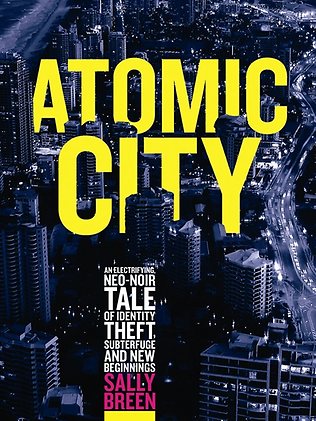
A Blue Room Book Review – Atomic City – Sally Breen

atomic

As your average ‘Mexican’ – southern visitor to the Gold Coast – for me Surfers Paradise and surrounds are redolent of bright sunshine, grey-cloud free skies, azure sea and endless golden beaches. It streets and strands feature and endless array of humanity shedding outer layers. After years of teaching in a smallish community, it is where I went to to feel free. These days, for the hipster, it is the ultimate tourist cliché, but I adore the hedonistic strip. Once upon I time I would have said I preferred the hippier Sunshine Coast, but, as ‘The Dealer’ says, ‘Of course people do the same shit in Noosa as they do on the Gold Coast; it’s just that Noosa makes people think they’re doing it better.’ Then there is, or was, the ultra-hip Byron – but these days even there has lost some of its sheen. Nowadays my personal focus is more beachside than beaches, being in my dotage. Flying into Coolangatta, though, is still the bees’ knees. I’ve been up to Mangoland umpteen times, although I have never attained my once longed for aim – the goal that Graeme Connors turned in a minor anthem for me (any many others I may suggest) – that of ‘Going a little further north each year.’ I don’t care now. I like to go where I feel comfortable and it’s now a place I know reasonably well. I am off up there in a few days, and another Gold Coast holiday will have been completed by the time this is blogged – and hopefully there will be tales to tell!!!

The Gold Coast caters for all age groups of ‘Mexicans’. In our younger, single years we stayed in the bustle of Surfers itself, although ‘Schoolies’ wasn’t heard of way back when. Once the sprouts arrived various ‘Worlds’ were the major attractions. These days we tend to base ourselves further south, in the more sedate surrounds of Burleigh Heads, Currumbin or around the Tweed – exactly where we’ll be this time around.

But obviously the view the ordinary punter receives, no matter where he/she is on the strip, is just the glitzy outer skin. Listen to ‘The Dealer’. For him we see ‘…a city of surfaces, an ocean of seamless blue framed by frivolous edges and as for what’s underneath?’ – well we don’t see ‘All that endless covert possibility.’

In a recent episode of ‘Media Watch’ our host reported on a shyster who had ‘stung’ innocent investors of squillions in a dodgy real estate scam, his victims cajoled into it by ‘trustworthy’ celebrities such as Jamie Drury and Eva Milic, a former Miss Australia and now television newsreader on the Coast. He reported how ‘Four Corners’ had tracked down the perpetrator now living in a Mermaid beach McMansion. He was all sunny smiles and bling until the reporting narrowed in on his business dealings, upon which he disappeared behind locked doors. In my mind he could easiy have been the prototype for PJ or Harvey, the callous wheeler-dealers of Sally Breen’s fine sophomore offering, ‘Atomic City’, set on this, Queensland’s sun-drenched far southern coast.

One doesn’t need a novel to alert to alert us to the fact that there is a darker, seamier side under the epidermis of Surfers and its surrounds. Newspaper headlines have been telling us for decades. Breen, though, ably takes us into this world – to the place she describes as a ‘mini-California. Perhaps Miami would have been a more apt analogy, but even so the world inhabited by the aforementioned ‘The Dealer’, PJ and Harvey, along with their calculating ‘honeypot’, Jade, is stunningly bought to life. Breen aims, successfully, at a hard-boiled style – film noir on a page.

Jade is the fulcrum of all the activity – a chameleon masterminding scams to rip off the ripper-offerers – and does so, for a while, with great aplomb. Aided by her sidekick, ‘The Dealer’, who quickly becomes enamoured of this loose young – perhaps too young in terms of age to be so manipulative (but what would this Mexican know?) – operator. The Dealer is well aware of the danger of being so in her thrall, for it all must come tumbling down at some stage, mustn’t it? He wants to be well out of range when it does. Jade is a more youthful, and blonde, version of the ‘Hustle’s’ Stacie Monroe, and it was Jaime Murray’s face (and body) I had in mind as I read ‘Atomic City’. Jade was more prepared to use her bits to effect far more than Stacie ever did, but you get the picture! And use them she did – indiscriminately and to lethal effect.

-sally-breen

Sally’s first novel ‘The Casuals’ received rave recommendations from notables such as Frank Moorehouse and Matt Condon, and she lives – you guessed it – on the Gold Coast – Mermaid Beach to be precise. On the basis of this novel she is a writer to keep an eye on. Hopefully, unlike her character, she will not sparkle brightly for a couple of literary forays and then fade, as Jade did with her shifty operations!