Category Archives: Book Reviews

The Short Long Book – Martin Flanagan

I think of him during another year of tribulation for his club – blessedly not my club, but any club that has had to go through what this one has damages the game I love so much. This individual I think about is as competitive as they come. He crossed over just before the shit hit the fan. Deep down, I wonder what he thinks now. He knew the window had closed at his previous club – one that had come so close, but yet had fallen short at the final hurdle. Soon it was headed for a stint of cellar-dwellering, despite his best efforts. He wanted so much for the ultimate. It looked a seriously stronger list where he opted to head to. Guided by a canny coach, a former champion of the outfit, they were on the up and up, starting to look the goods – or so he reasoned. Now, a couple of seasons in, there is no let up from the pain some might say that this mighty club has inflicted on itself. It just goes on and on. The players, for the most part, have been stoic and loyal, despite the testing times. The captain, as courageous and straight-talking as they come, has admitted that a recent injury, seeing him off the field for the long haul, came as somewhat of a relief. There is debate as to whether he will continue on carrying the load, such has been the pressure of the messy affair. And the player I am thinking about, looking at his old team, under a new coach who is building them back up and now possessing a list full of talent, in his more reflective moments, must be shaking his head. Yet he will suit up and go into battle week after week for his new employer, still giving his all because that is the way he is made. But along with his colleagues, be must wonder if there will ever be an end to it – will it all eventually be too much and the grand old club will be bent and beaten. He says the right adages to the media and works frenetically on the field to paper up the ever widening cracks, but how long before it all comes tumbling down around him? It’s another bitter winter for the Bombers. There is no greater test of his or the club’s character.

And then there’d be Longie. He is a hero from another football age – and still a hero today, even if his playing pomp is far behind him. His era was a time before footy became a corporate game, massaged to suit the big end of town and the demands of a voracious media. Some claim the core fans have been forgotten and the spectacle is but a mere shadow of its former self – but I would disagree vehemently with the latter at least. Longie knows that it has all changed, but for him, a servant of Essendon in his playing days still with strong ties, he had a different battle to fight. In many ways he is still fighting it. He is inscrutable, but he too must be bleeding for his beloved club, as well as for a coach/father who is back there to lend a hand; to see if a wise old head can help drag it back from out of the mire. It’s not his fight though – Sheeds can have it on his own. It’s not that he is not up for a job, but he has stood tall in the past on another issue and that particular journey is the one he feels he needs to see to the end. And as we have seen in recent times, with all the brouhaha over the Adam Goodes debacle, there is still much to be done off the field. Back in the day, with Sheedy at his side, he changed attitudes and made our indigenous game a safe haven for indigenous sportsmen, a place where they can display their magic for our collective wonder. We are all in thrall of what the Jettas, the Franklins, the Ryders and the Riolis bring to the table for our fantastic sport.

One of our leading writers on Aussie Rules, Martin Flanagan, took Michael Long on and has devoted a fair amount of time over the last decade trying to pin him down so as to construct a linear biography. It hasn’t worked. He failed. It was impossible from the get go – as impossible as it seems to be for Longie’s team to extricate themselves from the bogey-man that envelopes them today.
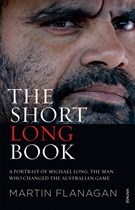
short long

What we have, instead, is ‘The Short Long Book’ – a lovely play on words to describe an equally lovely product. And it is that perhaps with this factual novella-sized work we get to the touchstone of the man better that a more traditional hagiography would ever do – for that is what a biography of this man could not help but be. For what he’s done and continues to do he is universally admired – including by Flanagan, such a capable renderer of words. Nicky Winmar may have provided the photographic symbol, but Long provided the story and the grunt to get it done. He was a black man who took that long walk to change perceptions – and he took the nation along with him. At its termination he told a nay-saying Prime Minister a few home truths.

In telling the yarn of how he failed to pin his elusive quarry down, the author has come up with a mini-gem. There are yarns within the one great tale too, dominated by the time Michael L took Flanagan into the desert lands and the Top End of his people so he’d understand more. It is also the saga of how MF became the Great White Hunter to Longie and his mob. In such tales, tall but true, we are given a hint of what makes such a mesmerising subject tick – one that, despite his elusiveness, is an out and out hero.

Flanagan, Martin

Martin F tells of how a Longie would relate to him a story, but the telling could take several years to complete as he would deliver it one sentence at a time. The book is brim full with tellings of these wonderful stories. There’s the young Longie sleeping regularly on his mother’s grave. At a similar age he found all his belongings on the family lawn when he dared to float the idea that his future lay with basketball rather than Aussie Rules. He got the message loud and clear on that one. And there’s………well there’s plenty more, but it is a short tome. Better you go out and purchase your own copy. But, just to pique interest a little more, in it you will find a hilarious description of the great footballer’s running style, another of Dermie’s infamous shirt-front of Paul Van Der Haar and best of all, there’s the magpie goose.

The nation will remember the Essendon star for his ‘Mandela’ year, 1995. To his credit, the villain of the piece, Collingwood’s Paul Monkhurst, now stands alongside Michael Long as an advocate for racial tolerance. At that time, when the black man he targeted with his racial tirade reacted by standing up for a principal and telling us all it would, from now on in, definitely not be left on the field on that day nor any other. He pointed out where we were all failing; he pointed us towards a better tomorrow.
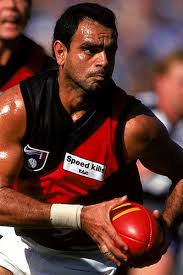
long01

Unlike many commentators, I refuse to concede that our game has lost its soul. In recent days we have only to look to the footy family’s coming together over the death of a coach who went before his time; as well as for a champion’s sister passed before hers. I also know that the great club of Michael Long, Kevin Sheedy, James Hird and countless other legends, as well as now a player who seeks grand final glory for himself, will rise to the top again

long02

The Long Walk website = http://www.thelongwalk.com.au/Home

When the Killing's Done – TC Boyle

‘And dogshit wrapped in neat little plastic bags. Does that drive her crazy? Yes it does. That people should take something natural, waste, feces (sic), the end product of an animal process, and seal it in plastic for future archaeologists to unearth from landfill in a thousand years is pure madness. This world. This skewered and doomed world.’

TC (Thomas Coraghessan) Boyle is one weird geezer. He looks weird and from all reports, behaves weirdly too – an eccentric, perhaps, with his slick looks and flamboyant dress. This professor of literature, for the University of Southern California, is well known around the traps for the equally flamboyant readings he gives. He’s a latter day Dickens.

He’s pushing up towards seventy now, this oh-so-cool dude, with a literary legacy that will mark him, in future years, not only as a one-off, but also a true great of turn of the millennium literature. He has been described as a maximalist novelist – one who eschews the simplicity of style advocated by many notables of last century – the warriors who put the American Dream into print. We are now in a new age, a complex age, with Boyle reflecting that. He is as flamboyant in his prose as he is in everything else – but here’s the rub. Although the reader may not have discovered previously in print a whole plethora of the magical sounding words he divines from who knows where and litters his oeuvre with, we know immediately their meaning – no need to go rushing off to dictionaries. It’s all explained in the context. He is amazing, his output so varied in narrative, but always so seductive in reeling the reader into each novel’s web.

tc boyle01

And ‘When the Killing’s Done’ is no exception. The opening paragraph to this opinion piece on the tome is of an Alma Boyd Takesure rumination on one of her early morning beach perambulations. And it is a pet (pun intended) peeve of mine, this nonsense of wrapping up canine crap, particularly when it’s taken to the ridiculous extreme, such as on our island’s gorgeous beaches. Here dogs may be permitted to run as free as the breeze, just as long as we follow the firm instructions on some rusting signage to clean up after them – with bags conveniently provided. On Bondi I see the point, but on our strands, where humans are rarely in mass numbers, it’s quite frankly ridiculous.

Alma is an environmental fixer-upperer of islands, those set in that same archipelago, off the Southern Californian coast, as Boyle’s subsequent offering, ‘San Miguel’. She works for the National Parks Service, tasked with clearing those isles of their feral populations, restoring them to pristine condition. But to her arch-enemy, Dave la Joy, any form of culling is an anathema. He’s a rabid greenie – as far left in that activist grouping as it’s possible to be. He will stop at nothing to protect every living organism on those islands, come hell or high water – and the latter figures prominently. He does not stop even at introducing fresh feral species to confound Alma and her crew. At first I read this character with disbelief. Could there be people around so madly fervent in their obsessions as to be unhinged? His main squeeze, Anise, a child of the islands, seems to put up with him almost to the end – I suppose it helps that Dave isn’t a short of a crust, being a successful businessman, owning a chain of profitable stores. But such is Boyle’s skill in the telling, in an odd way, I ended up liking this cove who obviously wasn’t the full shilling. He’s one of the author’s more out-there creations.

Even if the ending of the book didn’t unravel in the direction it seemed to me to be heading, in that sanity is eventually restored (not really a spoiler), it didn’t seem to detract. Boyle claims he places immense thought into the conclusions to his tales, but is open-minded about them till he actually gets there – or so he says. This could have gone either way.

Boyle is not a mega-seller here, although some of us may have seen the movie version of his ‘Road to Wellville’, based on a cereal king. Nonetheless he is well worth a library borrowing just to get a taste of what this unique wordsmith is all about.

TC-Boyle-001

TC’s website = http://www.tcboyle.com/

Between Us – Words of Wit and Wisdom edited by Marieke Hardy and Michaela McGuire

This fourth compilation of epistles in the ‘Women of Letters’ franchise (the editors may well hate that term) is now not only an Australian phenomenon, but is spreading its wings internationally as well. Hardy and McGuire sold out NYC, which now has monthly performances, with a tour of their concept also completed of the UK. What started out as a small time effort to raise a bit of dough for a local animal welfare charity has captured hearts all around the nation. I was in a Hobart audience a while back and the duo had the format down pat. It was a night of laughter and tears. If one of their live performances comes to a venue near you, do make the effort to attend.

between-us-

The volume in question – there has been an international edition since – has all the faults of its predecessors – there are still the try-hards and still some drivel. But overwhelmingly most letters contained within speak from the heart, some even quite intimate in nature. The editors have by now reached the conclusion that part of the reason for the success of these books, as well as their live source, is that, in letters, there is a sense of safety not present on social media. The shows have a rigorous no recording policy and the readers involved all need to give permission for publication. The audience for both would not be the milieu for trolls in any case, I would have thought.

The edition in question is bookended with poignancy. First cab off the rank is the magnificent Stella Young, composing a letter to her octogenarian self – ‘By the time I get to you I’ll have written things that change the way people think about disability. I’ll have been part of a strong, beautiful movement of disabled people in Australia.’ And arguably, along with the marvellous ‘The Last Leg’, she, at thirty-two, already has. Sadly a few weeks after publication of this book our gorgeous advocate for crips – her word, not mine – died suddenly. Very early on in the history of ‘W of L’ she had forthrightly stated that the organisers had better find a wheelchair-friendly venue for the live version or face her wrath. The two convenors did so immediately and the spirited Stella became a firm friend of the pair.

stella

The closing letter was by former Greens senator Christine Milne. Once upon a time I was a friend during her uni years and for a time we shared a school staffroom on Tassie’s North West Coast. Her letter was to her former students at Devonport High School and it centred on a book that is very close to my family’s heart – Paul Gallico’s classic ‘The Snow Goose’. My beautiful sister Frith derives her name from that tale.

snow goose

There was much else to enjoy, such as Chrissie Swan’s encounter with a woman breast feeding in a suburban shopping mall. She was dressed in a bear suit with a flashing neon sign attached to her head warning, ‘Boobs Ahoy’. I love Spiderbait’s drummer Kram’s relating of how the ‘House Husband’/’Play School’ host, Rhys Muldoon, came to be pashing Axyl Rose’s girlfriend at a Melbourne concert of the Gunners. Leading the way for Muslim women in their fight against sexism and for their right to be heard, Susan Carland writes emotively about her love for her son now and into the future. Columnist Amanda Blair, whose mother once tried to match her up with Martin Bryant on a blind date, muses on how much simpler life was for women back in the day – or was it? Angie Hart’s letter to her unborn child is a heart-breaker and I found out two facts about Poh that I didn’t know. One is, would you believe, she’s almost forty. The other is that she is not beyond dropping the f-bomb (but it’s okay, she uses it in describing some cretinous troll). Jess McGuire writes of her totally ‘annus horribilis’, but in doing so demonstrates how even the most dire of circumstances can have an upside. Guitarist for our beloved Go-Betweens, Adele Pickvance, writes engagingly on the difficulties involved for a Brit adjusting to life in Oz. And lastly, in my resume of ‘Between Us’ highlights, is the story of how Sommer Tothill’s life was turned around by the true narrative of her Uncle Rolly’s demise.

There is much, much else to recommend this penultimate addition to the ‘W of L’ list of titles and I bet, once you’ve devoured this glorious omnibus, you’ll be hankering for the other four. Now I think I might take up my pen and write a snail mail missive of my own to my good mate….

Women of Letters website = http://womenofletters.com.au/

Dept. of Speculation – Jenny Offill

Up front is passion. Never over-rated but can be debilitating in some circumstances. Time mutes and love transforms. Attachment is under-rated, comfort being a negative – and there is much to recommend it. Of course there are multitudinous variations on the core, but one factor is known – if it’s out of synch then it can invite disaster.

dept

Jenny Offill is the first to admit that this slight, in volume, book of hers should be a hard sell. ‘If someone described this novel to me, I would never had read it.’ the author tells one interviewer. It is a potpourri, an amalgam of fragments in the form of musings, random facts and quotes from the great wordsmiths the author obviously admires. Interspersing all this are micro-vignettes on the course of a marriage. Each small chapter is akin to a string of pearls – each oyster-spit shone to a sheen and in the whole, strangely relevant.

It takes a while to pick up the rhythm, but once that is cottoned on to this slim, not autobiographical, not a memoir, entrances. So much features – from the black dog to battles with parasitic bugs to the exploration of outer space.

A best seller in the US, it’s raised hardly a ripple in Oz against the ‘Gone Girls’ and ‘Girls on a Train’ overload – but Offill can hardly credit her success Stateside. Her last novel for adults was before the turn of the millennium. ‘Dept. of Speculation’ had a very long gestation, with the author filling in the gap with her teaching and well received picture books.

The novel is a mini-treatise on motherhood, wrangling a wayward husband and how, for women, it is impossible to become an ‘art monster’ ie devote oneself entirely to one’s writing to the rejection of all else. Men, it is claimed, have the luxury of doing this with no roadblocks whatsoever.

The two parties involved in this rendering are, for a time, out of synch. In recording their journey there are lessons to be discerned for all floundering relationships. This small tome swims against the tide in more ways than one and is well worth the effort to track down. On my daughter’s recommendation I am so glad I went to that effort. Thank you Katie.

dept01

Jenny Offill’s web-site = http://jennyoffill.com/

Be Near Me – Andrew O'Hagan

This 2006 novel is this reader’s first by Andrew O’Hagan. Hopefully it will not be the last. Essentially it is a three-parter; the first two sections building to a shattering finale in the last. By the time that presents itself I had succumbed to being so hooked it was unputdownable until the whole sorry story had played out to the last page.

benearme

Glaswegian AO’H was born in 1968 and is a graduate of the University of Strathclyde. By ’91 he was on the staff of the ‘London Review of Books’ and four years later published his first fiction product, ‘The Missing’. It and subsequent tomes have been nominated for all sorts of gongs including the Booker and Whitbread. This work won the Los Angeles Times Prize for Fiction in 2008. ‘Be Near Me’ has also been adapted as a play. O’Hagan has written and presented a television series on Bobbie Burns for the Beeb and has dabbled in writing for the stage. This guy has serious literary chops.

In the first part of ‘Be Near Me’ the scene is set. We meet 56 year old Catholic priest David Anderton, newly transferred to a tough Ayrshire parish, but we find he is half-hearted and somewhat removed from his duties. He seems disappointed in his calling but unable to release his mind from the need to be succoured by the church. Anderton has the necessary feeling for his flock, but struggles to make a connection with them. He is, above all, hungering for something more – the type of relationship he once had way back when – one that is no longer is possible given the constraints he labours under. He is lonely. In this fragile state of mind he is ready for an ‘adventure’ before it is all too late. That enters in the form of street savvy teenagers, feisty Lisa and charismatic skateboarder Mark. Very soon he finds himself part and parcel of their escapades, occasionally the ringleader. For a while we are unsure which one will bring him down as we are in no doubt this flirtation, with the dark side of the real world, cannot end well.

Now we’ve ascertained the situation he is in and which of the duo brings him to grief, we backtrack onto a different path. The author takes us to the tale of the love of the priest’s life and the event that caused him to fully turn to his god and the celibate way.

Once that has been conveyed we return to Father David’s fall from grace. Although it is debatable whether he committed the crime in the true sense of the accusation, the priest knows, had it all played out as he intended, he would have done so. Ergo he places self-imposed barriers to escaping what is about to befall him. We wonder if there’s an ultimate price to pay.

As he travels down his path to self destruction we see the strength and loyalty of the women in his life – Lisa to some extent, his novelist mother and his ill-married house-keeper, a vital cog in the case against him. They are all wonderful creations as characters, as is the latter’s deeply flawed spouse who is somewhat the hero of the piece.

I do not know where in the Bible Jesus preaches that to fully serve the god he believes in one has to enter a life devoid of sexual intimacy with another. If he did, then that is at variance with the Jesus I know. Of course, for many, like our main protagonist, being human they fail to measure up and as a result the Catholic church is now in deep do-dos. Once litigation takes over in the aftermath of the various enquiries, commissions and investigations in place world-wide, the institution may well be bought to its knees financially. To me it is an inhumane and self-defeating imposition and O’Hagan glaringly, as well as artfully, presents the troubled face of all this. Even though we look at Anderton as foolhardy for taking one last stab revisiting what he experienced so long ago, we can all relate to his fundamental need.

o hagan

The Pause – John Larkin

This is an important book.

Every book, it goes without saying, is important to its author. I suspect for John Larkin this is the most important book he’s written – perhaps the most important he’ll ever write. We get a hint why with the knowledge that it took him three years to get the manuscript to a stage he was happy to submit for publication. We receive another indication when we read its dedication – firstly to his children ‘.., the brightest stars in the darkest night.’ and then to his wife ‘.., for helping me to find my way back into the light.’

In January 2012 Larkin had a complete breakdown and was admitted to a psychiatric hospital. He describes it as ‘…an awful time in my life.’ He left with an ambitious goal for what was to become this novel. He wanted his words to give hope. He wanted it to save lives. This scribe has no doubt that, in the hands of those who need it most, ‘The Pause’ will indeed save lives. For some those words will be the most important they read in their short, to date, existence.

The book deserves a wider audience, as well, for it shows that even when the darkest thoughts envelope one – so dark that the ultimate price is contemplated, a pause to think, if only for an instant, can drive that destructive urge away. It demonstrates that always, always there are silver linings up ahead.

pause

Coming at it with adult eyes this is far from the perfect product. Clichés abound as do annoying repetitions (every laugh to be had was snorted). The structuring may not work comfortably for some – particularly those who have managed to keep the black dog at bay. I doubt Larkin’s effort will make a gong’s short-list on literary merit alone. But it is not written for those who are able to look back, but for those unable to see a way forward. This book contains something far more important than literary perfection. It speaks to vulnerable young people, many of whom may be despairing, in a way that connects. Despite its dark themes, it engages in a manner that is downy light, infused with a humour that makes it immensely readable. It is a page turner. ‘The Pause’ does not shy away from the barriers to happiness that life puts up, but demonstrates that most people have their hearts filled with goodness and they are here to help. In a country, such as Australia, there are plenty of safety nets when the path ahead seems only to be filled with potholes leading to an abyss. ‘The Pause’ asks that these good souls are looked to for support, for this is a novel full of the possibilities of life.

Its two central characters have a deep and abiding love for each other, despite their terrible situations, past and present. Its no spoiler to say that, against incredible odds, love wins out. It’s beside the point whether Declan paused or not before he took that plunge. What is important is the journey he went on after the event.

From my own experience, after forty years in the public education system, I know how important library workers are in schools. Libraries are the refuge of the vulnerable. Therefore those adults in there are the front line in many cases, often taking on the role as counsellor as well as providers and organisers of resources. As I’ve noted before, these are the people who will know which of their flock would benefit from having this important, uplifting YA book directed their way. Through them John Larkin will succeed.

Larkin, John

YouTube trailer = https://www.youtube.com/watch?v=LkDGRqbOXBI

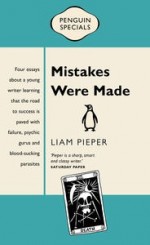
Mistakes Were Made – Liam Pieper

Yes, mistakes were indeed made and semi-novice wordsmith Pieper outlines them in fine humorous fashion in his collection of four essays for the Penguin Specials series. You too can read all about this fellow’s misdemeanours by shelling out a cheap ten bucks at your nearest quality book store.

mistakes were made

Who knew that trying to secrete one’s person behind a compliant steed to escape the predations of a whacked-out ageing hippy priestess would cause a doctor to scream in horror? Who knew that selling dope to your alternate lifestyle parents as a teenager, then writing about it, would be enough to force a person to flee the country? Who knew that attempting to enter the good ol’ US of A with the book telling that tale would almost get a person, courtesy of US Customs, on the next plane home? Who thought that inviting mad dog Geoffrey into a person’s life as an act of kindness would cause such mayhem to ensue? The crazy canine, for me, steals the show completely.

On a more serious side, implicit in Pieper’s musings are the vagaries of the writerly life.

liam pieper

But this small volume is a delight from cover to cover – and as such will be recycled through family and friends. The notion behind the Penguin Specials are that the books in the series can be read in one sitting. I’m never one to thrust what I have enjoyed on others unless I know the territory well. My hope is this works in reverse as well. Some know my predilections well and I am always happy to receive their recommendations, but when I feel obliged to work my way through a thousand page tome out of friendship, I can have a miserable time in doing so. I am always loathe to offend and cannot say no – so I am wary of doing the same. But in this case there are no issues and I’ll recommend it to all and sundry. I cannot imagine anyone failing to be amused by Pieper’s yarns which are, as he puts it, ‘…a kind-of-sort-of sequel’ to his first publication, ‘The Feelgood Hit of the Year’ (Penguin). I am now keen to get hold of this. I only hope we see much more in book form from this talented communicator despite the scrapes that doing so may lead him into.

Liam P’s website = http://liampieper.com/about-me/

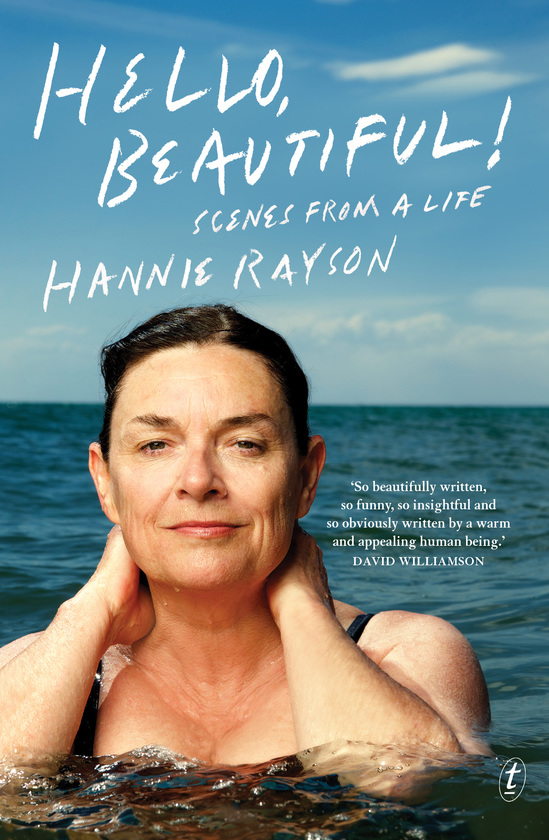
Hello Beautiful – Scenes from a Life – Hannie Rayson

‘A few years ago a friend of mine travelled to Vermont, in the United States. After taking in the panoramic views, she noticed an ice-creamery. She went in and joined the queue.
There, standing two metres away, was Paul Newman.
She thought to herself, ‘Oh my god, that is Paul Newman,’ (as you would) ‘I am standing two metres away from Paul Newman.’
She bought her ice-cream cone and walked out onto the veranda to take in the view. There he was eating an ice-cream.
‘Beautiful day,’ he said.
‘Yes,’ she said.
They both looked out for a bit more and then she said, ‘Oh, what have I done with my ice-cream?’
He said, ‘It’s in your handbag.’

hello beautiful

I love that anecdote – seven degrees of separation and all that (or far less in this account) – between author Rayson and the great and famous. Newman is by far the top of the pile of celebrities name-checked in ‘Hello Beautiful’. But we also find out that she and hubby (arts media personality Michael Cathcart) stay at Paul Cox’s French idyll when in that part of the world; that she is related to a former teacher who advised Cate Blanchett that fronting a class in the future would be far a better use of her talents as she was clearly never going to make it as a thesp and that on her business card, apart from name, comedienne Wendy Harmer has simply ‘Adventuress’.

To be quite honest Hannie Rayson had never been on my radar until recently. Had I been a frequenter of major city theatre productions I would have been more attuned to her prominence in that field. I know of an earlier work of hers through the resulting movie adaptation, ‘Hotel Sorrento’. But this book was all over that once Melbourne broadsheet and the Oz. Several amusing extracts in those convinced me to shell out for her tome.

Yarra City critic Cameron Woodhead describes it as follows –It’s a book of beautifully crafted, free-flowing vignettes that illuminates with warmth and humour and some urbanity the paradox of an artist who’s relatively well-adjusted and ordinary, and the contours of the intimate relationships that formed her.’ A few of these vignettes fall flat through being a little too forced in the humour department, but overwhelmingly she had me chortling away more often than not. Added to this levity there are reality checks such as miscarrying whilst in the process of interviewing, as a young journalist, icon Arthur Boyd at his home and the intensely intimate tale of a worrisome mole on her vagina. I related to her as a member of the select club that also features my own lovely lady – they both pride themselves in finding parking, without fail, immediately outside every destination – and the author does it in Melbourne! Poor Michael – or MC as he is lovingly referenced in the book – and yours truly have to invariably park several clicks away and commence walking. Her tale of her experience at ‘Wally Groggin’s Golden Mile of Used Cars’ also hit a nerve. This time she has it, in common with your scribe – we’re both complete and utter incompetents with anything to do with automobiles. In our relationship Leigh is the car-savvy one. And back in my old stomping ground up north, Burnie also boasted its ‘Golden Mile’ of used cars, at Cooee. Wanting to update my old banger, in lieu of Leigh who had already decamped to Hobs, I took along friend Keith. I quickly spotted a sporty number – sleek green and streamlined I seem to recall – and figured that I would look very nifty indeed behind it’s wheel. I think it was my one and only attack of the Peter Pans. Thankfully Keith, with the words, ‘You’d kill yourself in that thing Steve’ was able to bring me back to reality and we ended up with a serviceable but very boring Mondeo. With her mate Mark along in similar support, Rayson was protected from any dodgy dealer who’d figure he’d get one over the little woman. There’s also the delightful tale she tells of fellow wordsmith Carrie Tiffany, entering a book store to buy a copy of her own award winning (and excellent) ‘Mateship With Birds’, has the Gen Y person behind the counter advise her not to bother with it as it is a shit read.

hannie rayson

It seems Hannie Rayson wrote this memoir as an antidote to some recent career setbacks with several of her plays she’d invested much sweat in being underwhelming at the box office, or even failing to get up for staging. For one, I trust that this lovely and seamlessly readable trip down her formative years in the less sophisticated Victorian capital of the fifties, sixties and seventies – and then beyond to the multicultural metropolis it is today – will not be a one-off. Her work is as addictive as McInnes at his best and I was thoroughly enchanted by her ‘not so ordinary life’.

The Two of Us – Hannie and Michael = http://www.smh.com.au/good-weekend/two-of-us-michael-cathcart-and-hannie-rayson-20150220-12l96d.html

The Oz on Hannie = http://www.theaustralian.com.au/arts/review/playwright-hannie-rayson-recalls-her-not-so-ordinary-life/story-fn9n8gph-1227259658172

Esther, Charles Rennie, Mr Mac and Me

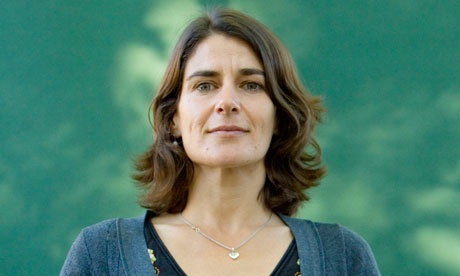
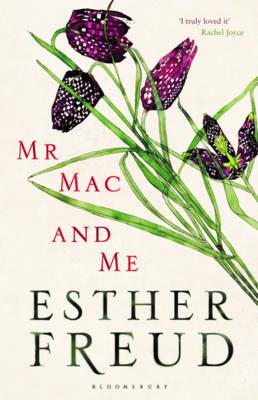
With a name culminating in Freud one would suspect the fifty-one year old British author may have an interesting lineage – and one would be spot on. Yes, she is the great-granddaughter of the game-changing psychoanalyst and the offspring of artist Lucien. Growing up, she didn’t know all this, only getting to know her father, notoriously anti-family, as an adult. Esther would then often pose for him, sometimes for his nude studies. Her mother, commencing at eighteen, spent a few short years with the then thirty-eight years old dauber, providing him with two offspring. He had fourteen known in all to a variety of women. Her sister Bella is an acclaimed fashion designer. Before Freud senior passed on he’d read and advised on all of his daughter’s literary oeuvre to that point – so he did mellow in later years – her first being what she is best known for, ‘Hideous Kinky’. Her latest is ‘Mr Mac and Me’.

Esther-Freud

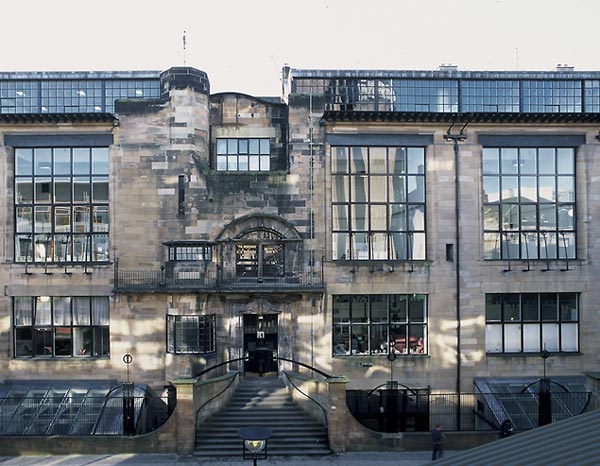
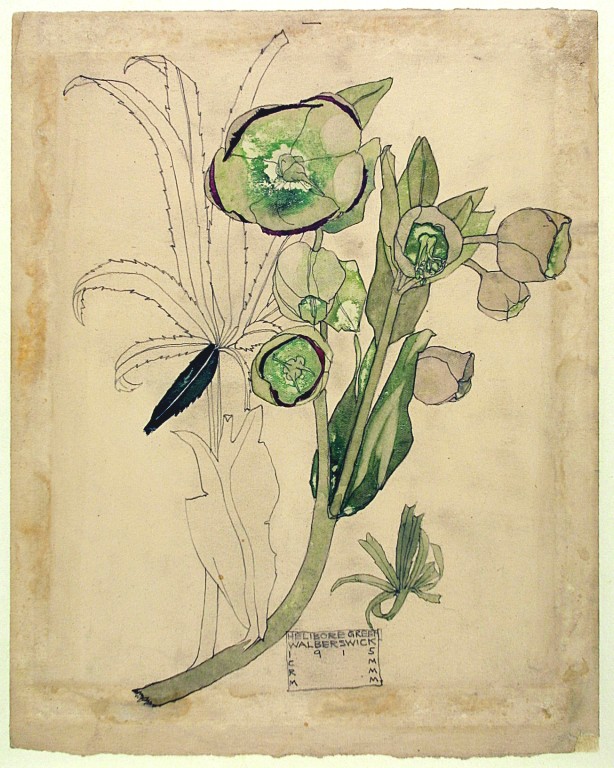
Charles Rennie Mackintosh is now recognised as Scotland’s greatest architect. In some quarters his triumph, the Glasgow School of Arts, is regarded as the UK’s most perfectly planned edifice. As well, he was a painter and designer – Britain’s most notable contributor to the Art Nouveau movement. Behind every great man…and Charles had his Margaret, a fellow artist who has only recently emerged from his shadow. He considered his wife a genius and her influence on his own style beyond measure.

gsa-mackintosh

Although Mackintosh died in 1928, he, Margaret and Esther F are unified by the fact that they all spent/spend part of their lives in the village of Walberswick on that part of the Suffolk coast that was/is crumbling into the briny. One village building was prominent in linking the trio – the Anchor Inn. It houses Esther and her husband, actor David Morrissey, when they come down from their other home in North London. And for a time, back in the day, it also housed the architect.

At one stage in his career Charles left the security of an established firm to strike out on his own. Due to the tough economic times in the lead up to the Great War, his ambitions were thwarted, the business failed and he retreated to Walberswick, a known haven for artists. There he licked his wounds. In 1915 he was caught up in anti-German hysteria and arrested as a spy. It was not done to be wandering the strands at night with lamp and binoculars. He and his muse stayed on in the seaside location until 1923, after which they decamped to France. They returned to London, he in desperate health, one year before his death.

John Rennie Mackintosh: little-known architectural gem near Helensburgh.   E.O. Hopp /Corbis

So it is perhaps apt that my only concession to the hoopla that is going on with the centenary of an event that occurred on the Turkish coast is that I have read this gently moving novel of life in a British coastal village. It’s also set one hundred years ago. Being Suffolk, though, the souls that feature in Freud’s loving tome can hear the cannon fire from across the water. Their closeness to Flanders require the townsfolk to billet soldiers en route to the slaughter fields and house some of the poor Belgian civilians fleeing the same. And yes, Zeppelins pass overhead to launch mayhem on the capital, as Thomas Maggs, the club-footed son of the publican reports – ‘I run with the airship back across the beach, up over the dunes, following it along the street and past the church. If there was someone on the flat roof of the tower, then I could shout to them and they might, just this once, jangle their bells or, better, aim a rifle at it, but there is no-one in the church yard, only my family of starlings, keeping watch over our grave.’

Soon, though, the blimp is indeed shot down, giving the novel a few pages during which the pulse quickens. For the rest of it the narrative clips along at a more sedate pace, being not in the least less engrossing for that.

Its story is relayed to us through the voice of the boy Maggs. For a while he is wary of the stranger he comes to call Mr Mac and his activities in town. The two come together through a love of drawing, with eventually Thomas becoming a part of the furniture in the Mackintosh residence. Margaret has to spend much time away for family and health reasons with the lad becoming the conduit via which letters are transferred from Mac’s hand to the post office. As the author’s means for us to peruse the actual correspondence between the two devoted artists, Ms Freud has her youthful protagonist steam them open and read, before resealing and sending them on their way.

Of course there is much else going on in young Magg’s world other than Mr Mac’s trials and tribulations. There’s his father’s alcoholism and the developing feelings for the herring girl who comes down from the Scottish Isles each season to gut the ‘silver darlings’. There’s his sister’s love life and illness to worry about. There’s also stormy sea rescues, as well, to get involved in.

mr-mac-and-me

The New York Times describes Esther Freud as ‘A superbly gifted writer.’ This mere scribbler can but concur. Little of huge import occurs in ‘Mr Mac and Me’ – but it is still a wonderful homage to life as it once was. At times it is tough and uncompromising as Thomas battles his lameness to be all things to those who rely on him. At times there are paragraphs of utmost tenderness – the artist’s devotion to getting his sketches of the local flora just right, the dash Margaret must make down from London to free her befuddled, perplexed husband away from the arms of the law. It’s all terrific stuff from a wordsmith who warrants a higher profile in these parts.

mac

De Lempicka, The Last Nude and Ms Abel

She ‘...set down her drawing board, and leaned forward. When I felt her hair wisping against my face again, I inhaled sharply. When she kissed me I sighed….I had never kissed lips so soft. She stood and lifted the scarf off me. Her eyes were like silver. ‘Oh?’ she said, holding the scarf in the air, the pale chiffon with its darker, wet bull’s eye. I closed my eyes, abashed. I couldn’t open them. I heard Tamara set her rings deliberately on the table before she said, ‘What’s going on here?

I know where there are a couple of stands of them in the city – one in the foyer of the State Library, the other at the entrance to the Long Gallery, Salamanca. It was at the latter I spotted those particular cards as I mounted the stairs to see an exhibition. I instantly recognised the artist’s work on them – or, at least, I thought I did. ‘I wonder why they’re advertising de Lempicka,’ I thought to myself.

Avant postcards are in similar stands at numerous locations all around the country. They give notice of upcoming events or, more excitingly for me, feature the work of artists and photographers trying to get their name out there into the public domain. As I reached for a handful of the cards I’d spotted, I soon saw they weren’t an example of the oeuvre of the artist I had in mind, but the work of another entirely. You could see, though, this painter was under de Lempicka’s spell, as I have been for some time now.

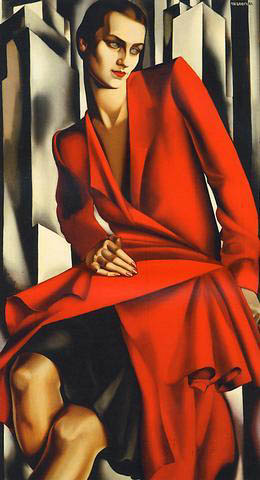
Think paintings that best represent the art deco style and more and more art fans think of the ‘baroness with the brush’, Tamara de Lempicka. She was the most fashionable portraitist of her generation. Celebrities lined up to be painted by her, but the Depression saw her popularity wane, only to be revived in the final three decades of the last century and into our new millennium. She is well and truly back in vogue, her daubings instantly recognisable and these days, ubiquitous.

de lempika

The artist was born Maria Górska in Warsaw in 1898. She was of Jewish background surrounded by wealth. The future Tamara de L attended boarding school in Switzerland and during her formative years lived in a variety of places, including the French Riviera and St Petersburg. She spotted the man she intended to marry at age fifteen and did so three years later – Tadeusz Lempicki. He wanted her for her money – not a recipe for success.

Come the Revolution and the couple were forced to flee to Paris, minus a significant proportion of their assets. Here Tamara gave birth to her daughter Kizette and became immersed in the bohemian life of the city, soon entranced by Picasso and the Cubists. She took to the brush to try and make a crust – something her layabout hubby thought beneath him. She was a quick worker, soon finding a populist approach to her renderings – one that would readily sell, it turned out. After 1925 she was exhibiting all over Europe and was charging top dollar for her portraits to boot. She fell in lust with many of her sitters. Even the notorious Gabriele D’Annunzio came under her spell, although it seems he failed to bed her.

She owned the Roaring Twenties like few others. If Gatsby was the male epitome, she was the female. She mixed with Cocteau and Gide, Collette and Sackville-West. She was also flamboyantly bisexual, neglecting not only the wastrel Tadeusz but also her daughter. She soon had a rich man as both her patron and sugar daddy. Travelling to the US was also on her agenda – here she fell in with de Kooning and Georgia O’Keeffe. Later on she married her older suitor, Raoul Kuffner, thus gaining her title, Baroness. With the advent of the second great war her star had well and truly diminished but, undeterred, she kept painting, trying out new styles to an unresponsive public. She also moved permanently to America, paralleling a move into prickly old age. The end saw her residing in Mexico where she died of a stroke in 1980. Her ashes were spread on Popocatepetl. She did live long enough to see her work reassessed by the artistic trendsetters, who declared that owning one or more of her works definitely put you front and centre amongst the in-crowd. These days her collectors include Madonna, Jack Nicholson and Barbra Streisand.

de lempika02

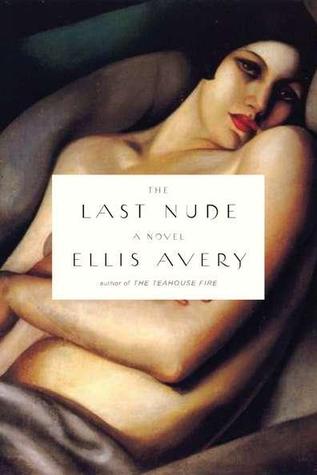
The opening paragraph of this scribbling is taken from ‘The Last Nude’ and are the initial sentences to a description of a lesbian coupling between the painter and one of her models – what follows is very saucy indeed. Ellis Avery’s novel is based on the main facts of the great woman’s life, but the gaps are filled in by supposition. The work received, on publication, rave reviews and several prestigious gongs in the United States. Reading the four pages of recommendations that prefaced the story in the book, as I perused it in a Melbourne bookshop, I felt I must be in for a real treat and rushed to the counter to purchase. I enjoy novels that do add made up substance to fact, plus it was about a favourite heroine, so what could go wrong?

AveryEllislast nude

Although I did manage to finish it, I really had to force myself to turn each page and refrain from skimming. I found it dirgeful, the writing uninspiring. Sad to say that the only time it came alive was with its few erotic passages – not enough to keep this customer satisfied. But it obviously struck a chord in America – so much so that Lempickaphiles can take a tour of Paris around its featured sites!

The major part of Avery’s offering is taken from the point of view of Rafaela Fano, an escapee from tight American strictures, enjoying the freedom the French capital affords. But she finds it struggletown too, even despite the seventeen year old’s willingness to use her body to achieve her ends. Life changes markedly when she is discovered by de Lempicka who offers to pay her to pose. Soon it is posing minus garments, apart from a well placed scarf – and before too long the two are intimately exploring each other’s body parts. As time proceeds both end up having much else on the boil as well, with the result that, at times, the plot and who was who lost me. I just wasn’t interested enough in all their scheming and machinations. The final part features the portraitist in her old age, contrary and cantankerous, with some her and Rafaela’s back story filled as bonus. The Washington Post describes ‘The Last Nude’ as ‘A compulsively readable novel.’ I found it anything but.

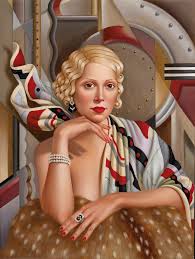
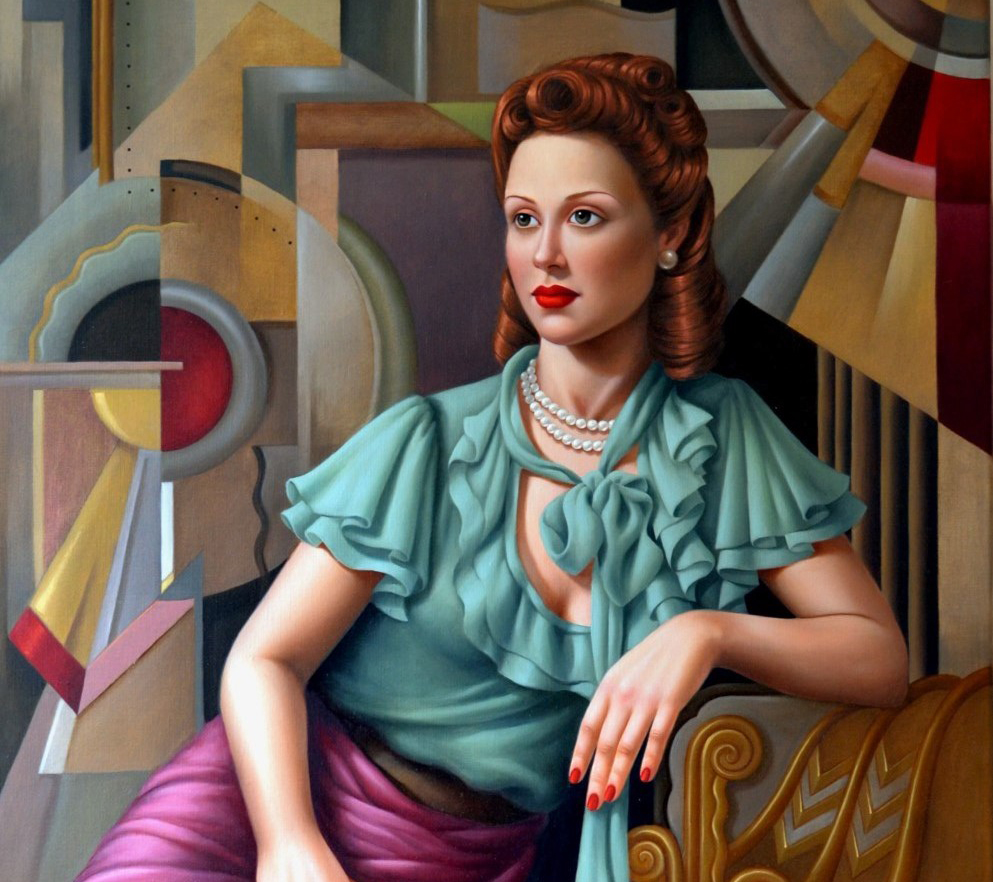
But the positive spin-off is that I discovered the postcards and through them, at the top of the stairs in the Salamanca Arts Centre, Catherine Abel. The card I initially took to be a de Lempicka was in fact Abel’s ‘La Femme en Soie’, an example of her expertise from only last year. It features a cool blonde, presumably from the Flapper Age, peering out at the viewer, draped in striped silk (soie), bejewelled and enticing. Up in the ether I found much more to like from this artist who readily admits the debt she owes to the daubing baroness, as well as to Picasso, Braque and Dali. This Australian has indeed honed her experience by travelling to Paris and has been a finalist for the Archibalds. She describes her infatuation with de Lempicka by likening her to ‘…the teacher I never had.’ It was seeing the Baroness’ masterpieces during her overseas sojourns that inspired her to attempt to paint for a living. As well as Abel’s figurative work, there are still lifes and landscapes to be viewed on-line. But its certainly her stunning capturings of the feminine form that stand-out, as is the case with her role model. So if you too fancy the work of the icon of the twenties, check out her modern day acolyte. Beware – for, as with de Lempicka, some of her product is NSFW.

abel la femme catherine

So the disappointment of the book has been offset by discovering a new artist to follow the progress of with interest. And if for me Avery’s book didn’t capture the spirit of T de L, Catherine Abel certainly does.

abel01

Gallery of Catherine Abel’s work = http://www.catherineabel.com/

Gallery of Tamara de Lempicka’s work = http://www.tamara-de-lempicka.org/

Ellis Avery Website = http://ellisavery.com/

A ‘Last Nude’ tour of Paris = https://americangirlsartclubinparis.wordpress.com/2012/01/25/the-last-nude-a-literary-tour-of-paris/