Category Archives: art and photography

Oslo

‘I took up drawing in my early twenties to escape the drudgery of teaching English to miserable high school kids in miserable towns on the west coast of Tasmania.’
That surprised me – but then I found this, trying to track down more of his personal history on-line
‘Oslo Davis was born in Brooklyn, Tasmania. He is now an illustrator and cartoonist living in Melbourne, Australia.’

At first I was going to write that, as we both taught in the same educational district of the island state and as I had forty years teaching in the same region as Oslo, I’d probably come across him. Then, to find out he was born in the suburb of Brooklyn in my home town of Burnie – one of my favourite cartoonists – I was gobsmacked to say the least. Oslo a Burnie boy – well I never. And like me, he headed south to complete his education at UTAS, possibly also well before it came to be generally known as UTAS – although, by the look of him, he is considerably younger than myself. And we both ended up teaching. No doubt we probably attended the same moderation meetings – they usually being a right royal waste of time really, trying to make sure our teaching of English was on the same page, so to speak. As if.

Now Burnie’s not the most attractive town on an island noted for its attractive locales, but, compared to places like Rosebery and Queenstown, down the west, it’s a veritable Paris or Florence – despite the latter mining town having the ‘Mountains of the Moon’ and the infamous gravel oval. In such a place most teenagers would be miserable – I’m sure it wasn’t entirely down to Mr Davis’ lack of pedagogical skill. But teaching obviously wasn’t for him. Thankfully, so it turns out. In between Oslo leaving the classroom and achieving the measure of fame he has today, he dipped into a number of professions, as well as some extensive travel, before he found his true calling. And that brings me to the point of this exercise – reporting on my perusal of his latest publication, ‘Drawing Funny’.

In this Oslo recalls that he’d always been a doodler, leading to now earning a living from producing funny drawings. He has developed, as any cartoonist worth his or her salt should, his own recognisable style – despite once receiving a letter of complaint, from a more senior artist, reckoning that, ‘I have never ever seen worse drawings anywhere by anyone.’

Oslo came to my attention through his work for the Age newspaper. He was a regular contributor until he, along with Horacek and Weldon, was sacked as full time employee in 2012 due to cost cutting measures that saw the broadsheet become more tabloid. He now only produces two weekly cartoons for that daily, one being his popular ‘Overheard’ series for the Sunday edition; as well as an occasional article. But he has various other gigs to fall back on – and then there are his books, ranging on such topics as the attractions of various Melbourne localities, Henry Lawson to even Donald Trump.

‘Drawing Funny’ is described in its blurb as a ‘how to’ guide, but it really just tells how Davis goes about it – I suspect such a thing cannot be taught in any case. And it is also a vehicle for the ‘best of’ his product. There were quite a few fresh ones for me to quietly have a chuckle over, the highlight being, for me, his take on the abomination that is the morning shower. I guess we may well have that in common too – our abhorrence of that form of ablution as opposed to languorously lingering in the tub. Showers apart, there’s much pleasure to be had in this small collection and for the uninitiated it would be a great introduction to Oslo’s product – and at around a mere $15, it’s a steal.

Oslo’s website = http://www.oslodavis.com/

The Real Sirens

‘It wasn’t like that,’ she stated firmly. ‘It wasn’t like that at all.’

And it would be hard to imagine it being so, I have to admit. It was another time, the ‘wowsers’ were in their ascendancy – but we do know that Springwood was out of kilter with the rest of strictured Australian society then. But what was displayed in the ‘that’ she spoke of would surely have been beyond the pale. The ‘that’ was the early nineties movie, ‘The Sirens’.

sirens-mov

The movie didn’t really set the world on fire critically – but it was popular because of the amount of flesh it exposed. And with the subject matter – well it would be necessary to have some bare maidens involved, wouldn’t it? But it was a thin premise. A newly arrived to Oz English priest, Tony Campion, played, by Hugh Grant before he became famous for being Hugh Grant, is instructed to visit Springwood and check out the rumours that aspects of what was going on there were blasphemous. This was particularly the case with a painting of the crucifixion, reportedly soon to be on display for all to see. Tony dutifully takes the train out bush to the property with his newly wedded and innocent wife, Estella (Tara Fitzgerald). At Springwood both are radically changed over the course of their stay by what they espy. Esther receives her sexual awakening and Hugh’s character leaves with a different set of attitudes to the ones he arrived with. This is the result of witnessing, as well as later participating in, the goings-on at the residence. Tara F’s character joins Elle Mcpherson, Portia de Rossi, Kate Fischer and Pamela Rabe as one of the sirens, the artist’s in-house muses and models. The coterie would slip off their clothes at a moment’s notice to either pose or cavort. I guess by now any reasonably savvy reader would have figured out the identity of the master of the house where the disturbing goings-on were occurring – none other than the country’s leading thorn in the side of the wowsers of society; those we’d perhaps now call the fun police. They were predictably shocked to their cotton socks about the hearsay of copious lewdness emanating from the homestead, with the proof of the pudding being the resulting works of art that were thoroughly scandalous to the minds of the establishment. Sam Neill, starring as Norman Lindsay, must have thought all his Christmases had come at once being surrounded by such a cast of stunning women.

But what was it really like at Springwood? Well let’s visit real life siren Pearl, of whom a punster could say had a purler of a life. She made the opening remark that, to the contrary, it wasn’t as the movie portrayed at all. Now I first came to her via a newspaper column, rather than the movie. Researching further, I found she blamed Elle and the lorelei (apt collective noun that) of other sirens in the movie for besmirching Norman Lindsay’s good name. From her Gold Coast apartment, in a recent on-line interview, she was still in sprightly and vivacious form when she recalled posing nude for the artist. She forthrightly stated that, through numerous sessions, when she wasn’t wearing a stitch all those decades ago, he never laid a finger on her. Admittedly, by the time the striking Joan Crawford look-alike posed for him, the grand man of Aussie painting was 60 or more.

pearl-g

The connection between the two came when NL saw a photo of her in a newspaper. He realised that this eighteen year old girl had a special quality that he could translate onto canvas. Getting her to do it, though, was another matter. The photo he espied back in 1937 came about because she managed to win that year’s Miss Bondi Surf competition. Norman wasn’t the only one to spot her qualities. He asked his son to track her down, which he duly did, but by the time he got to her the young beauty had already been submerged in offers. That she was also a self-starter saw her almost immediately becoming one of Sydney’s most sought after mannequins for magazine work, fashion parades and in-store promotions. Pearl claims that, back then, she had nil knowledge of men when it came to the ways of the world, was still a virgin and was terribly naive. At that stage she knew of Lindsay only as an illustrator of children’s books, such as the ‘Magic Pudding’. There was no inking of the scandal he constantly caused with his racy art work. It was almost a year later, when she was returning on foot from a fashion shoot in the Rocks, that she happened to pass Lindsay’s studio, remembered the approach and on a whim, knocked on the door.

At first the ageing dauber was content with just painting her portrait. But as she continued to answer his calls to pose, she became more trusting. So when he did broach the subject of nudity, she was willing. He remained completely professional during all her Bridge Street sittings, right up until Pearl Goldman moved on in 1943. You can check out the results in paintings such as ‘Mantilla’, ‘The Amazons’ and ‘Imperia’.

Posing for Lindsay bought Pearl into a world she knew little of, educating her immensely. The bohemian life style that abounded in artistic circles in the Emerald City would be an eye-opener for anyone, given the conservative nature of the era – but for a girl still in her teens it must have been quite shocking. But she handled it with aplomb – evidence of her growing sophistication. She became friends with some others in the artist’s circle, particularly the poet Douglas Stewart and the woman who was later revealed as Lindsay’s mistress. But another notable, Buster Fiddess, a well-known comedian at the time, set her on yet another course. He arranged an audition for her for a Tivoli show called ‘Okay for Sound’. She was successful and so was off and running with another string to her bow. She toured the country and overseas in numerous productions, sometimes even playing the leading role. This treading of the boards also intrigued Lindsay; so much so he based his 1950’s novel, ‘Dust or Polish’, on her tales. For Pearl this inevitably led to movie roles. She was an Egyptian spy in Chauvel’s ‘Forty Thousand Horsemen’ and spent a fair bit of 1959 on the set of ‘On the Beach’, becoming firm mates with Gregory Peck.

And at age 27 she married into money, not so innocent of worldliness any more. Hubby was nearly twenty years her senior, but he showered her with jewels, furs and even a sporty white Jaguar.

pearl-g01

And sadly, as to my first contact with Pearl in that newspaper article? Well, it was her obituary that sent me searching for more in the ether. She passed away in June, 2016.

But it is a very different story when it comes to Pearl’s pal and another of Lindsay’s muses – Margaret, the aforementioned mistress. As I was looking into Goldman I came across her, so I decided to glean what I could about this artist model’s story too. As it turns out, Pearl was not alone in having a remarkable one to tell. In doing this I came across a certain depiction of this other woman, one that stopped me in my tracks.

Perhaps I am not quite as worldly myself as I thought when it comes to the artistically presented undraped female body – but this portrayal of Margaret, if it didn’t exactly shock, it did cause a sharp intake of breath. I assumed I was also reasonably familiar with NL’s works, but this was somehow different and more confronting than anything else I’d observed on his canvases. It’s frankness, I suggest, must have really stuck it up the wowsers way back when. Pearls, mate looked fearless in it.

Originally this scribbling was to just focus on Pearl alone, but, by contrast, the legendary painter certainly did more than just lay a finger on Margaret. She was the opposite of Pearl. So off on a tangent I went, pursuing her as well. Now as far as may be ascertained the dauber had just two affairs, one being when he dallianced with Margaret. The other was earlier, whilst married to his first wife, Kate. The object of his desires then was a very young model, Soady. Lindsay left Kate to marry Soady. And whilst he was attached to her, along came Margaret Coen and NL was again tempted.

norman_lindsay_1931

As with Pearl, there was much more to Margaret than merely being prepared to take her clothes off for man holding a paintbrush. It was through his brothers, Percy and Ray, that Coen first came into contact with the Lord of Springwood. Trying to establish herself as an artist in her own right, she visited Lindsay in 1930, at his residence in the Blue Mountains, with the hope that he would educate her in the use of water colours. He certainly did that – and more it seems. It wasn’t long before she and the man she described as ‘...tremendously alive…like quicksilver, constantly moving, with an extraordinary lightness about him.’ were lovers. Later on, Lindsay’s daughter classed Margaret as ‘…a very beautiful, gentle creature.‘ She possessed a milky white complexion, sparkling blue eyes and a mass of lack hair. She was smitten by him and Norman reciprocated. Their liaison lasted until 1939. Their friendship, perhaps more importantly, lasted until death.

She was still in NL’s circle when Pearl arrived on the scene, but by 1945 MC was married to the artist’s other great mate, the poet Stewart. Although Coen’s artistic pursuits proved to be underwhelming in the years prior to Springwood, the fact that she was gifted a studio in Sydney bought her into contact with the local artistic set, most notably Grace Crowley and Thea Proctor, as well as the Lindsay Brothers. Post Springwood she honed her skills with a jaunt around Europe during the fifties. On her return to Oz she received some recognition through exhibitions and prizes for her works. These days she is represented in numerous collections around the country. She is noted primarily for her still lifes and floral arrangements. Margaret passed away in 1993.

coen02

Her daughter Meg, a noted journalist and film-maker, during the eighties, wrote and published a biography of her mother. In it there was no mention of the true nature of her relationship with NL – Meg simply had no knowledge of it at that stage. She added an extra chapter in a later edition of her tome once it was uncovered.

Now of course the paintings mentioned in this piece are all easily available on-line but, if you seek them out, be aware of where you are in doing so as the man’s work still can be NSFW, even in these enlightened times. As the artist’s muses these two women kept as much hidden from the eye as they revealed. I enjoyed spending time with them. An artist has given them the ability to intrigue for generations to come. They may intrigue you too, as they did me.

Official trailer for ‘Sirens’ – https://www.youtube.com/watch?v=JTzat7vRdCQ

Tassie Wild

In truth I preferred the old Wilderness Shop. It was more down market and therefore a more comfortable fit with me, I guess. I’ve scribed before on the putoffedness of some of the galleries around town for the likes of me. Wild Island doesn’t quite have that effect – I will still enter and peruse. It, though, has far less stock than its antecedent and the prices are beyond my budget, apart from the occasional card. But then I am not their preferred demographic and topping it off, unfortunately my walls are full. Still, there’s no question they are offering an outstanding product from some of our island in the southern seas’ leading camerasmiths, craftspeople and daubers. So don’t let me put you off. If you haven’t already done so, go in for a squiz, particularly if you do have some of that wall space going. Support local talent please.

So I made one of my rare visits last month. I didn’t purchase anything, but there was, as always, much to admire. On leaving, my eye was drawn to a brochure because of the work of art it featured. It was advertising the store’s latest exhibition, so I cast my eye around the shop in case I had missed the painting during my initial once over. It wasn’t there, but when I examined the card, I realised I was one day too early. Too me the painting portrayed seemed to perfectly capture Tasmania’s winter experience, particularly enhanced by the fact that it was of a snowy wilderness right on our doorstep.

Michael_Weitnauer01

So, duly, a week or so later I went back to see Michael Weitnauer’s ‘Snow Series – Mount Wellington’ in its glory. I was not disappointed – it is a terrific piece, even when measured up against some some great stuff from camera snappers who also took my attention, such as Loic le Guilly and Rob Blakers. Going out to art exhibitions reasonably regularly, I was already quite familiar with Weitnauer’s oeuvre, but this was the one item that projected his abilities for me more so than what I had previously espied.

In an on-line bio the artist states he is strongly influenced by Fred Williams and with ‘Mt Wellington’, even an untrained eye like mine can discern that in a thrice. I remember going to a showing of Williams’ works in Melbourne, if my memory serves me well, but being underwhelmed by much of his product. But then I turned a corner to a room of his desert landscapes and was immediately transfixed by their power and beauty. Had anybody captured the landscape of the Aussie heartland as well? And Weitnauer’s take on kunanyi had the same impact. Added to its entrancing allure is that we, as Hobartians, look at the mountain’s magnificent ramparts everyday.

Michael_Weitnauer

The artist’s surname indicates he is of German heritage and he has spent much time there and in other European locations. He states he is influenced, as well, by some of his homeland’s leading contemporary painters. He has won some serious gongs, including the Wrest Point 2002 Art Award – one of my favourite yearly exhibitions. Weitnauer has been, several times, a finalist for the Glover. His solo shows often sell out – and no wonder. The Hobart born, UTAS educated, practitioner must now rate amongst the island’s most prominent painters and I would definitely include ‘Mount Wellington’ in the art gallery of my mind – the only place I can hang it, given my circumstances. I’d love to look at it daily, but will have to make do with the small facsimile blu-tacked to the wall in my man cave.

Michael_Weitnauer02

Artist’s website = http://www.michaelweitnauer.com/

Heady Times for Bruno

Did he even know? And if he did, did it prey on his mind that his photographs led to executions?

Now I knew about the Franco-Prussian War, the monumental defeat at Sedan and the capture of Emperor Napoleon III. The victorious Germans were ready to lay siege to Paris. I had no knowledge of what went on in the City of Light during this period though. When a lecturer, during my university years, launched into an account of the events in that city during those troubled times, it was a revelation. During my formative years it was off the curriculum in France – it was the darkness of the Cold War and it had the stench of ‘Reds under the bed’ and all that malarky, even if it had occurred eighty years previously. What, a society where everyone is equal? We can’t have that.

So I quickly became fascinated with the Paris Commune – perhaps the first example in modern history of ‘people power’. We’ve had the Arab Spring in recent times and mostly that has ended badly – so history repeats. The Commune was an attempt at government from the bottom up, so unlike the top down inflicted on most of the world. And for a while, it looked promising for the Communards. In a nutshell, here’s what happened.

Bruno-Braquehais-08

The French government were very eager to take control of the various cannons that defended Paris before the Hun arrived, but the people of the city and their home guard had other ideas. Barricades were built to prevent this occurring – the people, you see, weren’t too rapt with the ineptitude of recent months from the Emperor’s people and most had republican ideals. When the army duly arrived the motley defenders called on the soldiers to join them. Many did – some even shooting their hapless officers. Of course, all this did not go down well with the high command, already smarting from the indignities foisted on them by the Prussians. They weren’t going to stand for a rag-tag rabble taking over the capital and started to plot the demise of the uprising. The Communards themselves were a real mixture – union officials, members of the local National Guard, hangers-on and a few fiery anarchists just to make the mix more volatile. They elected leaders who issued the declaration that from henceforth Paris was an independent commune and called on all other French municipalities to join in the cause. This was beyond the pale for the authorities who gathered their forces to crush the rebellion. The revolutionary councils in Paris set up then lost the plot – they spent all their time and energy bickering amongst themselves instead of preparing for the threat that was on their doorstep. They were, consequently, smashed. After they had control, the army went on the rampage, joined by members of the privileged classes acting as vigilantes. They killed at will. In the end 30,000 Communards – and many who weren’t – gave their lives for the cause. Eventually the excesses were reigned in, only for the authorities to commence with the executions of those involved who survived the initial carnage. Unfortunately, a quickly put together booklet of 109 photographs of those troubled few weeks, entitled ‘Paris During the Commune’, became a means of identifying the rebels. The soul who compiled the publication was only out to make a few centimes from his prescience of making a record of it, lugging his cumbersome apparatus to get those images of the Commune and its aftermath. Bruno Braquehais’ life went downhill pretty quickly after this attempt to turn a profit for his efforts.

Bruno Braquehais

Prior to that life had been pretty sweet for Bruno. He’d married the boss’ daughter and made a satisfactory living for engaging in what many a male would give their eye tooth to – photographing nude models – and doing so very artistically, you understand. The results of his labours proved, understandably, quite popular in exhibitions around the city on the Seine. Many members of Parisian society also sought him out to capture their features for posterity.

Bruno Braquehais01

Now back in my uni days I remember sitting in the Morris Miller Library on campus, amongst the stacks, pouring over his images of the Commune in dusty books. Back then my main attention was affixed on the causes, course and results of the upheaval, rather than the fellow responsible for recording it. My fascination with the pioneers of photography came much later. The Commune is also noted as a template for the events of ’68 in the same city, as well as all over Europe, when students tried to replicate its aims. This had happened only a few years prior to me being spellbound in that library. Braquehais’ most famous image was of the toppling of the Vendôme column, but he took many others during his days wandering amidst the barricades, as well as the effects on the city once the powers to be were back in charge. It was only after I recently rediscovered his handiwork on-line that finding out more about the person responsible for the pictorial account piqued my interest.

Braquehais was born in Dieppe in 1823. He was profoundly deaf from a young age. Initially he displayed a talent for lithography but, when he met prominent camera-smith Alexis Gouin in 1850, he found his calling. He soon joined the ageing Gouin who specialised in hand-coloured daguerreotypes and the amazingly popular stereoscopic plates. The person who did the hard yards with the colouring-in was Gouin’s step-daughter, Laure. In 1852 Bruno B set up his own studio on the Rue de Richelieu. Gouin died in 1855, so Braquehais returned to the fold, assisting his old friend’s widow to run the place. When she too passed he branched out on his own again, this time setting up on the Rue des Italiens. By now he was heavily into nudes, hand-tinted by Laure, his dutiful good wife. Whether he made a killing with them in the saucy postcard trade, conducted all around the city, is unknown – but I suspect it’s likely.

Place-vendame-bbraquehais

All was progressing quite well for him when, pushing fifty, he made his momentous decision to go out onto the streets controlled by the Communards with his gear. And, unknowingly, along with the great American Civil War camera-men, he became am early instigator of photojournalism.

After his death in 1874 Bruno was largely forgotten with his treasure trove from the Commume languished in the dusty corners of museums. It was in 1971, on the hundredth anniversary of those earth-shattering events he snapped, that his work came back into vogue. His images graced many a commemorative exhibition on those heady times.

Bruno-Braquehais-15

Those who delved through the archives found that the years1871 to 1875 were not kind to our hero-of-sorts. Bruno’s work dried up – perhaps it was thought he was sympathetic to the revolutionaries’ cause. He was declared bankrupt in ’74, leading to a prison stretch. He only lasted after few days after his release.

Of course, he was never to know the esteem in which his work is held today. The nudes have gone by the wayside, in terms of significance, for he was the man who gave us the real Commune for posterity. It is sobering to think that many of those featured, if they survived the holocaust after the surrender, may have met the same demise by posing in group portraits for Bruno. Did that, in turn, weigh heavily on our man? The answer to that the ether did not deliver.


Shooting Bambi, Olive and Jean

On that cool autumnal Melbourne morning I was early for my destination. I’d trammed up from my digs down in St Kilda to the top end of Swanston Street. Being half an hour or so early, I set to wandering around the university campus there. It was quiet, away from the road; felt cut off there, being very few other souls about. Misty rain was falling and the turning leaves on the trees against the older buildings looked quite special to my eye. Being no weather for camera-smithery, I quickly snapped away with my mobile, checked my watch and headed off to meet Bambi, Olive and Jean.

I’d first encountered Olive back in the nineties when Ozpost issued a set of stamps to commemorate 150 years of photography in Australia. Her ‘Tea Cup Ballet’ was very modernistic for Australia at the time with its emphasis on light and shadow. I’d met her subsequently, on a few occasions, around the traps – and that morning she was sharing the walls with Max. I had no idea the two were associated so closely. And what did she have in common with Jean and Bambi? Well, the great Max – Max Dupain – trained his camera on their beautiful faces and bodies.

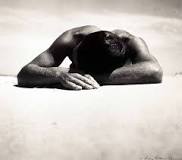
If there are any Australians who do not recall the name, most would recognise the lasting image that Dupain produced back in 1937 during his love affair with our beaches – ‘Sunbaker’. He took it on a southern NSW strand at Cuburra, the head and shoulders of his mate, Harold Salvage, lying on a horizon of sand and sky. It’s an image that has come to encapsulate our sun drenched nation. But he took many, many supposedly lesser views, on these beaches as well.
sunbaker

So what was a girl to do? The Depression had hit and young Jean Lorraine had nothing but a shapely body (her looks being described by some as quite plain) and a vivacious, life of the party personality. She was a good time gal but skint. She was not at all tempted by prostitution, as were so many others, to make ends meet. But she was not adverse to showing off her curvaceousness in its full glory. As a consequence she became sought after by artists and photographers. One such was Max.

Collection curator Jill White, who also worked with Max, but in his later years, comments that his take of the nude young model in ‘Jean with Wire Mesh’ ‘…is his most beautiful image. It leaves ‘Sunbaker’ for dead…it is incredibly sensual, masterful in its use of light and shade. To photograph someone with her forehead in full sunlight and the rest of her figure cloaked in shadow is an extraordinary achievement.’ It certainly caught my attention that morning – as well as the others included of Jean. She has been referred to as the camera-smith’s muse for the few years she was in his circle. Other contemporaries of Dupain took copious pictures of her as well, but none caught her spirit as did Max, nor her radiant beauty. Looking at his of her there is no hint as to why these others termed her ‘plain’. They lacked his skill and perhaps the relationship the three, including Olive, developed.

sunbaker01

At the Ian Potter Gallery, that crisp Sunday morn, I jotted her name down in the notebook I carry, resolving to take to the ether once I returned to Hobs to see what else I could discover about this muse of his. There wasn’t much, but in 2003 she was tracked down when the Library of NSW mounted an exhibition of the great man’s work, in association with the publication of a volume of his oeuvre.

She was aged 86 back in ’03, but the now Jean Bailey had been a resident of the US since 1947. When asked what she remembered of those youthful times when she posed for Dupain, she told how it was Cotton who had introduced her to the photographer. She had spotted 18 year old Jean flipping through an issue of ‘The Women’s Weekly’.

lorraine cotton

Jean by Olive

Olive Cotton was born in Sydney in 1911, her father Leo being a professor of geology. He was responsible for introducing her to the passion of her life when he purchased her a Box Brownie on turning eleven. Her young friend, Max, was similarly infatuated. By the onset of the thirties she was a member of several photography clubs and societies, along with her mate. In 1934 they began working together at his Bond Street studio. By now they’d progressed to being lovers – Max’s first marriage being over. Naturally, she also posed for him. She was second fiddle to Max artistically, her main role being in charge of the business side. But on occasions she went out on commissions with Max, taking her camera with her. It was interesting, at the Ian Potter, seeing two images of the same subject juxtaposed on the gallery wall – one by the pro, the other by his assistant clicking away surreptitiously. She more than stands up in comparison with the master. When he experimented, so did she.

Olive_Cotton_Max_Dupain_1930s

Olive by Max

It wasn’t until the war that Cotton come into her own. While the proprietor was away on official duty with his camera, she became responsible for all aspects of studio work. By now she was Max’s wife – but absence didn’t necessarily make the heart grow fonder. Although she continued on in his employ, they separated in ’41, divorcing three years later. In 1946 two important events happened for Olive, who by now was exhibiting her own work. Two volumes of her images were published and she married the new man in her life, Ross McInerney. This marked, for a period, the end of her earning a living with photography. Ross was a man of the land, managing farms about countryside NSW. She left city life for the rural and for the first three years of their marriage the pair lived in a tent. They eventually settled outside of Cowra, producing two children. One, Sally, has become a fine photographer in her own right, later on holding joint exhibitions with her mother. But these times were a long way off. In the 50’s there was no hope of earning a living from the camera, given the couple’s circumstances, so she became a mathematics teacher at the local high school. It wasn’t until 1964 that she returned to her greatest love, opening her own local studio. In the 80s there was a resurgence of interest in her pioneer work, thanks largely to a touring exhibition entitled ‘Australian Women Photographers 1890-1950’. Eventually she was in a position to hold shows in her own right and a film of her life and output, ‘Light Years’, was released in 1991. She passed away in 2003.

When Jean met Max, after they were introduced by Olive, the model had already, despite her tender years, been married and divorced. Decades later, after her tracking down to New York, she reminisced for an interviewer about the times they all spent together. She laughed when she recalled that, although Cotton was in reality somewhat older, Jean assumed she was around her age and told her so – and, as a result, although Jean declared herself to be ‘…as dumb as a stump’, she now had a friend for life. She felt easy and an equal in their company. She never gave any hint of embarrassment in taking off her clothes for their cameras. Other photographers, she explained, although they feigned worldliness, were clearly not comfortable in her naked presence. Perhaps their end product reflected this. She remembered fondly the duo’s love of experimentation with her body – thus producing one classic image and maybe others that should be.

dupain jean

Jean by Max

But the war and the fracturing of the relationship between the childhood friends changed all that. After it life became more frenetic for Max as his business expanded and he had little time for playing around, so to speak, with naked ladies. And besides, Jean was soon off to her new life in America and Olive headed bush.

But that didn’t mean Max ceased contact with beautiful women. In 1952 he shot Bambi. By that year he was the go-to man for society portraiture, including modeling portfolios, churning them out. But his take on Bambi was different – timeless. It’s been described as ‘…striking (in) its use of black, and the penetrating eye contact between subject and lens, (was) very rare for a Dupain portrait. The portrayal suggests an intriguing personality behind the beauty.’ She had all that in spades, did Bambi, as events turned out.

sunbaker02

Now some from an older generation may remember Bambi for she went on to give the world a jolly good shaking up – including the staidest of British institutions back then – the monarchy. Born in 1926, by the time she was sixteen Patricia Tuckwell was turning heads everywhere she went. And, at 89, she is still with us. She was also, in her youth, a prodigious musical talent, being a member of the Sydney Symphony Orchestra during her teens. On the side she was also a popular fashion mannequin and soon became one of a number of talented local beauties populating the small screens in our lounge rooms during the formative years of local television. She had a regular gig on HSV7 as a hostess.

At this time her life somewhat parallels Olive’s for she had also fallen in love and married another of our iconic camera-smiths, Athol Shmith. As with Cotton and Dupain, it didn’t last and by the late fifties she too was divorced. But she was now in Max’s orbit, thus his portrait. But Bambi, as she was nick-named in modeling circles, was destined for infamy.

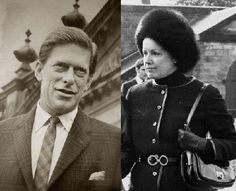
She had long desired to test her wings overseas so, like so many of our shining lights, she headed off, bound for Europe. En route she became waylaid at fog-bound Milan airport. Whilst waiting to be transported to Turin to continue her journey by air, she met and began chatting away to George. She sat next to him on the bus to the latter city’s aerodrome, as well as on a flight to Paris. By the end of that George was in love. Problem was, George was already married, with three kiddies, to Marion. And he also just happened to be in line for the throne of Britain as a relative of the Queen. He even had an earldom. He was, in fact, George Lascelles, 7th Earl of Harewood.

They, though, had so much in common, thought George. She was obviously a brilliant musician and he ran an opera company. Plus she was a stunner – anybody could see that. At 31 she was in her prime. On arrival in the City of Light he took her to the classy Tour d’Argent, for an equally classy meal, before departing the next day for London. But he was so besotted that, within 48 hours, he was back in Paris, wining and dining her. By now Bambi, no wide-eyed innocent in the headlights, was starting to realise what she was getting into. The Earl’s pile was a 104 roomed Georgian mansion in Yorkshire, stuffed full of priceless masterpieces, set on 4,600 acres that supported 3000 pigs and sundry other bucolic endeavours. Bambi did, though, find her new lover to be rather ‘…dishy and funny and intelligent.’ Once she arrived in London George was discreetly in her company as often as possible, eventually setting her up in her own comfortable digs to be at his beck and call. Soon, though, he figured she was more than just a mistress – she was, in fact, the love of his life. He wanted her wholly and solely. He wanted to be wedded to her.
sunbaker03

Now, after that pesky business with the heir to the throne pre-war and the more recent goings on between Margaret and that Townsend fellow, he knew the Palace would not be impressed with another scandal. This was especially the case once Marion discovered Bambi’s existence, some three months into the couple’s affair. He spilt the beans, begged for his freedom, but she refused point blank to go quietly. It soon became all too much for the now also besotted Miss Tuckwell and she fled back to Oz, only to relent to her man’s constant pleadings to return, sweetened by an even more luxurious pad (a six-bed roomed townhouse no less) to call her own. As the half-life of their existence continued in public, they resolved to cement their genuine love for each other by producing a child. Mark was born in 1964. Eventually, after her own mother died, Marion relented and she sued for divorce on the grounds of adultery. Predictably, all hell broke loose. Fleet Street made hay with the new royal-linked black sheep and his antipodean temptress. George lost all his prestigious positions and was blacklisted by London society. He considered escaping abroad till the dust settled, but in the end decided to stick it out and eventually the tabloids moved on. Buckingham Palace was singularly unimpressed but imposed no direct demands on him as happened with past upheavals closer to the throne. By 1967 there was perhaps a more permissive attitude in the air at all levels. Some pundits feel the business with George and Bambi set the template for what later occurred with Charles/Diana/Camilla. The couple quietly married, retreated to Yorkshire and got on with their lives. But poor Marion – the next man in her life was the wretched Jeremy Thorpe, leader of the Liberal Party, who soon became entangled in the murder of his alleged gay lover. She couldn’t take a trick.

The royals had a subtle welcoming of the couple back into the good books a decade or so later. After all, the pair freely gave so much of their time to worthwhile charities and British institutions. These days this tale of illicit love has faded into the past, largely forgotten. George died back in 2011.

And of the man who captured not only Bambi, but Olive and Jean as well, for posterity? Well, he continued to have an active life behind the camera lens. He became heavily involved in advertising for a while, before espousing a distaste for certain aspects of the burgeoning new industry. He didn’t try his luck overseas and rarely travelled out of Oz full stop. One of the few occasions was for the opening of the Australian embassy in Paris to photograph it for his good friend Harry Seidler, the architect. He also remarried after Cotton – his son Rex is also now a highly regarded snapper.

sunbaker04

Max once wrote, ‘Modern photography must do more than entertain, it must incite thought and by its clear statements of actuality, cultivate a sympathetic understanding of men and women and the life they live and create.’ Another of his classic shots, ‘The Meat Queue’ certainly does that.

sunbaker05

But that morning in Yarra City it was his early stuff that affected me the most – the stuff he took at the beach, or in the bush, with Jean and/or Olive in tow. They were free spirits, taking their cameras along to explore a fascination with their surrounds and each other. Those were more innocent times. Dupain lived long enough to record our country as it morphed into something else entirely.

teacup and olive

Max Dupain website = http://www.maxdupain.com.au/

Olive Cotton on-line gallery = http://www.artgallery.nsw.gov.au/collection/works/?artist_id=cotton-olive

Kiss in the Cloisters

He’s in his eighties now. He has a long memory; has seen all that is good at first hand, but has witnessed the evil our world can produce as well. He remembers, during the rule of dictator Mussolini, he was, like every young man, forced to join the Fascist youth movement. He sadly recalls being on a bus heading to a rally when he observed his troop leader stop it and hop off. His reason – to thrash an older man, a road maker. His crime – the poor fellow had failed to offer up a salute as the bus passed. The great man had had his first taste of what the male of the species is capable of. This distaste for the incident lives with him to this present day. It never sat well – doesn’t now.

Although so much was out of his control he still, even so, drew a line in the sand and took a risk during this time when he was living in Rome. An edict was issued late in the war by Italy’s Nazi occupiers. All citizens were to hand in their cameras. He refused to give up his – and he continued following his passion openly, in defiance.

For a time he also lived in Venice and he feels that today, in his visits there, he is witnessing another violation. This time the victim is the city of canals itself. With sadness he watches the giant cruise ships pull up in the lagoon to disgorge their passengers. The liners despoil the fragile environmental balance, the punters the social one. He considers those tramping over the city a travesty and recently completed an assignment for a national newspaper, capturing his moments in time to reinforce his view.

Although he is a revered doyen of his art in Italy, outside of that nation he is not widely known. It was through a kiss that I attained my first knowledge of Gianni Berengo Gardin, from up in the ether. It drew me in to investigate him further. I thought it was a timeless image, stark in its monochrome. As I discovered – he rarely uses colour. I suppose, if one looked closely at the garb of the two lost in love, it would date the image to the past. The framing of the couple by the colonnade captivated. Cyberspace was not backward in coming forward with a plethora of information when I googled GBG’s name. He’s obviously a camera-smith of immense repute for Italians.

VENICE 1959 - ST. MARCO SQUARE - VENEZIA 1959 - PIAZZA SAN MARCO


These days he calls Milan home and during a forty year period as a professional has taken over a million and a half pictures. The negatives are all stored in his studio. He has published 250 books, only ten of which are in colour. And don’t get him started on the evils of digital photography. He cites Dorothea Lange, Robert Doisneau (famed for another kiss) and Henri Cartier-Bresson as his inspirations. And in turn, his impact has been similarly huge. One of his volumes, co-produced with a psychiatrist, dealing with the vicissitudes and treatment of souls with mental illness, was directly responsible for changing the laws on the issue in his home country.

gianni-berengo-gardin-minor-scozia-1977

Before, during and immediately after the war he used his camera, as we all do, to take pretty sunsets and the images of our loved ones posing. It was a book sent to him by an American relative that changed his life. It was on the work of Lange, photographing victims of the Dust Bowl. Immediately he sat up and took notice. He now knew the power his own camera could possess. In his work on mental asylums, as well as in India, her influence is palpable. His subjects are people living with abject misery, but always there is dignity in the way he portrays them.

Venezia, “Il traghetto di san Tomà”, 1959

Born in Liguria in 1930, this image-maker is part Swiss and lived in that country for a while. As far as his education in the art is concerned, he is entirely self taught. He reckons schools of photography can teach the mechanisms, but never the soul. He was first published in Il Mondo in 1954. This magazine championed his photo-essays in the early years of his career. Stern, Vogue, Time, Le Figaro and others followed suit. The Touring Club of Italy was a prominent supporter for years; his product illustrating numerous of their guides for all over Europe. Automobiles feature strongly in his oeuvre as a result. Other notable contributions to the culture of his country were books on employees who laboured for signature firms such as Alfa Romeo, Fiat, Olivetti etc. Another tome throws a light on gypsy culture and then there are those on the great cities of the peninsula, lovingly reproduced.

Gianni Berengo Gardin05

His abode is a 19th century palazzo, occupied as well by his beloved dachshund Nina. His studio contains only one of his own images. Gracing the walls instead are the works of contemporary Italian artists, particularly drawings. But regarding the picture that first bought me into his orb – the smudged birds in the foreground, the two hidden faces in the embrace – it all made me wonder. Was it truly a fleeting moment in time, with me now for the rest of my years on a wall in the man-cave. For all I know he may have posed it, but I like to think not. In it there is, no doubt, a story worth speculating on.

gardid

An on-line gallery = http://www.dailymail.co.uk/travel/travel_news/article-3606488/Disappearing-world-Gianni-Berengo-Gardin-s-breathtaking-images-50-years-photography-document-Europe-s-industrialisation-capture-magical-moments.html

Big Picture Man

Fintan Magee. Now there’s a name the rolls off the tongue in a Huckleberry Finn kind of way. But it wasn’t his appellation that attracted me, but a painting of Fintan’s that appeared in my newspaper of choice, the Age. He was spruiking an exhibition of his work at a gallery in Collingwood, the theme of which was related to the Queensland floods of 2011. Entitled ‘The Rebuild’, it featured a blue-shirted figure, ankle deep in water, carrying a faggot of wood. In the accompanying puff piece, penned by Philippa Hawker, the artist talked of the inspiration for it as the evacuation of the family home in Brisbane, desperate to beat those flood-waters as they inexorably rose. The painting was in a semi-realistic style that I am attracted too, so I clipped out the piece, placing it in my blogging folder for future reference.

fintan magee01

Eventually I came back to Fintan and took to the ether to see what else he had to offer. Out there in cyberspace I discovered work that quite frankly kind of gobsmacked me. Hawker’s article did talk of his passion for street art, but I found what he produced was on a scale I did not expect – it was magical and eye-opening. So much so that this lad from Lismore has gained a reputation as the Banksy of Oz. In an interview on-line he laughed at the comparison, stating the only factor he had in common with the enigmatic master was that they both used walls as their canvas. Their styles couldn’t be more different.

fintan magee01

Fintan studied fine arts in Brissy before he migrated to Sydney – the reason for doing so was that the city on the harbour had more available wall space on its streets and its authorities were less conservative about the art that went on them. He commenced using his art to beautify their urban landscape with his impressive imprint.

He comes right out and says he is impressed with painting big, despite the fact he has diversified into other genres as well. Here in Australia we followed in the wake of Europe and US in latching on to the concept of harnessing street art to rejuvenate the living spaces of city dwellers. And Fintan M was one of the first here to do so. The result is that his big ticket artistic abilities are now gracing buildings in many parts of the country, as well as overseas. He’s set on conquering the world with it.

Fintan-Magee-2015

Shaun Tan has never been my cup of tea, but Magee stated he has been majorly influenced by the author/illustrator. They both, according to the artist, follow the same notion of their product being used to ‘…make an alternate world that runs parallel to our urban reality, something that you can escape to.’ Magee does it on buildings, Tan on the smaller space of a page in a picture book.

fintan magee05

In recent times Fintan has been invited to produce murals in Las Vegas, Atlanta, Moscow and the Tunisian island of Djerba. This year sees him in Rome holding an exhibition of his smaller offerings, plus decorating a couple of the Eternal City’s walls.

Asked what attracts him to such projects, Fintan replies, ‘I like the scale, I like working in public, I like making art that’s integrated into public spaces and part of people’s everyday lives.’ It’s impossible not to agree that he has been successful in that goal.

fintan-magee

Fintan’s website = http://www.fintanmagee.com/

Pug in the Landscape

It’s a fair point Corwin makes, during an interview for ‘Inside Art’, when he states, ‘The really amazing and really terrible thing about the internet is how easy it has become to find new artists, and see everything they have done. Many people don’t see the need to support the artists they enjoy on the internet, which makes things even more difficult.’

And I, along with millions of others, fit that category. Of course, had I the necessary, I could see myself as a financial benefactor to people like him – but that will never be. But I do try to share my enthusiasms with others, albeit in a very limited way. Those writers, musicians, artists and photographers out there in the ether give me so much pleasure and I do attempt to spread the word – which brings me to pugs.

It seems of late, if one walks into a gift or card shop, there’s many a pug regarding you, tempting you with that adorable squashed-faced cuteness. I am a pug lover from way-back though – before they became canine flavour of the month. The inspiration – well, her name was Cleo.

Franco01

These days, although I don’t have the privilege of having my own hound, there is still plenty of doggy love in my world. At my second home, my son and daughter-in-law’s pets make up for it. Oscar has been part of my life for so long now, with his constant companion, Memphis, a joy to be around. There is also next door’s Bella, as well as the other dogs we visit – Summer, Bronson, Ada and Jasper to mention a few.

Why no dog? Well, I guess owning a dog is not as easy as it used to be. There is expense involved, especially when we head off on travels. And then there are all the dos and don’ts petty officialdom have introduced – following a dog around with a plastic bag and scooper is not for me. It was far more lax when I was a kid and I seem to remember there were always animals to love in our Burnie home – cats, various bird species, rabbits, tortoises, blue-tongues and my father, bless him, had a thing for tropical fish. As an adult there was Jeannie. Named after a favoured pupil, this springer spaniel was so loved in the days before Katie and Rich arrived on the scene. I was devastated when she came off second best to an automobile.

But it has been Cleo that has left the lasting impression down through the years. I am pretty sure I once wrote a poem about her for a school magazine. I’d also be pretty sure that my dear mother, knowing her, would have that ode stored away somewhere in her extensive family archives and could readily produce it if asked. And I think Cleo was pretty liberal in her favours around the neighbourhood as she always seemed, in my mind, to be pregnant or suckling a litter. Her offspring were always of indeterminate breed – I don’t think we ever hooked her up with one of her own kind. Despite their rough pedigree, we never seemed to have trouble disposing of her offspring – and it was fun trying to guess from their appearance the local ‘tramp’ responsible for the outcome. But I also know, that without doubt, Cleo was family and at the time it would have been impossible to imagine life without her.

I have no recollection of what ended her life. I am hoping it was old age – maybe that occurred during my uni or early teaching years – but I couldn’t be sure. Undoubtedly Nan will fill me in once she reads this. Cleo, though, left a through-line that continues to this day. Sister Frith has owned another beloved pug, Barney – and her daughter Peta has her Mia. And she would be loved to bits too. And this brings me back to Corwin.

Yellowstone

Corwin Prescott owns a pug – Franco. He – Corwin, not the pug – is an internationally exhibited and published photographer. He’s known for his fine art nudes, particularly taken in landscape, as well as portraiture. But it wasn’t either of those genres that initially attracted my eye – it was his magnificent vistas of wilderness, minus any human form. They really made me sit up and take notice. I know a small laptop screen didn’t do them their full justice. But I envisaged them in huge scale, occupying considerable gallery wall space. Even so, what I did espy gave this armchair traveller an inkling of the grandeur of the places he visited to capture his magnificent images. It’s remarkably fine camera-smithery. The one that held my attention, in particular, was that of a buffalo emerging from the mists of Yellowstone National Park. It took my breath away, particularly knowing the history of those magnificent bovines.

Olympic-National-Park

‘As soon as I started taking photos I was doing portraits in the woods I would escape to when I was a kid. I’ve always felt safer surrounded by trees than people, so my photos of landscapes and nudes in nature are sort of my own meditation. They help me to relax and try to share all of these special places people tend to overlook with others.‘ Obviously, as this quote would indicate, checking out his website and galleries on-line, there is much that is NSFW, but his figurative work is worth a gander if nudity doesn’t trouble. But in many, if not all his journeys into the realm of nature at its wildest, there may be another companion, apart from his muses. He is worthy of a gallery or two of his own; an annual calendar even. I looked at Franco and memories of Cleo came flooding back.

pug in the wild

Prescott is a Philadelphian, graduating from the Antonelli Art Institute in 2008. Over the last five years he’s criss-crossed the US, attempting to travel and take images of every state in the union. The national park system is another fixation. And I’d like to think Franco is always with him on his adventures. ‘As a species we have drifted so far from the forest that just to hang out…in nature means exposing yourself to so many elements we aren’t equipped to handle any more.’

Grand-Teton

So here I am Corwin, doing my little bit, putting your name out there amongst the small circle who read my scriblings. Accompanying my words will be tangible proof of your talent – and one never knows, it just might lead to something tangible to your benefit. More than likely not, but it’s my way of saying thanks for what you have placed in the ether for us ordinary, financially challenged art lovers to take pleasure in. And give Franco a pat from me – a denizen of an island not without its own attractions, nature-wise.

Franco03

Corwin Prescott’s web-site = http://www.corwinprescott.com/

corwin

Grace, Life and Loomis

Grace: We all know her. She was luminous. Her time in Tinsel Town was truncated because she was soon wedded to a prince. Yet she still found time for some legendary movies – ‘High Noon’, ‘Rear Window’, ‘Dial M for Murder’ – and to win an Oscar for ‘Mogambo’. She met a tragic end in 1982. And he, Loomis, reflected the beauty of her and bought it into our lives.

dean - kelly

Life: I remember my family had a subscription for a while. I vaguely recall it as an Australian edition, but when I checked the ether I could find no mention of there being such a thing. For decades Life was the vehicle for the best in photojournalism world wide. It was also, I suspect, a contributory factor to my lifelong fascination with the photographic image. When I think back, I know I was always excited when it arrived in our mail box. I have a specific memory of taking an issue to the beach, to peruse, one summer’s day. That was long ago, that time of yore when ‘the beach was the place to go’ for myself as well as the Wilson Brothers. All this occurred in my youthful pre-uni Burnie days. Such quality, even then, would have been cruelly expensive to print and Life Magazine didn’t see much of the new millennium before folding – but, of course, on-line is the place to go these days for what this mag once provided. It started life (poor pun) in 1883, but it wasn’t until Henry Luce took over in 1936 that it gained its reputation for excellence. At its height Luce made sure it was staffed by the best in the business – and he, Loomis, was certainly up there in the mix. This employee, unlike some of his colleagues, wasn’t interested in the fripperies of camera-smithery. Just getting an image up to the standard the editors expected was his sole aim. He was the go-to guy when a photo of the greats of Hollywood or of European royalty was required. His bosses knew he would make them look human, accessible even – with just a hint of show-biz to mark them out from the rest of us. And he presented Grace to us, numerous times, via Life. And look at his capturings of her. Wasn’t she something? She was special and he only enhanced her specialness, turning her into the sublime.

Obituary photo of Loomis Dean.

Loomis: Good name, isn’t it. It’s his Christian name, not surname. Loomis Dean. Googling him, he often comes up as Dean Loomis, but that’s not right. Loomis Dean it is.

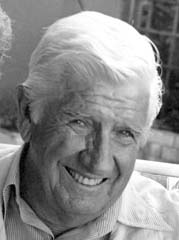
Grace’s photographic capturer was born in Florida in 1917. His dad ran a museum celebrating circuses – and that was an early fascination for Loomis too as a lad. Circuses were big business back then – having their own museums, schools even. In fact Loomis studied at one – the Ringling Bros Art School. He couldn’t draw to save himself, but he later stated it gave him an eye for composition. He then moved on to engineering – and that was even less to his liking. But during that time came his light-bulb moment when a fellow student took him into his darkroom and Loomis watched as a print emerged from a bath of chemicals. He was hooked. He was soon enrolling at the Mechanics Institute of Rochester, NY to study at its famous photography department. On graduation, what was his first job? Why, working as a camera-snapper for circuses. With Ringling Bros and Barnum and Bailey he started to develop his signature style, a style a critic once described as ‘…photography with a twinkle in the eye.’ Then along came the war and he signed up with the army air force – as an aerial photographer. This had the side effect of giving him a life long fear of flying. Of course many future assignments meant doing just that.

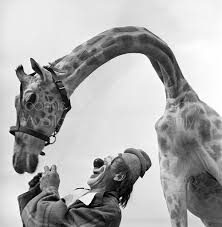
After the war he started off doing some freelance work and soon came on Life’s radar. His second commission for them landed him a coveted cover – and it was so Loomis, a giraffe peering over the shoulder of a clown. Yes, he had been commissioned to do a series on circuses. Realising his talent, the editors at Life soon had him on permanent staff, operating out of their LA office. He didn’t take a backward step after that. He was the first photographer at the scene when the liner Andrea Doria went down in the Atlantic. He photographed Hemingway in his beloved Spain not long before his self-induced death. His crowning glory was to convince a mad Englishman, Noel Coward, to indeed go out, dressed to the nines, into the midday sun of Nevada to help promote a certain song into being a world-wide hit.

loomis giraffenoel

In all Loomis Dean contributed fifty-two covers for Life. He left the organisation in 1961 only to return five years later. He stayed with them until 1969, then again went freelance. One of his favourite jobs later in his career was a gig as set photographer for James Bond movies.

In 2005 he passed away, aged 88. Just before his death he was asked what was the greatest moment in a long, illustrious career. He answered it was a photograph from a series he did on the Vatican. The Pope, Paul VI, obviously liked it too for he awarded LD a medal for it as well as granting him an audience. The snap in question showed white-robed bishops, bearing the Pope’s tiara, marching through St Peter’s Square.

dean kelly

This camera-smith had, in the days before television really took a stranglehold on the public’s imagination, one of the most glamorous jobs in the business. Although he hobnobbed with the world’s glitterati, he never lost his common touch. He was just as happy capturing images of, as he put it, the ‘…ski bums and the beach bums…’ of his world. He loved people of any persuasion and his photos, whether they be of rich or poor, demonstrate his affinity with all humankind – that’s what really shines. And he certainly made Grace shine for Life – and I thank him for that.

dean kelly01

An on-line Loomis Dean gallery = https://www.photographersgallery.com/by_artist.asp?id=215

And Then I Saw Her Face – Anna A

It was initially to be all about Laura – that was my intention. So what happened? I liked her work – it was in a semi-realistic style I am drawn to. As usual, it was one particular image that stood out for me – and as it turned out, that was Laura’s downfall. Two factors put me off doing a complete scribbling about her obvious talents. The first was that she became a dame so therefore was not so much emerging from deep in the shadows of history as do the stories of those I normally like to chase through the ether. And then I checked out the background to this particular daubing of hers.

Ruby-Loftus.laura knight a

My beautiful writerly daughter knows pretty well what I am into when it comes to my writings, such as they are. I always bookmark her sendings – and invariably, when I return to them later, I find there is usually a good yarn to be had from them – as was the case here. When she linked me to Arifar Akbar’s article, she knew I would be fascinated. So I will let the columnist herself tell the story of the subject of Laura’s striking painting:- ‘Ruby Loftus (was) a 21-year-old “shop girl” who mastered the difficult skill of screwing the breech ring of the anti-aircraft Bofors gun, a technique that normally took men almost a decade of dedicated experience. Her story was picked up by the Ministry of Information, which was trying to encourage women into weapons production at that point. Her portrait was painted by Knight and promptly exhibited at the Royal Academy.’

The problem was how the already Dame chose, or was pressured into, painting Ruby. Laura had had controversy erupting before regarding her work when, back in 1913, as a woman (shock horror), she chose to paint a nude. With Ruby she came full circle. Now it was the feminist brigade she was upsetting, not her male betters. This contretemps obviously did not develop till more recent times, but did demonstrate how under the male thumb lady painters, doing official work, were in the war years. So the problem with Laura’s image was that it was not ‘feminist’ enough – the Dame had supposedly glamoured Ruby up. There was a hint of lipstick, for heaven’s sake; she was beautiful and her machinery gleamed. It was even suggested that Ruby was some sort of poster girl imported for the occasion, as surely there could be no woman strong or intelligent enough to do the type of task this assembly line worker had the hide to be expert at. Of course, in reality, the work place would more than likely be fiendishly hot, sweaty and grimy – as Ruby would be herself. That type of image, though, would not be good for morale, nor would it entice womanhood into that type of war occupation.

The women who painted the two world wars, with perhaps the exception of Knight, have been largely forgotten. Not for them was the ‘glamour’ of capturing real fighting in oils or watercolour like their male colleagues did. The indelible images we have of these two great conflicts, together with other wars throughout history, have come from men. In our own nation’s experience, think Will Longstaff ‘s ‘Menin Gate at Midnight’ and the work of Ben Quilty in Afghanistan. There were a few women, working as nurses or ambulance drivers, who sketched/painted, in an unofficial capacity, their personal take on events closer to the fronts of both wars, an example being Olive Mudie-Cooke. Evelyn Dunbar, in the second conflict, was commissioned to visit battlefields, but well after the fighting had moved on. So, for the women, it was largely the home front they concentrated on. And once I had forsaken Laura, I decided to see who else amongst them had a story I could tell.
In the end I found one and it really was a case of – ‘And then I saw her face’. In fact it was that capturing my eye, once I typed Anna’s name into Google Images, before I even sighted her product. Statuesque, with a beauty that defied time, I was hooked. Somewhat disappointingly, mostly what on-line delivered was about her painting – little of her personally, but what was there was still worth passing on.

anna airey

In giving birth to Anna Airy (1882-1964), her mother died. Her father, Wilfred, who was to become the Astronomer General, was thoroughly supportive of his daughter’s artistic ambitions/adventures. She trained at London’s Slade School of Fine Art and was one of the very few women painters to be commissioned by a government body to record the war effort at home. In 1918 the Munitions Commission of the Imperial War Museum and the Ministry for Information – War Memorials Committee both engaged her to produce propaganda pieces. She was posted to Whitney Army Camp in Surrey where she worked along side Laura Knight. Who knows, they may have become friends. And here’s the rub. Anna’s contracts were of far less value than those awarded to forty-seven men doing the same work; the penalty clauses, if she did not meet the allocated time-frames, considerably harsher. She was to required to work under very difficult conditions and although her life was never in danger from a bullet, the places she painted were very primitive by modern day standards. There is a notation to the effect that in a projectile factory, near the Hackney Marshes, the floor was so hot it burnt the soles of her shoes. Due to her gender, it is recorded that there was a deep suspicion of Anna by her immediate superiors who felt put out that a woman had been foisted on them. She was also the only commissioned artist to have an official work rejected. This happened in 1919 – it affected her deeply and she destroyed the offending rendering, one depicting working girls leaving their place of work at the end of a day.
airy01

Of course she needed to have some sort of track record to receive a commission in the first place. After she left the Slade School in 1905 she successfully submitted her first work for exhibition at the Royal Academy. She continued to do so at this venue, most years, right up until 1956, exhibiting around eighty paintings there in total. Her first one-woman exhibition was held in 1908. Around this time she married fellow painter Geoffrey Buckingham Pocock. By the end of the decade she was regarded as one of the nation’s most promising painters of the fairer gender. Throughout her career she also took on students and in the end found a vocation in the teaching of art in her eventual home, Ipswich. Here she is well remembered with several schools to this day having bursaries in her name. Many former pupils have recalled how inspirational she was in this role. Later she also became President of the Ipswich Art Club. In the artistic sense she was admired for her draughts(wo)manship – and we are pointed to her exquisite botanical studies as proof of her capabilities in this aspect. She was also a more than competent portraitist with, as well, painting many a bucolic country scene in contrast to her war work in the harsh industrial landscape. ‘The Blackberry Harvest’ is an attractive example. Later in her career she settled down to become a contributor to Ipswichian life using her talents in art and pedagogy. An off-shoot of this was the publication of two books on her practices, ‘The Art of the Pastel’ and ‘Making a Start in Art’. She exhibited overseas and a jubilee exhibition of her oeuvre was held in 1952 by the Royal Society of British Artists.

anna-airy_blackberry-harvest

One of her works that intrigues is the fetching ‘The Little Mirror’. Garlanded by blooms, if one looks closely into the looking glass a figure may be discerned. Is it of the artist herself? Do the masses of flowers symbolise the marking of an important life milestone? Of course, Airy is not well known enough to have each of her works examined in digital-print detail but, even so, this particular work, for me, is a thing of beauty worth closer investigation.

anna_airy_the_little_mirror

I suppose, in the end, these words have been as much about why not Laura as they have why Anna. In any case they were both pioneers in their field, even if what they produced had to reflect an establishment and decidedly not a woman’s point of view about what was going on in a time of war. But they did pave the way for those who followed and who did have the freedom to present a feminine, even a feminist, perspective. Now photo-journalism has largely made the notion of war artists somewhat redundant, but it has also freed up practitioners, now awarded the right to visit war zones, to interpret as much as to relate. In her article ‘Women at War: The Female British Artists who were Written out of History’, Akbar mentions several who followed on in Knight and Airy’s wake. Examples cited were Mona Hatoum, Rita Duffy and the German Frauke Eigen. Hopefully the current Imperial War Museum’s exhibition, ‘Women War Artists’, will bring Anna and her lesser known colleagues in from those shadows of history.

airy03

Arifa Akbar article = http://www.independent.co.uk/arts-entertainment/art/features/women-at-war-the-female-british-artists-who-were-written-out-of-history-2264670.html