
All posts by stevestevelovellidau
Animal People – Charlotte Wood
Stephen is a fine name – in fact, an extremely fine name. It is derived from the Greek ‘Stephanos’, meaning ‘wreath’ or ‘crown’. Some have interpreted this to mean ‘kingly’, but a more appropriate ‘translation‘ would possibly be ‘encompassing’, just as a wreath encompasses the head. In Ancient Greece a wreath was traditionally presented as a reward for victors in contests such as the original Olympics – these being certainly more pure back then than the travesty they are today! As a name Stephen first appeared in Homer’s ‘Iliad’, with St Stephen a martyr of significance in Christian history. Back in the Middle Ages the name was actually pronounced Step-hen. Its shortened form ‘Steve’ first came accepted in the mid 1800s. Stephen reached its zenith of popularity in the United States in 1951. 1951 was a sensational year for Stephens. After that it began a long decline that continues to this day. In the UK in 1954 it was the nation’s third most popular name – today, there, it doesn’t even rank in the top 100. There has only been one King Stephen of the English (1135 – 1154) – he did such a mediocre job there’s never been another. He embroiled the nation in a long civil war fighting sis Matilda for the right to reign. Much of his time was spent plotting for his son Eustace to succeed him, no doubt hoping for a long line of Stephens and Eustaces – obviously it never happened. There have been a few more King Stephens in European countries. The name also did better at the Vatican with nine Stephens as Pope. Stephen VI was a particularly ghastly character who oversaw one of the grisliest events in papal history. This Stephen had his predeccessor Formosus’ rotting nine-month-old corpse dug up, redressed in his papal vestments and seated on the throne so he could be tried. Somehow the corpse hadn’t built much of a defence, and Formosus was found guilty of what were likely bogus charges. As punishment, three of Formosus’ fingers were cut off (the three fingers on the right hand used to give blessings). The corpse was then stripped of his sacred vestments, dressed as a layman, dragged through the streets and dumped in the Tiber River — where he was finally able to rest in peace. It’s a wonder any Stephens followed him. There have been many more Stephens famed in recent times for worthier reasons, but drop the appellation into Google and it takes a while to find any other than ‘King’ and ‘Jobs’.

Charlotte Wood’s Stephen, as he appears in ‘Animal People,’ was no luminary like King or Jobs. He was more akin to the kingly Stephen – that is, significantly mediocre. He didn’t deserve the love of his Fiona and knew it, feeling he was a square peg in a round hole – not so much with her and her girls, but certainly with her extended family, her ex and her friends. For this sequel of sorts to ‘The Children’, Ms Wood takes the ‘day in the life’ approach, accomplishing that hard ask reasonably successfully. It certainly is an eventful twenty four hours for our anti-hero. The time span is made up of encounters with all sorts of the weird and wonderful. There are deranged neighbours and their pets. There’s the spaced out junkie he manages to run over on his way to work. There’s Russell, his best mate and possibly Wood’s best creation, who betrays him in the end. Then there are the accursed professional development gurus – oh so familiar to me after forty years of excruciating team building PDs. The one our Steve is forced to partake of certainly takes the cake though. Thank She above that I have never had to participate in a ‘Coyote Canyon’ in cowboy gear. It is also the day of Fiona’s precocious daughter’s birthday. Stephen is quite fond of both her offspring and very fond of Fiona. – and go figure, Fiona is also very fond of him! Oh, this is also the day he decides to split with Fiona.
At times I felt I was in Moodyland – as in the tele series; at other times it smacked of ‘The Slap’ – ripper pun, eh! As for its time frame, it is not as successful a novel as Gail Jones’ excellent ‘Five Bells’ – too much occurred for it to be remotely believable. Nobody, with the slightest iota of common sense, could have had such an ogre of a day as the one Steve tried to bat away with grog – with unfortunate consequences.
The book speeds along at a fair crack and I was engaged until the very last page, if not enraptured. I am coming to dislike overly truncated endings. As with several I have read of late, I needed a slower denouement, or at least an epilogue, so I could stay with Mr Mediocrity just a little while longer. As with Tsiolkas ‘ masterpiece there were some truly odious characters, with Wood milking them for all she was worth – Belinda and Richard come to mind. And I do trust that Balzac survives.
It’s a thumbs up from me.

Charlotte Wood’s website = https://www.charlottewood.com.au/
Tulip03

Sun-Dappled Beauty
You can see her for yourself – up there in Gallery 9, NGV (National Gallery of Victoria), St Kilda Road. You yourself can see how stunningly beautiful she is, this sun-dappled beauty – this free spirit. She existed, caught in time by the painter, in that golden age – the time before La Belle Epoque was bought to a crunching halt by the darkness of the Great War. I don’t know for sure, but I reckon I have a fair handle on who she might be – this uninhibited maiden captured so tantalisingly at the height of her glory.
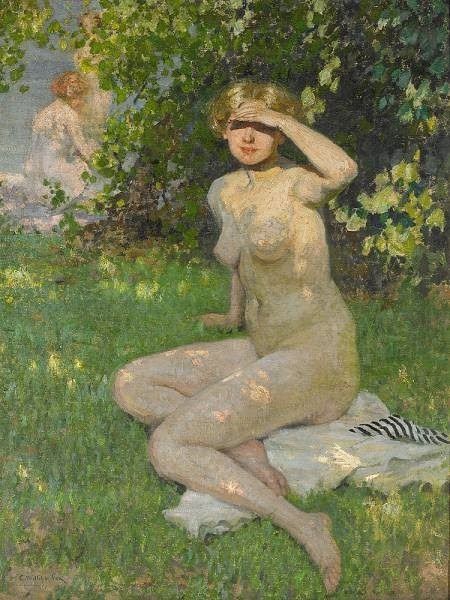
But for my viewing she had moved. As I entered that room at the Fed Square NGV, she caught my eye first and drew me towards her. In a room of luminous works of art she exuded a luminosity unmatched by her fellows on those four walls. She was part of the ‘Australian Impressionists in France’ exhibition, held in conjunction with the ‘Monet’s Garden’ show down the road. For me she even outshone the master’s water-lilies! They were both sublime, these two Winter Masterpieces – such showings being a highlight of Yarra City during the chilly months. So, on that wall, despite the best efforts of Condor, Bunny, Streeton et al, she was queen. Nothing they produced during their Continental years held a candle to her. So magical was she that the NGV used her in all the pre-publicity for the show – but nothing matched seeing her in the flesh in her gallery. She owned it!
Of course discovering the creator of such a vision was the easy bit in quenching my desire to discover more about her. E Phillips Fox is not a huge name amongst the pantheon of our great coverers of canvas, but he is starting to come into his own. The E is for Emanuel. He is best recalled for his epic, iconic ‘Landing of Captain Cook’ – to my mind pedestrian dross compared to her. He was also the hubby of one of our foremost female artists of the period, Ethel Carrick. There’s was a great love story. Fox didn’t see out the war, although he was never a participant, dying in Melbourne of lung cancer (the world was full of chain smokers back then too) in 1915. Well before that the couple had split – supposedly because of Ethel’s attachment to Theosophy, the Scientology of the times. She, as well, found it difficult on their return to Oz in 1913 coping with the claustrophobic nature of his antipodean family. She rushed from Sydney to be at his bedside when hearing of his imminent demise, championing his abilities with the brush till her dying breath in 1952. Arguably she was the better practitioner, but to my non-trained eyes nothing she produced measured up to her husband’s depiction of another stunning woman of his close acquaintance.
The marriage of Fox and Carrick was happiest when the couple were ensconced in France – in Montparnasse, the heart of intellectual and artistic life in Paris at the time. Their abode there possessed a small garden where Fox painted some of his atmospheric images of women, particularly in the act of reading. Women engrossed in a book sold well at the time. We know that his model for many of these was the woman I suspect to be her. Ethel also painted her and she was another Ethel – Ethel Anderson.
She has been recorded as the resident muse for some of his clothed oeuvre – works such as ‘On the Balcony’, ‘The Green Parasol’ and ‘Nasturtiums’. The latter work was recently purchased by the Art Gallery of NSW in remembrance of Margaret Olley. Edmund Capon stated that the late grand dame of Aussie art would have adored the choice – but we’re off track!
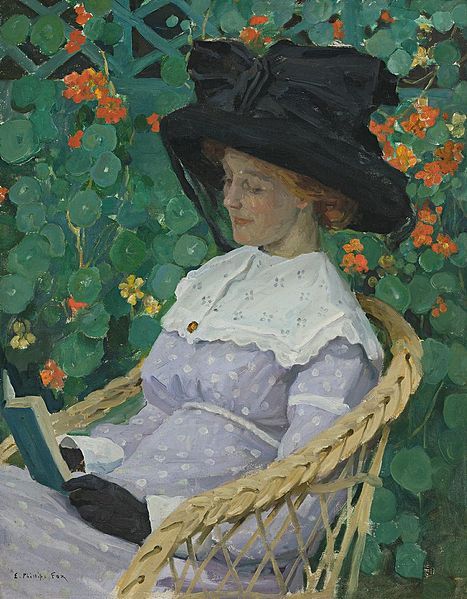
A stunningly beautiful auburn haired, green eyed beauty, Anderson was first a pupil of Fox’s – it’s interesting to note that, although men still dominated the world of art back then, women far outnumbered them as pupils. She and Fox later became great mates, it being the artist who introduced her to her future husband, fellow dauber Penleigh Boyd. The surname is a famous one in Australian artistic circles. They later produced a son, Robin, who dominated the architectural landscape of the country in later life, writing the seminal ‘The Great Australian Ugliness’. Arthur Boyd was a nephew. As an artist Penleigh was mainly a landscapist, but it is conceivable that in that millieu Ethel – maybe even both Ethels – would be liberated enough to divest themselves of clothing in the name of art. As to Ethel Boyd, comparing the pictures – there would seem a certain similarity to the model who posed as the voluptuous sun dappled beauty, shading her eyes in the French soleil, with the one in the aforementioned trio of works. It seemed the same model featured in other of Fox’s nudes – some quite intimate. The hair’s the giveaway – although in the days pre-August, 1914 women of that hued hair were favoured as models – so I could be completely askew in my thinking.

Ethel and Penleigh married in 1912, witnessed by Fox and Rupert Bunny – could she have also been the model for the latter’s ‘The Sun Bath’? Ethel was ten years senior to her husband, with their marriage ultimately not being any more successful than that between the other Ethel and Fox. At one stage Penleigh returned to Melbourne, leaving his wife in Old Blighty. Once the marital shackles were off, he promptly proceeded to have an affair with Minna Schuler, the daughter of the editor of the Age! When his family eventually joined him in Oz, there was constant quarrelling, not letting up till the day Penleigh died in 1923, as a result of a motor accident. Like her namesake, Ethel continued on till a ripe old age, not passing until 1961. So, if Ethel is she, this beautiful creature was still alive in my lifetime. By this stage her greatest claim to fame was as a writer of successful radio plays.
I suppose those with the time/money/desire could more forensically examine the sources and deduce whether I am on the right track or otherwise. For now, though, that sun dappled goddess of ‘The Bathers’ is, for me, Ethel Boyd nee Anderson. She was from a time that has now long passed, but I’ll always remember seeing her hung on that wall as if it were yesterday. I do wonder if the two Ethels were friends, or at least remained in contact down through the years – remembering a tiny garden in a Parisian suburb from whence the sun will shine on forever.
Postscript – This morning I travelled into the city to view the ‘Capital and Country’ travelling exhibition at the TMAG – Tasmanian Museum and Art Gallery. It is on loan from the National Gallery in Canberra until May 11th. It gave an overview of Oz art in the years around Federation and featured works by all the artists I’ve referenced above. I stood before Penleigh’s large, golden canvas of the site near Yass for a future national capital. I pondered on the likelihood that she may also, at some stage, have stood before the same painting, marvelling at her husband’s expertise, just as I stood before another artist’s rendering of her and commenced my own wonderings.
Some examples of works by E Phillips Fox = http://www.artgallery.nsw.gov.au/collection/works/?artist_id=fox-e-phillips
Tulips02

The Memory Trap – Andrea Goldsmith
‘Later he will still wonder how it is possible to see someone, actually select from the surroundings, how you can possible know that this woman is important, that you are, in fact, facing your future.’

I love this sentence from ‘The Memory Trap’ almost as much as I hate the word resonate. But I am about to use it, I am and I hate myself for it. But his sentence really resonates for me, as it did for Elliott. He used it to describe his meeting with Zoe, all those years ago in Central Park, New York. He could, though, equally have used it on meeting Beth, whilst walking his dog beside Merri Creek, Melbourne, decades on. He is on sabbatical from Zoe, his brittle, fragile now wife – a woman who, for all of their marriage, has been patently in love with another man. Beth is a koori woman and is at the opposite end of the spectrum to his distant, disengaged spouse. It never takes much to change the projection of a life, a meeting with a stranger by a creek or, as in the case of your scribe, a photo arriving in an envelope. In a novel, jam- packed with intriguing relationships, the one Elliott forms with Beth, later in the book, is the one I relished the most. That creekside encounter is possibly the coming together of two fractured souls, but in its nature it is something not often written of. The man is an American in his fifties and their conversation between strangers leads to one night of sex. Beth is in her sixties, recently bereaved and still grieving. Elliott also grieves for his marriage dominated by another man, the seemingly Helfgottian savant, Ramsey. Beth is soft, luscious and exotic with her dark skin – so earthbound compared with his flighty, distracted Zoe. Although their sex finishes almost as soon as it started, Elliott and Beth spend all future nights entwined in each others arms and sharing a love that needs no words, no demonstration – and it is beautiful.
It is very hard to let go of the couples in this book – they are all flawed, but I wanted so much to continue on with them after I finally turned the last page on their journeys – journeys which, I felt, were so incomplete. I suspect Goldsmith is not the type of author prone to sequels, but this needy reader would sure celebrate one to this gem.
It is like a giant maze – the relationships that gather on Goldsmith’s pages. There’s Zoe – Elliott – Beth; then Zoe – Ramsey – George (the pianist’s stepfather); Ramsey – Sean (his gay brother); then, well you get the drift. Firstly, though, ‘The Memory Trap’ has the marriage of Nina (Zoe’s sister) and hubby Daniel as its main focus, but as it progresses the novel deftly broadens out to minutely examine the aforementioned and more. Early in the piece Daniel gets a fit of the ‘Peter Pans’, leaves Nina for a younger substitute, causing his wife to flee London, accepting a job in her former home town – Yarra City. Her occupation is the facilitation of memorial projects, giving the author ample leeway to riff on the nature of recognising the past. She loves riffing, this author, but it’s never a distraction – her topics all fit seamlessly into the context. And the provenances of her characters sure gives ample opportunity on all manner of subjects.
Speaking of characters, my favourite leaves it till towards the end to emerge from the thumbnail sketch Goldsmith initially gives her. Hayley, daughter to Zoe and Elliott, is a feisty sixteen year old, turning out to be more adult than the adults as she commences a journey of her own. So truncated was her emergence that, as a thread on which to piggyback a future – hint, hint – addition to Goldsmith’s oeuvre, she would be ideal.

Surely Goldsmith is one of our nation’s premier accessible wordsmiths, up there with Winton, Miller and Carroll. I loved her last, ‘Reunion’, and I loved this. Sadly the author lost her long term partner in life, poet Dorothy Porter, back in 2008. I trust the author has found a happy place to be in her life and continues to produce her literary diamonds for eons to come – maybe one being a sequel to this. In conclusion, I can only repeat, ‘If you have ever loved and lost – read it’
Ms Goldsmith’s website = http://andreagoldsmith.com.au/
Snow White Bloom
The Dirty Chef – Matthew Evans
As I have espoused many times prior to this scribbling, I am a lucky man! When my Darling Loving Partner says those magic words, ‘How do you feel about salmon tonight?’ I salivate in expectation each time. Mind, it could be the mention of her cooking a steak, or the promise of one of her amazing butterflied roasts on the barbecue and I am equally in culinary rapture. DLP is not a foodie in the Matthew Evans’ sense, but she is a damn fine cook. When she is ‘rostered on,’ I know I am in for meat or fish cooked to perfection and presented to the table in a manner that would do any restaurant of reasonable quality proud. I also like to think that I know my way around a kitchen and can rustle up an acceptable repast, but DLP has the touch.
I am also a lucky man in where I have chosen to live with my wondrous DLP. My island in the southern seas is gaining a reputation for standard of product that sees it ‘punching above its weight’ in national terms. The exceptional freshness and attention to quality ensures our seafood; beef and lamb; cheeses; cool climate fruit and wines; as well as craft beer and ciders are a gourmand’s delight. Our vegetables are grown in the world’s cleanest air on some of the richest soils in the land. Then there is the ability of our producers to take risks into fare such as olive oil, saffron, quinoa, and truffles that are audacious, but ultimately commercial success stories. Of a weekend, all around Tassie, farmers’ markets bring this harvest of excellence to its towns and cities – fresh, fresh foodstuffs that were in the soil or sea only a few hours prior to selling.
Sometimes I hanker for the days of my upbringing when the connection between source and consumption was even closer – days when tucker was shot or collected by a range of family members, friends or close connections – backyard poultry and eggs, bandicooted potatoes, game meats (rabbit, roo wallaby), mutton birds, oysters from trips to Black or Detention Rivers, abalone collected from the sea rocks below our house, fish we caught off Burnie’s wharf, sugar bags of cray tails down from Circular Head or freshly shucked scallops. In my ideal world supermarkets would be factored out of the equation – but for most of us, even here on a paradisical island, the world has changed.
But Matthew Evans is not most of us. Working as a highly respected (although reviled in certain quarters) restaurant critic in Sydney, he was living the big city lifestyle, but, increasingly becoming disenchanted with it. He developed a dream and had the blinkered will to pursue it. He wanted control over the whole journey of what entered his stomach. He had a yearning to farm and that’s what bought him to Tasmania’s Huon Valley – to Puggle Farm at first, then taking on Fat Pig as well. Both were sited in the hills around the valley town of Cygnet.
The Huon, south over the Wellington Range from where I live by the Derwent on the northern outskirts of Hobart, is where both my parents hail from, growing up when it produced apples for the British market. Once the Poms went all European on us, that industry faltered and for a time the Huon went backwards economically. It has now largely bounced back with diversification. Its decidedly four seasons of climate now also attracts an overlay of tree and sea-changers from all over Oz. And it is stunningly beautiful to boot with the wilderness just beyond the tree line.
Evans’ transition from urbanite to rustic landholder has been well recorded in the three seasons of ‘Gourmet Farmer’ on SBS. As one can imagine, this huge change in his life had its ups and downs – with it still being a work in progress. Such has been his persistence, he now has a ‘brand’ within his adopted state.
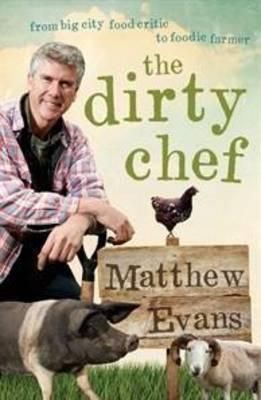
I was as enamoured of this book as I have been of the show. It was a pleasure for me to have him sign my copy of ‘The Dirty Chef’ at his book launch late last year. I also own a couple of his recipe compilations, but this tome is a different kettle of fish, although recipes close most chapters. It takes over from his television programmes and gives a more detailed account of the territory covered in ‘Gourmet Farmer’ – especially the challenges that beset Matthew as he strove to attain his goal. In Series 2 of the show and in his tome he is latterly joined by new wife Sadie, with Hedley arriving in due course. Along the way he also gathered good mates Nick and Ross as his companions for ‘adventuring’ on the farm and throughout the island as they set out to conquer their version of the world. This made for terrific reading – close to home reading. From now on, going up and over Vinces Saddle, then down into the Huon, will be, for me, as closely associated with Evans’ series and book as it is to family.
I do, just a tad, take issue a little with his definition of the Huon. His seems more or less based on municipal boundaries, but for me the area after Geeveston, moving away from the river, is the Far South. The country changes, the communities are more hardscrabble and there is less of a mainland invasion. The eclectic disappears. But I am being pernickety.
There are wonderful moments in the book – his description of tasting his first farm egg from his own chooks; his assertions as to why Tassie should now be nicknamed ‘Spud Island’ rather than the outdated apple appellation; his descriptions of the foibles of the long standing residents, as well as their sense of community. There are the relative hardships winter presents down in these parts, although Evans has come to terms with the season of the frost and ends up rather liking it. Many of the farm animals, including the dog, have their own personalities. He describes the coming to terms with the necessary deaths of such beasts that need to occur to fulfil his vision. He argues persuasively for many of the practices vegans and vegetarians abhor. He describes the battle it is in this economic climate to make both farms economically viable. Then he describes the joys of the goose.
For a time my mother was married to a farmer – a lovely salt of the earth fellow called Bill. I remember well several Christmases at Bill’s farm, up behind Somerset, on the island’s North West Coast. On his property the soil was so rich it was almost edible. Bill had made an arrangement with one of his rural pals to prepare a goose from his flock for our yuletide table. Of course, it was my mother’s task to roast it. Now my mother claims never to have taken to the art of cookery. But I aver, based on the fact she raised three healthy sons and a daughter. And to me, those several birds we devoured those Christmases at the farm would be amongst the finest meals I have partaken of. The flesh of the king of poultry is even superior to that of duck, which I similarly adore. Oh to have another goose at some stage down the track! Evans does write, with evidence, that raising them is a little on the tricky side.
An earlier tome by Matthew Evans (‘Never Order Chicken on a Monday’) had left me somewhat underwhelmed in terms of its shallow content and pedestrian prose. With this publication his standing as an engaging writer has come ahead in leaps and bounds. In what he now scribes he is a lively and engrossing author. Perhaps it does help to know its setting so well, but all kudos to him for making the time to share his journey with those of us who are not prepared to shake up their lives to the same degree. He has presented the island I love in positive tones to the outside world and I congratulate him on that.

Matthew Evans’ website = http://www.matthewevans.net.au/
Tulip01
Why Avs?
The Blue Room took serious umbrage to the latest Sunday Age column from Sam de Brito where he savagely attacked, of all things, the av. Here is the Blue Room’s rebuttal of his nonsensical assertions.

Why pick on avs? I love avs. I know perhaps they’re not the most flavoursome item you can place in your mouth – but I find them, well, sensual. There is the texture of this de Brito maligned fruit as well as its subtlety that appeals to me. It doesn’t hit your taste buds with a sledgehammer unlike some other fruits I could mention. It has a lush unctuousness that I consider most rewarding – slightly oily, somewhat, dare I say it, even sleazy. And it is bit of an elusive strumpet as well. As my culinary-savvy Darling Loving Partner points out, it is only with gentle prodding to its bottom region can one tell if it is ripeness is fully fledged for the plate. There is a sort of tingling joy when divesting it of its outer covering, followed by the culminating climax of the insertion of a knife point to pluck its perfectly formed, hard central core out for disposal. No, to me the av is the queen of fruit, even if its reputation has been sullied by being associated with the word ‘smashed’ on the carte du jour of numerous eateries of hipster persuasion!
De Brito thunders it’s ‘…the perfect food for the mediocre.’ being so bland and diffident in its nature. He aligns it with salmon and sauvignon blanc as the other refuges for the unfulfilled, both of which this punter also takes immeasurable pleasure in. So what if the av’s name, in Aztec, means that sac dangling beneath the male sex organ To me it is almost aphrodisiacal, sharing its virtues with with a plump olive or briny oyster.
As far as it being the food of choice for those who have failed to shine in life, I’ll let you know, young Sam, that I am perfectly comfortable with what I have and haven’t achieved in all aspects of life – my relationships; my former vocation; my capacity to earn – too often the sole measurement; in my artistic and sporting endeavours. And yes Mr de Brito – I too drive a white Mazda. I find it quite zippy.
I would be quite happy to exist, for the remainder of my days, on avocados and Atlantic salmon, all washed down with spritely sav blancs. I have no wish to be Richard Branson with his squillions and women hanging off every appendage, if that is an example of being ‘non-mediocre’. Nor can I abide watching tennis – although I once played it to a mediocre level. I have never, in my life, watched an episode of ‘Rove’. And, back in the day, I was quite fond of ‘The Bridges of Madison County’ – book and film. So there!
And no, Sam de Brito – you haven’t slighted me in the least. I’ll continue to read your Sunday column in the Age religiously, even if you’re becoming increasingly curmudgeonly as the years pass. And as for being addicted to the wanton av, I am also partial to a that sluttish coquette of fruits that leaves nothing to the imagination, the mango. Am I redeemed?
Here follows said column:-
Mediocrity – learn to rejoice in it – March 02, 2014 – Sam de Brito
One of life’s great challenges is coming to terms with mediocrity. When you’re young, you kid yourself recognition of your genius lies just ahead. Then, one day, you crash into the hard shell of your limitations and it dawns you’re not Nietzsche or Nabokov; you’re not even Noel Gallagher.
Many of us subsequently drink a lot or take up cycling. Others search for comfort in food. It’s a very common experience, one I believe has directly resulted in the popularity of the avocado.
The avocado is the perfect food for the mediocre, an ancient Central American fruit tasting like the bland love child of the green pea, almond and potato. Marketers have positioned it as the no-guilt-inoffensive-butter-substitute-cum-wonder-food and the pedestrian have duly convinced themselves they adore it.
That’s the insidious nature of the avocado. People tell themselves they love it, like they do couscous, professional tennis and Rove McManus. Like? Sure. Love? I think not. People love fried chicken and oral sex.
I also like avocado but I’m supremely mediocre. I get a thrill using my new Dustbuster. I cried reading The Bridges of Madison County. I drive a Mazda. It’s white.
Compare your approach to an avocado with the equally large-seeded mango. A person slices and scrapes an avocado like they’re doing colon surgery. It’s clinical. Emotionless. A mango, however, requires passion, bare hands, mess, indignity, pulp in your teeth.
Avocados are just so … safe.
Its mediocre relative in the fish world is salmon. No one scoffs its blushing flesh and says, ”That’s the best meal I’ve ever had!’
Like the avocado, salmon is a safe place for the mediocre to shelter. It’s the polar opposite of risk-taking. Navy SEALs don’t eat salmon. Richard Branson loathes avocado. And neither drink sauvignon blanc. Sav blanc is the wine, of course, that goes perfectly with salmon; it brings out the nuttiness in avocado. It’s the varietal no one feels strongly about. People have an opinion about chardonnay or riesling but sauvignon blanc? You top up from different bottles. It’s acceptable to drink it with ice.
If you recognise yourself in any of these fancies, don’t take it as a slight. We mediocre are a significant force in the world today. We might lack balls, but we’ve also managed to castrate a grape which takes its name from the French word for ”wild”, a fish that jumps up waterfalls and a Neolithic fruit whose Aztec name means ”testicle”.
That’s gotta count for something.
 Sam de Brito

