All posts by stevestevelovellidau

She Said No…He Complied

I pass all my hours in a shady old grove,
But I live not the day when I see not my love;
I survey every walk now my Phyllis is gone,
And sigh when I think we were there all alone,
Oh, then ’tis I think there’s no Hell
Like loving too well.

But each shade and each conscious bower when I find
Where I once have been happy and she has been kind;
When I see the print left of her shape on the green,
And imagine the pleasure may yet come again;
Oh, then ’tis I think that no joys are above
The pleasures of love.

You would think his reign would be a goldmine for the BBC, HBO, Netflix or some other media heavy of that ilk to take on – much in the same way that old Henry VIII has been done to death. In recent years alone there’s been ‘The Tudors’ and ‘Wolf Hall’. Yet, despite having arguably the most hedonistic court in the history of the English monarchy – a time of scuttlebutt and scandal, of perfumed dandies and plunging necklines – it has only been bought to screens, large and small, around the fringes. The Restoration saw Charles II throw out the puritan drabness of Cromwell’s Commonwealth and bring back colour and social (read sexual) freedom to his domain. His court was full of Machiavellian intrigue, usually associated with the royal bedchamber and the parade of wantonly women who made their way to it. Hollywood, etc, has only skimmed the surface of this fecund period – it’s time a more detailed light was shone on it, methinks.

With the possible exception of Wallis Simpson, perhaps the most famous of all mistresses popped her head up to be savoured by the royal personage, to seduce or be seduced, at this time. Most with a modicum of knowledge of the Brit narrative will know of this apple of the King’s eye who emerged from a dank, festering East End, as an orange seller, to become the top banana in his boudoir. She was probably the only woman in his life to have truly loved him and she was Nell Gwynne.

But the delicious Nell was only one in a long list of promiscuous misses to court the favour of randy Charlie. For twenty-five glorious years this ruler gave his subjects plenty to gossip about after he threw off the grey stays of the religious zealotry that preceded him at the top. He lived the life of a rake to the full, fitting his duties of state around dalliances with a long list of mistresses, some serving up their wares to him concurrently. He regarded his long-suffering queen as just another duty he had to endure before he could indulge throwing the royal seed about. He didn’t care about their station in life, these gold-diggers. Just as long as a woman was comely and not pock-marked too badly by the pox, she was fair game.

charles

We know of fifteen official mistresses – but as to the unknowns, it’s anybody’s guess. This is the case, as well, for the number of bastards his endless bedding of the fairer gender produced – there are fourteen recorded as part of the royal lineage.

Let us take a closer gander at some of his conquests. His first, to the best of our knowledge, was Lucy Walter, his constant companion in exile from the age of eighteen until he received the call to return from The Hague to the throne. Once he had his ascendancy sorted he went back to Holland to fetch her, only to find her in the arms of a soldierly rival. He dumped her on the spot. She ended up a prostitute ravaged by venereal disease.

Charles found Nell Davis on the London stage, a bountiful source for spirited wenches. Samuel Pepys’ wife termed her ‘…the most impertinent slut in the world’. She came undone when the other Nell, who followed her onto the scene, stuffed her full of laxative which caused her to disgrace herself whilst the royal person was in the saddle. The King was mortified.

Then there was Squintabella, a nickname Nell G gave the haughty Louise-Renée de Kéroualle, whose baby face and Frenchiness intrigued the monarch, despite her lazy eye. He was in her thrall until she got above herself and started demanding that he came out of the closet as far as his preference for the Catholic religion was concerned. The second Charles had better sense than to put his head on the block in such a manner, so soon dispensed of her services. But she stayed around long enough, fighting off all pretenders to usurp her prominence in the King’s bedchamber, to have him declare her the ‘maitresse en titre’ (the official one) – for a time.

Barbara Villiers was heavily pregnant to Charles when Catherine de Braganza arrived from Portugal, in 1662, to take up her arranged station as queen of the realm. Barbara was a married woman and a very feisty customer who had such a hold over her lover that after a spat, and they were very frequent, he could be found down on his knees grovelling for forgiveness. But she was forever giving her favours to lesser mortals and eventually he wearied of his high maintenance courtesan.

There was Hortense Mancini. She dressed as a man and was ‘wedded’ to another royal conquest, Barbara Palmer, whilst the latter was with child – his of course. There was nothing Charles liked better than to sit by their shared bed and watch these two beauties sleeping in each other’s arms.

If all that’s not enough to build a compelling bodice ripper around, I’ll eat my hat. But now let’s turn our attention to another Restoration beauty who was of a completely different disposition and was perhaps the only one of the women in his life that he, in turn, truly adored with all his heart. Her name may not be recognisable to us, but we all know of her in another way. This unique individual was Frances Stuart – in court she was awarded the appellation ‘La Belle Stuart’. Mrs Pepys’ husband described her as ‘The finest sight to me…that I did ever see in my life.’ So how did this undoubted stunner of flashing blue eyes and golden brown tresses fit in amongst all the other goings on in the royal household. What was her story?

Frances_Teresa_Stuart_by_Lely

She grew up in exile too – in France this time – her family chose the wrong side in the Civil War. As her name would suggest, she was also a distant relative of his majesty. When Charles was setting up his court in 1660, with due emphasis on gaiety and frivolity, he put the word about that he was on the lookout for pretty women, of worthy parentage, to populate it. His sister recommended Frances after watching her bloom across the Channel, so she was summoned. At fourteen she was bought to England and became a maid of honour to Charles’ new queen. The very instant the monarch laid eyes on her he was smitten – her beauty, the way she dressed, her gentility and her conversation enthralled. She excelled at dancing, wasn’t a meddler and flirted outrageously with him. Her decorous kisses were akin to sweetmeats on his lips Why, she even laughed with pleasure at his lame jokes. Even at so youthful an age, she was the complete package and he desired her almost beyond reason. Even though, verbally and in action, she gave every indication that she shared his affection for the other – there was a line she would not transverse. At a time when one’s virginity was used as a tool to make it to the top of the heap, Miss Stuart was determined that she would sacrifice hers for nothing short of true romantic love. Charles used every trick, every ounce of praise, every cajolery too at his behest to entice her into his chamber – but she was immovable. To his credit – he always took her ‘no’ as the final word – that is, until the next time he asked. Now, with all the temptation he had at hand, you would think he would soon lose interest. There’s no doubt his sexual needs were being fully catered to by more compliant minxes – but it seems his ardour for her continued to climb to boiling point the longer she withheld the ultimate prize. But every step of the way she managed to waylay him, yet did enough to convince him that one day she would be his for the taking. She remained his constant companion at many a courtly function and when the Queen appeared to be on her deathbed in 1663, it was assumed the throne besides his was hers. Unfortunately for Frances, Catherine rallied and so the game of cat and mouse continued. When the plague struck the capital and functions of state were transferred to Hampden Court Palace, the king was becoming decidedly more insistent in his wooing. Something had to give. The beautiful one started to realise that, as patient as his majesty had been to this point, there was a veiled threat now involved. She would either have to gift him her virginity or find someone to marry. That latter option would work to put her legally, if not entirely realistically, beyond his reach. What to do? What to do?

As luck would have it, into the court in exile strode her knight in shining armour. Coincidently, his name was Charles Stuart, a distant relative to both herself and the royal house. He was also loaded up with titles as the Duke of Richmond and Lennox and she was soon completely smitten with him. He seemingly reciprocated and they were quickly wed, but in secret – neither wanted to face the royal displeasure, before they had to, by making it open. Frances was no fool and soon realised her husband was very flawed – he was a philanderer, a drinker and a compulsive gambler – but he did extricate her from her fix so she settled in for the long haul with him. Of course, when he discovered her deceit our lusty monarch was livid and vowed never to set eyes on the pair again. They departed the scene and he kept his word. But in 1669 the King displayed his ongoing affection when he rushed to her beside on hearing she had caught the dreaded smallpox. He lavished her with all the care he could muster and as Nelly G was now foremost in his thoughts, there was no ulterior motive on his part for his compassionate actions on her behalf. Frances duly recovered and soon found the King had transformed himself into something of far more value to her than a frustrated suitor – he became her friend for life. She returned to court as Lady of the Queen’s Bedchamber and to counter her feckless spouse, became an astute business woman. On the death of her wastrel hubby the King awarded her a substantial pension. In the end she used it to return to Scotland, the land of her birth, living there in comfort till her own demise in 1702.

So how come the vast majority of us are familiar with her – despite no inkling of her tale? Well, in 1664 the British defeated the Dutch at sea and Charles decided to have a medal struck in celebration. He envisaged a figure of Britannia, contemplating her victories, as the motif. With Frances at that stage, in his opinion, being the most beautiful damsel in the land, it was by decree that she was to model in the role for the casting. When he later decided to then have new coinage struck, her pose for the medal had a fresh use – gracing one face of the new design. Her portrait has thus appeared on British pennies right up till the introduction of decimal currency in 1971. So Frances Stuart is our notion of Britannia.

There has never been another Charles on the throne since Frances’ would-be lover. Is this because of the licentiousness of his life style? It will be interesting to see if our present Charles, if he ever gets to ascend to kingship, retains the name. After all, his story has not entirely been free of shenanigans behind a wife’s back either.

Frances Stuart by alfred chalon

But, in closing, let us return to the soppy versification the earlier King Charles scribed when he was lovelorn, pining for the fair Frances, a woman not afraid to say no to a king:-

While alone to myself I repeat all her charms,
She I love may be locked in another man’s arms,
She may laugh at my cares, and so false she may be,
To say all the kind things she before said to me!
Oh then ’tis, oh then, that I think there’s no Hell
Like loving too well.

But when I consider the truth of her heart,
Such an innocent passion, so kind without art,
I fear I have wronged her, and hope she may be
So full of true love to be jealous of me.
Oh then ’tis I think that no joys are above
The pleasures of love.

britannia

Between Us – Words of Wit and Wisdom edited by Marieke Hardy and Michaela McGuire

This fourth compilation of epistles in the ‘Women of Letters’ franchise (the editors may well hate that term) is now not only an Australian phenomenon, but is spreading its wings internationally as well. Hardy and McGuire sold out NYC, which now has monthly performances, with a tour of their concept also completed of the UK. What started out as a small time effort to raise a bit of dough for a local animal welfare charity has captured hearts all around the nation. I was in a Hobart audience a while back and the duo had the format down pat. It was a night of laughter and tears. If one of their live performances comes to a venue near you, do make the effort to attend.

between-us-

The volume in question – there has been an international edition since – has all the faults of its predecessors – there are still the try-hards and still some drivel. But overwhelmingly most letters contained within speak from the heart, some even quite intimate in nature. The editors have by now reached the conclusion that part of the reason for the success of these books, as well as their live source, is that, in letters, there is a sense of safety not present on social media. The shows have a rigorous no recording policy and the readers involved all need to give permission for publication. The audience for both would not be the milieu for trolls in any case, I would have thought.

The edition in question is bookended with poignancy. First cab off the rank is the magnificent Stella Young, composing a letter to her octogenarian self – ‘By the time I get to you I’ll have written things that change the way people think about disability. I’ll have been part of a strong, beautiful movement of disabled people in Australia.’ And arguably, along with the marvellous ‘The Last Leg’, she, at thirty-two, already has. Sadly a few weeks after publication of this book our gorgeous advocate for crips – her word, not mine – died suddenly. Very early on in the history of ‘W of L’ she had forthrightly stated that the organisers had better find a wheelchair-friendly venue for the live version or face her wrath. The two convenors did so immediately and the spirited Stella became a firm friend of the pair.

stella

The closing letter was by former Greens senator Christine Milne. Once upon a time I was a friend during her uni years and for a time we shared a school staffroom on Tassie’s North West Coast. Her letter was to her former students at Devonport High School and it centred on a book that is very close to my family’s heart – Paul Gallico’s classic ‘The Snow Goose’. My beautiful sister Frith derives her name from that tale.

snow goose

There was much else to enjoy, such as Chrissie Swan’s encounter with a woman breast feeding in a suburban shopping mall. She was dressed in a bear suit with a flashing neon sign attached to her head warning, ‘Boobs Ahoy’. I love Spiderbait’s drummer Kram’s relating of how the ‘House Husband’/’Play School’ host, Rhys Muldoon, came to be pashing Axyl Rose’s girlfriend at a Melbourne concert of the Gunners. Leading the way for Muslim women in their fight against sexism and for their right to be heard, Susan Carland writes emotively about her love for her son now and into the future. Columnist Amanda Blair, whose mother once tried to match her up with Martin Bryant on a blind date, muses on how much simpler life was for women back in the day – or was it? Angie Hart’s letter to her unborn child is a heart-breaker and I found out two facts about Poh that I didn’t know. One is, would you believe, she’s almost forty. The other is that she is not beyond dropping the f-bomb (but it’s okay, she uses it in describing some cretinous troll). Jess McGuire writes of her totally ‘annus horribilis’, but in doing so demonstrates how even the most dire of circumstances can have an upside. Guitarist for our beloved Go-Betweens, Adele Pickvance, writes engagingly on the difficulties involved for a Brit adjusting to life in Oz. And lastly, in my resume of ‘Between Us’ highlights, is the story of how Sommer Tothill’s life was turned around by the true narrative of her Uncle Rolly’s demise.

There is much, much else to recommend this penultimate addition to the ‘W of L’ list of titles and I bet, once you’ve devoured this glorious omnibus, you’ll be hankering for the other four. Now I think I might take up my pen and write a snail mail missive of my own to my good mate….

Women of Letters website = http://womenofletters.com.au/

Yoli's Cards

I am enamoured of cards as much as I am of writing letters. And of course the two can be combined – I love sending off missives to my mates. I probably somewhat swamp them with my predilection, but my friends are a tolerant mob and hopefully I am forgiven. Out and about I keep a whether eye open for greeting cards that enchant the senses – but, dear me, they’re getting expensive these days. They are now around the seven dollar mark for many of the nature that I prefer. That price is difficult to justify when they are purchased in the number that I like to. Some of the best can be found in our local book emporiums – Fullers, Dymocks and the Hobart Book Shop. Not so long ago I was down in Salamanca, enjoying autumn sunshine, when outside the doors of the last listed store I espied arrayed a number of boxes of cards – good cards – some at three dollars a hit, others at a wonderful single dollar. I was soon into them like a moth to the flame. Since then, each time I am in that part of the world I pay the bookshop a visit and to my delight find that those boxes are regularly refilled with fresh designs – although, now with the chill winds of winter blowing, they are housed inside. Even more to my budgetary pleasure a new sign has appeared. They have been further reduced in cost. One can now choose ten beauties for the former cost of one, a mere seven bucks!

And that’s how I discovered artist Yoli Salmona. Occasionally one finds an image that particularly captures the attention and holds it. And rifling through the described boxes one Sunday morning, I found such-like from her.

Yoli-pic

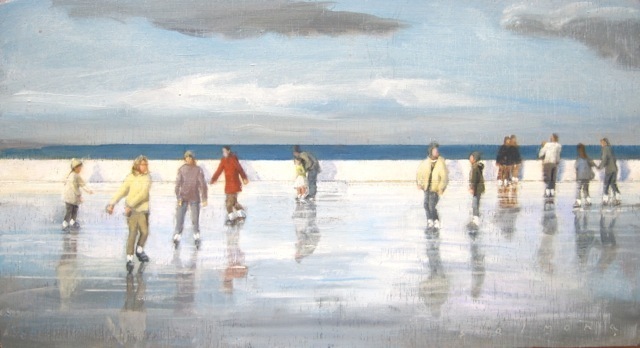
The card featured a summery-clad gentleman gazing out across a yacht-splattered Sydney Harbour, from a colonnaded balcony, towards the Bridge and Opera House. On returning home I endeavoured to track down that image on-line to no avail, but I did discover a little about the card’s producer and some more of her offerings. One that intrigued, from talented Yoli, was entitled ‘Bondi on Ice’. This was mainly because it was so at odds with the usual images we get, in spades, of the iconic strand. It’s a winter scene. Instead of golden sand and a dazzlingly azure sky, we are confronted with muted pastel heavens and a shivery, silvery beach. Instead of bikinied gals and budgie-smuggled lads, we have have a line of figures clad more for the bite of winter here on my island in the southern seas. And – look closely – are there skates on their feet?

Bondi_on_ice_study_-1349670291m

Like many of our best daubers, Ms Salmona hails form foreign shores too. In her case it’s France. Her initial training was in the field of fashion design and before the relocation to Oz, in 1986, she had plied her craft in Los Angeles and Tunisia, as well as Paris. A new country bought a change of tack as the markets for her previous oeuvre dried up with the tough economic times in the nineties. She turned to oils as her new medium and was soon garnering success. Many of her works continue to be taken up by card companies world-wide and she exhibits frequently. Yoli S has also won several prestigious awards. She teaches portraiture in Sydney and the latest string to her bow are what she terms ‘floor canvasses’ – having her product printed on rugs. So I invite you to check out what Yoli Salmona offers on-line and if you share my predisposition, you may even find her on a local card-of-quality rack at a vendors near you. I agree with her sentiment that art, such as hers ‘…can enhance the experience of everyday living through pleasure addressing our senses or a particular aesthetic, and our sense of humour.’ She did that for me one morning down at Salamanca.

Yoli Salmona - Rendezvous_avec_B

A gallery of Yoli’s works = http://www.absolutearts.com/portfolios/s/salmona/

Wave

The surfing miner felt unfulfilled. Sure, there was great money to be had underground digging out what is so vital to the nation’s financial health, but now he was grounded from both his passion and his work place – one on the sea, one in the bowels of the earth. He needed something to take his mind off the damage done to his right knee that would leave him incapacitated for six months. His brother and sister were both fortified with their engagement in artistic pursuits, so he looked to that area for inspiration. He picked up the expensive camera he had treated himself to a while ago, then had put aside due to time constraints – now he had no such excuse. Gradually an idea took hold and he clicked on to the ether to see if he could make it pan out.

ray collins

That was back in 2007. Fast forward to to the present day and the thirty-two year old, on the basis of what he taught himself to do back then, has seen his skills taking him all over the world – even to dipping his toe in minus twenty degree water off the coast of Iceland. He now combines his first love with this recently discovered expertise to win accolades and awards world-wide, as well as a handy amount of pocket money.

I initially encountered Ray Collins one Saturday morning, earlier this year, on opening the Weekend Magazine supplement of the Oz. Within there was a quite stunning photograph that took me away from a disappointing Tasmanian summer to a place where I know the weather is blissful in all seasons. Fusing glistening water and a bright blue-hued sky, the snapper had captured a gloriously perfect wave in the instant before breaking. And through its tubular pipe we get a glimpse of a coastline fringed by sand, pine trees and Coolangatta towers. I took to my laptop to find out more about the obviously talented creator of such an image.

ray cillins coolangatta

During his time away from the coal seam and riding the white horses of the sea, Ray discovered that he was quite the camera-smith once he mastered the intricacies of his rediscovered purchase. But now it came time to find out if the theory of his nub of an idea could be put into practice. Maybe in doing so he could match his siblings and produce works of beauty too. He has done that in spades, but it wasn’t easy. First he needed to outlay some cash, not a small ask when he was on half-pay, to see his vision realised. For three thousand dollars he purchased himself a housing unit – all to take his camera to sea.

The tough going didn’t end there. Although technically he was the match for any other surf-snapper, there was nothing in his photos that stood out from dozens of other practitioners. He needed an angle. He decided to break away from the convention of man’s (and woman’s) mastery of the breaking swell. He resolved to focus on the wave itself – its ‘…textures, colours and purity.’ He wanted ‘anticipation’ in his product – and he worked at it till he achieved that aim. He attained his goal. Surfing magazines more readily came to pick up his depictions and eventually he came to the notice of the guru of his art in the States, Larry Moore, who took him on by awarding him one of his prestigious mentorships – the first Australian to be thus honoured. He was set.

ray collins

Following on from that, he has won just about every gong going in his field and he services a list of international brands as long as your arm with pictures for their advertising – Qantas, Red Bull, Apple, United Airlines just to cite a few. Each day he has to sort through several hundred emails, all clamouring for permission to use his work for a multitude of purposes.

Attached to this, though, there are two rubs. The first is that he still works away at that coal seam. Despite his international repute, income from his output with the camera is still fluky and he needs the stability of a regular wage in his life. He is not one to go simply where the waves take him.

Rub number two? He will never see his images the same way as you and I do. Ray Collins is colour-blind.

Ray Collins website = http://raycollinsphoto.com/

The New Nigella

She’s gone off the boil, has Nigella. The Kitchen Goddess hasn’t been seen on our screens since her bout of bad publicity – she wasn’t the last to find out not all is sweetness and light marrying a sugar daddy.

I also love Poh, but she’s not exactly the goddess variety for all her talents and charm – so who to replace the voluptuous, sumptuously sensual Nigella? I needn’t have worried – someone has come along. She’s a real gem, is Ms Rachel Khoo. Now her first series, admittedly, didn’t really have much of an effect on me – NL was still being beamed in. I watched a few episodes of Rachel and it was a novel idea, but little else so I decamped. The idea? A Brit cooking up a storm in a tiny Parisian garret for pernickety French foodies seated in her pop-up restaurant for two. And to add a bit of drama, she only has only a couple of gas rings to work with. It became all the rage in the City of Love. To attain a place at the minuscule eatery was of great social cachet. Seizing her chance, she spruiked it as a book, with its stunning popularity leading to the tele show, ‘The Little Paris Kitchen’. This was followed up with another publication, ‘My Little French Kitchen’.

khoo_v_

But she didn’t grab me then. Missing Nigella, when “Rachel Khoo’s Kitchen Notebook – Cosmopolitan Cook’ appeared on SBS’s listings back in April, I tuned in to give her another go. She certainly grabbed me this time. Goodbye Nigella.

Ms Khoo is no overnight sensation. Her success is based on general talent and an ability to self promote, as well as a soupçon of luck, as much as her culinary qualifications. Her looks have not hampered her either. Her initial training was in artistic design – thus her attractive illustrations in her ‘Notebooks’. As well as the series I watched, there’s ones on London and Malaysia in the pipeline. Hopefully SBS will do the right thing. Why Malaysia? Well her exotic appearance is down to a Malay-Chinese father and an Austrian mother – she was bought up in a London suburb. There’s also a whisper that she may be on her way to Oz for a season, given her popularity here.

At some stage our ‘new Nigella’ decided to combine her design talents with her love of tucker and devote her life to that. With six hundred quid in her pocket she set herself up in Paris, underwent training at the prestigious Le Cordon Bleu, worked as an au pair, behind a perfume counter and ran bakery workshops. Then she took a chance. One day she walked into the offices of Penguin in Paris and hawked her idea for a book based around home made muesli bars. And now, seeing her in her latest small screen offering, who wouldn’t be charmed by her? The honchos at the publishing house certainly were and she was on her way.

‘The Little Paris Kitchen’ hit a nerve in the UK, drawing in over a million and a half viewers per episode, but it was the ‘Cosmopolitan Cook’ that made me a fan.

Rachel Khoo

Garbed in her trademark retro vibe, with thirty-something Ms Khoo there’s none of the overt lasciviousness of the original Goddess in her shtick. She is reported to have mused that she was unsure whether the great Nigella was all that wonderful an advertisement for women in the kitchen. I’ll hedge my bets on that one. For me, as with Nigella – it’s partly in the lips coated in bright hues, the fullness of the curves, but mostly in the eyes – always the eyes – that has me glued. There are the recipes too.

This latest show was also just so sunshine-y. Our charming host took me to such culinary meccas as Provence, Istanbul, the Amalfi Coast and Barcelona. To vary this southerness a tad there were also excursions to Nordic regions. What Rachel K ascertained in these locales she tweaked back in her small London flat in order to present lip-smackingly creative meals for an assortment of mates.

Thanks to Ms Khoo I no longer yearn for more doses of the other one – but if they happen to appear they won’t be ignored by me. But now for this ageing appreciator of all that’s good that comes out of a kitchen, Rachel Khoo is one to savour.

Ms Khoo’s website = http://www.rachelkhoo.com/

Dept. of Speculation – Jenny Offill

Up front is passion. Never over-rated but can be debilitating in some circumstances. Time mutes and love transforms. Attachment is under-rated, comfort being a negative – and there is much to recommend it. Of course there are multitudinous variations on the core, but one factor is known – if it’s out of synch then it can invite disaster.

dept

Jenny Offill is the first to admit that this slight, in volume, book of hers should be a hard sell. ‘If someone described this novel to me, I would never had read it.’ the author tells one interviewer. It is a potpourri, an amalgam of fragments in the form of musings, random facts and quotes from the great wordsmiths the author obviously admires. Interspersing all this are micro-vignettes on the course of a marriage. Each small chapter is akin to a string of pearls – each oyster-spit shone to a sheen and in the whole, strangely relevant.

It takes a while to pick up the rhythm, but once that is cottoned on to this slim, not autobiographical, not a memoir, entrances. So much features – from the black dog to battles with parasitic bugs to the exploration of outer space.

A best seller in the US, it’s raised hardly a ripple in Oz against the ‘Gone Girls’ and ‘Girls on a Train’ overload – but Offill can hardly credit her success Stateside. Her last novel for adults was before the turn of the millennium. ‘Dept. of Speculation’ had a very long gestation, with the author filling in the gap with her teaching and well received picture books.

The novel is a mini-treatise on motherhood, wrangling a wayward husband and how, for women, it is impossible to become an ‘art monster’ ie devote oneself entirely to one’s writing to the rejection of all else. Men, it is claimed, have the luxury of doing this with no roadblocks whatsoever.

The two parties involved in this rendering are, for a time, out of synch. In recording their journey there are lessons to be discerned for all floundering relationships. This small tome swims against the tide in more ways than one and is well worth the effort to track down. On my daughter’s recommendation I am so glad I went to that effort. Thank you Katie.

dept01

Jenny Offill’s web-site = http://jennyoffill.com/

A Model Story

Let me take you back to an eve before the turn of the century. No, not the last one – not the one most of us witnessed. It’s to the one before that – the night the nineteenth century became the hundred years the same number of us were born into. It’s to London we’re going, to Hammersmith to be exact – although some of the tale is set around Picadilly Circus, about eleven clicks from the small terraced house in Musboro Road West. It’s a cosy two up and two down with latrine/laundry out back in the tiny yard. That night, on the other side of the globe, gas lights cast an eerie pall. Light snow is flurrying around together with the smuts of factory detritus. If we peer into the front room of the tiny abode we are able to discern a figure haloed by firelight, seated in an ancient, faded lounge chair, covered in blankets. He has a woolly cap pulled down low and a bristling; grey-stained moustache can be discerned. This overhangs a mouth clenching a briar-pipe, exuding a thin spiral of tobacco smoke upwards. The face is deeply lined; his hands, clutching at the blankets, indicate they have rarely been idle with their callouses and grimy nails. Beside him there is a bottle containing a dark liquid – more than likely porter. This old fellow is obviously a man of working class tastes, although the room is far from gimcrack. There are items that look as though they may even be of some value today, especially a few works on the wall that could be from artists of fair repute. Beside the porter bottle is a small framed photograph in sepia. It’s of a much younger man, handsome and virile in appearance. The old fellow in the glow looks warm enough and seems to be dozing. He doesn’t know it yet, but this man will live on till the second year of the Great War, will soon see the death of his old queen and see out her son, the new king, as well. Finally he’ll witness the cream of his nation’s manhood march off to the killing fields of Flanders.

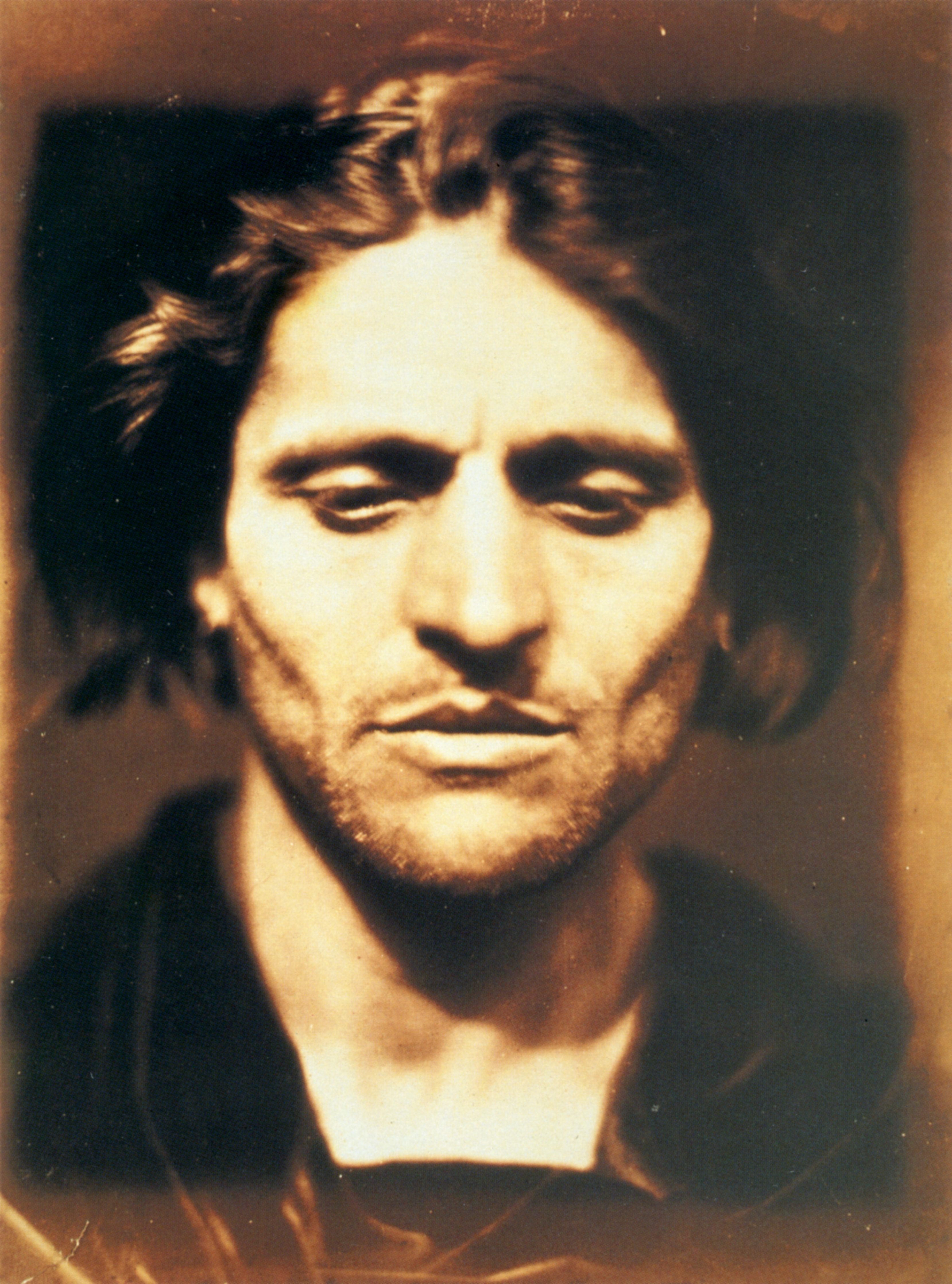
angelo colarossi_by_julia_margaret_cameron

Look and see – his eyes are indeed closed, but he will stir and take another puff, or a sip of the ale from time to time. He will also routinely check his fob, pulling it out by its chain from under his coverings and squinting at it in the dim light of table-side lamp. He wants to see in the new century – he vowed he would; he’s determined to. He nods at the watch – still a while to go so he returns to his reverie in the gloom. First he turns to the small sepia image and yes, we can note a sigh and slight smile for it is a reflection of his own manhood from a long time ago – a time when he was considered the go-to person for all the artists in the area if they wanted a sturdy soul to pose for their works. Some went on to be recognised as amongst the Victorian era’s greats.

colarossi01

If we could now penetrate into the workings of Angelo Colarossi’s mind, we could read the nature of his thoughts as they worked their way back through the recent and not so recent past. They would inform us of the day he’s just experienced – one he regards as singularly memorable. On a daily basis he does keep himself busy. He is still called on to stretch canvas and help out odd jobbing in artists’ studios, with occasionally there being the need for an older man to pose – but these days he has largely lost his knack for stillness. Around the Hammersmith markets he can be seen still lending a hand to various stall-holders and it all adds up to keeping him going. His surviving offspring chip in too – but today was a period of freedom from his labours with it being the last hurrah of the old century. His son, also Angelo, came calling, with a young lass in tow to introduce. Four years on Angelo Junior would marry his belle and provide Mary Anne and he with more little ones to add to the ever increasing brood. When he thinks of how many there’d have been if all his own had survived a frown clouds his face. Still, six did and he’s mighty glad of it. His Mary Anne was sturdy of hip, but this sweet slip of a girl has the waist of a wasp so he can’t believe, when the time comes, how she will ever manage. His own Angelo is also so slight he marvels how he and his beloved wife ever came to produce him. But his father did give him one of his own great talents – his own knack of stillness.

That very day the foursome had travelled by omnibus and on foot to view the result of this talent – to look at it once more – at his son, Angelo Junior, high in the sky over Picadilly Circus. He’s atop the memorial to Lord Shaftesbury. His slim, undersized son is up there, perched on tip-toe, one leg extended back, with bow in hand. None that day would know that later generations would name his likeness Eros. Few models could have posed so agonisingly for the length of time required as young Angelo, not even, the elder one suspects, his father back in the day. But he managed to do so as the sculptor, Mr Gilbert, hacked away at the stone that would provide the moulding for the aluminium-cast final work. The artist intended it to signify mythical Anteros, the god of requited love, but the populace were soon to be convinced it was of his more lustful brother.

Piccadillycircus1896

The man by the coal fire reflects on the stories of various sittings he had told that day, once they had retired to a tea house near the Circus for refreshments. At first the four had talked of the marvels of the age – the noisy horseless carriages that were starting to appear on the byways and the planned extensions to the Underground railway. It had reached Hammersmith some years back, but the son had yet to convince his father that it was safe to travel on. The younger man lovingly chided him for his stubbornness on the matter. The boy related how he had read somewhere that now everything had been invented that possibly could be and the old man nodded in agreement. Little was he to know that, in the second decade of the century about to dawn, his son would be helping to construct heavier that air machines to fight a terrible war.

The father and son regaled the young lady with the tale of how they had posed together for a painting by Mr Leighton of the sea giving up its dead. The son spoke of his times modelling for Mr Waterhouse and the senior family member his own times with Mr Sargent and Mr Millais. He told of the occasion he had to pretend to be wrestling a python for Leighton, how the sculptor had rolled up a mat for him to hold to represent the reptile. He always received a goodly laugh at its telling.

f-leighton-and-the-sea-gave-up-the-dead-which-were-in-it

The wee lass had then queried how her beau’s father had became an artist’s model in the first place. Angelo Senior by the fire, checking his timepiece one more time, had responded by returning right back to the start, to his Italian childhood. He came into the world in the town of Picinisco cradled in the picturesque Val di Comino, through which the road from Rome to Naples passed. His family were suffering financial setbacks and one brother had already struck out for London. He established himself as an artist’s model, amongst other things and was soon successfully encouraging Angelo to join him. Between that and working in the markets the pair were soon making ends meet. To further increase his skills, Angelo learnt how to stretch canvasses and he became a fair carpenter as well. He was part way through this tale when he noticed that his wife was beginning to fade and was nodding off – she had heard all this so many times before. Her husband did have the gift of the gab. Checking his fob he realised the afternoon was getting on, so he decided that it was time to say his farewells and get Mary Anne back to Hammersmith.

The son of Italy, in that faded chair we observe in the lamplight, twitches back to reality, pulls out his timepiece and observes there is still an hour and then some to go with his vigil. He upends his bottle of porter and takes a healthy glug, pulls at his pipe several more times and then casts his eyes again towards the little photograph. There was one story he hadn’t told that afternoon – the strangest, most wondrous of all.

jmc

For a while he had assumed she was mad this short, squat woman he had been taken to pose for on the Isle of Wight. Tennyson, the old man marvels – it had been the great Lord Tennyson who was responsible for him being there. By that only just flicking flame on the last night of a century the old man shakes his head at the grand times he once was privy to, but none surpassed those few days at a residence called Dimbola Lodge off the southern coast. Tennyson was neighbour to this woman – a very strange woman obsessed with a new art. He reflects on how these days it is so commonplace for folks to go to a studio to have their portraits taken by a professional operator. There are post-card sellers on every corner in his city, plying their pictures of great sights and the latest music hall stars. He knows for a few extra coins, a nudge and a wink most of those vendors could produce, from a secret place, some purely for a gentleman’s pleasure as well. But back then all that was in its infancy.

It was Mr Millais going down to the Isle to stay with his friend, the poet, that was instrumental in it all. One day Tennyson took him across the lawns to meet the woman and she insisted that he sit for a photographic portrait. He remarked to Angelo later what a complicated process it was. He had become bored and unthinkingly adjusted his position for greater comfort, only to have her admonish him most sternly. Eventually a successful image was obtained – but like all the rest he’d observed taken by her, it had a certain fuzziness. He still liked it, mind, but it was not like the precise images he’d seen up in London. Back then Angelo had no knowledge what was involved in making these likenesses – but he was soon to find out. When Millais commented on its lack of clarity to the woman she immediately took umbrage and started blaming him for being so twitchy.’Nobody around here can sit still for more than a minute,’ she bemoaned to the artist. It was here that Mr Millais informed her that he knew a man who certainly could – that she needed a professional sitter. That, of course, set the train in motion. The woman sent her man up to London to make the necessary offer – and before he knew it he was taking the steam packet to the island. He reflected on his first meeting with her – there were no ‘how do you dos’ or offers of tea – she just told him that it would all have to come off. He chortles at the memory. He had posed nude on several occasions and had assumed she was instructing him to dispense with his clothing – but soon it became clear that it was his moustache that would have to be foregone. Apart from it he was clean shaven, but she then pronounced her Iago would have to have stubble – therefore she would require him to stay until an amount she considered sufficient grew. She alerted him to the fact she would pay him handsomely if he followed her instructions to the letter. In the end it wasn’t as handsomely as he would have hoped, given all she expected, but it was sufficient to make his trouble worthwhile.

julia_margaret_cameron_lord_tennyson

Tennyson by JMC

A few days later she declared he looked ‘Arab enough’, as she phrased it, for her purposes. In the meantime, he had come to know how odd her existence was on the island. She seemed to survive on air, so besotted with her image making was she. Her ageing husband simply spent his time wandering around in a greasy dressing gown muttering to himself. Angelo Colarossi took repast of basic victuals alone in his room, but was invited to tea and cake when the poet came calling to meet his friend’s recommended sitter and to inquire how it was all going. The woman seemed as abrupt with him as everyone else and soon wandered off to attend to other matters. He, though, found the Lord a most agreeable conversationalist – they found themselves very easy in each other’s company.

Came the day of the sitting she explained that, for the image of Iago, she required him to don a rough cloak and have his eyes downcast – certainly not staring at the camera. It took some time for her apparatus to be organised to her satisfaction and some time more for her to capture him with a blinding flash – that was the term she used, ‘capture’. She then stalked off to her chemicals to do her ‘developing’. When she graced him again with her presence she actually smiled. ‘That will show my colleagues in the London Photographic Society.’ When he asked what she meant by that comment, she informed him that, when she went up to the capital to attend meetings to critique each other’s product, they looked down their very long noses at her work, advising that, being a woman, she couldn’t hope to be as skilled in the difficult processes required as they were. And worse, they refused to include her in their exhibitions. Then brandishing a small copy of his image she exhorted,’This will show those feeble fools! You have given me something of character and clarity. I dare them to mock your magnificent likeness! Thank you Mr Colarossi.’

Before his departure the next morning Angelo Colarossi received two gifts. Tennyson sent over a slim volume of his poetry inscribed with the wording, ‘To the man who makes an art of stillness.’ And Julia Margaret Cameron herself presented him with an ‘Iago’, complete in gold-leafed frame. Both items he treasures to this day. For he was young back then. And with the small memento he can not only remember, but see the man he once was.

He often wonders what became of her – of Mrs Cameron. He once heard from an artist friend that she had decamped the Isle and headed for the Orient to pass her final days, but he knows no more. And as we take our leave of Angelo Colarossi, in his small abode, we see that indeed the midnight hour has has finally arrived. He stands and stretches, takes the little image in his hand and stares at it for a few seconds. He then replaces it on its chair-side table, bends to dampen down the fire before heading to the stairs and his Mary Anne.

In truth our Angelo still has much to look forward to in the new decade that has now arrived – and beyond, till a war takes its terrible toll. There will be weddings and more grandchildren to celebrate, visits to view the windows of great new stores such as Mr Selfridges’, moving pictures to marvel over and he will see men taking to the skies. Why, in the years to come, there will even be women agitating over the right to vote.

ellen terry_by_Julia_Margaret_Cameron

Ellen Terry by JMC

As we move back through the decades to our own time we can only wonder what Angelo would make of the value of that tiny image today, let alone the others she took in the ten short years of her obsession. Nowadays we observe the portraits of the famous Julia Margaret Cameron ‘captured’ – with their lack of focus that we contrarily regard as part of their allure. Think of the names – the poet laureate himself and Robert Browning; artists Sir John Everett Millais, Dante Gabriel Rossetti and Sir Edward Burne-Jones – and even the remarkable actress Ellen Terry. As well there are her interpretations of historical scenes and romantic imagings from the works of Shakespeare. There are also a rare few from her time in Ceylon where she and her husband journeyed to on self-imposed exile. There she passed away in 1879. All this legacy was taken by her in a few short years from the 1860s on. In our digital age they are so ethereal – so dated by our standards, yet ‘Iago’, methinks, could have been snapped yesterday. Thousands gaze at her work in great galleries – books are devoted to her and the world has access to her portraits at any time of day on-line. Julia Margaret Cameron is now rightly regarded as a pioneer of an art form and for a woman’s place in the world.

Be Near Me – Andrew O'Hagan

This 2006 novel is this reader’s first by Andrew O’Hagan. Hopefully it will not be the last. Essentially it is a three-parter; the first two sections building to a shattering finale in the last. By the time that presents itself I had succumbed to being so hooked it was unputdownable until the whole sorry story had played out to the last page.

benearme

Glaswegian AO’H was born in 1968 and is a graduate of the University of Strathclyde. By ’91 he was on the staff of the ‘London Review of Books’ and four years later published his first fiction product, ‘The Missing’. It and subsequent tomes have been nominated for all sorts of gongs including the Booker and Whitbread. This work won the Los Angeles Times Prize for Fiction in 2008. ‘Be Near Me’ has also been adapted as a play. O’Hagan has written and presented a television series on Bobbie Burns for the Beeb and has dabbled in writing for the stage. This guy has serious literary chops.

In the first part of ‘Be Near Me’ the scene is set. We meet 56 year old Catholic priest David Anderton, newly transferred to a tough Ayrshire parish, but we find he is half-hearted and somewhat removed from his duties. He seems disappointed in his calling but unable to release his mind from the need to be succoured by the church. Anderton has the necessary feeling for his flock, but struggles to make a connection with them. He is, above all, hungering for something more – the type of relationship he once had way back when – one that is no longer is possible given the constraints he labours under. He is lonely. In this fragile state of mind he is ready for an ‘adventure’ before it is all too late. That enters in the form of street savvy teenagers, feisty Lisa and charismatic skateboarder Mark. Very soon he finds himself part and parcel of their escapades, occasionally the ringleader. For a while we are unsure which one will bring him down as we are in no doubt this flirtation, with the dark side of the real world, cannot end well.

Now we’ve ascertained the situation he is in and which of the duo brings him to grief, we backtrack onto a different path. The author takes us to the tale of the love of the priest’s life and the event that caused him to fully turn to his god and the celibate way.

Once that has been conveyed we return to Father David’s fall from grace. Although it is debatable whether he committed the crime in the true sense of the accusation, the priest knows, had it all played out as he intended, he would have done so. Ergo he places self-imposed barriers to escaping what is about to befall him. We wonder if there’s an ultimate price to pay.

As he travels down his path to self destruction we see the strength and loyalty of the women in his life – Lisa to some extent, his novelist mother and his ill-married house-keeper, a vital cog in the case against him. They are all wonderful creations as characters, as is the latter’s deeply flawed spouse who is somewhat the hero of the piece.

I do not know where in the Bible Jesus preaches that to fully serve the god he believes in one has to enter a life devoid of sexual intimacy with another. If he did, then that is at variance with the Jesus I know. Of course, for many, like our main protagonist, being human they fail to measure up and as a result the Catholic church is now in deep do-dos. Once litigation takes over in the aftermath of the various enquiries, commissions and investigations in place world-wide, the institution may well be bought to its knees financially. To me it is an inhumane and self-defeating imposition and O’Hagan glaringly, as well as artfully, presents the troubled face of all this. Even though we look at Anderton as foolhardy for taking one last stab revisiting what he experienced so long ago, we can all relate to his fundamental need.

o hagan

Three Stages of the Dame

She came out of the water dripping and sent certain feelings whizzing through my teenage self. The venue was the Somerset Drive-in so therefore there would have been seagulls flying across the screen to add to the authenticity – but this lad’s mind was not on those particular birds. I have no idea whose car I was in and whether my girl friend of the time was beside me. I remember nothing else of that movie – but that scene is still etched on my mind to this day.

No, it wasn’t Ursula Andress in her white bikini – that was way back in ’62. This was half a decade later and by 1969 what could be shown up on that big amount of white space had changed markedly, but a scene featuring bare breasts was still novel and the beautiful girl emerging from the sea wasn’t wearing a stitch of clothing. I’d never heard of the actress concerned, but the male lead, playing an artist, was well-known, being British actor James Mason. His muse and model, Cora Ryan, was played by Helen Mirren in her first screen role. The memorable scene in question took place on a beach on Queensland’s Dunk Island – it was my first encounter with the Dame.

age-of-consent_

In the nineties, close to thirty years on, she became a regular feature of my Friday nights. Mirren was no longer that nubile lass from ‘Age of Consent’, but as DCI Jane Tennison, in the police procedural ‘Prime Suspect’, she was in the prime of womanhood and still had that something about her that stirred the blood – only this time on the small screen. She was riveting. This night on Auntie was devoted to crime and one hundred percent British. From 1991 till 2006 ‘Prime Suspect’ was one of the best of its kind as we followed our feisty DCI, catching the villains and coping with being a female in a man’s world with a private life that was, of course, flawed.

Prime-Suspect-

Move a couple of decades on again and Mirren, along with Judi Dench and Maggie Smith, are the grand dames of UK female thespians and still going strong. She remains luminous, still taking on starring roles in such box-office friendly fare as ‘Calendar Girls’, ‘The Queen’ and ‘A Hundred Foot Journey’. There are more creases these days, but she is still as stunning up there as she was breathtaking back at the end of the sixties.

And her latest, ‘Woman in Gold’, is doing very nicely too, thank you. Based on a true story, it’s another clichéd tale of the underdog overcoming great adversity to battle the power-brokers of our world and coming up roses. Our Dame, complete with a semi-authentic sounding German accent, appears as Maria Altman, trying to retrieve a family portrait from the clutches of the Belvedere, the great art gallery of Vienna. You see, it was stolen back in the war years from her kin by those dastardly Nazis. To assist in carrying out the task she hires a lawyer (a mostly muted Ryan Reynolds), still very wet behinds the ears, on the grounds he is the son of a family friend and grandson of somebody famous. The problem is the family portrait was painted by the one and only Gustav Klimt. His rendering of Adele Bloch-Bauer only bows down to ‘The Kiss’ as his signature work and hence is regarded as an Austrian national treasure. We all know how this will pan out and it duly does so. But the film maintains interest along its narrative journey and is not without its delights – why there’s even a Gerald Ford moment for us Aussies. That chameleon from small screen series ‘Orphan Black’, Tatiana Maslany, is gorgeous as the young Maria and would seem odds on for more action on the big playing field. She’s on the upward trajectory whilst Katie Holmes, in a nothing role as the lawyer’s wife, would seem headed in the opposite direction. Charles Dance also adds his gravitas, but it is the Dame front and centre and she carries it off well, as one would expect.

mirren

From Pacific mermaid to unassailably still at the top of her game in our current decade, hopefully there’s no end in sight for this ageless marvel. Long may she continue to delight film goers – and me.

Official Trailer ‘Woman of Gold’ = https://www.youtube.com/watch?v=geJeX6iIlO0

From the Alps to the Pampas

Jake Wilson – you got this one seriously wrong.

Largely I go by reviews. If a film rates relatively highly across the range of reviewers from the Age and the Oz, throwing in the Mercury’s Leigh Paatsch and Tim Martain, I take note. Of course there’s the genre to consider and the players involved as well. An added tick is won if its French or, these days, Scandinavian. So I do my homework to ensure that nothing goes wrong and that I will have a cinema experience that I will enjoy, or at least get something positive from. So, in my scribblings there will rarely be a film I see little merit in – but, gee Age film critic Jake, I was struggling with ‘Clouds of Sils Maria’. And silly man, you gave it four stars.

 Clouds-of-Sils-Maria-2014

You’d think featuring the remarkable Juliette Binoche and being by a director with an acclaimed track record, Oscar Assayas, who also wrote the piece, it would come up trumps, I grant you.. The first surprise was when the actors broke out in English – I was expecting a fully sub-titled affair – and perhaps that was an omen. Part one – yes, it had parts including an excruciatingly long epilogue which added little to the experience – seemed relatively promising. Binoche, sporting luxurious locks, was her luminous self and sparkled. Come the second chapter our lead returned with short, spiky hair and now her personality seemed to match. It was all downhill after that and by the final stanza I was well over this offering. I only stayed put to find out what happened to her wingman (spoiler alert if you do venture to view this) – and that was never revealed. Binoche was playing one of her country’s stellar thespians, about to perform, somewhat reluctantly, in a sequel to the play that introduced her to the world. Her wanderings around the Alps with her personal assistant Val – Kirsten Stewart – practising her lines and getting all angsty, were as boring as all get out. Jake describes the movie as ‘….a destructive romance between two women, one young and manipulative, the other middle-aged and vulnerable.’ Some of those adjectives may be accurate, but if there was romance between the two – well, I missed it. There was a certain love/hate thing going on when Val wasn’t chasing some photographer wastrel – but the impression I had was that the actress still had the hots for the leading man (Hanns Zischler) in her break-out play! Nor, Jake could I discern any of your ‘…vivacity and freedom.’ in Ms Stewart’s performance. She showed far more animation in her role in ‘Still Alice’ and that’s saying something. Remind me never to be sucked into watching the Twilight sagas. Val abruptly disappears from the narrative and that provided some relief for this viewer. I wondered if she was meant to be really there at all – but as the second hour of this turgid offering crept on I was beyond caring.

clouds-of-sils-maria

Still, as you would expect, the Alps were stunning. The play our actor and offsider were prepping for was entitled ‘The Maloja Snake’. It receives this appellation due to a weather feature of the Alpine region where the film was set. Think a high mountain version of the Bridgewater jerry and you have a notion of what it’s like – and it was the most interesting feature of the yawnfest I sat through.

Now for ‘Wild Tales’. Thankfully it was anything but a yawnfest. This effort from Argentina had my cinema room in stitches. If I wasn’t chortling with this, I was cringing, hiding my face from the screen. If you have ever thought you’ve had a bad day I bet if you see this, yours will never match the dies horribilis, with emphasis on the first Latin word, the guys and gals had in this omnibus of truly revolting experiences. All the episodes are totally unrelated except for the fact that they portray human behaviours in the worst possible light. A couple relaxing in their backyard are about to have an extremely bad day. A business man travelling a lonely byway is about to have an extremely poor few hours too, with shades of Spielberg’s ‘Duel’. A waitress in a cafe is about to have the worst evening of her life as the night’s first customer arrives.. A bomb disposal expert, stopping off to buy a cake for his daughter’s birthday, is about to become a national hero after losing the plot completely due to his very bad day. And a bride, at her reception, discovers she has been cuckolded by her hubby so chucks a reggie like no other. Director Damián Szifrón takes us on this rollicking lark with flair and verve. It features a prescient take on a recent airliner disaster, sex with a wedding cake, defecation in an unusual spot and a road rage that puts anything experienced in the real world into perspective. The vignette featuring that was the most successful of the movie for my money, worth the ticket price alone.

wild tales

Rightly this was huge in its homeland, was nominated for an Oscar and won the gong at last year’s Goyas for best Spanish-language film. Unlike Jake with the French title, Age critic Paul Byrnes so gets it right when he concludes ‘Wild Tales’ ‘….is a blast of fresh air.’ It has to be amongst the year’s best simply for its audacity.

Trailer for ‘Clouds of Sils Maria’ = https://www.youtube.com/watch?v=Zup27u6tMzY

Trailer for ‘Wild Tails’ = https://www.youtube.com/watch?v=QUnXv6R2HI8