
Rescue – Anita Shreve
Good friends of ours have done it – remaining together till this day and raising three fine lads to adulthood to boot. A beautiful work colleague has done it as well, tying the knot to Rod Stewart’s rendition of ‘Have I told You Lately’. And Anita Shreve has done it too – married a childhood sweetheart, but after a convoluted journey.
She met John Osborn at a summer camp when she was a mere 13 years old. During this period of time in their relationship they merely held hands – didn’t even kiss. When they went their separate ways at the end of summer the tyranny of distance intervened and they lost touch. In 1991 Shreve published her second novel, ‘Strange Fits of Passion’. John espied it in a bookshop, recognised the name and on a whim, wrote to Shreve’s publisher. The author by this stage had two marriages behind her and was in another relationship when her editor handed her the letter. ‘Did she remember him?’ the letter-writer had queried. She did. She had thought of him many times down through the decades, wondering. She initiated a correspondence between them that lasted for several months before they eventually met. It wasn’t long before they knew – the chemistry they first discerned as children hadn’t abated. They had to disentangle themselves from their partners, but eventually they too wed childhood sweethearts.

Anita’s own romantic story would make good fodder for one of her own novels. Her life experience is perhaps one of the reasons she has been so successful for such a long time. She knows the heights and pitfalls of love so well. Sometimes it just simply has to be that convoluted journey before the right one is found or, as with her, comes back into one’s life. Sometimes it is just simply there forever.
It is essentially romantic fiction she writes – both historical and contemporary. She has the knack of producing page-turners with just the right amount of literary merit so as not to make them merely disposable as, say, Nicholas Sparks. She is perhaps the US equivalent to somebody like Joanna Trollope. She can build a sense of place exceedingly well, particularly if it is in her own north-east corner of the States – and even more so if the magic ingredient of the sea is included. ‘The Weight of Water’ and ‘Fortune’s Rocks’ are two fine examples of the latter. Her work is often pigeon-holed as women’s fiction as she writes of her own gender with such vivacity and knowingness.
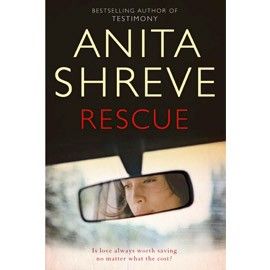
With ‘Rescue’ she breaks the mould somewhat as it is a paramedic, in John Webster, who takes centre stage. There is not much of the sea, either, involved here, although it does have a Vermont setting. Webster falls for one of his rescuees in the wild-child Sheila – choc-full of spunk and demons. For a while our hero tames her and together they produce a female child, Rowan. But it all becomes too much, this small town life. Sheila drowns her post-natal blues in grog, to the extent that hubby is forced to give her her marching orders for the sake of the baby girl. He takes on the onerous task of single dad-dom, making a fair fist of it, But oh, those dreaded teenage years! Darling daughter begins to display, during these, the same symptoms that wrecked her mother’s life. Who should her father call on for assistance when eventually he reaches his wits’ end? You can probably guess that.
Throughout the story there are vignettes about the pointy end of a paramedic’s life. There is as much interest in these as there is in how the main narrative will pan out – all to Shreve’s credit. A highlight is the black humour found in a failed suicide attempt.
Shreve is in fine form here with ‘Rescue’ being up there with her accessible best – with ‘Testimony’, ‘A Wedding in December’, ‘All He Ever Wanted’ and ‘Resistance’. Occasionally, she does get a little too heavy handed with literary pretensions which provide roadblocks to the enjoyment of some of her oeuvre, but not so here. This is just darn good, straight forward storytelling, ideal for a beach holiday, that long flight or as a salve between weightier tomes. In it John Webster’s love unravels – but will he be able to make it whole again? It is worth reading to find out.
Anita Shreve’s website = http://www.anitashreve.com/
Flower Power
 .
.
You Don't Know Me
You give your hand to me
Then you say hello
I can hardly speak
My heart is beating so
And anyone can tell
You think you know me well
But you don’t know me

Look at her picture. It’s of its time, but there’s no doubt the dame is one beautiful lady – and talented to boot. She gave up the above lyrics to the world, to be recorded by hundreds of singers planet wide. You name them, they’ve done it – Willie, Ray Charles, Michael Bublé – the list is endless. Down though the years it will be added to. It’s just one of those songs. If one classic wasn’t enough, there are her other offerings – five hundred or so that have been recorded, including such timeless ditties as ‘Distant Drums’, Dream Baby’ and ‘In the Misty Moonlight’. She was inducted into the Country Music Hall of Fame in 1997 and in 2006 Willie released a tribute album of her songs – just nine days before she passed away.
Of course we know the facts about CindyWalker’s public career, but precious little of her private world. In 1918 a Texan farm saw her birth. By the 1930s, as a young girl, she was already writing songs about Dustbowl America. By decade’s end Cindy was also a popular chanteuse in her local area. In 1940 she was so determined to further her career she took the long drive to LA, straight to Bing Central, hopped out of her car and demanded that Crosby himself listen to her latest tunes. He didn’t, but somebody did and soon ‘Lone Star Trail’ made it to the great crooner. He was impressed, recorded it and she was on her way, Walker soon had a gig on Gene Autry’s show with such luminaries as Bob Wills, Webb Pierce and Eddy Arnold having her songs on the airwaves. In later times came Elvis, The Byrds, Chet Atkins, Jim Reeves, Roy Orbison and more.
For me, though, her signature song is ‘You Don’t Know Me’. It could have been about her own self – how she kept her feelings under wraps; how she was notoriously private. Then again, it could be about any of us who like to keep our personal doings closely guarded; who prefer anonymity to notoriety.
The now standard first hit the charts in 1956 with Jerry Vale, but these days it seems that Ray Charles ‘owns’ it. Mickey Gilley had a Number 1 with it in 1981. Meryl Streep sang it in the movies during ‘Post Cards from the Edge’, as did Robert Downey Jr in ‘Two Girls and a Guy’. It featured in ‘Caddyshack’ and recently, Lizzy Caplin trilled it on the small screen in ‘Masters of Sex’.
Ms Walker hid away from public view, particularly when her stage appearances decreased as the royalties for her songs went in the opposite direction. She revealed in later life that she was once married for a short time, but it didn’t suit her. She did not appear to have any other lasting relationships of a romantic nature. She lived with her father, in humble circumstances in small town Texas, for a long time – he helping out with the lyrics to her music. After his demise, in 1991, she further withdrew into herself. No, we didn’t really know her, or who she was referencing, if anybody, in this example of her iconic songsmithery –
No you don’t know the one
Who dreams of you each night
And longs to kiss your lips
And longs to hold you tight
To you I’m just a friend
That’s all I’ve ever been
No you don’t know me
Eddy Arnold was the guy who came up with the idea for the song. Was it the country superstar she had in mind when she added the bones to his notion for this paean to unrequited love? We know Eddy was married to his sweetheart Sally for an incredible sixty-six years. Is there more to know?

To me the version of her tune that moves me the most is that by Charlie Rich. It is the second track on an album entitled ‘Pictures and Paintings’, recorded in 1992 during the twilight of the Silver Fox’s career.. This collection of covers, purchased several decades ago, would have to be the CD that has graced my various music machines the most down through the years, with the Walker contribution the stand out. The whole album is a marked contrast to his mega hits of the early seventies – ‘Behind Closed Doors’, ‘The Most Beautiful Girl’ and ‘A Very Special Love Song’. He hated his music career – country was by no means his first love. By mid-decade he was totally disenchanted with Nashville and what his label did to his songs, increasingly embellishing them with massed strings rather than guitars. Instead of joining Willie, Waylon and others, also similarly pissed off, in becoming ‘outlaws’, he turned to the grog. He embarrassed himself at one awards ceremony when, very drunk, he insulted John Denver, whose music he considered too pop to be country. He came to be regarded as unreliable by those with the power behind the scenes. He struggled on, having a couple more hits, notably ‘Rolling With the Flow’, but alcohol and frustration eventually forced him into semi-retirement. Now Rich was free to turn to the music he loved best – jazz and blues. He became a lounge singer. Eventually a record company agreed to take a chance on him in this style and thus, we have ‘Pictures and Paintings’. This bought him some critical acclaim but only moderate sales – just enough for him to take to the road for the last time. Surprisingly, in this, Tom Waits was his support act. The come-back he’d hoped for didn’t last. He went back to self-imposed obscurity. Travelling to a Freddy Fender concert in 1995, he stopped off at an inn en route and The Silver Fox passed away in his sleep. The year was 1995. He was 62.

Listening to the album, one can only agree with the inestimable Mr Waits, who made mention of him in his song ‘Putnam County’
The studio’s spitting out Charlie Rich
He sure can sing, that son of a bitch
I wonder if it is still available, this collection I love – certainly no ‘Pictures and Postcards’ were listed on eBay when I checked. It is a beautiful set of tunes without a dud on it. Listening to it you can picture Rich at the piano, his silver mane ascendant; his gnarled, hoary hands coaxing the ivories, surrounded by a smoky fug. He loathed the happy, poppy stuff that dominated the charts throughout most of his Nashville years – now he was in his element. With ‘You Don’t Know Me’ he could almost be giving the Nashville Sound the ‘bird’ for what it tried to turn him into.

Back when he started with Sam Phillips, at Sun, in the mid-fifties, the legendary producer loved the jazz infused stuff Rich pitched to him, but told him to go away and get countrified. His style, well it simply would never sell records up against this new fad rock ‘n’ roll or country. Charlie did as he was told, to the degree that Phillips thought he’d have a bigger career than Elvis. Sam Phillips wasn’t wrong very often. Apart from a brief window, Charlie never came close. It wasn’t for lack of talent – it was just that Country Music City neutered him. The real Silver Fox only appeared on this last issue – by then it was all over bar the shouting:-
Afraid and shy
I’ve let my chance go by
The chance that you might
Love me too
Cindy singing ‘You Don’t Know Me’ = https://www.youtube.com/watch?v=TsoQ945fqkY
Charlie singing ‘You Don’t Know Me’ = https://www.youtube.com/watch?v=GRDdz7DS3tI
Orchid Blooms

Love in the Autumn of Life
There’s to be another ‘Exotic Marigold Hotel’ with Richard Gere added to the returning cast to give the sequel even more pulling power. All of us of a certain age will flood to the multiplexes to see that, no doubt! Finally film-makers are realising they’re on a gold mine appealing to the baby-boomer generation. Why trouble wasting millions on the fickleness of GenY with newly retired, sixty-pluses, looking for stuff to spend their children’s futures on, even if it’s only heading off to Gold Class for a splurge. Yes, the eye candy of Hollywood’s ever youthful ‘next big things’ is okay for us not quite geriatrics, but we also yearn to continue our journeys with those actors of substance that we have matured alongside, see them strut their stuff while they still can. There’s only so many taut young hotties flexing their six-packs or breasts we can take – we do not want to be constantly reminded of what once was! We also need something that reflects where we are in life as well. We need reminders that the scrapheap is still a little way away just yet and that even, at our age, we are still capable of adventurings of the heart and mind – just as long as they aren’t too much of a physical nature. We need to know that there are still silver linings to be experienced. And, unlike all our sons and daughters with their digital dexterity, as a rule we will leave laptops, ipads and other assorted gizmos to them and troop off to the cinema to have a collective experience doing so. Yes, there is a profit to be had showing us actors of a certain age finding love anew, or perhaps rekindling it in exotic locales. Three times this last fortnight I have left the comforts of the abode by the river to view the latest, in an increasingly crowded field, of that nature at my favourite North Hobart cinematic haunt.
The first viewed was ‘Le Weekend’, featuring an English couple – competently played by Jim Broadbent and Lindsay Duncan – who are attempting to recapture the zing of more romantic times by revisiting, where else but Paris – the City of Love. Meg still seems to have a bit of zest about her but poor old rumpled Nick has seen better days – he is a sad sack worn down by life. He’s a burnt out teacher having just lost his job giving a female student a reality check – not the done thing in this era of the need for hyper-senstivitiy to the delicate feelings of oncoming generation. The young miss complained and of course poor Nick was given his marching orders – not that Meg is aware of that. As their former honeymoon hotel is a disappointment, Meg throws caution to the wind and books into one of the city’s finest, with views to the Eiffel Tower no less. Nick trails disconsolately in her wake. Soon, though, Nick rouses himself and professes to be up for a bit of nookie. Meg is off hand in her rejections and at this stage the viewer feels that this cannot possibly end well. Enter Jeff Goldblum, playing a quirky former colleague of Nick’s, whom the couple accidentally come across. The trajectory of the narrative now starts to change course. He is married to a younger woman, this not helping matters with the older duo. Then Meg finds herself being propositioned by a man, decades more youthful, at a diner the Goldblum character invites them to. Whilst Meg is tempted, Nick also finds a soul mate of sorts and we soon find we have to revisit our feelings on just how it will all pan out. The answer is with a bit of naughtiness, but elaborating any further will let the cat out of the bag. Go see it and have a giggle – the humour is gentle and there’s plenty to like about ‘Le Weekend’.

Be warned, though – there is a scene that I felt was decidedly ‘off’ – and interestingly the venerable David agreed with me. I felt it was unnecessary and demeaning of the actors to expect it from them. Something similar occurred in ‘The Wolf of Wall Street’ and I had no problems with it – it could be expected in that excess of debauchery and the participants were much less than of a certain age – if that makes a difference. My daughter and my partner reckon I greatly resemble Mr Stratton in looks and gestures – perhaps I am beginning to think like him too!
The second, I thought, despite the critics demurring, was the most successful and entertaining of the three – yet it too had its faults. I think the reason I enjoyed it is that I just simply like Michael Caine. Of course, in my mind, he’s forever ‘Alfie’ and in this movie, ‘Mr Morgan’s Last Love’, we can conceivably see what may have become of that hedonistic young man in his dotage. Again the city was Paris – the scene where the old fella Matthew forces open a long closed window to reveal what a breathtaking view he has of the Eiffel Tower from his apartment is magic, as well as ridden with symbolism. You see, he’s just picked up a ‘bird’, to use Alfie speak, on a bus. Pauline – winsomely played by Clémence Poésy- was the problem for the critics though. What would a vibrant young thing like her see in a run down, aged crusty former American academic, still paralysed by grief from the death of his life partner? To me, this didn’t seem implausible at all – after all, on her part it was purely platonic, even if our hero was head over heels. What, to me, did not ring true at all was her falling, in turn, head over heels for his son Miles, a not overly pleasant character reeling from a busted marriage (great seeing ‘Weeds’ man Justin Kirk in another light). Matthew is not about to make a fool of himself with the young Parisian lass – although his son and daughter (the latter played in loathsome fashion by Gillian Anderson) don’t see it that way. Another of the critics, gripes was the cockneyism of Caine’s American accent – I agree, it was all over the shop. Surely it would have been simpler to have him play an Oxbridge ex!! Yes there were flaws, but it was satisfying viewing. We are never too old to have our heads turned by a pretty face, so long as it all is kept in perspective, as Matthew strove to do.

Gloria – what a force of nature she proved to be! Fervently and bravely played by 53 year old Chilean actress, Paulina Alfonso, this effort from the world’s most slimline country has gonged at festivals world-wide. She’s not over-attractive is Gloria, but is one of these character actors who possess a certain something, especially when she allows a radiant smile to light up her face. Not that, initially, she has too much to smile about. The singles’ scene is proving rather barren for her when she desires something more than dissolute one night stands. When one fellow, Rodolfo (Sergio Hernández), comes back for more, she feels she has finally lucked in and starts the head over heels stuff with him. He, unfortunately, is carrying a little too much baggage; still pandering to his former wife and his daughters, despite his obvious passion for Gloria. Eventually our heroine decides she has to drag herself out of the love-lorn abyss. This she does so spectacularly. She indulges herself in the mother of dummy spits, creating mayhem with a gun in one of the movie’s best scenes. The ending is most uplifting, almost having me dancing on my chair. Of course the eponymous song has to feature somewhere in all its pumping pomp. In ‘Gloria’ there’s unrestrained sex and nudity to be had as well, but as a paean to the pitfalls of love in the autumn years it provides a reality check – no saccharine Hollywood ending here.

No film exactly set the world alight, but each, in its own way, shook off the condescending tweeness that can afflict offerings of this ilk. In two of the three they weren’t afraid of depicting bedroom scenes and in all, even in the autumn of our years, they prove there are still glorious days to be had.
.
A Beautiful Photogenic Daughter

Animal People – Charlotte Wood
Stephen is a fine name – in fact, an extremely fine name. It is derived from the Greek ‘Stephanos’, meaning ‘wreath’ or ‘crown’. Some have interpreted this to mean ‘kingly’, but a more appropriate ‘translation‘ would possibly be ‘encompassing’, just as a wreath encompasses the head. In Ancient Greece a wreath was traditionally presented as a reward for victors in contests such as the original Olympics – these being certainly more pure back then than the travesty they are today! As a name Stephen first appeared in Homer’s ‘Iliad’, with St Stephen a martyr of significance in Christian history. Back in the Middle Ages the name was actually pronounced Step-hen. Its shortened form ‘Steve’ first came accepted in the mid 1800s. Stephen reached its zenith of popularity in the United States in 1951. 1951 was a sensational year for Stephens. After that it began a long decline that continues to this day. In the UK in 1954 it was the nation’s third most popular name – today, there, it doesn’t even rank in the top 100. There has only been one King Stephen of the English (1135 – 1154) – he did such a mediocre job there’s never been another. He embroiled the nation in a long civil war fighting sis Matilda for the right to reign. Much of his time was spent plotting for his son Eustace to succeed him, no doubt hoping for a long line of Stephens and Eustaces – obviously it never happened. There have been a few more King Stephens in European countries. The name also did better at the Vatican with nine Stephens as Pope. Stephen VI was a particularly ghastly character who oversaw one of the grisliest events in papal history. This Stephen had his predeccessor Formosus’ rotting nine-month-old corpse dug up, redressed in his papal vestments and seated on the throne so he could be tried. Somehow the corpse hadn’t built much of a defence, and Formosus was found guilty of what were likely bogus charges. As punishment, three of Formosus’ fingers were cut off (the three fingers on the right hand used to give blessings). The corpse was then stripped of his sacred vestments, dressed as a layman, dragged through the streets and dumped in the Tiber River — where he was finally able to rest in peace. It’s a wonder any Stephens followed him. There have been many more Stephens famed in recent times for worthier reasons, but drop the appellation into Google and it takes a while to find any other than ‘King’ and ‘Jobs’.

Charlotte Wood’s Stephen, as he appears in ‘Animal People,’ was no luminary like King or Jobs. He was more akin to the kingly Stephen – that is, significantly mediocre. He didn’t deserve the love of his Fiona and knew it, feeling he was a square peg in a round hole – not so much with her and her girls, but certainly with her extended family, her ex and her friends. For this sequel of sorts to ‘The Children’, Ms Wood takes the ‘day in the life’ approach, accomplishing that hard ask reasonably successfully. It certainly is an eventful twenty four hours for our anti-hero. The time span is made up of encounters with all sorts of the weird and wonderful. There are deranged neighbours and their pets. There’s the spaced out junkie he manages to run over on his way to work. There’s Russell, his best mate and possibly Wood’s best creation, who betrays him in the end. Then there are the accursed professional development gurus – oh so familiar to me after forty years of excruciating team building PDs. The one our Steve is forced to partake of certainly takes the cake though. Thank She above that I have never had to participate in a ‘Coyote Canyon’ in cowboy gear. It is also the day of Fiona’s precocious daughter’s birthday. Stephen is quite fond of both her offspring and very fond of Fiona. – and go figure, Fiona is also very fond of him! Oh, this is also the day he decides to split with Fiona.
At times I felt I was in Moodyland – as in the tele series; at other times it smacked of ‘The Slap’ – ripper pun, eh! As for its time frame, it is not as successful a novel as Gail Jones’ excellent ‘Five Bells’ – too much occurred for it to be remotely believable. Nobody, with the slightest iota of common sense, could have had such an ogre of a day as the one Steve tried to bat away with grog – with unfortunate consequences.
The book speeds along at a fair crack and I was engaged until the very last page, if not enraptured. I am coming to dislike overly truncated endings. As with several I have read of late, I needed a slower denouement, or at least an epilogue, so I could stay with Mr Mediocrity just a little while longer. As with Tsiolkas ‘ masterpiece there were some truly odious characters, with Wood milking them for all she was worth – Belinda and Richard come to mind. And I do trust that Balzac survives.
It’s a thumbs up from me.

Charlotte Wood’s website = https://www.charlottewood.com.au/
Tulip03

Sun-Dappled Beauty
You can see her for yourself – up there in Gallery 9, NGV (National Gallery of Victoria), St Kilda Road. You yourself can see how stunningly beautiful she is, this sun-dappled beauty – this free spirit. She existed, caught in time by the painter, in that golden age – the time before La Belle Epoque was bought to a crunching halt by the darkness of the Great War. I don’t know for sure, but I reckon I have a fair handle on who she might be – this uninhibited maiden captured so tantalisingly at the height of her glory.
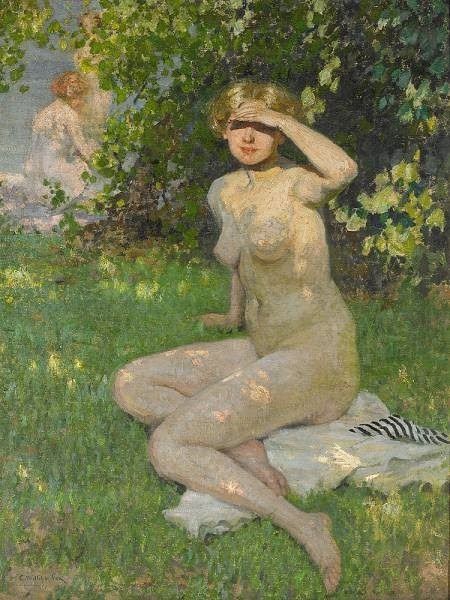
But for my viewing she had moved. As I entered that room at the Fed Square NGV, she caught my eye first and drew me towards her. In a room of luminous works of art she exuded a luminosity unmatched by her fellows on those four walls. She was part of the ‘Australian Impressionists in France’ exhibition, held in conjunction with the ‘Monet’s Garden’ show down the road. For me she even outshone the master’s water-lilies! They were both sublime, these two Winter Masterpieces – such showings being a highlight of Yarra City during the chilly months. So, on that wall, despite the best efforts of Condor, Bunny, Streeton et al, she was queen. Nothing they produced during their Continental years held a candle to her. So magical was she that the NGV used her in all the pre-publicity for the show – but nothing matched seeing her in the flesh in her gallery. She owned it!
Of course discovering the creator of such a vision was the easy bit in quenching my desire to discover more about her. E Phillips Fox is not a huge name amongst the pantheon of our great coverers of canvas, but he is starting to come into his own. The E is for Emanuel. He is best recalled for his epic, iconic ‘Landing of Captain Cook’ – to my mind pedestrian dross compared to her. He was also the hubby of one of our foremost female artists of the period, Ethel Carrick. There’s was a great love story. Fox didn’t see out the war, although he was never a participant, dying in Melbourne of lung cancer (the world was full of chain smokers back then too) in 1915. Well before that the couple had split – supposedly because of Ethel’s attachment to Theosophy, the Scientology of the times. She, as well, found it difficult on their return to Oz in 1913 coping with the claustrophobic nature of his antipodean family. She rushed from Sydney to be at his bedside when hearing of his imminent demise, championing his abilities with the brush till her dying breath in 1952. Arguably she was the better practitioner, but to my non-trained eyes nothing she produced measured up to her husband’s depiction of another stunning woman of his close acquaintance.
The marriage of Fox and Carrick was happiest when the couple were ensconced in France – in Montparnasse, the heart of intellectual and artistic life in Paris at the time. Their abode there possessed a small garden where Fox painted some of his atmospheric images of women, particularly in the act of reading. Women engrossed in a book sold well at the time. We know that his model for many of these was the woman I suspect to be her. Ethel also painted her and she was another Ethel – Ethel Anderson.
She has been recorded as the resident muse for some of his clothed oeuvre – works such as ‘On the Balcony’, ‘The Green Parasol’ and ‘Nasturtiums’. The latter work was recently purchased by the Art Gallery of NSW in remembrance of Margaret Olley. Edmund Capon stated that the late grand dame of Aussie art would have adored the choice – but we’re off track!
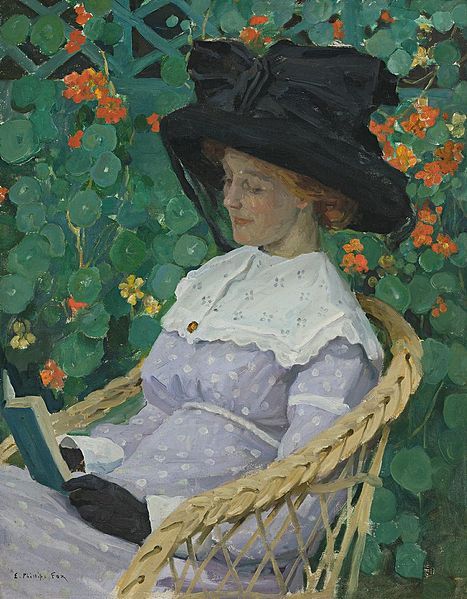
A stunningly beautiful auburn haired, green eyed beauty, Anderson was first a pupil of Fox’s – it’s interesting to note that, although men still dominated the world of art back then, women far outnumbered them as pupils. She and Fox later became great mates, it being the artist who introduced her to her future husband, fellow dauber Penleigh Boyd. The surname is a famous one in Australian artistic circles. They later produced a son, Robin, who dominated the architectural landscape of the country in later life, writing the seminal ‘The Great Australian Ugliness’. Arthur Boyd was a nephew. As an artist Penleigh was mainly a landscapist, but it is conceivable that in that millieu Ethel – maybe even both Ethels – would be liberated enough to divest themselves of clothing in the name of art. As to Ethel Boyd, comparing the pictures – there would seem a certain similarity to the model who posed as the voluptuous sun dappled beauty, shading her eyes in the French soleil, with the one in the aforementioned trio of works. It seemed the same model featured in other of Fox’s nudes – some quite intimate. The hair’s the giveaway – although in the days pre-August, 1914 women of that hued hair were favoured as models – so I could be completely askew in my thinking.

Ethel and Penleigh married in 1912, witnessed by Fox and Rupert Bunny – could she have also been the model for the latter’s ‘The Sun Bath’? Ethel was ten years senior to her husband, with their marriage ultimately not being any more successful than that between the other Ethel and Fox. At one stage Penleigh returned to Melbourne, leaving his wife in Old Blighty. Once the marital shackles were off, he promptly proceeded to have an affair with Minna Schuler, the daughter of the editor of the Age! When his family eventually joined him in Oz, there was constant quarrelling, not letting up till the day Penleigh died in 1923, as a result of a motor accident. Like her namesake, Ethel continued on till a ripe old age, not passing until 1961. So, if Ethel is she, this beautiful creature was still alive in my lifetime. By this stage her greatest claim to fame was as a writer of successful radio plays.
I suppose those with the time/money/desire could more forensically examine the sources and deduce whether I am on the right track or otherwise. For now, though, that sun dappled goddess of ‘The Bathers’ is, for me, Ethel Boyd nee Anderson. She was from a time that has now long passed, but I’ll always remember seeing her hung on that wall as if it were yesterday. I do wonder if the two Ethels were friends, or at least remained in contact down through the years – remembering a tiny garden in a Parisian suburb from whence the sun will shine on forever.
Postscript – This morning I travelled into the city to view the ‘Capital and Country’ travelling exhibition at the TMAG – Tasmanian Museum and Art Gallery. It is on loan from the National Gallery in Canberra until May 11th. It gave an overview of Oz art in the years around Federation and featured works by all the artists I’ve referenced above. I stood before Penleigh’s large, golden canvas of the site near Yass for a future national capital. I pondered on the likelihood that she may also, at some stage, have stood before the same painting, marvelling at her husband’s expertise, just as I stood before another artist’s rendering of her and commenced my own wonderings.
Some examples of works by E Phillips Fox = http://www.artgallery.nsw.gov.au/collection/works/?artist_id=fox-e-phillips
 The Blue Room, Riverside Drive