Belle and the Way It Was
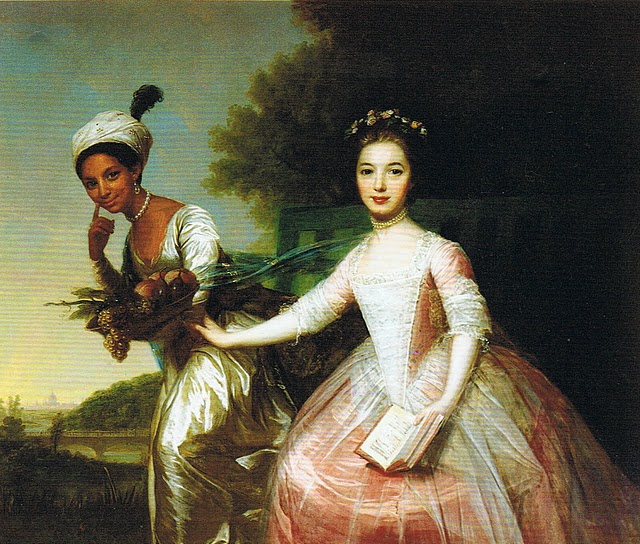
Look at her in the 1779 Zoffany portrait – exotically turbaned and emerging cheekily from behind her cousin. The placement of the latter’s hand on hers indicates that the two, at least in Elizabeth Lindsay’s eyes, are equal. Quite astonishing when you think about it. She was no maidservant. If that was the case the white young lady’s hand wouldn’t have been within a bull’s roar of hers. In the past, had she appeared in a work of art of this nature, that is what she would have had to have been, or worse – a slave. For in Britain at this time slavery was at its zenith and fortunes were to made off the backs of the chained black man – and woman.
Slowly, though, society was becoming more liberal as the Age of Enlightenment took hold. Despite an upbringing surrounded by luxury, she was still up against it. She was illegitimate, a coffee coloured ‘mulatto’ and she was a woman – misogyny was rampant, stifling most attempts for the fairer sex to be their own person. Being, more or less, a chattel of a man was the go – an aspect the Amma Asante directed movie, ‘Belle’, well captures. But Dido’s real story is remarkable – and it has come to movie houses to such critical comments as ‘Elegant’ (Variety) and ‘Extraordinary’ (UK Guardian). Largely the praise is not overblown, just as long as you do not believe all the facts about her portrayed up there on the silver screen. Her tale actually needed no embellishment – but those associated with the movie have done plenty, playing very loosely with the ‘based on a true story’ facts.
Dido Elizabeth Belle certainly existed in the records, as well as in that astounding portrait. She was born the daughter of an admiral – one Sir John Lindsay to be exact. Her mother, quelle horreur, was a West Indian slave. The exact details of her conception are not known, only guessed at. Her upbringing was entrusted to a relative – but a very eminent one. He was no less than William Murray, First Earl of Mansfield and the Chief Justice of England. He treated her well and largely protected her from the trolls of the era – and there were plenty of those. Murray (skilfully played by Tom Wilkinson) was largely a man of his age, but had a stiff enough backbone to know what was right, even if it wasn’t socially acceptable. So, surrounded by wealth and all she could reasonably wish for as a child (then woman), Dido was still banished from the family table when guests were present. After her protector’s demise she was well-endowed financially and married a Frenchman – not the son (Sam Reid) of the local preacher, as presented in the movie.
It is historical fact that Murray’s high court decision over a case concerning a runaway slave – The Somersett Verdict – was the first step in the emancipation of the Negro from bondage in Britain. This journey’s culmination is also on the big screen in the fine ‘Amazing Grace’. Whether Dido played a role in his decision is unclear, although she certainly was employed by him as a clerk – also very forward for the time. In the movie she certainly has a defining role – although the nature of the case is entirely different – for dramatic effect I assume. On screen it involves the shocking mass drowning of slaves for insurance purposes.
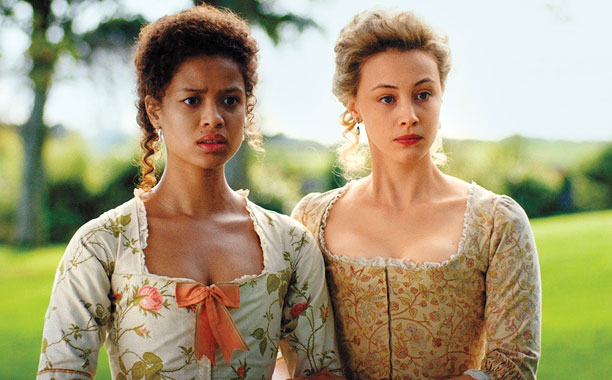
In the lead role Gugu Mbatha-Raw’ is, well, ‘elegant’ when she has to be, but hardly ‘extraordinary’. Emily Watson as Mrs Murray can act in such roles, as given here, in her sleep. It is the troubled, protective Murray as poignantly portrayed by one of the Brit’s finest that is the stand-out. It is a story with a happy ending and is well worth a bo-peep. The flick did put me in mind of my island’s own troubled past. A similar situation to Dido’s tale occurred in our early years – the ending of which was sadly not happy at all. The story concerns the ‘adoption’ of Mathinna, a young Tasmanian Aboriginal girl, by John Franklin, an early governor, together with his redoubtable wife, Jane. I guess the major difference here was the lack of ‘blood’, and it showed. This story has been bought to life in Richard Flanagan’s awesome novel ‘Wanting’.
We have largely left the misogyny of the past behind us, although in less civilised places Pakistan, the Sudan and India, horrible stories of it have emerged just in the past week alone. No, here though, there is no place for the ill treatment of women in our Western society. We have risen above all that, haven’t we? Well, maybe not as Wendy Squires elucidates:- http://www.theage.com.au/comment/how-the-misogynists-found-a-new-model-target-20140530-zrted.html
Trailer for the Movie = https://www.youtube.com/watch?v=cJ3VUbfJWD0
Rainy Afternoon Fed Square
A Little Bit of Doc
You knew they’d play it – it was a given. In forty teaching years – for at least two decades of that it was a given at any school social I attended. Along with ‘Nutbush’ and ‘The Time Warp’, it was a given. This tune, though, had a sting in its tail. – something that’d get the ‘too cool to dance’ set out on the floor – and even those too scared to normally would also join in. They knew, we knew, they’d soon be bellowing out the words that were forbidden in any school situation. And bellow they did – gleefully, with passion. For those few seconds, after each chorus, every kid was a rebel; snubbing their noses at the mainstream. They’d shed their cool, they’d shed inhibition. Up would go their fists, pumping in time with those beloved expletives – and there wasn’t a bloody thing we, as supervisors, could do about it. They were taunting us – daring us. But nor did we want to ruin the moment if the truth be known – for this was an Aussie anthem. It was almost sacred. Given half the chance we’d be bellowing it out with them. We all knew those words – it would be un-Australian not to. Where did it all start? Well the man himself knows. He’d have loved a dollar for the number of times he repeated the tale over the years – of that first time, when he looked down from on high, heard it – half amazed, half bemused. In part that refrain – those words, have made him a legend. And now he’ll rock it out no more in this life.

Australia has produced a pantheon of great front men; guys who could walk on stage to hushed anticipation and in minutes have a crowd in an ecstatic frenzy – be they playing to beer barns or stadiums. He was one of those. These are guys, who with their swagger and ‘mercurial’ struts, gave the punters more than value for their dollar. Most of all they possessed those great rock voices. You know the names – they’re etched into our lives. They had that special something – Stevie Wright, Bon Scott, Michael Hutchence, Dazza in his pomp, Barnesy of course. JO’K had it in the beginning – and for me Gerry Humphries was an under-rated master. But the Doc almost took it to Freddie levels. Dancing onto the stage, arms raised with that scarf between them – with the Doc it was as much about his show-stopping presence – dangerous, threatening – as it was the music. With the Angels behind him thumping out that pub rock beat, he was up there, spittle and sweat flying. The Doc, well, he just simply imposed himself.
When I saw him last year as part of the RocKwiz juggernaut, wending its way around the country, he really struggled up there on stage in his ‘Who Can It Be?’ role. He was ill – that was plain for all to see. Still he had to sing that song. And the crowd, packed into the showroom, responded with gusto, pounding back that inevitable response to him. It wasn’t long before word filtered through, later to be confirmed by his ‘Australian Story’ profile, that his remaining time with us would be short, unless a miracle occurred. The miracle never came.
After the show Julia, Brian, Jo Jo Zep and the Doc lined up to greet the fans. When I made it to him I asked if he’d have his photo taken with me me and he complied. I had a brief conversation – he was patently ‘spaced out’. Still he placed his arm across my shoulders and I responded. Sadly the photo didn’t come out. But all wasn’t lost. Doc had a signing pen in his hand and he inadvertently scrawled it across my jacket in indelible purple texta. Every time I wear that coat I think of Doc Neeson – and ever will. Tonight he’ll be up there, beyond the silver lining in the sky, belting out ‘Am I Ever Going to See Your Face Again’ to the angels.
Doc rocks it out one more time = https://www.youtube.com/watch?v=z87GJiNA7dE
Flag Reflected – Yarra City

Eagle
As much as I believe in a god I believe in totem – and in my case it has always been that of the eagle; specifically sea eagle and wedge-tailed. I regard them with much reverence. Espying one of these alpha-raptors evokes as much spirituality in me as occurred on seeing Uluru or Chartres for the first time, or indeed on the day I took that walk on a narrow strand of white sand by the sea at Oyster Cove.
In 2006 I had the good fortune to teach my school’s shiniest senior students for creative writing. As part of their first lesson for the year I felt that I should prove that I was able to ‘walk the talk’. I had little of the time I now possesses to indulge myself with scribbling, nor the time to polish – but this is the piece I presented.
SUMMER 0F THE SEA EAGLE
Each summer, in recent years, I have travelled south to my partner’s house of tranquility by the Derwent, on the semi-rural outskirts of Hobart. Here I find peace, respite and love. At the end of my lady’s street is a path that serpentines its way along the eastern bank of my island’s premier river, for five or six kilometres, towards New Norfolk. It has been my habit to walk the length of this track most days, partly to satisfy the adage that ‘half an hour’s exercise keeps old age away’, and partly because of the delights that may unfold on this ramble.
The path is named for a young lady kidnapped and murdered many years ago now – her body disposed of amongst the reeds that fringe the river’s edge. But no gloomy thoughts enter my mind as I traverse the length of the walkway, particularly on the glorious summer days we had through this January just past. Firstly there are the various moods of the river itself – from grey white-capped anger to glassy reflectiveness of the surrounding hills. On my outward walk along the Derwent the grey bulk of Mount Dromedary dominates. On the return journey the pinnacled head of Mount Wellington gradually emerges from behind the hills, flanking the western bank, as I close in on my destination.
Then nature can open up to me as well. At various times I can appraise numerous groups of black swans. During the warm weather months their flocks are often sprinkled by downy grey cygnets as well. One such quartet of mother and offsprings once blocked my path on the return journey – the protector of the group angrily hissing and flapping at me as I tried unsuccessfully to pass. I envisaged headlines in the Advocate –‘Yolla Teacher Severely Injured After Attack by Feral Swan’. I escaped by scurrying up the railway embankment that aligns itself with the river path. It is always a treat watching the blue wrens as they flash and twitter in the shrubbery, the brilliant male’s plumage glinting in the sun. Often scampering around are poo-cackers (such an inspired collective noun!) of native hens. In the shallows I often catch fleeting glances of a fisherman’s quarry. One day I watched a dozen or so pelicans take flight nearby, on another an echidna made a tortuous crossing of the railway tracks. But nothing beforehand matched my encounter with the resident raptor king of the Derwent on one particularly golden summer’s day.
Shortly after the turn of the New Year I stood transfixed on the decks of a catamaran on its journey down the Hobart’s estuary to Peppermint Bay as a screeching flurry of kelp gulls hooned in on a sea eagle. It had obvious designs on their eggs – this being my only previous contact with the magnificence of this feathered denizen of our coastlines. A few days later, on my walk, I spotted in the distance, high up, what I first took to be a circling hawk – only this bird seemed to be too big, too majestic – and there was that same distinctive undercarriage of pristine white. On later walks I repeatedly saw it, but always too tantalizingly far off to positively identify. One day, though, a fellow perambulator confirmed that this solitary bird was indeed a sea eagle.
The day of which I write will stay forever embedded with me. I was loping along the track, again on the return journey, when a certain feeling induced me to turn and look back towards Dromedary. Against the dun green hues of its flanks I was able to pick out the redoubtable avian of earlier sightings, gliding low to the river, obviously on the lookout for piscatorial delights. He (she?) was heading my way, so I remained to watch its progress. Closer and closer it flew. As it neared me the bird seemed to align its flight path with my stationary figure. He was so low his piercing eyes seemed to be at the same level as my own startled ones. For a brief time I indeed felt I was the sole focus of his interest. Then, when it was almost on me, up he soared to the heavens to hunt thermals. I felt a rush of air as he passed overhead. He knew who was the dominant species in this scenario, and it wasn’t the onlooker. The eagle then glided down again, up ahead of me, to continue his appraisal of the Derwent. I reluctantly returned to my trek towards the small car park that signifies the Bridgewater end of my promenade. A small gaggle of tourists were there, observing the sky and engaged in animated discussion about what they were gesturing towards – my eagle.

One asked if I could enlighten on its provenance so I regaled her with what I knew of a sea-eagle’s habits. For I time I stood with them in their observances as the raptor gradually disappeared downstream over the causeway. They’ll probably remember the thrill of it, but that momentary connection I made with my ‘kindred spirit’ is with me forever.
*****
And that is as good a way as any to segue into a discussion about ‘Healing’, a recent movie that had me weeping unashamedly into my hankie by its conclusion. I doubt if I’ll see a better Aussie movie this year. I know I’ll not view a more affecting one from anywhere in 2014 – that’s for sure.
Being picky – it wasn’t perfect. There were occasions of overt Aussie-ness that were cringe-worthy. The normally reliable Justine Clarke here was quite jarring. But anchored by Hugo Weaving and Don Hany, this fluid vehicle from director Craig Monahan would go a long way to charming any affected by the ‘black dog’ out of their despair. Of course Weaving is an old hand at this sort of stuff – it was Don Hany, making his big screen debut, who was the revelation. Playing Viktor Khaden, a long-termer in the prison system, his character’s chances of rejoining normal life were running out. He finds himself transferred to the low surveillance prison farm, Won Wron. He’s Iranian, in for committing a ‘saving face’ crime. He also seems a hopeless case for redemption, but Matt Perry (Weaving) is going to have a go. As a senior rehabilitation officer it’s his job to attempt this; it’s not his job to also believe in Viktor. Tony Barry, as Matt’s offsider, is cynical about it all. This movie is a throwback to Barry’s younger days of pomp when he was in the same position as Hany is now, a darling of the small screen. Also demonstrating actorly chops that are prescient of bright futures in the industry are Xavier Samuel and Mark Leonard Winter. But the real star of this Oz offering is Yasmine, the eagle – Viktor’s ticket to the future. She is awesome, – just so stunningly awesome. To see this movie is to believe my words – particularly as she imposes herself over the opening credits. What an introduction, till it all comes to a horrible end! That it is all based on a true story only increases the allure of Monahan’s engrossing fare.
I know this inspiring effort will not attract the mindless masses away from their brainwashing at the altar of Hollywood dross, but this is so worth tracking down when it is eventually makes it on to DVD. I know there are two very special young ladies who will receive it in their Christmas stockings from me.

‘Healing’ website = http://www.healingthemovie.com/
Melbourne Shininess

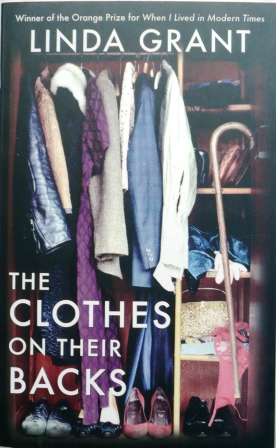
The Clothes on Their Backs – Linda Grant
Tasmanian winters are, by Australian standards, long, chillsome and in some areas, very, very pluvial. We are, on this island in the southern seas, on the cusp of a brand new one. They take a great deal of getting through for this scribbler with summer in his synapses – and I’ve been through a few. But I am away from that part of the isle where the mid-year months meant the westerlies bearing down on my coastal environs, downloading a heavy cargo of the world’s purest precipitation. This old fella is more sanguine about the cold season now that I am in southern climes. Hobart winters, under a Kunanyi oft frosted with white icing, can have freezing starts, but now I do not seem to possess the lack the forbearance I once had for winters past. I am just chuffed to be still here no matter what the seasons throw at me. Burnie/Yolla winters seem a now distant memory.
But it was forbearance I required to get through this book. Although the climate played no great part in it – to me it seemed continually grey and drab. It was like those Tassie winters of my teaching days – a hard slog, hoping there was a moment of sunshine up ahead. In the tome there wasn’t – spring never came, although I stuck at it in the hope. It was not aided by the mittel-Europeanness of its context, nor by its time setting – the Winter of Discontent in Thatcherite London. Under Abbott methinks we may be in for something similar here – certainly he seems intent on a diaspora from this island, as there was from Hungary post-war – something that shaped two generations of characters in Grant’s offering, ‘The Clothes on Their Backs’.
It’s not that Ms Grant isn’t a fine writer. I was entranced, bowled over by her later ‘We Had it So Good’ – thus the purchase of this title – and she has won an Orange for ‘When I Lived in Modern Times’. I won’t be shelling out for the latter any time soon.

Although this is a book I’d perhaps prefer to forget, essentially it is the story of a girl racked by self-doubt, trying to break away from the stifling family life lived by her parents, former Magyar refugees. Their lives were joyless, just simply existing in a depressing block of flats amidst other assorted odd-bods. How our heroine achieves her freedom is by aligning herself with the black sheep of the family – her Uncle Sandor. He, in past lives, had been a pimp and tenement owner ripping off the displaced. When she eventually finds love, tragedy strikes and she resorts to ‘friends with benefits’, slumming it till Sandor provide his means of escape.
I hate it when I don’t like a book. There is always a decision to be made – do I persevere in the hope some sunlight will come, or chuck it in before I’m trapped by endless winter. I made the wrong decision here.
Linda Grant’s website = http://www.lindagrant.co.uk/
Sex for Sale
There have been classics of the past using the titillating effect of having a central character being a purveyor of the world’s oldest profession. These movies, of course, to survive the test of time, had to possess more than disrobed bodies engaging in the act. They had to resonate for other reasons as well – for plenty of simply ‘doing it’ can be had on-line at home if that is your cup of tea and would eventually get to be a tad boring in a cinema house. It takes far more than that to drag me out, as did two offerings with the central premise of selling sex in recent weeks. Would they possess what made memorable entities of such fare as Catherine Deneuve in ‘Belle de Jour’, Jane Fonda in ‘Klute’, Richard Gere in ‘American Gigolo’, John Voight in ‘Midnight Cowboy’ or Julia Roberts in ‘Pretty Woman’? Then there was the moderately successful Aussie tele series ‘Satisfaction’ that lasted three seasons on our little screens.
Not that I was disappointed with the two that I viewed, but I doubt if they will have the staying power of those referred to above. John Turturro’s ‘Fading Gigolo’ and Francois Ozon’s ‘Young and Beautiful’, nonetheless, although very different beasts from each other, have had sound critical praise and were certainly worth the effort. They both possessed a degree of sexual activity and nudity, particularly the latter, but had much more going for them. I saw ‘Young and Beautiful’ at the cinema’s first showing for the day and was the only male present. The other attendees were a group of old darlings of my mother’s age who weren’t in the least fazed by the frank goings-on on the screen. I had no need to feel uncomfortable in their presence.
Now imagine, if you will, that you are an actor of some note but wouldn’t be the first choice on anyone’s list as a romantic lead, let alone a Gere-like figure who would naturally draw women to take off their clothes and pay for some horizontal delights. No you, John Turturro, would not immediately come to mind. So, perhaps feeling left out, with father-time a-ticking to be in any way credible in such a role, Turturro obviously saw the need to strike immediately rather than wait and hope. What should JT do, then, to realise his goal? Why, being a fellow of catholic skills, he would first write a plausible screenplay in which to cast himself as the lead, sign himself on to direct and then use a shared barber to convince Woody Allen to participate. The old hand would give his project the necessary gravitas and pulling power for the monied interests to invest. And he has pulled it off quite well. It’s more than a vanity project – it’s a darn good visual experience.

With the streets of Brooklyn casting a burnished, honeyed glow to match its brownstones, the film sees Allen doing as he has done for years. He has his usual patter down pat, but he is more discerning with it in this role as the pimp for Turturro’s character, Virgil Harris. Allen revels as the gloriously named Dan Bongo. His usual nervous carping wouldn’t cut the mustard here. No, this is Turturro’s project, the rewards of which is that he gets to bed some gorgeous women of a certain age. Still sexy, in a mature way, Sharon Stone at one stage seems set to repeat her ‘Basic Instinct’ moment with her glorious pins. Doesn’t. For a bit of eye candy there is Columbian bombshell Sofia Vengara, but the main focus is soon on that gap-tooth delight, Vanessa Paradis. She plays the repressed ultra-Jewish goddess Avril. Under Virgil’s guidance she soon throws off her sexual shackles, even if Liev Schreiber, playing a sort of orthodox Jew cop, is silently in love with her. He is determined to keep her on the extreme straight and narrow. Who will attain her favour in the end – the gigolo or the cop?

This is a bit of a caper, but in the main a quietly sensitive one. Despite his limitations in the looks department, Harris takes to his role as gigolo like a duck takes to water and it seems for him the money is soon secondary – despite Bongo’s best efforts to make it the central motivator. It is a deliciously appealing way to spend ninety minutes or so, as well as providing an entry into two worlds largely foreign to the average Joe. – Jewishness and providing sex for money.
The latter is precisely what Marine Vacth spends most of her time doing in ‘Young and Beautiful’. If nudity offends, then this is not the movie for you – although how anyone could be offended by this young actress’ blooming body would be beyond this scribe’s comprehension. More troubling was how it was salivated over by a procession of older men for the purposes of the narrative. The seventeen year old hooker does manage to develop some feelings for one of their number, played by Johan Leysen, with this forming one of the narrative drivers of the piece. The other thread is just why a girl still at school would be motivated to proceed on such a course when money is again seemingly secondary. Her earnings are simply stashed, but when the family finds out her vocational proclivities all hell breaks loose. Will they be able to cure her of her ‘addiction’?

This effort comes from a director, Ozon, who is one of the great purveyors of what makes French movie making so special. His oeuvre is always thought provoking, with this being in the same league. It is not the customary explanation that he provides for the actions of Vacth’s Isabelle – that of exploitation. She is strangely willing to be exploited – is addicted to it and it is an intriguing performance by the actress. For the most part she is disengaged from the sexual ‘treats’ she performs. Her little brother, conversely, takes an over-active interest in proceedings. All this is typically Ozon with this offering falling short of his best – especially ‘The Swimming Pool’ where he again glories in the body of a young actress, this time that belonging to Ludivine Sagnier, as well as that of veteran Charlotte Rampling. She has an affecting cameo in this too. Again, for those who appreciate quality art house product, this somewhat disconcerting peep into the lives of the French middle-class is still, nevertheless, worth the ticket price..
So there you have it. Sex for sale will continue to be a source of interest for film makers for many reasons, some of which could possibly be predominately voyeuristic. Still, with these two there are other layers that would prevent that finger being pointed in the direction of Turturro and Ozon.
Official site ‘Fading Gigolo’ = http://fadinggigolo-movie.com/
Trailer ‘Young and Beautiful’ = https://www.youtube.com/watch?v=IzSJ5mijWyA
Colour Contrast02

 The Blue Room, Riverside Drive