Mark R and the Kids

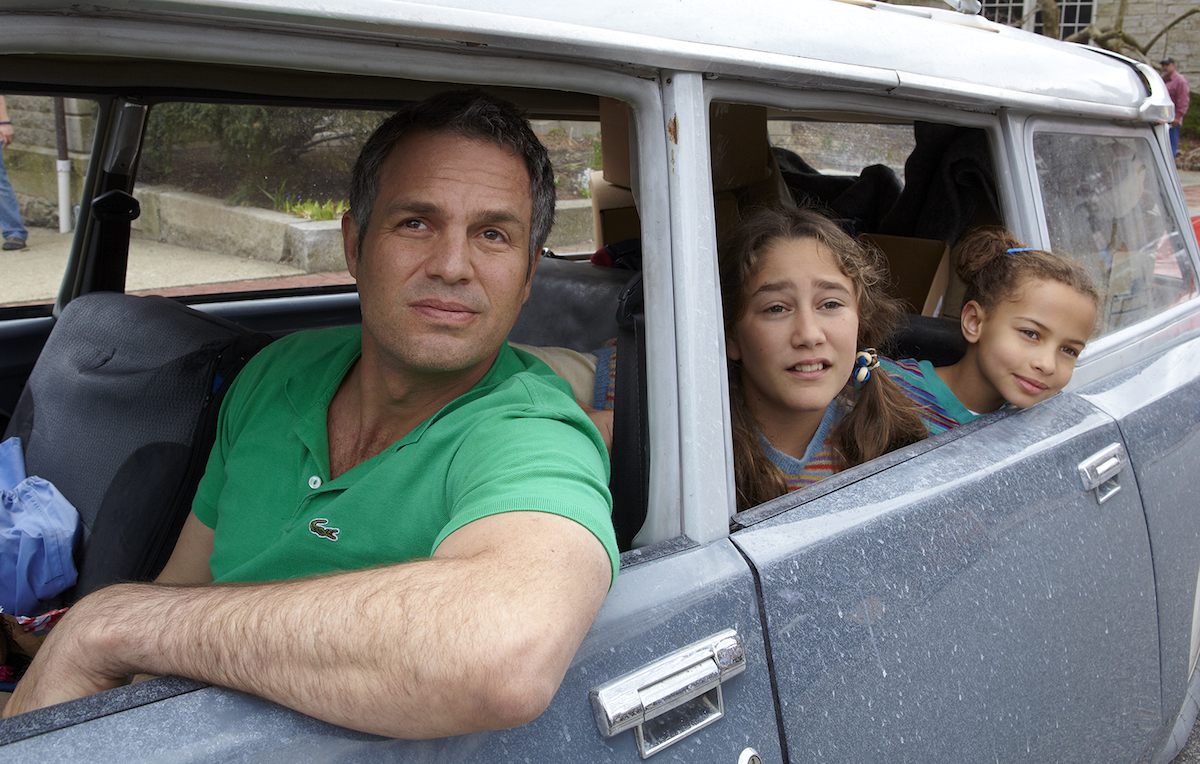
The kids didn’t grate, they honestly didn’t grate. The lovely Leigh and I discussed this fact as we drove homewards after seeing the movie ‘Infinitely Polar Bear’. Why didn’t they grate? Was I getting more tolerant in my dotage – or perhaps it was that American and film-makers world-wide are now looking for more from their junior-thesps than cutesypieness, as Leigh suggested. The two kids in this production – Imogene Wolodarsky as Amelia Stuart and Ashley Aufderheide as her sister Faith – expertly played just being kids. They weren’t perfect goody two-shoes. They had spats and they had tantrums. They were believable and increased my enjoyment of the offering – rather than, as in the past, detracting. Turns out young Imogene is the daughter of its writer/director, Maya Forbes.

infinitely-polar-bear-poster

I was certainly charmed by the pair of lasses, but what really caught my attention and impressed was a performance I felt up there with the Oscar nominated boys this year. I now realise that Mark Ruffalo has passed under my radar for years, not seeing his turns in the recent ‘Foxcatcher’ or the ‘Avengers’ franchise. His face was familiar, so checking out the forty-seven year old actor’s filmography, I discovered I had seen him up on the screen in that marvellous ensemble piece ‘The Kids are All Right’ from 2010, as well as, further back, in ‘My Life Without Me’ and the Jane Campion offering, ‘In the Cut’. I have the latter on DVD somewhere so must watch it again.

As written, I thought Mark Ruffalo was sensational in ‘Infinitely Polar Bear’ – see the movie and if you’re attentive you’ll pick up the origins of the title. This Wisconsin born is of mixed Italian/French Canadian heritage and was a wrestling champ at school – thus his casting in ‘Foxcatcher’? He worked in minor movies through the nineties, hitting the big-time alongside Laura Linney in 2000’s ‘You Can Count on Me’. He has been in demand ever since. He also takes to the stage on occasion and has tried his hand at directing. He now resides in NYC, has a couple of daughters – so he’s no stranger to that species – and a son, being married to French actress Sunrise Coigney for thirteen years. Politically active, he is a strong campaigner for pro-choice and anti-fracking – good on him.
InfinitelyPolarBear-2014-2

In ‘IPB’ he plays Cam and he’s a bit of a plonker. But it’s not his fault – you see he’s afflicted with the curse of bi-polar. He is unable to hold down a job, boozes and constantly has a fag dangling from his lips – not a great role model for his girls, but they love him – for good reason. In contrast, long suffering missus, Maggie (Zoe Saldana), is struggling to cope with him. When she is forced to leave Boston, for better employment opportunities in New York, she has no choice but to make Cam responsible for the two girls. Mayhem ensues. But it’s Cam’s ability to stick his head above his usual hopelessness that charms the audience, if not so much his wife. Whatever his failings, we’re left in no doubt of his love for her and devotion to the kids. With a manic father, this family is battling against the odds. Will it all fall apart or can they finally make it work? Well, this is Hollywood, after all, so what would you think? But even so, this is a journey well worth taking and for my money Ruffalo surely proves he has real star power. So take it from me, I’ll be off to see him whenever his name appears up there in lights – although I’ll draw a line at ‘Avengers Age of Ultron’. I am not that enthusiastic about him!

Infinitely Polar Bear’ – official trailer = https://www.youtube.com/watch?v=fvjS7rN8HT0
Fish 'n' Chips

I don’t see how they can be allowed to get away with it – what with truth in advertising and all that. Claim they have the best chips – or is it fries – in the nation. Some sun-drenched, stereotypically knockabout Aussie beach-type lads walking towards a car, skylarking over a cup of chips (or fries), with a voice over making that claim. The good life = KFC chips. How can they be the most delectable in the country – what proof is there? What surveys have been done? Just gives me the pip.

Advertising is yet another reason free to air television annoys the heebies out of me – well at least on the commercial channels. It’s no wonder the punters are turning off in droves. And now it seems you cannot enjoy a quarter of footy without them trying to squeeze in not one, but two, ads after each goal. To my mind people would be so peed off that they’d deliberately not go out and buy that product. Sure there are ads with a modicum of intelligence about them – the Jeep campaign for instance – but any effectiveness they might have are killed off by repeated exposure. But having inanities shouted at you after each six-pointer – that is just beyond the pale. But enough of railing about that – I’m off topic. That rubbish from the Colonel – that’s what I need to be focused on.

I suppose, really, I should put it to the test and actually buy some of them before I rant away – but I haven’t been in a KFC, or a Maccas, this century and I don’t plan to start now. I do not have a great deal of respect for my stomach in terms of what I put in it, but going to any one of those generic fast-food outlets is a step too far over to the dark side. But I like fish ‘n’ chips, I really do. I envy Dave O’Neil who, when he’s not scribing about all the great pub rock bands he saw back in the day when he and they were in their pomp, he’s rattling on about what he can stick in his ample gut. He’s a great columnist though, I reckon. He usually raises a smile or more from me. Living, as he does, in Melbourne, he can still seek out the old fashioned variety of fish ‘n’ chips – the type I yearn for. He has to drive a distance for it, though, to get to a place where ‘…the man behind the counter dumped a big load of flake and chips on the paper and shaked salt over the fried goodness.’ Read the attached article ‘Fish and Chip Heartbreak Served Without Salt’. If you’re pining, like me, for the good ol’ days, it’ll take you back. It sure took me back.

fish-and-chips-2

I’m a Burnie boy and proud of it. But back when I was a lad every ‘burb, big or small, had them – the take-away shop, usually run by Greeks or Italians. These served up fish ‘n’ chips in the way that has all but disappeared. Salt, of course, was a given – the only choice then was vinegar or no vinegar. I remember the one I used to frequent, way back in the mists when I was in primary school. I can picture it now. After class had finished for the day I made a beeline for it. You could never see what was on offer from the outside as the plate glass was so steamed up from the hot expectant breath of dozens of children waiting, the younger ones repeatedly forced to the back by the pushy grade sixers. Then there were the super hot vats of boiling, infrequently-changed, oil to increase the fug. But you didn’t need to see in – just open the door, feel the exhale of warmth, particularly if it was winter, then make your way, as best you could, to order your shilling’s worth at the counter. Flake was not affordable, reserved for family occasions on the weekend. There would be dark haired, swarthy men in singlets serving it all out, the sweat oozing down from hairy armpits, what with the effort required to keep up with demand. It was like the six o’clock swill in the pubs of the day. A bob’s worth in the chilly season would keep you toasty all the way up the hill to home – no helicopter parenting in those days. And they were wrapped in raw newspaper, soon to be punctured at the top for hand dipping. In cold weather you would tuck the package under your jacket. This would serve two purposes – firstly to protect it from the elements and secondly, to warm you from the chill winds. You’d wonder how the chips would be on any given occasion. Would they be exquisitely soggy, or deliciously crunch-inducing? If you came up with a particularly long one you’d show it to your mates to see if they could outdo it from their yesterday’s news package. Some chips would invariably have big black spots of god only knows what on their skins. The finicky would chuck them – I wasn’t finicky. And when you had scoffed them all down, at the bottom would be more delight – the salty, oily scrag ends and crumbs.

fish

During my uni days, in the seventies, it was still possible to enjoy the same binge as I had the previous decade. From my residential hall there was the ten o’clock nightly run down to the Monaco on Sandy Bay Road. There’d be a rota, orders were taken and if it was your turn, off you’d go, returning with a steaming mass of chip orders. If you were flush, added to it would be dim sims, chicko rolls and flake. If not, probably a potato cake or two. A scallop was pure ecstasy

When I finally moved back to Hobs, a few years ago now, there was a place along the Main Road, at Austin’s Ferry, that still retained a semblance of the old ways. From his stock, though, you could tell the sole owner was struggling. He eventually merged with the pizza place next door, but the last time I looked both had gone the way of so many small businesses these days.

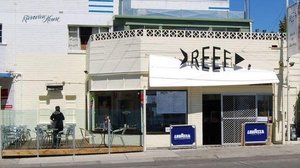
maning reef

Yes, ‘…slices of lemon are the new potato cakes and it all comes in small cardboard boxes.’ Leigh and I have gone with the flow and now frequent a ‘Fish and Chippery’, as Dave puts it. Ours isn’t bad. Sure, it’s not like the old days, but the blokes who run it, John Caire and Giovanni Bertelle, are friendly, the prices are not over-inflated and what they produce is tasty – not old-fashioned tasty, but good enough. It still warms the cockles and is probably a darn sight healthier. And it also takes me back to Sandy Bay Road – 479 in fact. Like Dave O’N’s new place, it is a bit of a drive from our abode by the river in Bridgewater, but we combine lunch there with a trip to the casino once every couple of months or so. Leigh can have a flutter and I take my newspapers to enjoy the river views from the Sportsman’s Bar. If you’re in those parts you could do worse that a cheap repast at the old petrol station, the site for our tucker on such occasions. Leigh reckons their pizzas are pretty delectable as well, but I’ll stick to my simple ‘two pieces of flake, battered, with chips.’ The light tempura batter is not the same as the floury overload of earlier times. Its all fried in cotton seed oil, regularly changed, which I guess is a bonus on the cholesterol. And I’ve even taken to their sweet potato cakes. Despite my yearnings, Maning Reef Cafe, licensed, does it for me. I’ll see if they’re interested in putting Thai fish cakes with dill sauce on the menu.

Dave O’Neil’s column = http://www.smh.com.au/entertainment/comedy/dave-oneils-fish-and-chip-heartbreak-served-without-salt-20150324-1m67to.html

Maning Reef Cafe website = http://maningreefcafe.com.au/

De Lempicka, The Last Nude and Ms Abel

She ‘...set down her drawing board, and leaned forward. When I felt her hair wisping against my face again, I inhaled sharply. When she kissed me I sighed….I had never kissed lips so soft. She stood and lifted the scarf off me. Her eyes were like silver. ‘Oh?’ she said, holding the scarf in the air, the pale chiffon with its darker, wet bull’s eye. I closed my eyes, abashed. I couldn’t open them. I heard Tamara set her rings deliberately on the table before she said, ‘What’s going on here?

I know where there are a couple of stands of them in the city – one in the foyer of the State Library, the other at the entrance to the Long Gallery, Salamanca. It was at the latter I spotted those particular cards as I mounted the stairs to see an exhibition. I instantly recognised the artist’s work on them – or, at least, I thought I did. ‘I wonder why they’re advertising de Lempicka,’ I thought to myself.

Avant postcards are in similar stands at numerous locations all around the country. They give notice of upcoming events or, more excitingly for me, feature the work of artists and photographers trying to get their name out there into the public domain. As I reached for a handful of the cards I’d spotted, I soon saw they weren’t an example of the oeuvre of the artist I had in mind, but the work of another entirely. You could see, though, this painter was under de Lempicka’s spell, as I have been for some time now.

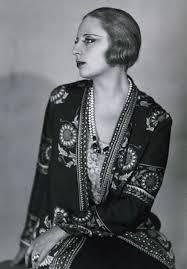
Think paintings that best represent the art deco style and more and more art fans think of the ‘baroness with the brush’, Tamara de Lempicka. She was the most fashionable portraitist of her generation. Celebrities lined up to be painted by her, but the Depression saw her popularity wane, only to be revived in the final three decades of the last century and into our new millennium. She is well and truly back in vogue, her daubings instantly recognisable and these days, ubiquitous.

de lempika

The artist was born Maria Górska in Warsaw in 1898. She was of Jewish background surrounded by wealth. The future Tamara de L attended boarding school in Switzerland and during her formative years lived in a variety of places, including the French Riviera and St Petersburg. She spotted the man she intended to marry at age fifteen and did so three years later – Tadeusz Lempicki. He wanted her for her money – not a recipe for success.

Come the Revolution and the couple were forced to flee to Paris, minus a significant proportion of their assets. Here Tamara gave birth to her daughter Kizette and became immersed in the bohemian life of the city, soon entranced by Picasso and the Cubists. She took to the brush to try and make a crust – something her layabout hubby thought beneath him. She was a quick worker, soon finding a populist approach to her renderings – one that would readily sell, it turned out. After 1925 she was exhibiting all over Europe and was charging top dollar for her portraits to boot. She fell in lust with many of her sitters. Even the notorious Gabriele D’Annunzio came under her spell, although it seems he failed to bed her.

She owned the Roaring Twenties like few others. If Gatsby was the male epitome, she was the female. She mixed with Cocteau and Gide, Collette and Sackville-West. She was also flamboyantly bisexual, neglecting not only the wastrel Tadeusz but also her daughter. She soon had a rich man as both her patron and sugar daddy. Travelling to the US was also on her agenda – here she fell in with de Kooning and Georgia O’Keeffe. Later on she married her older suitor, Raoul Kuffner, thus gaining her title, Baroness. With the advent of the second great war her star had well and truly diminished but, undeterred, she kept painting, trying out new styles to an unresponsive public. She also moved permanently to America, paralleling a move into prickly old age. The end saw her residing in Mexico where she died of a stroke in 1980. Her ashes were spread on Popocatepetl. She did live long enough to see her work reassessed by the artistic trendsetters, who declared that owning one or more of her works definitely put you front and centre amongst the in-crowd. These days her collectors include Madonna, Jack Nicholson and Barbra Streisand.

de lempika02

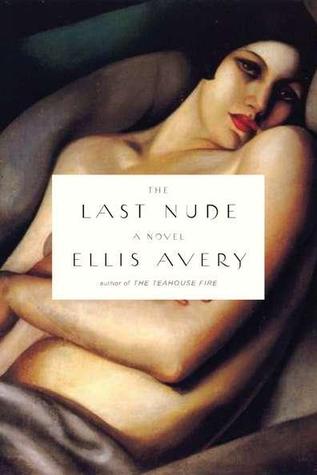
The opening paragraph of this scribbling is taken from ‘The Last Nude’ and are the initial sentences to a description of a lesbian coupling between the painter and one of her models – what follows is very saucy indeed. Ellis Avery’s novel is based on the main facts of the great woman’s life, but the gaps are filled in by supposition. The work received, on publication, rave reviews and several prestigious gongs in the United States. Reading the four pages of recommendations that prefaced the story in the book, as I perused it in a Melbourne bookshop, I felt I must be in for a real treat and rushed to the counter to purchase. I enjoy novels that do add made up substance to fact, plus it was about a favourite heroine, so what could go wrong?

AveryEllislast nude

Although I did manage to finish it, I really had to force myself to turn each page and refrain from skimming. I found it dirgeful, the writing uninspiring. Sad to say that the only time it came alive was with its few erotic passages – not enough to keep this customer satisfied. But it obviously struck a chord in America – so much so that Lempickaphiles can take a tour of Paris around its featured sites!

The major part of Avery’s offering is taken from the point of view of Rafaela Fano, an escapee from tight American strictures, enjoying the freedom the French capital affords. But she finds it struggletown too, even despite the seventeen year old’s willingness to use her body to achieve her ends. Life changes markedly when she is discovered by de Lempicka who offers to pay her to pose. Soon it is posing minus garments, apart from a well placed scarf – and before too long the two are intimately exploring each other’s body parts. As time proceeds both end up having much else on the boil as well, with the result that, at times, the plot and who was who lost me. I just wasn’t interested enough in all their scheming and machinations. The final part features the portraitist in her old age, contrary and cantankerous, with some her and Rafaela’s back story filled as bonus. The Washington Post describes ‘The Last Nude’ as ‘A compulsively readable novel.’ I found it anything but.

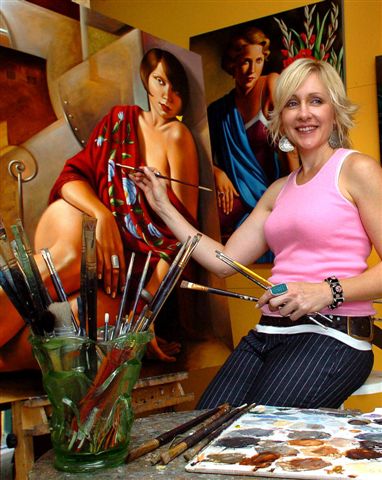
But the positive spin-off is that I discovered the postcards and through them, at the top of the stairs in the Salamanca Arts Centre, Catherine Abel. The card I initially took to be a de Lempicka was in fact Abel’s ‘La Femme en Soie’, an example of her expertise from only last year. It features a cool blonde, presumably from the Flapper Age, peering out at the viewer, draped in striped silk (soie), bejewelled and enticing. Up in the ether I found much more to like from this artist who readily admits the debt she owes to the daubing baroness, as well as to Picasso, Braque and Dali. This Australian has indeed honed her experience by travelling to Paris and has been a finalist for the Archibalds. She describes her infatuation with de Lempicka by likening her to ‘…the teacher I never had.’ It was seeing the Baroness’ masterpieces during her overseas sojourns that inspired her to attempt to paint for a living. As well as Abel’s figurative work, there are still lifes and landscapes to be viewed on-line. But its certainly her stunning capturings of the feminine form that stand-out, as is the case with her role model. So if you too fancy the work of the icon of the twenties, check out her modern day acolyte. Beware – for, as with de Lempicka, some of her product is NSFW.

abel la femme catherine

So the disappointment of the book has been offset by discovering a new artist to follow the progress of with interest. And if for me Avery’s book didn’t capture the spirit of T de L, Catherine Abel certainly does.

abel01

Gallery of Catherine Abel’s work = http://www.catherineabel.com/

Gallery of Tamara de Lempicka’s work = http://www.tamara-de-lempicka.org/

Ellis Avery Website = http://ellisavery.com/

A ‘Last Nude’ tour of Paris = https://americangirlsartclubinparis.wordpress.com/2012/01/25/the-last-nude-a-literary-tour-of-paris/

Love and Woolies' Odd Bunches

Wendy Squires, invariably in her columns, strikes a chord with me. She did it again this week in her latest – this time it was her way with words on fruit and veg. She’s not talking so much about the sleek, succulent examples we have for the taking on the supermarket shelves of the Big Two, which, once bought home, more often than not, soon start to shrivel. No, she’s pontificating on the ones overlooked – those thrown on the scrap heap, left to rot or ploughed back into the farmers’ fields. Such wastage with so much of the world hungry! Now one of the Two has seen the light and is offering imperfection at a reduced price. Woolies is following the trend in the UK, championed by Jamie Oliver, that has gone gangbusters there – let’s hope it does here. Squires not only likened these second grade carrots and apples to her own physical imperfections, but also to Ronnie and Jean, a Canadian couple she met in an Auckland hotel – an older pair living their dream before it all becomes too late.

Now I am about to take Wendy’s analogy one step further and liken a couple we can meet in the movie ‘Love is Strange’ to these not beautiful enough products of agrarian effort.love is strange

Ben (John Lithgow) and George (Alfred Molina) are gay, still in love after decades together, but with age starting to become an impediment – neither are as beautiful as they once were. But they also decide to live the dream too. Unlike our own country with its Dark Ages politicians, more and more US states are freeing up repressive laws and allowing same sex couples to marry. Our two imperfects decide to similarly formally commit. Soon their happiness turns sour when, for George, this decision is crossing the line for his employer. He’s a teacher of music in a school and although they have known about his sexual orientation, openly marrying is not favoured by the Catholic Church and he is immediately dismissed. This causes a financial crisis for the duo and they are forced to give up their Manhattan apartment. For a while it seems, until fortunes change, the only alternative is couch surfing with family and friends. They both struggle to cope with apartness, their hosts struggle to cope with each of them.

Director Ira Sachs produces for us a fine film that has as much to do about ageing and the fragility of life as it does about gaydom and attitudes towards it. It is an offering of muted pace and muted tones, but the performances from the two leads are brave, heartfelt and nuanced – as we would expect from these two seasoned thesps. It’s not played for the appearance of hankies and tissues, even when one of the pair doesn’t make it through to that change of fortune. The production has garnered gongs world wide for what the New York Daily News describes as its ‘…thoughtful, intelligent reserve.’ I couldn’t put it better.

Film Set - 'Love Is Strange'

As well as Lithgow and Molina, for me the other stand-out performance was from young Charlie Tahan as Joey, the put upon teen who is forced to share his confined bedroom with his gay great-uncle Ben. The lad understandably resents the intrusion and all sorts of friction ensues. But in the development of a positive relationship between the two, as well as Joey’s struggles to develop relationships of his own, we have one of this movie’s true joys.

Yes George and Ben, along with Ronnie and Jean, as well as undoubtedly yours truly, are of an age where, as imperfections increase and we generally fade from view to join the plethora of similarly invisible baby-boomers, there are still films such as this and increasingly many others – cite the ‘Exotic Marigold Hotel’ franchise. It all serves to remind the rest that old people, like disfigured fruit and vegetables, still have some worth.

Wendy Squires article = http://www.theage.com.au/comment/inglorious-fruit-and-veg-were-so-aware-of-looks-we-wont-even-eat-ugly-food-20150409-1mdeya.html

Official trailer for ‘Love is Strange’ = https://www.youtube.com/watch?v=XdfA5Ff5e78

Of the Madame and the Eye of the Granddaughter

Madame_de_Staël by  Firmin Massot

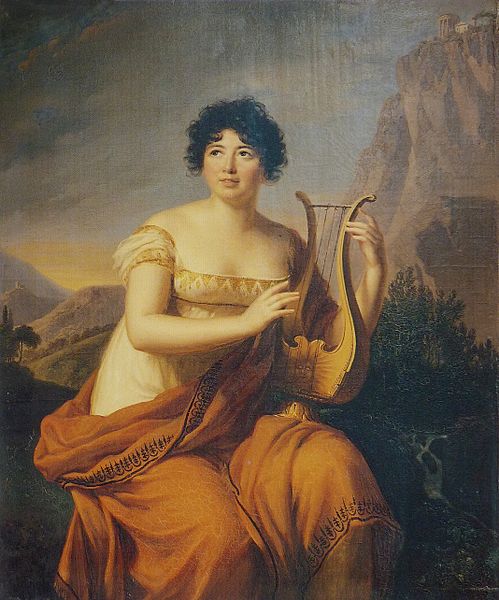
As you may judge from Firmin Massot’s portrait, Germaine de Staël (that’s the abbreviated version – her title in full is Anne-Louise-Germaine Necker, Baronne de Staël-Holstein) was not conventionally beautiful for those times or even ours. But she had a certain something – call it charisma, call it money, call it intelligence, call it needfulness, call it notoriety – it all came with her territory. She was always in the news, such as that was in those times, getting up the nose of the powerful. She took on Napoleon and saw him off. Her views on liberalism, divorce, the superiority of the British and German character and the virtues of Protestantism didn’t make her flavour of the month in Catholic France. In the end her ruffling of feathers saw her banished from the place. But despite this, or maybe because of it, she attracted men like moths to a flame. And she didn’t like letting go once she got her clutches in – all of her conquests were expected to tend to her sexually for life. It was not uncommon for her to have five live-in lovers on the go at once. These men were writers, philosophers, soldiers – even the occasional statesman. Her voraciousness in the bedroom became legendary, but it was through a granddaughter’s eye that I discovered her – out there in the ether.

There is what I consider to be a stunning Facebook page, that I am constantly exploring, called the ‘Musetouch Visual Arts Magazine’. It caters to those of us, probably the most of us, who are partial to timeless feminine beauty – and associated objects. On this day it was merely a segment of a work of art that caught my attention. There was a blue-irised eye framing a dilated pupil, with what I took to be a come-hither look. There was an abundance of alabaster skin and a finger crooked enticingly under chin. A folded digit wore a narrow gold band. There was the hint of a garment of blue satin. I had to know more.

 comtesse d'haussonville

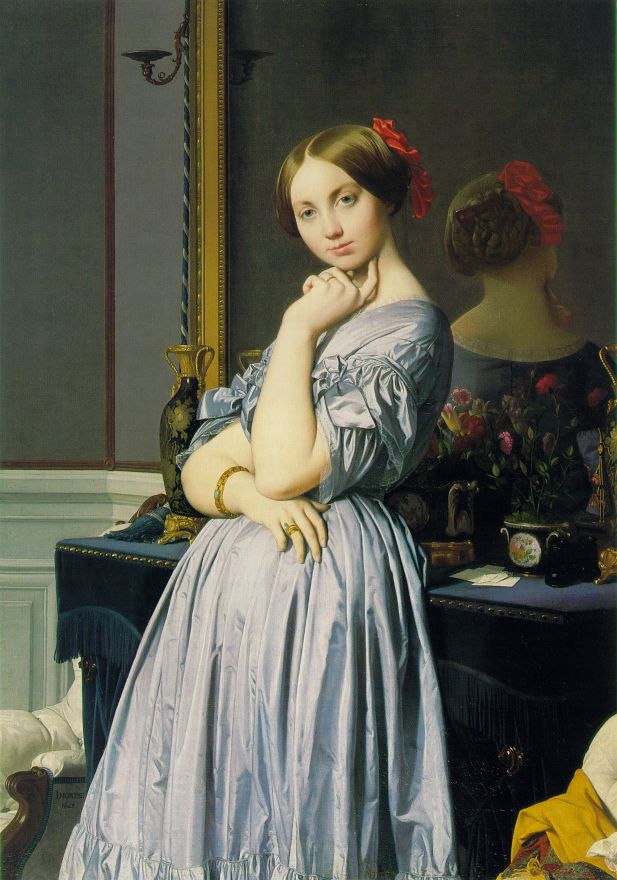
From the fine print I established her name and a link to her portrait in full. The subject was Louise, Princesse de Broglie, Comtesse d’Haussonville – what fine titles these ladies possessed back then – and she was the granddaughter, the information was quick to point out, of Madame de Staël. I had vaguely heard of her, so I determined to investigate her more fully once I was done with Louise.

These days the granddaughter, if she has any fame at all, it is as the woman gracing a glorious Ingres’ 1845 rendering. Louise was born in 1818, married off at 18 to a member of the French Academy, thus, as with her grandmother, ensuring she moved in rarefied circles. Though she never achieved her ancestor’s high station in history, Louise was no slouch, publishing several tomes, most notably a biography of Byron. She devoured books herself, regularly attended the opera and was inspired by her acquaintance with Chopin to master the piano. She was also a dab hand with the paintbrush. And reportedly, she was down to earth and most approachable for a woman of her standing in society.

And as for the painting itself – well neo-classicist Ingres (1780-1867) was a perfectionist and prepared with numerous sketches of the lady before he committed to canvas. Even so, the great man considered this to be a side-project and kept interrupting its completion to attend to what he considered greater works. This was not aided by Louise’s travels combined with, to Ingres, an unfortunate pregnancy. The artist completed his first sketch for it in 1842 when the sitter was just 24. The whole shebang was not completed till three years later. It was immediately a hit with Louise’s family and her set – it is now regarded as one of the master’s masterpieces. If one reads the art-wank, the pose can be traced back to Roman times with ‘…the chin supported by the hand, the gaze that looks not so much at us but through us (so much for my come-hither assertion), the look of a privileged and uninterrupted abstraction.’ (John Russell, New York Times)

louise-de-broglie-

Much of what was on-line referred to the painting and not what I was I was really interested in – the woman herself – so my thoughts returned to the grandmother. Why was Louise’s relationship to her noted by every commentator I read under Google’s banner? She must be worthy of a look. Judging by my opening paragraph, she certainly was.

Massot (1766-1849) was certainly no Ingres, but this Genevan dauber was operating around Lakes Geneva and Lausanne at the time de Staël was in residence there, so he was the best to be had. The Madame invited him to attend to her villa and stay awhile in 1794. Were they lovers, given her proclivities? That is not recorded, but we do know that the following year Firmin, aged 28, took a seventeen year old as his bride. But, given the era, we cannot read too much into that. Interestingly, he and his subject were exactly the same age as she too was born in 1766.

Her father was a finance minister to Louis XVI, her mother an icily formal leading light in the salons of Paris with little interest in her daughter. Young Germaine grew up simply besotted with her father. At twenty she was married off to a Swedish diplomat, allowing her to attain the de Staël-Holstein part to her appellation. It was a loveless affair – he got his kicks elsewhere as did she in spades. He rarely shared her boudoir with only only one offspring being produced. She was frequently pregnant to other lovers but the good man was always by her side to keep up appearances out in public. She produced another four children in amongst miscarriage and stillbirth. The most intense relationship of her life was with Benjamin Constant, a Swiss writer who hung around her for twelve tumultuous years, most spent spatting with de Staël. He based his best known novel, ‘Adolphe’, on her.

As her hubby was ambassador during the Revolution, her diplomatic immunity enabled her to survive the Terror unscathed. To Germaine’s credit she was instrumental in organising the flight of many royalists away from the blades of Madame Guillotine. Many of these aristocrats were to join her in exile in Switzerland when her outspoken views enraged the Little Corporal. Even in a foreign country Napoleon’s spies kept watch on her, so dangerous was she perceived to be to the state. Her husband’s death did not slow her down as she remarried, this time to an Italian soldier twenty years her junior. On the demise of Bonaparte she returned to Paris but could raise little enthusiasm for the Restoration. By now she was addicted to opium and in 1817 all her excesses caught up with her. She died in her sleep of a stroke.

Her writing, of course, lives on – even recently, for the literary purists, coming back in vogue. Her best known publication is 1802’s ‘Delphine’. It was a huge success when it hit the stands, telling of a beautiful woman who sought happiness through love. Unfortunately its popularity caused the Emperor to read it. He was singularly unimpressed by the outbreak of feminism it contained, so it contributed to her banishment. These days her works are viewed by those in the know as from ‘…the struggle of an exceptional intellect trying to the transcend the social and creative constraints imposed on women of her time.’

These were two remarkable women, Louise and the Madame. One’s beauty will live forever due to the efforts of a great artist, the other’s creativity and zest for life will ensure history remembers her. And, as I cast my own eye back over that sublime image that first attracted me to their tales, I wonder what either would make of the advances of their gender in our own century – not that misogyny has been completely eradicated. I am sure, though, they would be rightly gobsmacked. They helped set the scene.

Woman on the Rise x2

I am quite partial to ‘Antiques Roadshow’. Its not television that I hang out for, nor do I sit down and watch it each time it is on. It is something I can dip into when I am preparing or partaking of the evening meal whilst it’s in its present ABC timeslot. I like the woman of a certain age (Fiona Bruce) who hosts it. I like the looks on the faces of those who found an old painting up in the attic or who purchased a bit of crockery for 25p at a second hand shop and are gobsmacked when the valuer informs them of the multiples of thousands their finding is worth. And I like the back history of some of the items presented.

A couple of nights ago I was watching one of the show’s co-hosts, a very personable chap, waxed lyrical about a late Seventeenth Century teapot afore him for valuation. During a description of its provenance he remarked that the introduction of tea into British society was the first step on the long road to women achieving equality with menfolk – a road that still hasn’t fully arrived at its destination.

Previous to the transformation the humble tea leaf caused, a respectable woman could not enter the ale or coffee houses of the time and of course were completely subjugated in wedlock – emphasis on the lock. The arrival of this new beverage gave the mistress of the house a renewed purpose and allowed for some minor independence from hubby’s control. Drawing rooms could be opened up and gossip could be had around the intricate preparation then involved in making a cuppa. It was a matter of pride, getting the mixture of green and black teas used exactly right to create a signature blend. Chairs were no longer positioned around walls, but rather circled small tables designed especially for the serving of the refreshing hot liquid. As tea became more affordable and the drinking of it spread down the social strata, so women opened up their formerly underused front rooms for the commercial selling of the brewed product – thus gaining a modicum of financial security in isolation from their spouses. Women were on their way.

Around the same time tea was revolutionising the balance between the sexes across the Channel, a great palace was being built in the countryside around Paris – and here a singular woman was attempting to also break through the glass ceiling of the time – or as one commentator put it, more like a stone ceiling – Madame Sabina De Bara (Kate Winslet). Along my lovely Leigh and I went to view the film of her story this week. It turned out to be a good saga.

De Bara was a creation of the mind of Alan Rickman, the director of ‘A Little Chaos’. Now I am also quite partial to Alan Rickman – he enhances every project he is involved in. Of course a large amount of his recent time has been taken up by the Harry Potter franchise, but my favourite of his many offerings was the 2006 Canadian indie ‘Snow Cake’. Here he plays a man involved in a fatal car crash, thus causing a major attack of the guilts resulting in a life changing experience, a reawakening. It was the loveliest of movies.

little_chaos

In ‘A Little Chaos’ he also plays the role of Louise XIV, the Sun King. He is heavily involved in matters of state as well as attempting to build said palace, Versailles, together with its magnificent gardens. Mattias Schoenaerts, so revealing in his amazing previous outing, ‘Rust and Bone’, has a more subdued role here as the king’s gardener, André Le Nôtre – and this guy really existed too, although he was considerably older than the age of the hunk the Belgian actor portrayed in the movie. Madame De Barra, sadly, never existed. It would have been unthinkable back then for a real woman to crack that stone ceiling and be responsible for part of the landscaping under Le Nôtre. Still, without her, it would have been a dull old tale and the fictional she certainly caused consternation among the vested interests as portrayed in this cinematic product. Both Winslet and Schoenaerts are serviceable in their roles, as is Helen McCory as the scheming wife of the head gardener. Leigh could not understand how the handsome young fellow could be hitched to such a vile, much older creation – but they did things differently back then.

For me the movie doesn’t quiet work. The story line plods along – some judicious editing could have sped it up somewhat. Also there was seemingly no need to insert a back story towards the end to interrupt the flow – surely the audience would be intelligent enough to work out that widow Sabine bought a shit load of baggage into her relationship with André, once they eventually got around to acting on their feelings. Enough hints had been dropped. Broad English accents did not entirely sit well with such a period piece set in France.

It’s only when Rickman is on screen that proceedings liven up. He was delightful when, freeing himself from the remorse caused by the death of his wife and dispensing of his regal attire, he retires to his pear arbour only to meet Sabine. She decides he is just another horticultural type, causing confusion before the penny dropped – and then friendship. And I loved the bit where he explains the reasoning behind the building of Versailles was to take the children away from the temptations of city life. There are also some attractive performances from the lesser lights – Stanley Tucci as the king’s gay brother, for instance. His missus’ (Paula Paul) acceptance to Sabine of the fact her prince swings the other way is a quiet gem. ‘Silk’s’ Rupert Penry Jones is similarly very becoming in his small role as De Barra’s first friendly face at court. Rickman was very concerned that the fashions of the day – the gowns, frock coats, make-up etc – be as realistic to the times as possible, rather than a modern day type gloss over. It all largely gives the former impression despite the perfect teeth. And I did enjoy the ending, despite it being complete Hollywood mush.

All in all there is an opportunity missed here, but it still was a reasonably pleasurable way to while away a couple of hours – despite the distraction of some overly effective air-conditioning at the State turning our viewing room into an ice-box.

Fast forward now to the last century. Within the lifetimes of many of us, advancement for the female gender still had not made much headway on what De Barra had encountered. In Eisenhower’s America, on the sun-dappled coast of Northern California we find the Keanes, a couple riding a wave of fortune due to wife Margaret’s talent for kitsch and hubby Walter’s head for business acumen. The only trouble in their version of Camelot was that Walter was a fraudster – and the victim was Margaret. Claiming to be as equally endowed with artistic gifts as his spouse, Walter imported cheesy Parisian streetscapes to peddle as his own work at local markets and this is how he met his wife to be. On that occasion she was set up in a neighbouring stall, selling her own artwork, trying to make a buck after escaping misogynist husband number one. Her oeuvre on show consisted of small children with overly large eyes. After a whirlwind romance she was so charmed by the oily Walter Keane that nuptials soon ensued. Soon the man of the house was arranging joint showings of their artistic output, but hers, through a combination of events, took off and his knock-offs were being ignored. ‘No worries,’ he no doubt thought, ‘I’ll just pretend they’re mine as well.’ Word spread and Margaret’s work, signed by Walter, was soon flavour of the month with the punters, despite being derided by the critics. When Walter hit on the bright idea of turning her originals into thousands of prints so Average Joe and Josephine could afford them, they were on a roll. But at all costs the secret of their true origin had to be kept. As the marriage wore on and Walter’s behaviour developed peculiarity, Margaret became more incensed at her situation. She wasn’t going to take her subservience any longer, so she escaped to Hawaii and let the cat out of the bag. All hell broke loose, so over to the lawyers.

big eyes01

Initially ‘Big Eyes’ was a project intended to be a vehicle for Kate Hudson and Thomas Hayden Church. I wished it had remained that way. Whist I had no issues with Amy Adams in the role of Margaret, Christoph Waltz, as her over-bearing spouse, simply gave me the irits. No doubt this was intentional on the part of director Tim Burton, but when the proverbial hit the fan and Walter attempted to defend his own actions in court, the whole thing descended into farce. Waltz, clearly enjoying himself as a fellow going off his rocker, hammed it up for all it was worth and the film completely lost its way. Up until then I was thinking it was an interesting yarn. Burton, in an outing unusually taking him into the real world, should have exercised the control the ffilm’s courtroom judge was too inept to. It spoilt the exercise for me.

BIG EYES

Still the movie certainly shed more light on the treatment of women during the early ‘Mad Men’ era – and it was lovely seeing actor Adams and the real artist Margaret together as the closing credits came down.

Unfortunately there are still men like Walter Keane here in our current century. Daily headlines constantly shout at us of ongoing mistreatment of women in all manner of ways – in the workforce, on our streets and behind the facades of suburbia. But whilst we have the modern equivalents of Sabine and Margaret ready to declaim ‘Enough’ and shatter glass ceilings, the fight will go on until the road reaches its destination.

‘A Little Chaos’ Official Trailer = https://www.youtube.com/watch?v=ENSjt4naxlE

‘Big Eyes Official Trailer = https://www.youtube.com/watch?v=2xD9uTlh5hI

A Margaret Keane Gallery = https://keane-eyes.com/

Bromance on the Southern Seas

‘We get along quite well, but the thing was we all knew what we were in for and the fact we were all going to be in close quarters. No one really pushed anyone’s buttons. We know we can wind each other up, but the fact is, being on a boat, you just can’t walk away, you’re stuck there.’ Thus relayed Ross in a recent interview piece for the Fairfax Press. In fact, it turns out, after watching the series, small of stature Ross was often the on the receiving end of good-natured joshing from his bigger crew mates – barrel-chested Nick and tall, gangly Matthew. He had a thick skin – the jovial jibes flew off his hide. The only tense moment was when Ross announced on Cape Barren he was off to shoot the game they would be devouring that evening for tea. Paddock to plate is one thing, but going out into the scrub and actually slaughtering it is another. But this was only a minor divergence of opinion, the other two scoffing down his bag of wild duck, goose and wallaby readily enough.

SBS has described the trio of seasons of ‘Gourmet Farmer’ as a developing diary of the bromance between the three foodies, but in the fourth, where the word ‘Afloat’ is added, Ross is correct, there was no escape from each other. Ross (O’Meara) and Nick (Haddow) reside on Bruny Island, up to their necks in pork (Ross) and cheese (Nick). The latter’s product is excellent – if you ever have cause to cross on the ferry to their domain, get to his cheesery and try some. Their island off an island, for decades, remained undiscovered by non-Taswegians, but these days its reputation is spreading. The two ferries crossing the Channel during the summer months have trouble keeping up with demand.

gf02

Matthew Evans lives on the mainland within sight of his two mates just across the water. He is a former Sydney restaurant critic turned gentleman farmer just outside the idyllic village of Cygnet. Up to this point he has been the face of the popular, as SBS goes, programme – but his two cobbers are television naturals and are quickly catching up. ‘Gournet Farmer Afloat’ is definitely a three-hander – or even four, if skipper Garth Wigston is counted. He’s the master of the Solquest, the vessel bringing the premise of an anti-clockwise circumnavigation of Tasmania to fruition. The resulting six hour-long episodes are an eye-opener as the lads retrace the sailing steps of the early explorers – Tasman, Baudin, Flinders, Freycinet, Kelly et al. It’s great boys-own stuff.

crew02

These episodes delve heavily into the history, indigenous and non-indigenous. It also looks at the produce of the island, both from the briny and the soil. After all, it is pretty special with our isle having the world’s freshest rainwater and purest air, I actually thought I knew the back story fairly well and I did, although I enjoyed their fresh take on it all. There were a few gems that surprised me, including the nugget that there is strong evidence that Bass and Flinders became lovers, possibly due to those extra-close quarters they had to endure, in the process of proving there was a Strait separating us from our Victorian neighbours. There is no evidence that any of this sort of thing occurred on the Solquest though.

Eggs. I’ve often wondered about the eggs. Out front of our abode on the river are hundreds, maybe even a thousand or two, of black swan. Come spring it’s a joy to see their numbers multiply by an equivalent number of cygnets. As lovely as that image is, there is the thought that all that new life must have emerged from eggs. So there is a possibility of a wonderful food source in the reed banks all along the Derwent – explaining the number of copperheads and raptors that thrive hereabouts. The three gourmands on Solquest possibly had a similar idea, probably lubricated by one or two of the couple of hundred bottles of wine they had on board with them. When they reached Moulting Lagoon up on the East Coast – a place with a similar abundance of aquatic avifauna – they put that notion to the test when Ross was presented with a swan egg. He made a pork omelette with it and the trio pronounced the result most flavoursome tucker. Swan eggs for brekky? Why on earth not?

The series is choc full of culinary treats that the lads prepared on board, on beaches or, occasionally, in the restaurants of ports they tied up in. At the final destination, Hobs, this all culminated in a grand feast at Government House for all those who participated in the project. It featured the best of Tassie produce, influenced by what they discovered during their epic adventure. It was hilarious watching the boys get lost in the vice-royal pile as they tried to find the shortest route from kitchen to a dining room that has seated royalty. This last episode is dedicated to our island’s beloved and gregarious former Governor who passed away soon after that event.

I thoroughly enjoyed seeing my beguiling island from the perspective of the sea that surrounds it. It all reminded me how lucky I am to be an inhabitant of such a place. You would be mesmerised too, dear reader. With Matthew, Ross and Nick as your guide, be taken to such magic locales as Bruny’s Adventure Bay, Stanley’s Cable Station Restaurant, the indigenously owned Cape Barren Island and on to the wild and rugged West Coast, with its Macquarie Harbour and Port Davey. Feel the tension as the Solquest attempts to surf the notorious bar at St Helens or squeeze its way in through Hells Gates. A highlight for me was seeing our crew visit the first vegie patch established by Europeans on our shores well before white settlement – the French Garden at Recherche Bay. One of our hosts suggested that the island’s history may have been entirely different had this nationality established colonisation first with their more benign view of the native population. Another high point was when Ross and co tried their luck trawling deep for arguably the most flavoursome of all piscatorial delights, the mighty stripy trumpeter. All in all the boys had a ball and entertained us mightily. It is all available on DVD now.

gf

Associated with this is a new cookbook on the market. Although it contains photos from the expedition, the recipes featured are not those from the circumnavigation. They can be discovered on-line. No, ‘The Gourmet farmer Goes Fishing’ features more the means to cook the species of fish caught recreationally around our coast. I traipsed off to its launch at Fullers a few weeks back, thoroughly relishing the bonhomie that these three, when they get together, create. Some of their culinary fare was available to sample and the large crowd gathered were regaled with tales – some true, some tall – of their adventurings. Fullers pronounced it their most popular event ever, saying something for how these guys are working their way into the consciousness of all of us who love our paradise in the southern seas. They do our assets proud by bringing them to the attention of a wide audience through their offerings on the small screen.

gourmet-farmer

Ross’ newspaper interview = http://www.smh.com.au/entertainment/tv-and-radio/gourmet-farmer-afloat-tight-space-tests-friendships-20150209-139jyc.html

The Master of Vice

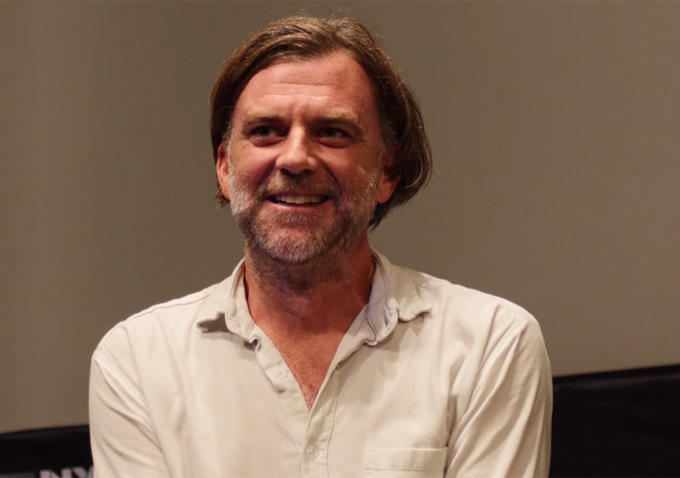
He went to film school for two days and decided it wasn’t for him. Yet he is now one of Hollywood’s most critically acclaimed and bankable directors. Instead of the normal route, to learn his aspired-to craft he watched movie after movie on video/DVD, all accompanied by the director’s audio-commentary. In other words, he taught himself to direct. He thought the best way to get the movers and shakers to sit up and take notice was to direct porn – or, at least, a short about porn. This took the form of a mockumentary on the life of the legendary John Holmes – you’d have heard of him if you’re into that sort of thing. This half-hour 1988 effort, ‘The Dirk Diggler Story’, later morphed into ‘Boogie Nights’, the movie that really announced the arrival of a special progeny back in ’97 – and the one that introduced this scribbler to his world.

anderson

Paul Thomas Anderson was born in 1970 to a disc-jockey, voice-over father and a mother who had difficulty relating to her son, the third youngest of nine offspring. Dad, though, was very supportive, allowing son PT to run with his passions. This soon turned out to be various forms of the video camera – to the detriment of his schooling. By the early nineties his shorts were receiving notice, leading to his first full length feature in 1996, ‘Hard Eight’. Those believing in him, to the degree they gave him the financial means to make it, included luminaries such as John C Reilly and Gwyneth Paltrow. His sophomore effort was ‘Boogie Nights’, resurrecting Burt Reynolds’ career. Anderson’s idiosyncratic style has since enhanced the careers of many noted thespians including Tom Cruise (‘Magnolia’, 1999), Adam Sandler (‘Punch Drunk Love’, 2000 – a personal favourite) and the vehicle that gave Daniel Day Lewis the second of his three Best Leading Actor Oscars,’There Will Be Blood’. Many regard this as the best film to come out of the noughties. The critical and commercial success of PTA’s offerings have continued on into this present decade.

Being one of the last movies to feature the incomparable Philip Seymour Hoffman before his untimely departure, when I espied ‘The Master’, considerably reduced, at my fav merchants of popular culture, I grabbed it quick smart. I’d missed it at the multiplexes. Hoffman didn’t disappoint and was duly awarded a nomination for the big gong. But it wasn’t he that blew me away, but the lead guy, Joaquin Phoenix. He was simply incredible in this and was also duly accoladed for his efforts during the awards season. Freddie, his character, was a WW2 vet off his head with PTS and industrial strength alcohol – plus anything else he could ingest. Returning back to the States after the conflict, he creates a fracas as a fashion emporium photographer, resulting in him being down and out, stowing away on a yacht, as one does in that condition. On this vessel he encounters the charismatic leader of the Cause (Hoffman). It’s a semi-religious cult Anderson presumably based on Scientology. As Freddie’s life becomes entwined with the Cult, so do his demons wax and wane. This has the result that we, the audience, are taken on a fantastical journey through the middle-America of the Eisenhower years. There was some memorable imagery involved in this, plus a copious eyeful of sex and nudity – so be warned. Through it all Phoenix’s contorted face and body are mesmerising – a truly remarkable performance that had this punter in awe – with, I suspect Anderson also so much in his thrall that the actor was a shoo-in for the lead in his next offering.

iv

I was hanging out to see ‘Inherent Vice’ after the excesses of the above – and as I had read about the mutton-chops. I suspect that such glorious side-burn hair may not have been witnessed since the seventies – the setting of the film. And magnificent as well were JP’s actorly chops in this production.

I’d tell you about more about the plot if I could, but it completely lost me – as it did many more competent critics than I. I reckon it’d take more than another viewing to figure it all out, a fact that possibly cost it dearly when it came to those gongs this year. ‘IV’ only raised a three for the Globes and the Golden Man combined. But the trip it takes one on is wonderful. With a palette of washed out, sun drenched and burnished hues, the movie swings viewers back to more hedonistic times when pot-addled PI Doc (Phoenix) is up to his neck in drugs and loose women. He’s searching for his ex’s new lover. Katherine Waterston is brave in her role as said ex, but the whole ensemble revelled in out-and-out weirdness. Josh Brolin, as a possibly mad LAPD officer, was a great turn. Martin Short, a manic dentist, was unrecognisable. Owen Wilson entranced as a dead saxophonist, Benicio del Toro was terrific as I am not exactly sure what and Renee Witherspoon remained super-cool as Doc’s current squeeze. I adored the whole she-bang and will wait with baited breath to see what the directorial one-off, Paul Thomas A, has next in store for us.

master

Official Trailer ‘The Master’ = https://www.youtube.com/watch?v=fJ1O1vb9AUU

Official Trailer ‘Inherent Vice’ = https://www.youtube.com/watch?v=wZfs22E7JmI

Dance x2

Steve can’t dance. Steve has all the clichés – two left feet, is a Peter Garrett wannabe – all that shit. My father could glide across and dance floor like Astaire, my lovely lady is a svelte mover and my music-adoring daughter has all the cool moves. I have none of that – but it doesn’t mean that, when the occasion arises and I’m in a comfort zone, I will not shake my booty. In front of a class was such a place. To Spiderbait’s ‘Black Betty’, the Masters ‘Turn Up the Radio’ or ‘Daydream Believer’ (Smashmouth version), for instance, I was known to put on a show – and encourage my cherubs to do the same, despite their teenage inhibitions. My swansong in this regard, back in ’11, was a solo performance, via video-link, for the leaving students of that year. I am told it was a hit. And this scribbling features what Steve can’t do – dance.

In May 1988 Leonard Cohen had a new set of lyrics, with music, he felt worthy enough to open his show – a song he put together on an obsolete Casio synthesiser he found in a shop on Times Square. It’s that sound that introduces ‘Dance Me To The End Of Love’ to his audiences to this very day. It never fails – on hearing the opening refrain chills run down my spine – and then that’s repeated when that instantly recognisable voice kicks in. It’s much the same feeling many of his fans get when he launches into ‘Hallelujah’, Cohen’s eternal gift to the world. But to me, Leonard’s lullaby about ‘Dancing to your beauty with a burning violin’ sits number one on my attempted rating of his best songs – see below. Many, on line, have tried a similar exercise. This exquisite aural masterpiece of Leonard’s always makes me think of my Leigh and her incredible gifts to me – even if her Steve can’t dance.

leonardcohen

The grand old Canadian songsmith is pushing eighty-one and still touring. I wonder how long he can go on – enchanting us. And he is still such a lady’s man – just listen to Clare Bowditch, who toured Oz with him recently, on the subject of his marriage proposal to her.

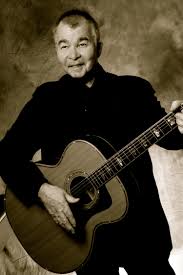
There’s also another of my favourites who can’t go on forever either. John Prine is battling cancer. In 1998 he was diagnosed with squamous cell cancer. Like LC, his voice is also an acquired taste – a guy you either, like me, love – or have to turn off the moment you hear him. Prine’s cancer has added even more gravel to his instrument, with part of the right side of his neck being removed by the surgeon’s scalpel. In 2013 Prine posted, on his website, that he was now suffering from unrelated lung cancer and proceded to cancel all forthcoming gigs. This month he is bravely attempting to take to the road again. Unlike Mr Cohen, Prine is not well known on these shores, although he has visited. In the US he’s a legend of the alt country scene, regarded as one of the most influential songwriters of his generation.

prine

His 1973 collection ‘Sweet Revenge’ was passed on to me by my brother Kim who had far cooler musical tastes than I back in the day. Your scribe was immediately hooked and rushed out to buy his back catalogue – and I’ve purchased each new product ever since. As is my wont, I also had a go at conjuring a top ten for him– every bit as difficult as doing the one above for the world treasure.

Prine was born in Maywood, Illinois in 1946. And just as the Man in Black discovered Kristofferson, so the latter found JP singing in the folk dens and bars of Chicago and kick stated his career. Prine has won numerous awards for his music, including Grammys. Cash considered him one of the ‘big four’ of writers to whom he’d turn when he needed a little inspiration – along with Rodney Crowell, Steve Goodman and Guy Clark. So this fan well and truly reckons Australia has, in the main, missed out on a good thing.

German_Afternoons

So why am I grouping him with Cohen for this piece? Well, coincidentally, for me it’s a no-brainer what this guy’s best tune is. It comes from one of his most attractive recordings, ‘German Afternoons’, which entered the world in 1987. As well as my top song, it contains such gems as my number six;’Out of Love’; ‘Linda Goes To Mars’ and ‘Sailin’ Around’. The ditty in question was a massive hit for George Strait and a UK one for Daniel O’Donnell. So peruse my list, check the items out on YouTube – but pay particular to the top dog and you’ll answer the query that opened this paragraph. And of course it all brings me back again to my Leigh and the fact that Steve can’t dance.

COHEN
10. I’m Your Man
09. Anthem
08. First We Take Manhatten
07. Hey, That’s no Way To Say Goodbye
06. Everybody Knows
05. A Thousand Kisses Deep
04. Hallelujah
03. Bird On A Wire
02. Suzanne
01. Dance Me To The End Of Love

Dance me to your beauty with a burning violin
Dance me through the panic ’til I’m gathered safely in
Lift me like an olive branch and be my homeward dove
Dance me to the end of love
Oh let me see your beauty when the witnesses are gone
Let me feel you moving like they do in Babylon
Show me slowly what I only know the limits of
Dance me to the end of love

Dance me to the wedding now, dance me on and on
Dance me very tenderly and dance me very long
We’re both of us beneath our love, we’re both of us above
Dance me to the end of love

Dance me to the children who are asking to be born
Dance me through the curtains that our kisses have outworn
Raise a tent of shelter now, though every thread is torn
Dance me to the end of love

Dance me to your beauty with a burning violin
Dance me through the panic till I’m gathered safely in
Touch me with your naked hand or touch me with your glove
Dance me to the end of love

PRINE
10. The Sins Of Memphisto
09. Angel From Montgomery
08. Just Wanna Be With You
07. Blow Up Your TV
06. Speed of the Sound of Loneliness
05. Aimless Love
04. Hello In There
03. Illegal Smile
02. Sam Stone
01. I Just Wanna Dance With You

I don’t want to be the kind to hesitate,
Be too shy, wait too late
I don’t care what they say other lovers do,
I just want to dance with you.

I gotta feeling that you have a heart like mine,
So let it show, let it shine.
If we have a chance to make one heart of two,
I just want to dance with you.

I want to dance with you, twirl you all around the floor
That’s what they intended dancin’ for,
I just want to dance with you.
I want to dance with you, hold you in my arms once more,
That’s what they invented dancin’ for,
I just want to dance with you.

I caught you lookin’ at me when I looked at you,
Yes I did, ain’t that true?
You won’t get embarrassed by the things I do,
I just want to dance with you.

Oh the boys are playin’ softly and the girls are too,
So am I and so are you.
If this was a movie, we’d be right on cue,
I just want to dance with you.

I just want to dance with you,
I just want to dance with you.

YouTube of Leonard, with Casio, singing ‘Dance Me To The End Of Love’ = https://www.youtube.com/watch?v=ye6JssTdnvw

YouTube of Prine singing ‘I Just Wanna Dance With You’ = https://www.youtube.com/watch?v=nsTwI9FRDUE

Aussie Gem x2

First Aussie Gem is Toni Collette. Bursting into our multiplexes in 1994’s exuberant ‘Muriel’s Wedding’, Toni then went international. More the under-bubbler than the out-and-out superstar, she lights up screens large and small world-wide in such fare as ‘About a Boy’, ‘Little Miss Sunshine and the recent ‘Long Way Down’. She has also brightened up tele viewing in the ‘United States of Tara’, portraying a unique range of characters.

Lucky_Them

In her latest project, ‘Lucky Them’, our Toni plays a soon-to-be-washed-up-rock-journalist-unless-she-can-bring-home-the-bacon-one-more-time Ellie Klug, writing for the once iconic rock mag ‘Stax’. The publication is struggling in the digital age and editor (Oliver Platt) suggests that hunting down presumed dead, but sighted countless times, a la Elvis, songsmith god Matthew Smith, could just save her said bacon. Of course it just had to be that the singer was one in a long line of musician bed-buddies of Ellie’s, albeit one who particularly resonated. In this outing Collette exhibits what RogerEbert.com describes as ‘…smarts, humour and world-weary cool.’ She is almost upstaged by Platt as her strung-out boss and Ryan Eggold as her twinkly I-wanna-be-that-next-muso-you-bed try-hard. But best of all there’s Thomas Hayden Church as her odd couple travelling companion on the search. If you loved this guy in ‘Sideways’, as this punter did, you’ll adore him in this. Without giving too much away in spoiler form, another of the film’s assets is the cameo from a Hollywood legend towards the end. Accompanied by an excellent soundtrack, this indie perhaps won’t trouble next year’s award season, but it retains its interest throughout with quality performances.

Aussie Gem number two has largely passed me by all these years, but to my beloved and her daughter, Ilsa, he is solid gold. They are long standing fans of stand-up comic Carl Barron. But what made this stage star think he was movie material is a bit of a mystery beyond this scribbler’s ability to comprehend. It also has been for others, judging by the lukewarm reviews ‘Manny Lewis’ has received from the critics. The plot line is trite, clichéd, reliant on unlikely coincidence and also has my pet hate device – the last minute dash to prevent the departure forever of the potential love of one’s life.

manny

But here’s the rub. I enjoyed the thing despite its only too obvious shortcomings. Barron reportedly is the first to admit he can’t act, with that being an understatement. He comes over as a cross between Paul Kelly – who’s also had a go with underwhelming consequences – and Karl Pilkington. Barron plays it all with a ‘Tears of a Clown’ vibe. Manny is huge on the comedy circuit – Barron doesn’t stray from what is known territory – but possesses a loveless, joyless private life. He is befuddled by fame and desperate for a woman, if only he wasn’t shy and tongue-tied in the presence of beauty. For me, when he played himself on stage he raised a few laughs, but the rest of time it’s a journey of pathos. But Barron has had the nous to surround himself with some fine supporting cast members. Roy Billing, as his sad-sack father, does his usual shtick that makes him one of our most endearing thespians, with Patrick Garvey, as Manny’s mate/manager, showing he is also a dab hand at a lighter role than the usual heavies he plays. The scene stealer for my money, though, is Lewis’ fantasy sex-line confidante (Caroline)/potential love interest (Maria) – you’ll need to see the movie to figure that out. This is charmingly played by Leeanna Walsman. She is a stunner and knocks Manny’s socks off – but he stuffs it all up in typical style.

With Barron’s fan base there is hope for this movie to have some sort of success, despite it being far inferior to many other recent local offerings that have faded away without giving a whimper. I must say, apart from another couple, my lovely lady and I were the sole viewers at our showing – not a good sign, but fingers crossed. And the interesting soundtrack, including Barron warbling to his guitar, helps no-end.

For ninety-minutes or so I was pleasantly entertained by this light confection as Barron’s alter-ego tried his best to shoot himself in the foot with his Maria. As with the above title, I strongly suspect ‘Manny Lewis’ will be absent when gongs are handed out during our own awards season. Definitely worth seeing if you are a fan and I can clearly discern that the man’s laconic stage patter does have its attractions.

‘Lucky Them ‘ Official Trailer = https://www.youtube.com/watch?v=2KIcYfmkQcU

‘Manny Lewis’ Official Trailer = https://www.youtube.com/watch?v=7PMoUMjWUBs