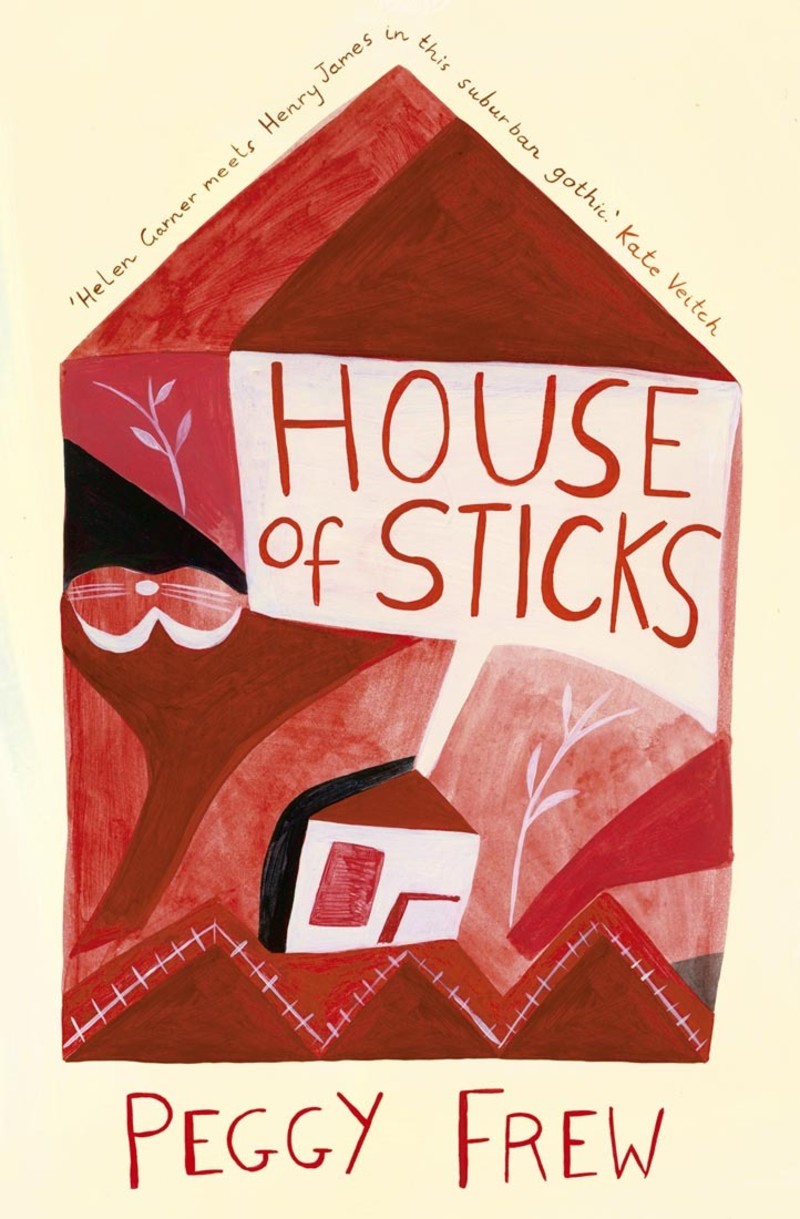
House of Sticks – Peggy Frew

The recent Brendan Cowell film production, ‘Ruben Guthrie’, places the sunshine-y hedonism of the Harbour City front and central to it’s plot, almost leading to the destruction of the titular character in a sea of alcohol and drugs – and so that city does for Bonnie. She could have been a contender in the music industry, but in Frew’s ‘House of Sticks’ she has fallen in love with a tradie husband and is burdened down by three sprogs. She loves them all dearly, life rubs along okay – but she’s unfulfilled. Then a window of opportunity beckons in Emerald City, she grabs at it with both hands but Sydney’s party lifestyle and a sleazeball predator brings her undone big-time. Her trouble is, she’s honest to a fault and it all goes belly-up. Cue for the entry of an unlikely hero, staggering to her rescue.

house

Author Peggy Frew says of the book, ‘…it’s taking a subject that a lot of people wouldn’t think is worth writing about…Family is a key matter for a lot of writers, so how can it be not a valid subject worth writing about? But it’s the mother and baby thing that mean people put it in a pigeon hole. Now I’m a bit worried that it’s not going to be taken seriously enough because it’s ‘only’ about motherhood.’

But it was taken seriously – ‘House of Sticks’ winning a prestigious first manuscript gong, her prize being this tome hitting the shelves in 2011. But had it been just a mother, baby, struggle-town story it could have been a trite affair. Frew, though, has created Douggie, threw him into the mix and for me this is the difference. As if this business of holding it all together wasn’t tough enough for Bonnie already? Doug’s down on his luck and he and hubby Pete go way back. Doug’s a bit of a chancer – not quite to be trusted. But he has some sort of hold over Pete and works it for all he’s worth. He gives Bonnie the heebie jeebies to the max – she can’t bear to be around him. But before she knows it he’s a semi-permanent fixture in the home. Worse, the kids adore him. Then Dougie gets a nod on a sure thing at the races – and their lives are changed forever.

As well, in this Frew is quite potent with her wordsmithery. And she’s writing from a certain amount of experience. Back in the day she was once bass guitarist for prominent band Art of Fighting. Her husband is also a muso – and of course these days she has the balancing act with a family to cope with. Finding time to write in such circumstances is always at a premium. She admits she feels frustrated, like her main protagonist and yeans for the freedom her character Mickey possesses – a free-spirited vagabond in the Adalita mould. In their dreams Peggy/Bonnie wish they could spend time being Mickey.

This novel reflects the domestic challenges most of us on average wages are or have had to contend with in modern Australia. At first Bonnie and Pete have it all down pat pretty well. There’s just enough dosh to get by on as long as they are careful; they have a roof over their heads and food on the table. But Douggie makes Bonnie twitchy and the first cracks start to appear. Throw in Sydney, the nags and it all becomes an abyss.

I enjoyed this first time novel. The author doesn’t hide the fact she admires Tsolskis’ ‘The Slap’ and there’s a whiff of that about the writing – perhaps she’ll emerge as the feminine counter to his view of contemporary Oz. She does promise her sophomore effort, ‘Hope Farm’, due out this September, will be something entirely different. I’ll await its arrival with much expectation.

FREW-Peggy

No Drover's Wife, She

Yes, I know Mr Twenty-first Century Man, I can see how you you might deduce we did her wrong back here in my time. From where you stand, way up there in 2015, we did treat her unfairly; didn’t recognise her true talent. But that was not the case at the start – certainly not. And some may argue she had only herself to blame for what occurred later. But I don’t concur with that notion, Mr Twenty-first Century Man – and I did try. Believe me when I tell you – I really did try. You must bear in mind, good sir, that it is a very different world when I was on the planet last century. People had different attitudes to a woman’s role in the world – but I do grant you – what that country girl did with a paintbrush, few could equal at the time. Perhaps that was part of the problem. Yes, yes, yes, you’re right Mr Twenty-first Century Man – but that was the way it was. And, given my standing, I take some of the blame myself. I can see now I should have tried somewhat harder.

And who am I to judge? I can sense you are dying to ask me that. Perhaps it will help you understand the veracity of what I am saying if I first tell you a little of my own story. Then I will relate to you what I know of her. For you see, in the end, she was no Lawson’s drover’s wife archetype. She was not thrust into the background. She refused to be. She wasn’t trampled down as many others of her gender were back in my era. And perhaps that also counted against her.

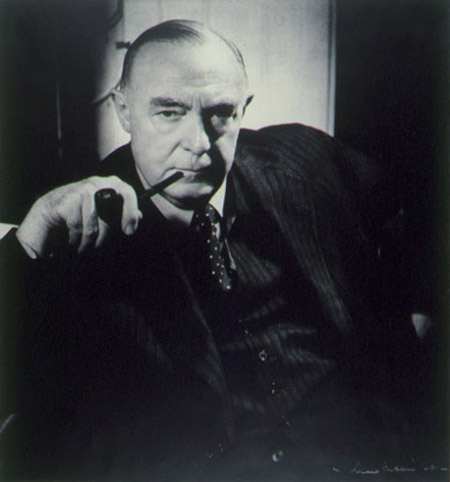
My name is Ure Smith. No, Ure is not my Christian name, Mr Twenty-first Century Man, although you may think so as many assumed the same back in my time. You see, my father took my mother’s surname as part of his own, except, like the woman under discussion, without the hyphen. It wasn’t official. It wasn’t on paper, but it wasn’t an unknown occurrence, even then. My full name? Since you asked it’s Sydney George and no, I am not named after the city. I am a Londoner by birth. Truth be known, though, I like Ure better than my documented appellation – and most called me by it in any case. But Sydney certainly was where I have spent the most productive years of my life, immersing myself in its art and literary scene.

ure

What bought the family out to Australia in the first place, you ask? Well, my father came to the antipodes to manage hotels – first the Menzies in Melbourne and then the Australian in its northern sister city. I went to art school after Sydney Grammar. I’d always been a pretty handy sketcher, my good man, but, although I fiddled around with being an amateur artist all my adult life, I soon became attracted to other associated fields. You see, I had no desire to be some penniless, half-starved artist down in some dingy garret in the Rocks. I wanted to make money – and make it I succeeded in doing. Early on I developed a taste for the good life, for the great wine and food Sydney admittedly came more famous for after I passed-on. In fact, that was perhaps the death of me. I went before my time in 1949. I was only fifty-two. But don’t feel sorry for me. I led life to the full while I was around.

Anyway, that is by the by. By the age of nineteen I was already charting my course for the future, taking Viola as my wife and developing my first commercial enterprise with some mates – an art studio under the moniker of Smith and Julius. Working out the technicalities of how to display a client’s art output to its best advantage soon became my forte. Some of the people we started to employ included the likes of Lloyd Rees and photographer Harold Casneaux. We linked them up with companies, such as Berlei and Dunlop, to formulate advertising campaigns. We were soon leaders in the field. When I tired of that I tried my hand at publishing, also keeping artists in gainful employment. I started a magazine called ‘The Home Monthly’. It became Australia’s version of something like Vanity Fair and it ran for over twenty years. I’m as proud as punch over that.

I admit, most of the artists who worked with me on it and the books I simultaneously put out into the market place were indeed men, Mr Twenty-first Century Man. But I did champion a few of the fairer sex too – for instance, Grace Cossington Smith – you’d know of her – and Thea Proctor too. On my rota were also the likes of William Dobell – yes, that fellow who caused a scandal at the Archibalds. They were so staid and strictured in my era before he came along to set the cat among the pigeons. There was Norman Lindsay too – another I published. Some considered Norman the devil incarnate with his penchant for voluptuous maidens, in nary a stitch, frolicking around. Rumour had it that his models, up at his property in the bush, were altogether most brazen in their disdain for any form of clothing. So scandalous! Let’s see – there were also Donald Friend, Arthur Streeton and Hans Heysen I recall. I looked after them well and they did quite nicely out of it too. For most of them I published lavish, expensive-looking volumes full of plates of their art work – coffee table books you would call them up there in your century. I did one for Margaret Preston too – tried to give her a leg up, but it seemed harder to accomplish with the women I represented. It truly was a man’s era. Women who attempted to make headway in the art world just seemed not to be taken too seriously. The perception with many was that it could only be a hobby for them – not something to make money with. That was left up to the menfolk. Look at that lady from down Mornington way in Melbourne – the one whose art trove was found in a barn somewhere and now, in 2015, where you’re coming from, her work is worth a fortune. When she was around it was dismissed as worthless. No, it was all so different for us, Mr Twenty-first Century Man.

And, as for Hilda – well she was something, she really was. She was tough, resilient and would not deviate one iota from what she thought was right and proper for her. She could ride a steed as well as any male and crack a whip, in both senses of the saying, up there with the best of them. And she could paint – my word, she could paint. But you know all that, Mr Twenty-first Century Man. What you want to know is how we came to fail her – considering the flying start she got off to. Well. good sir, I firmly believe it was simply a matter of, for better or worse, tastes changing.

hilda01

She was Ballarat born and displayed an early proclivity towards artistic pursuits. I know you know all this with your instant knowledge, from what you call being on-line, up there in your century – but indulge me. I am going to tell you anyway. I think it will illustrate what I said about where the fault lay for her rejections in her later years – that I, Ure Smith and my ilk weren’t all misogynists failing to see the sheep from the goats.

Anyway, the talent was there so off to Melbourne Art School she went, once her local education was complete. Following that came the usual rite of passage for most affluent Aussies back in her day – the trip to Europe to broaden one’s mind. She used it, of course, to further enhance her skills on canvas. She went to Morocco and produced some remarkable work out of that. She also set herself up in Paris, as any self-respecting artist wanting to hit the big time would do There she could feed off the greats already trundling their easels around the boulevards and the surrounding countryside. She travelled to all the recommended places in France that supposedly produced the type of light that seduced painters. As a result of her unstinting efforts she also discovered, to her joy, that the Paris of La Belle Epoque enjoyed Miss Rix and all she produced. She exhibited and sold quite well.

hilda

But, as we know, the war clouds were gathering and in the end she fled to the safety of England as the Hun advanced. She left most of her oeuvre cached away, in her wake, on the French coast. At this stage she lost both her sister and mother, who were accompanying her in her foreign adventures, to typhoid. Shrouded in grief, she soon thought she had found her saviour. That is when George Nicholas swept her off her feet. He was serving in France when he heard rumours of a fellow Australian, a lady artist, who had escaped the war leaving her paintings behind. He sought them out, liked what he espied and communicated his admiration to her – no mean feat in the days well before the ease of your social networking, Mr Twenty-first Century Man. Taking leave, he came to London, met her and then one thing led to another, as they did during those times of conflict. All too soon he was walking her down the aisle. Her awakening from grief was fleeting though. Within six weeks the Western Front had claimed him.

Hilda_Rix_Nicholas_painting_'In_Australia'

You can imagine, good sir, what that did to her state of mind. But she had backbone. She resolved to return to Australia and throw herself into the one love that remained to her – her art. Almost unheard of back then, she decided to buy a car and by herself, travel the byways of Australia Felix, painting what she found en route. Her mode of transport had to be modified to be up to the task. She took a gamble and it bore success. Australia was still in the grip of post-Impressionism and she soon found there was a market for what she sent back to her dealers. Then, in her travels around the Southern Tablelands, she met a returned soldier, Edgar Wright. Suddenly the world was a better place for her. He removed all her burdens, took her to his property, Knockalong, near Delegate, then wedded her, Mr Twenty-first Century Man. She took to the lifestyle of a grazier’s wife like a duck to water. He built her a fine studio for her art, but she was just as happy out mustering and bringing in the sheep on horseback as she was with brush in hand.

All was tickety-boo for a time, Mr Twenty-first Century Man, but then came the Depression and the bottom fell out of the art market. It also seemed, to many, that the gains made by women became more muted in the thirties. The jobs weren’t there any more and often there was little choice but to knuckle down and just do what it took to survive. Hilda was fine out in the country, but there was little appetite for her paintings with the public in those straightened times. And when the country emerged from the tough years there was another war. By that stage, a new type of artist had emerged. Modernism took hold and all of a sudden daubers like our subject were very much old school, were passe, if you will. She kept on producing and of course, after our mutual demises – hers way after mine in ’61 – she became searched out again. But in her last years she became quite bitter about her, if you like, forgottenness. Her son, Rix, wrote about it at the time so all knew how she felt. The fact remains the market had just moved on and she refused to move with it. Am I to blame for that? She hated the new vogue for painters like Drysdale and Dobell.

hilda02

But, my dear man, it is good that so many have come back into their own during your time – my old chum Lindsay, John Russell and so on. But I am particularly pleased about the ladies. There’s not just Hilda, but as well that woman, Clarice Beckett – you know, the one I mentioned earlier.

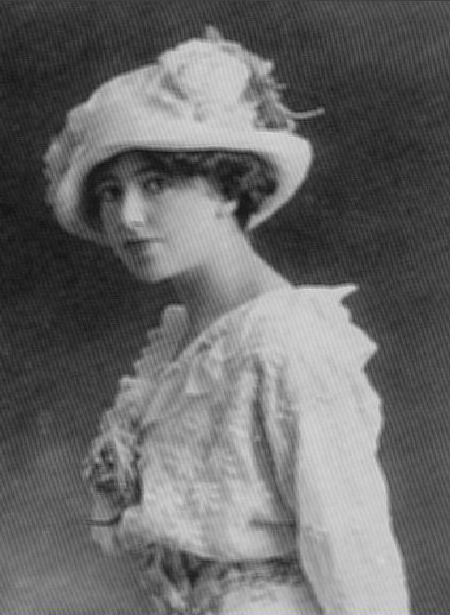
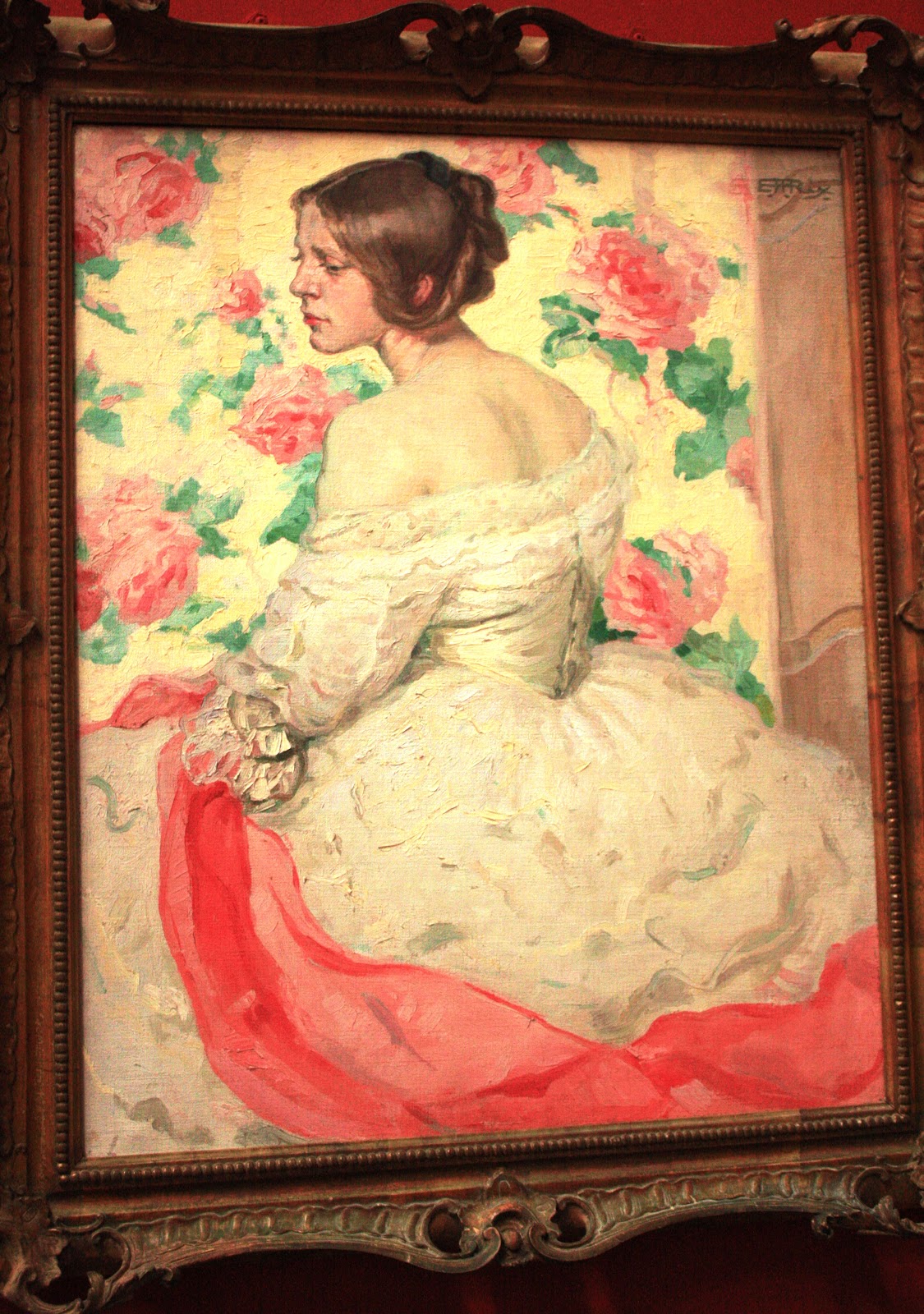
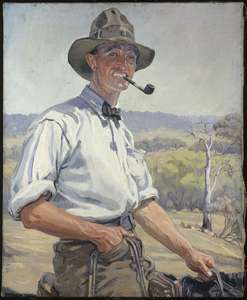
But, anyway Mr Twenty-first Century Man, I remember Mrs Rix Nicholas fondly. She was a stunning woman in her earlier years. Use that internet machine you have and take a look at some of the photos that captured her in her prime and you will see what I mean. And her art – well some of her paintings really stand out – are timeless. I am particularly fond of the ‘The Pink Scarf’. She produced that delight just before the Great War while she was still overseas. It now hangs in the Art Gallery of South Australia and lights up the room. I know you value that one too. Close to where she lived, ‘Bringing in the Sheep’ is housed in a Bega gallery. I’m told that’s her up on the steed doing the mustering. It’s a self-portrait of sorts then. There’s also the rendering, ‘In Australia’, of a Wright family member that has, I feel, so much of the character of the landowners who inhabited the bush in those days.

At one stage though, she became furious when a work of hers didn’t win a prize she was aiming for to reassert herself. That really had her dander up. She knew it was more technically stronger than the eventual winner – it ticked far more boxes, as it is said in your time, as far as the guidelines went. But, of course, she was up against it because she was female – or at least that’s the way she saw it. The winner was male – and I believe is now quite obscure up there in 2015. The whole farrago bought out Hilda’s pugnacious side, Mr Twenty-first Century Man. The judges never heard the end of it for months. But it didn’t help her cause at all – it just served to get those pulling the strings off-side. She could be a bit of a spitfire when it wasn’t going her way and they didn’t take too kindly to that.

hilda03

I feel, my friend up there looking back, she would be pretty chuffed to know the regard in which your generation of art-lovers hold her. From what you tell me, she now has her rightful place in the pantheon of artists who have enhanced your time’s understanding of what it was like back in my years – particularly out in the bush. I’m pleased that in 2015 she is seen as a pioneer, a true modern breaker of boundaries. She was a woman from the back blocks who refused to be pigeon-holed. Now, rightfully and finally, she has made a name for herself out in the light, away from the shadows we placed her in back in our day. You tell me that gender matters far less in your new century. I cannot but applaud those who made it so. Ergo thank you, Mr Twenty-first Century Man. Hilda, I now know, is one of those.

Sherlock Without Watson

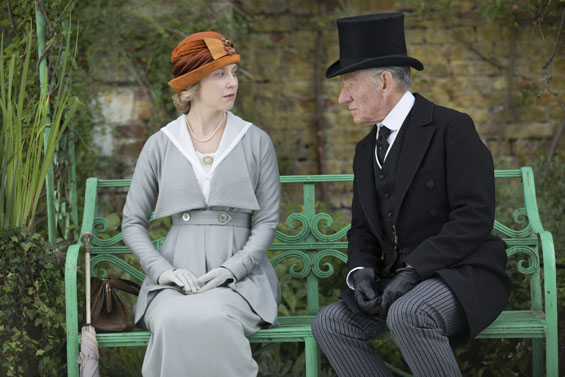
The trove that are the stories of Arthur Conan Doyle give and give anew for each generation. They’ve been adapted for moving pictures; added to by other wordsmiths – some are up to the mark, others pale by comparison. A recent addition has now come to the big screen, based on the novel ‘A Slight Trick of the Mind’ by American writer Mitch Cullin. This movie certainly doesn’t fall short of the mark.

In it there are none of the idiosyncrasies and embellishments of the Hollywood franchise, based on the crowd pulling power of Robert Downey Jr and Jude Law – the first of these put me to sleep in Gold Class. Much better is the television series helmed by Benedict Cumberbatch. Presently on our small screens, as well, is an American update with Johnny Lee Miller as the great sleuth. But the production in question, ‘Mr Holmes’ is an entirely different kettle of red herrings to these – and all the better for it. There are no bells and whistles – just straight old-fashioned yarn-spinning.

holmes

In this take on the tales the famous detective is presented as a nonagenarian, nutting out his last case through the powers of deduction (his and a young lad’s), before his mind deserts him completely. The film, in my view, is as much a vehicle for the remarkable doyen of Brit cinema, Sir Ian McKellen, as anything else. The audience is riveted to his face whenever he is in view. In all this he needs nothing from the gee-whiz merchants of Tinsel Town, except for some make-up to even more advance his already redoubtable age. To me the back story of the offering – one that caused the old man such a heavy heart – is a filler. It would have been enough to concentrate on his relationship with the boy (an excellent Milo Parker), house-keeper (Laura Linney) and his bees. Roger is the house-keeper/carer’s son, on the verge of teenagerdom and starting to show signs of wanting to wriggle out from under the thumb of parental control. As the film progresses, so the bond between Holmes and this intelligent young man increases. Some critics have used this to riff on the possible homosexual undercurrents here, something they assert exists in all the classic Holmes stories. Maybe I’m naive, but sitting there that day, in my comfortable seat at the State, that consideration never entered my head. Maybe I missed something. McKellen is gay, Sherlock is unmarried – so what?

 Holmes-trailer

I also found it puzzling that an American thesp was chosen to play the role of his carer. Looking after Holmes, now retired to a stunning coastal Sussex, is not an easy task given his increasingly curmudgeonly ways, but Mrs Munro does a sterling job. And Linney is sterling in her efforts with an English accent, even if it jars on occasions. She is solid in the role, but I cannot help but wonder why some home grown actress was not selected? Who knows? Perhaps they were all busy or demurred for some reason.

In ‘Mr Holmes’, another product from capable director Bill Condon (Dreamgirls, Gods and Monsters – the latter also featuring McKellen), the literary icon has outlived two world wars. He’s recently been to Japan in search of a mysterious, if plain-labelled, elixir to prolong life. He found it in the ruins of Hiroshima. Alongside all this are his attempts to place together the final pieces in the puzzle that was his final shattered commission. And there’s a beautiful lady (Hattie Morahan) at its core. He is anguished that he rejected, out of hand, her advances – of a sort. At the end of the tale, what happens to the boy further increases his pain. And, if all of the above is not enough of a homily to reflect on, his bees are dying off. That is another conundrum to come to grips with, requiring all his faculties in full working order.

HolmesLEDE

It is a lovely effort, this movie, taking us deep into the soul of a man – one initially appearing to be tiring of earthly existence, without too many of the deeper feelings for his fellow beings. But as the film peels away his outer layers, we find a humanity that most modern takes on Sherlock Holmes lack and therefore this leaves them well in its wake. It was a little tedious around its narrative edge – but at no stage was I in any danger of falling asleep.

Official website = http://www.mrholmesfilm.com/

Potato Starch Miracles

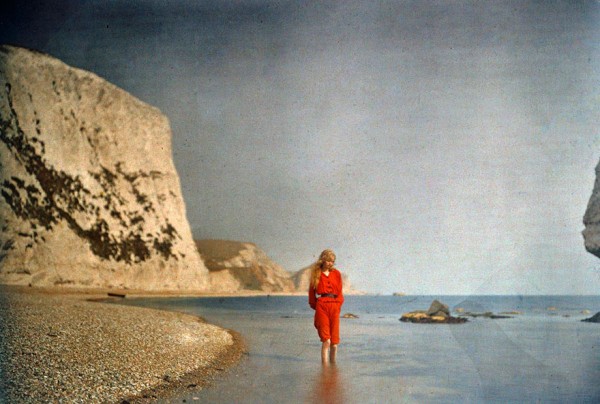
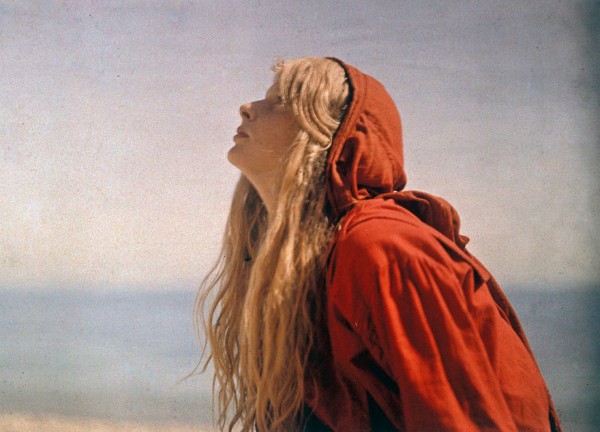
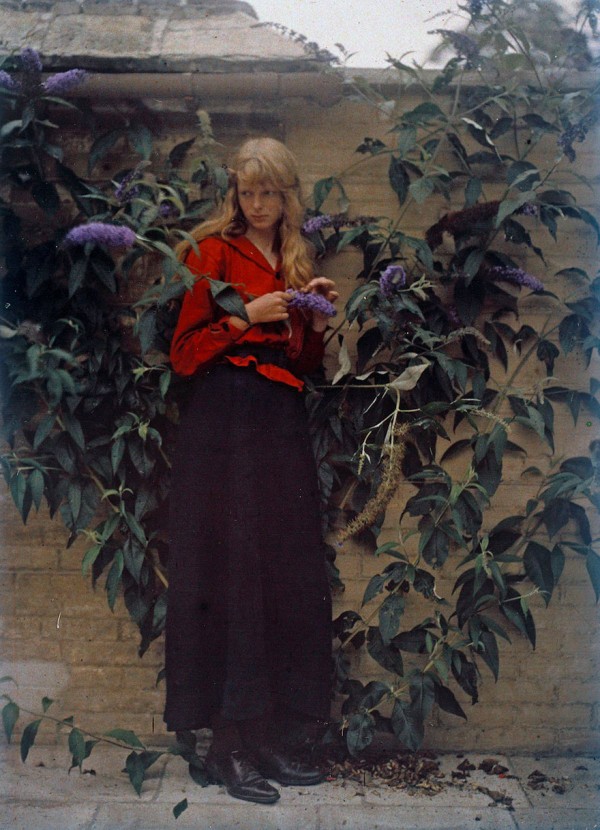
The unknown girl in red still haunts many. It’s been deduced she wasn’t his daughter, so exactly who could she have been – a relative, a friend’s daughter or just some damsel he found with a group of others on the shingle of Ludworth Cove, Dorset? For some reason it’s been passed down that her name was Kristina. But whoever she was, Kristina has become a potato starch mystery.

christina6-19113 o'gorman

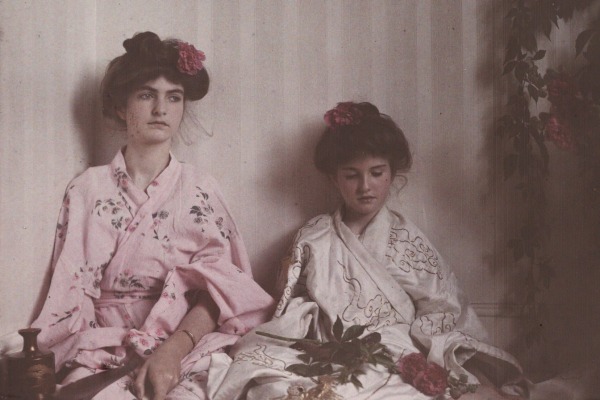
Around the same time as she was captured for eternity, in the year before the Great War, Etheldreda Laing was also using the same relatively new process to take photos of her two girls, Janet and Iris. She did so in the gardens and on the rolling lawns of her family home near Oxford – Bury Knowle House. Between the two photographers, we have some of our earliest surviving colour photographs – they are potato starch miracles.

eltheldreda laing01

The two photographers concerned were both amateurs, but like many throughout the history of the art/hobby, they became obsessed by it. Both were fortunate to be well off enough to service their passion in days when it wasn’t as cheap or as ubiquitous as it is now. A couple of plates for this challenging process would equal a day’s average wage. But with it photography pushed the envelope into territory that was difficult to master, but one that produced stunning results. Amazingly though, the key ingredient in the ability to take and make these surprising images was something very humble and everyday – potato starch. A microscopic amount of the root vegetable was stained red-orange, green and blue- violet. Then this was used to provide a filter for light to pass through. When a photographic plate was inserted the light would react with the plate’s chemical emulsion to make images appear naturally coloured. Not simple by a long shot and thus it took skilled practitioners. They are ethereal, the results, redolent of days gone by, but exquisitely still exhibiting the eerie freshness of just having been taken yesterday. The process was called Autochrome Lumière, invented, as the second part of the name would indicate, by the same two French brothers responsible for giving us moving pictures.

eltheldreda laing02

Audrie, as Etheldreda was known to family and friends, must have given birth to two very patient daughters, given the time needed to be still for a successful picture to be created. She had been playing around with the colour process since ’08, but it took her years to get the hang of it. The use of it had virtually died out by the twenties, given its complexity. Colour film itself, as we who were born before the digital age would be familiar with, only came into being in the mid-thirties. Gone then was the necessity for the earlier unwieldy means. But potato starch had its place in the history of the art form – what amazing and intriguing photos it made possible!

eltheldreda laing03

Laing was a trained artist before photography took hold of her. She married lawyer Charles in 1895 and moved to the nineteen acre property appearing in the images. In 1898 the first of her two children entered the world, followed by number two in 1903. So enamoured was Audrie of her camera that she had a dark room constructed on site for her hobby. She took to the autochrome method early and is now recognised as one of its greatest success stories.

Originally photography was thought to be an unsuitable pastime for genteel womenfolk because of all the messy chemicals involved. But by the turn of the century it was considered ‘developed’ enough to to be respectable for the fairer gender. But for women it was still not the done thing to go wandering around with camera in hand snapping willy-nilly, so subjects were normally family members – thus Janet and Iris were constantly prevailed upon to satisfy their parent’s fixation. Take a gander at the photographs on-line – to my mind they are remarkable, given their provenance.

Etheldra-Laing-autochrome-Iris-bench

Audrie later became a noted painter and developed a new fascination with miniatures when that became fashionable. But she still continued camera-smithing throughout her life as a side-interest. She passed away in 1960, aged eighty-eight.

At forty-two Mervyn O’Gorman was considered a bit of a dandy. He was also, undoubtedly, a person of stature. When he died in 1958, at age eighty-seven, it was written of him that he was ‘…a man of agile mind and Hibernian eloquence.’ In 1913 he was married and one year on would be serving in Flanders Fields, reaching the rank of lieutenant-colonel. We know a great deal about him, but little about the strawberry blonde posing afore his camera in that cove before awfulness took over the world. What was Kristina to Merv we wonder? He and his much older wife produced no offspring.

The determined souls who have sought to solve this riddle can only point to one census record of a Kristina O’Gorman around the time – the 1911 count registers an eleven year old Irish lass by that name. A relative perhaps visiting England? She was photographed in a group, so she was no lone random he picked up on that day. It could all point to the fact she was known to him – especially as she also posed for his camera at other locations. That she was in a group on a beach suggests rejecting the notion she was a hired model.

christina3-girl in red 1913 mervyn o'gorman

The muted tones of her surrounds in the images allows the reds of her various items of clothing to really stand out, to be incredibly distinctive. O’Gorman’s portraits of her possess a timelessness that ensnares your eye – and you cannot but wonder about her, although some dismiss the need to find out her story. They maintain that we should be satisfied that the reproductions of her have found their way down through time for us to marvel at. She has been described as the true embodiment of the pre-Raphaelite ideal. – and I’d like to think that O’Gorman, for that reason, saw her potential in that group out for a day by the briny. Assessing her suitability, he asked her guardians permission, under supervision, to capture her for posterity.

christina7-1913 o'gorman

As to the other questions about her, part of me would like to know more, but another hopes she will always remain a mystery to tantalise lovers of beautiful images down through time. And to think that her youth will remain eternal is the result of adding to a mixture just a minute smudge of potato starch.

The Guy, the Girl, the Artist and his Ex' – Gabrielle Williams

Poor Race. Race Matthews that is. They called him the ‘Minister for Plod’, ‘…a tiresome old bag of swamp gas’ and a ‘…pompous fathead’ – they being a group calling themselves the Australian Cultural Terrorists (ACT). Race, being a pollie, had a thick skin and had possibly been called much worse – and we are, all these years on, still no closer to knowing who those rude guys were. But they managed to perpetrate one of the most audacious of art heists in our history – and on Race’s watch. This event Gabrielle Williams has woven very deftly into her latest novel for the savvy YA crowd, ‘The Guy, the Girl, the Artist and his Ex’

guy

Mr Matthews was Minister for the Arts in the Sate Government, back in 1986, when a Picasso, ‘The Weeping Woman’, mysteriously disappeared from the National Gallery of Victoria. The thieves left a calling card on the wall in its lieu, imposed with the acronym – ACT. For some time the staff at the gallery assumed the prize painting had been taken to the Australian Capital Territory for some form of restoration – then the reality dawned on them. Whilst it was missing, all sorts of rumour mongering and innuendo went on as to what had happened the valuable stolen item. Eventually it, equally mysteriously, turned up in a railway concourse locker. The canvas had been expertly wrapped and was in good health. Therefore it was surmised it was no amateur job – maybe even an inside job, given the specialist tools required to remove the painting from its location and then to release it undamaged from its frame.

weeping

Ms Williams, on given the task of describing herself as a writer, in a few words, for an on-line forum operated by teen readers, offered up that she is ‘…original, quirky, interesting, different, unique, funny, pacey, literary and relatable.’ After reading ‘Guy/Girl/Artist/Ex’, I would concur. It was certainly an original approach to append a range of diverse, innocent characters around those fictionally doing the stealing of the great man’s work. A quirky guy, Guy, is the hero of the piece – someone who initially spends most of his time figuring out ways to prevent his olds from discovering how entirely slack he was being at school, but later becoming far less shallow. The novel is truly interesting in its recreation of the eighties and it is certainly different, having a bunch of characters of Latin American origin as major participants in the goings-on. I could continue, but you get the gist that I like this novel. It also possesses a structure that must have been no mean feat to figure out in the author’s head. As well, the tale hit all the right notes for her audience with the coming together of the Guy and Girl. Their intimate scene is handled with just the right amount of tact. For its readers, it gives out positive messages in the escape of Ex from Artist – he being an out-and-out drop-kick, the type of boyfriend to be avoided at all costs. The author has alluded to the fact that Ex is her most autobiographical creation. The parallels include the fact she is also single mum who has been involved, in her time, with several plonkers decidedly lacking in sensitivity. Ex also shares Ms William’s tastes in music and fashion.

The book, in part, is based around the premise that the Spanish for ‘weeping woman’ is ‘llorona’ – that and a couple of admittedly unlikely coincidences. In the hands of a less skilled wordsmith I would find the latter detracting from my pleasure in the product, but not so much here. I have no doubt the age-group this novel would appeal most would accept these occurrences in their stride – and that is not intended to be disparaging in any way. I particularly enjoyed Raffi as a protagonist – a new arrival in Oz from Columbia, thus part of the Spanish connection. Gabrielle W reports she is working on a sequel to this terrific yarn. Hopefully in it Rafi and Guy will continue their adventures as a team – and perhaps more.

williams-gabrielle-small

This promising writer first came to the attention of lovers of YA with her well-gonged ‘Beatle meets Destiny’. She has been praised by critic Graeme Wood of the Age as ‘…one of the funniest young adult fiction authors around.’ For me, I trust she goes around many more times in the future, giving us more unique takes on young people on the verge of adulthood.

She and Him

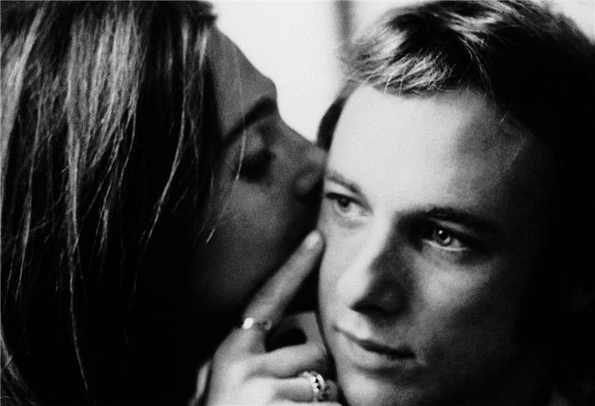
Is she giving him a peck on the cheek, or whispering of her love into his shell-like? It’s so difficult to tell. But one thing is quite evident. Back then they were so young, as we all were – so very young. And they were so much in love.

stills collins01

My beautiful, talented daughter and I were sitting in a favourite watering hole a few weeks back, shooting the breeze about music – as is our wont. I was telling her how pleased I was that she had recently purchased a box-set of the remarkable Go-Betweens, a favourite of days gone by. She was informing me of a newly formed fascination with the Smiths and Morrissey. Then she said something that quite surprised me – that she was also getting into her.

Once upon a time I was so very into her too – but in the decade it occurred I knew nothing of her relationship with him. It was much later that I connected the dots. It was all so long ago, their romance – back in 1967, just before the ‘Summer of Love’. Their time together lasted just two years – then she was swept off her feet by, of all people, Stacy Keach. He took her away from him and he was devastated. He had lost his ‘chestnut brown canary’, his ‘ruby-throated sparrow.’ It happened just as he had written his special song for her – had laboured over it for months. When he initially played his first demo of it to her, it was far from the finished product – the version of it that would appear on his group’s first album. It was important to him that she liked it. A decision had soon to be made as to whether he and his band-mates would perform it at what was to be only their second live performance. It was. The planned gig was an open-air affair on some farm field near a small upstate New York town called Woodstock. He knew, deep down when he penned the lyrics, that all was not well between she and him. He sensed there were rocky times on the way. At that stage he didn’t know of her other suitor. All that didn’t make it any easier, but at least the words poured out of him.

Much later on she would write, ‘Stephen came to where I was singing one night on the West Coast and bought his guitar to the hotel and he sang me…the whole song. And of course it had lines in it that referred to my therapy. And so he wove that altogether in this magnificent creation. So the legacy of our relationship is certainly in that song.’

That ‘much later’, approaching more recent times, also occasionally involves them appearing on stage together – not so difficult as they had being seeing a bit of each other. She had, as well, become good mates with his wife. One such time was a Q and A event where the obvious topic of that song would come up. He is now sixty-eight and quite hard of hearing, but together with his fellow musos from back in the day, Graham and David, they still perform a set or two together in public. Sometimes they even sing the song – and it still hasn’t lost any of its magic. The punters are always pretty appreciative of it. The tune has stood the test of time and the royalty cheques for it still roll in – handy, as well as a reminder of the glory years that, as a solo performer, although he does okay, it is impossible to recapture. Also one can never fully recapture youth, but up on stage that night, she was still radiant – despite her years. She had a twinkle in her eye and as always at such events, mischief on her lips.

crosby-stills-nash-2008-617

She recalled that, after he sang the song for her again, the more polished version, in her hotel room, her heart melted and she made promises she knew she could never keep. The stately singer, now well into her seventies, surmised that she was too far gone into her relationship with Keach, by that time, to go back to the songsmith. As well, she knew, she had a love affair with the bottle to deal with – thus the therapy. It was a tough time for both of them all round. But out of the disintegrating partnership came a song, one of the great paeans to love and longing for which our musical heritage is all the richer.

With their renewed friendship he bears no ill-feelings. There’d be no point. He still thinks about how, out of such a personal mess, something wonderful emerged – so much so that up on stage that evening he turns to look at her. He notes she still possesses those all-enveloping blue eyes he so adored back in the sixties – still does, if truth be known.

As he watches, on that New York night, she is telling the audience that she hasn’t heard the song performed live for going on forty-five years. She was rhapsodising to them about how it was such a romantic tune and that she still loved it – so much so that her autobiography bears its title. She informs how chuffed the man sitting beside was when she communicated to him that decision. Now that they have reconnected, she reckons there is a good chance they may even get together to do an album – maybe, perhaps, we’ll see.

stills collins

When the spotlight turned back to him, it caused him to cease his reverie of her and concentrate on the people out in front. He philosophised to his audience that, when you are young and love comes calling, you fall so hard and so continually wear your heart on a sleeve. He likens it to Taylor Swift’s recent cathartic album of tunes about her break-up and he claims, ‘You know who she’s singing about and it really doesn’t matter.’ He looks again towards his old love and tells her how touched he was about about how tenderly she described their years together in her tome. Then Stephen Stills paused, turns away from the crowd and towards her. With a slight tremor in his voice, he states, ‘I don’t know how to thank you for that song.’

Judy Collins, looks back at him and replies, ‘Nor I you.

CSN perform ‘Suite Judy Blue Eyes’ = https://www.youtube.com/watch?v=XWvw_uZPGDA

Lyrics = http://www.metrolyrics.com/suite-judy-blue-eyes-lyrics-crosby-stills-nash.html

The Short Long Book – Martin Flanagan

I think of him during another year of tribulation for his club – blessedly not my club, but any club that has had to go through what this one has damages the game I love so much. This individual I think about is as competitive as they come. He crossed over just before the shit hit the fan. Deep down, I wonder what he thinks now. He knew the window had closed at his previous club – one that had come so close, but yet had fallen short at the final hurdle. Soon it was headed for a stint of cellar-dwellering, despite his best efforts. He wanted so much for the ultimate. It looked a seriously stronger list where he opted to head to. Guided by a canny coach, a former champion of the outfit, they were on the up and up, starting to look the goods – or so he reasoned. Now, a couple of seasons in, there is no let up from the pain some might say that this mighty club has inflicted on itself. It just goes on and on. The players, for the most part, have been stoic and loyal, despite the testing times. The captain, as courageous and straight-talking as they come, has admitted that a recent injury, seeing him off the field for the long haul, came as somewhat of a relief. There is debate as to whether he will continue on carrying the load, such has been the pressure of the messy affair. And the player I am thinking about, looking at his old team, under a new coach who is building them back up and now possessing a list full of talent, in his more reflective moments, must be shaking his head. Yet he will suit up and go into battle week after week for his new employer, still giving his all because that is the way he is made. But along with his colleagues, be must wonder if there will ever be an end to it – will it all eventually be too much and the grand old club will be bent and beaten. He says the right adages to the media and works frenetically on the field to paper up the ever widening cracks, but how long before it all comes tumbling down around him? It’s another bitter winter for the Bombers. There is no greater test of his or the club’s character.

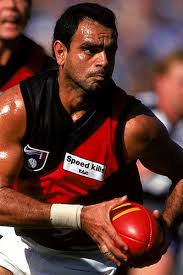
And then there’d be Longie. He is a hero from another football age – and still a hero today, even if his playing pomp is far behind him. His era was a time before footy became a corporate game, massaged to suit the big end of town and the demands of a voracious media. Some claim the core fans have been forgotten and the spectacle is but a mere shadow of its former self – but I would disagree vehemently with the latter at least. Longie knows that it has all changed, but for him, a servant of Essendon in his playing days still with strong ties, he had a different battle to fight. In many ways he is still fighting it. He is inscrutable, but he too must be bleeding for his beloved club, as well as for a coach/father who is back there to lend a hand; to see if a wise old head can help drag it back from out of the mire. It’s not his fight though – Sheeds can have it on his own. It’s not that he is not up for a job, but he has stood tall in the past on another issue and that particular journey is the one he feels he needs to see to the end. And as we have seen in recent times, with all the brouhaha over the Adam Goodes debacle, there is still much to be done off the field. Back in the day, with Sheedy at his side, he changed attitudes and made our indigenous game a safe haven for indigenous sportsmen, a place where they can display their magic for our collective wonder. We are all in thrall of what the Jettas, the Franklins, the Ryders and the Riolis bring to the table for our fantastic sport.

One of our leading writers on Aussie Rules, Martin Flanagan, took Michael Long on and has devoted a fair amount of time over the last decade trying to pin him down so as to construct a linear biography. It hasn’t worked. He failed. It was impossible from the get go – as impossible as it seems to be for Longie’s team to extricate themselves from the bogey-man that envelopes them today.

short long

What we have, instead, is ‘The Short Long Book’ – a lovely play on words to describe an equally lovely product. And it is that perhaps with this factual novella-sized work we get to the touchstone of the man better that a more traditional hagiography would ever do – for that is what a biography of this man could not help but be. For what he’s done and continues to do he is universally admired – including by Flanagan, such a capable renderer of words. Nicky Winmar may have provided the photographic symbol, but Long provided the story and the grunt to get it done. He was a black man who took that long walk to change perceptions – and he took the nation along with him. At its termination he told a nay-saying Prime Minister a few home truths.

In telling the yarn of how he failed to pin his elusive quarry down, the author has come up with a mini-gem. There are yarns within the one great tale too, dominated by the time Michael L took Flanagan into the desert lands and the Top End of his people so he’d understand more. It is also the saga of how MF became the Great White Hunter to Longie and his mob. In such tales, tall but true, we are given a hint of what makes such a mesmerising subject tick – one that, despite his elusiveness, is an out and out hero.

Flanagan, Martin

Martin F tells of how a Longie would relate to him a story, but the telling could take several years to complete as he would deliver it one sentence at a time. The book is brim full with tellings of these wonderful stories. There’s the young Longie sleeping regularly on his mother’s grave. At a similar age he found all his belongings on the family lawn when he dared to float the idea that his future lay with basketball rather than Aussie Rules. He got the message loud and clear on that one. And there’s………well there’s plenty more, but it is a short tome. Better you go out and purchase your own copy. But, just to pique interest a little more, in it you will find a hilarious description of the great footballer’s running style, another of Dermie’s infamous shirt-front of Paul Van Der Haar and best of all, there’s the magpie goose.

The nation will remember the Essendon star for his ‘Mandela’ year, 1995. To his credit, the villain of the piece, Collingwood’s Paul Monkhurst, now stands alongside Michael Long as an advocate for racial tolerance. At that time, when the black man he targeted with his racial tirade reacted by standing up for a principal and telling us all it would, from now on in, definitely not be left on the field on that day nor any other. He pointed out where we were all failing; he pointed us towards a better tomorrow.

long01

Unlike many commentators, I refuse to concede that our game has lost its soul. In recent days we have only to look to the footy family’s coming together over the death of a coach who went before his time; as well as for a champion’s sister passed before hers. I also know that the great club of Michael Long, Kevin Sheedy, James Hird and countless other legends, as well as now a player who seeks grand final glory for himself, will rise to the top again

long02

The Long Walk website = http://www.thelongwalk.com.au/Home

Gemma and Mia – Madame(s) Bova(e)ry

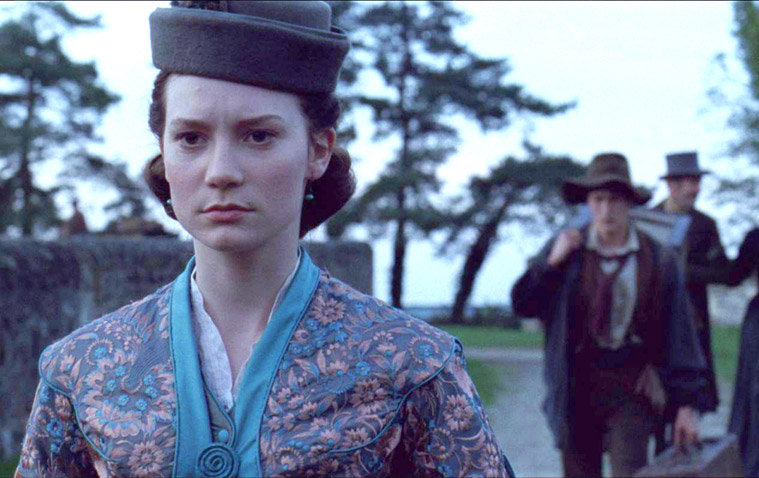
Gemma and Mia have both been the tragic wife in two new takes on a French classic, Flaubert’s eternal ‘Madame Bovary’. They both, the actresses and the movies themselves, bring something very individual in doing so – one much more than the other.

Mia Wasikowska’s vehicle is by far the straighter retelling of the two. The Canberran is on an upward trajectory since her debut in local production ‘Suburban Mayhem’. Prior to that she’d had some appearances in the usual soaps, had given up a promising future in ballet and claims to owe her cinematic poise to her parents. Both professional photographers, they were constantly placing her before the camera lens. And no wonder – what a photogenic young lady! She’s a self-starter. At an early age she was spiriting herself off to every Australian talent agency listed and eventually one took a punt, casting her ethereal looks around the traps to see if there were any takers. There soon were and she was away. At only seventeen Hollywood came calling, casting her in HBO’s ‘In Treatment’, as a suicidal gymnast. Big screen appearances followed. Her breakout role came playing Alice in another adaptation of Lewis Carroll’s classic tale. It helped that the director was Tim Burton. Later came ‘Jane Eyre’, ‘Stoker’, as well as ‘Only Lovers Left Alive’. Then the ingenue returned home for ‘Tracks’ and Tim Winton’s ‘The Turning’. To come is ‘Alice Through the Looking Glass’.

madame b

Her ‘Madame Bovary’ is quite routine, some might say even plodding. Directed by Sophie Barthes, it is the first time that a woman has been at the helm for a film production of the novel, but it’s still somewhat of a let down all for that. This is a saga so repeated that to start at the end, for which the director has been criticised, hardly matters. We all know the journey, but there was little deviation from a rote telling here. A young woman is taken away from a convent by a hubby-to-be she hardly knows and after a village wedding, she settles down to life in a dank, bleak Normandy. The groom, the local doctor, is distant and leads a narrow existence. Her life soon becomes stultifyingly boring so she takes lovers and engages in the equivalent, back then, of on-line shopping (emporium catalogues), placing the couple deep in debt. In the end, she sees no way out but to take the ultimate step. The costuming of the film is really the only stunning feature but, dear me, why did the director have her actors, a mix of nationalities, speak so heavily in Americanese? To appeal to where the money is? It just made it all sound quite hokey.

madame-bovary-mia-wasikowska

In the end, Madame B is just a plaything for her assistants in cuckolding the good doctor. She’s is naive putty in the hands of the rapacious merchant Monsieur Lheureux- an odious Rhys Ifans. His playing thereof is perhaps the film’s highlight. Mia does an okay job in the lead as a none-too-bright ninny. In truth, it doesn’t require great acting chops, although she is beautiful poured into her array of fancy outfits – and I did appreciate the way her beauty seemed to mature as the offering progressed.

Screening simultaneously to Madame Bovary is the latest version of ‘Far from the Madding Crowd’, headed by a luminous Carey Mulligan. If one had to make a choice as to which production to spend a dollar on, get oneself to the latter would be my advice.

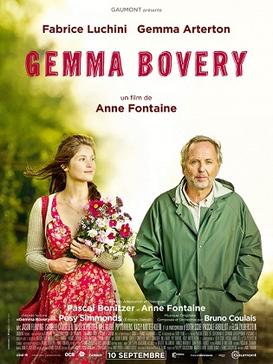
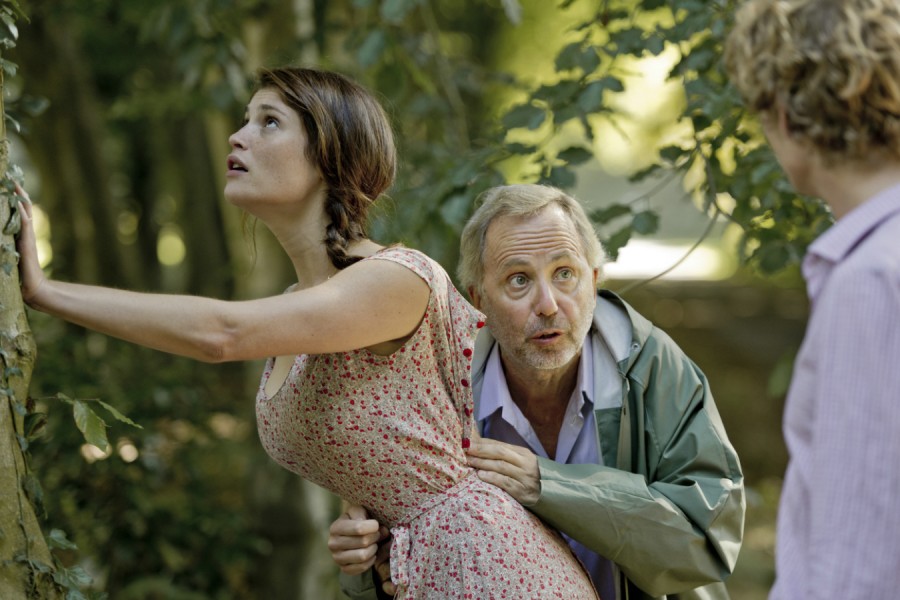
‘Gemma Bovery’ has now left our screens, but inevitably will soon be out on a smaller format. It is a much lighter take on the cautionary tale – and here rural France is sun-dappled and most appealing. It updates the whole business to current times, but still with a tragic outcome despite, for the most part, being played as a form of farce.

Gemma B (Gemma Arterton) breezes in from across the Channel, with hubby in tow, to set up residence next to Flaubert-loving retiree Martin Joubert (Fabrice Luchini). The lesser lights all are more than adequate in their roles, but as one would expect, it is a showcase for the sensuous Ms A.

Gemma_Bovery_2014_french_film_poster

She’s one of my favourites, this ravishing thesp. Although being in the game for a while, her breakout performance seemingly is still yet to come, despite the fact being a Bond girl figures on her CV. The poor girl has even lost roles she would be superb in due to her perceived lack of star pulling-power. Nevertheless, she still has managed to pile up quite a resume on the large and small screen. Her debut was the romp ‘St Trinians’ in 2007. She was Strawberry Fields in ‘Quantum of Solace’, had lead roles in the underwhelming ‘Clash of the Titans’ and ‘Tamara Drew’, then she flounced around in the footlights for ‘Made in Dagenham’ – the musical. She’s played Hardy’s Tess on tele. Her bravest and most demanding role, to date, was in ‘The Disappearance of Alice Creed’. Here a kidnapping victim gets her ultimate revenge, but not before much gritty realism takes place. It caused some well-founded controversy on its release. I can but imagine the fortitude it took for her to take on such a taxing story.

But as Gemma Bovery, she is all charm and sparkling, come hither eyes. She happily has an affair behind her husband’s back under the watchful gaze of Joubert – a gaze that becomes obsessive, with him soon perceiving she is headed for deep do-do. And when this did come it was quite a shock, given the tone of the piece up until that point. Her retribution was not at all in the manner of the original. Do the explanations for this version of it stand up to close scrutiny? You be the judge on viewing this fine addition to the oeuvre. To me, despite this, it was a joy, coming to us in a manner we expect of the French. Another woman, this time Anne Fontaine, of ‘Coco Avant Chanel’ fame, was guiding the cast along the narrative and it is most entertaining.

I know I’ll be accused of being unpatriotic, but in this battle of the two Madame Bova(e)rys, the luscious Gemma wins, hands down.

gemma b

Trailer for ‘Madame Bovary’ = https://www.youtube.com/watch?v=La-clCmfWGo

Trailer for Gemma Bovery = https://www.youtube.com/watch?v=D6AHGtq_zqk

Son and Father

tmag

She’s as keen as mustard, is Janet Carding. That was the tone of a feature article on her in our local daily recently. What was once a fusty and in places, woebegone collection of bits and pieces, bibs and bobs, has now been transformed into a happening hub. It’s not quite up there with its newer, flashier, brassier, edgier colleague further up river (MONA), but it’s also not too shabby in comparison, thank you very much. The last time your scribe visited, on a mid-winter morning, TMAG (Tasmanian Museum and Art Gallery) was pumping with people. Ms Carding is newly in the top job. Considering funding restraints – current governments tend to hold such meccas of culture and community activity low on their priority lists – she has a task ahead of her. But she is very determined to maintain standards and patronage. There are plans as big as kunanyi, our city’s stolid overseer, to further expand TMAG, but for the present, it’s a holding process for her until purse strings loosen.

Janet Carding has the view that our local museum is here ‘…to tell Tasmanian stories,…’ and that these will be ‘…forever shifting’. She wants it to be not only the go-to location for tourists to discover much about the island they’re visiting, but somewhere for Hobartians to return to over and over again. She eschews the notion that it be a ‘Night at the Museum’ clone, a ‘…big, stuffy, boring institution full of dusty showcases and uniformed guards saying ‘Shhh…’ That was the old TMAG, not the vibrant new face it displays to its public today – and will continue to do so under her watch.

The first exhibition that came on-line after she took up her tenure, back in April, was ‘The Suspense is Awful – Tasmania and the Great War’. That was what I perambulated down Argyle Street to its site between city and docks that morning to see. By the end of my viewing I was impressed. During the hour or so I spent perusing I had been moved to tears several times. And that is also where I discovered a letter from a father to his son, both personages being intimately involved with another museum. It was a missive, together with its accompanying few words of explanation, that piqued my interest and left me dewy-eyed. It also caused me to take to the ether and to do a little imagining as well.

Launceston’s Queen Victoria Museum and Art Gallery (QVMAG) has had a similar make-over to its southern cousin. It was there that the two men in question spent a very large part of their working lives.

Herbert Henry Scott died on March 1st, 1938. I have no idea whether his son, Eric Oswald made it back for his funeral. He had just commenced some travels in the other hemisphere. I suspect not, given the state of international transport back then – the flying boat service to and from Britain only commenced later that year – see, I’ve done my research. So this is where the imagining comes in. I imagined that somehow he was there to say farewell to his father. What follows is perhaps something akin the eulogy he would have given from a pulpit somewhere in the city on the Tamar, before his father was taken away and laid to rest in Carr Villa Cemetery.

My dear family, my dear friends and friends of my father – I am standing before you, on this sombre occasion, to tell you something of my father – of the man I respected and loved. I will tell you a little of his life and deeds, as well as how a letter from him to me changed the course of my life. You all know his character, you all know how admired he was in this community, particularly in the scope of his preoccupation with the surrounds of this beautiful island that has added so much knowledge of it to the scientific world. You all know the immense contribution he made to our local museum, a place that has afforded most of us assembled here hours of wonder through the many exhibitions he curated. You all know the tireless hours he willingly gave up to enhance that city asset. We also all know, that as I speak, war clouds are again gathering over Europe and that gives me such a heavy heart due to the knowing of what he, my mother and my sister went through during the years of the Great War. Many of you before me also were sorely tested during that period. I will relate to you my own testing time during the last year of that war and how my father was able to prevail on me to take, or rather not take, a certain course of action.

My father was London born, grew up in the United States of America, returning to the UK at age eleven to be apprenticed to a cabinet maker – a trade that would hold him in good stead in later life, building display cases. He was a sickly young man and he was advised to migrate to a climate possessing cleaner air. That turned out first to be New Zealand, but eventually Launceston. After various occupations he was invited to take up the position for which he has become well known and even revered in our city – that of curator of our museum, the Queen Victoria. It was two years after that I came into the world.

Before he took up this position he had been noted by the powers to be as a fine chronicler of the natural environment of Northern Tasmania and he was keen for the Queen Victoria to reflect that. At the onset he found the place, on close inspection, to be in a state of neglect and disarray. He took wholeheartedly to the task of transforming it into the pride of the city it is today. In fact, it would be fair to say he became obsessed by the never-ending tasks he found necessary to complete single-handedly there. My father could be equally seen dusting its various collections as he could be pouring over the books, trying to balance the meagre budget, in his broom-closet of an office. The museum also became a home for his teaching; the passing on of his knowledge of the natural world to students of all ages. He was particularly sort after for his intimate awareness of the native marvels of his beloved adopted island.

The museum expanded during his tenure, adding new galleries and acquiring another building in which to exhibit what previously could not see the light of day due to lack of space. Every new showing he would have to set up himself. He was also busy publishing learned accounts of the natural history of our environs. To my mind, he was a great man; a great man that all who are gathered here will retain positive memories of. He will sorely be missed for his contribution to our community. Of course, as family, we will miss a loving husband and father.

As you are all aware, since 1930 I have worked alongside my father at the Queen Victoria. I am with heavy heart, but nonetheless excited, to be taking over in his role a curator after I complete my travelling scholarship.

In conclusion, I wish to relate to you some of the contents of a letter my dear father wrote to me on the 16th of May, 1918. It was the last year of the conflict and we had discussed the previous evening my desire to do my bit for my country now that I was finally old enough. I informed him that I would be shortly leaving for the front. He was a persuasive letter writer and found it easier to formulate his feelings and arguments in that format rather than verbally. He knew of my mother’s would be reaction to this news and was well aware of the fact that I may not return. Friends of ours had lost loved ones and he determined that I should not be among them. Without that letter there is every possibility I would not be standing here, sending him off, this hour. In part, these are the words he put to paper to me:-

‘Dear Eric
Apropos of our talk last night respecting your keen desire to go to the great war, I wish to pen you a line or two. I have to ask you a very hard thing, namely to put your love for your mother in front of your fixed idea of your duty to State. The decision on your part to serve at the front would end her life with worry so I ask you to spare that life for you and your sister, and also for myself. The law of love for a mother overrules all but the deepest call of state or country.
Always your friend and best chum
Dad’

In the circumstances, back then, he well knew that he was asking me to make the hardest of calls, given the pressure at the time for all men of my age, who were reasonably of sound health, to sign up. He was well aware of how many in the community would brand me with cowardice and I know it was not a plead he took lightly in the making. Such was my respect I acceded to his wishes.

Thank you for bearing with me for these few words. I will continue to dearly lament the passing of my father for some time.

Now as a father myself I have, since that sojourn to TMAG, often thought what a thing it was for that other father, long ago, to make such a request of a son. How much it must of taken out of him to dissuade him from going – and how relieved he would have been that he was successful in that argument. I would imagine there would be some Muslim fathers around the country at the moment suffering in the same way, anxious that their sons not be tempted by the zealots of IS. In those years, though, the anguish of such a great number of parents, fearing a son joining up and facing the likelihood of death in a foreign land, must have taken a terrible toll. I thought on all that after I read that letter in the TMAG that morning.

No doubt Eric used the occasion, to a degree, to set the record straight – and all too soon another war would again sorely test him. He had already been appalled by what he had seen in earlier travels immediately after the first war, especially how the rest of the world treated the German people who were innocent pawns in the games their leaders had played in the years pre-1914. That and the letter would possibly prove instrumental in Eric deciding to become a conscientious objector, on religious grounds, during the next war. For that he lost his position at the Queen Victoria and was imprisoned.

Before he joined his father, Eric was a teacher, plying his calling at such places as Epping Forest, Devonport and Ulverstone. At the latter he met and married fellow chalkie, Freda Lloyd. After the Second World War Eric returned to his teaching career.

In his later years he became, to his own admittance, quite eccentric and reclusive, dedicating himself to a study of sea-life. He co-authored ‘Fishes of Tasmania’, published in 1983. He wrote over eleven thousand quatorzains, a form of verse – one every day. He was fatally hit by a car in 1987. Eric Scott was survived by a son, as well as two daughters, no doubt giving him also a great understanding of the import of that father’s letter he treasured to his dying day – a letter that may have saved a life. But at what cost to son and father?

queen vic

Website for the Queen Victoria Museum (above) = http://www.qvmag.tas.gov.au/qvmag/

Website for the ‘The Suspense is Awful – Tasmania and the Great War’, TMAG = ‘The Suspense is Awful – Tasmania and the Great War’.

When the Killing's Done – TC Boyle

‘And dogshit wrapped in neat little plastic bags. Does that drive her crazy? Yes it does. That people should take something natural, waste, feces (sic), the end product of an animal process, and seal it in plastic for future archaeologists to unearth from landfill in a thousand years is pure madness. This world. This skewered and doomed world.’

TC (Thomas Coraghessan) Boyle is one weird geezer. He looks weird and from all reports, behaves weirdly too – an eccentric, perhaps, with his slick looks and flamboyant dress. This professor of literature, for the University of Southern California, is well known around the traps for the equally flamboyant readings he gives. He’s a latter day Dickens.

He’s pushing up towards seventy now, this oh-so-cool dude, with a literary legacy that will mark him, in future years, not only as a one-off, but also a true great of turn of the millennium literature. He has been described as a maximalist novelist – one who eschews the simplicity of style advocated by many notables of last century – the warriors who put the American Dream into print. We are now in a new age, a complex age, with Boyle reflecting that. He is as flamboyant in his prose as he is in everything else – but here’s the rub. Although the reader may not have discovered previously in print a whole plethora of the magical sounding words he divines from who knows where and litters his oeuvre with, we know immediately their meaning – no need to go rushing off to dictionaries. It’s all explained in the context. He is amazing, his output so varied in narrative, but always so seductive in reeling the reader into each novel’s web.

tc boyle01

And ‘When the Killing’s Done’ is no exception. The opening paragraph to this opinion piece on the tome is of an Alma Boyd Takesure rumination on one of her early morning beach perambulations. And it is a pet (pun intended) peeve of mine, this nonsense of wrapping up canine crap, particularly when it’s taken to the ridiculous extreme, such as on our island’s gorgeous beaches. Here dogs may be permitted to run as free as the breeze, just as long as we follow the firm instructions on some rusting signage to clean up after them – with bags conveniently provided. On Bondi I see the point, but on our strands, where humans are rarely in mass numbers, it’s quite frankly ridiculous.

Alma is an environmental fixer-upperer of islands, those set in that same archipelago, off the Southern Californian coast, as Boyle’s subsequent offering, ‘San Miguel’. She works for the National Parks Service, tasked with clearing those isles of their feral populations, restoring them to pristine condition. But to her arch-enemy, Dave la Joy, any form of culling is an anathema. He’s a rabid greenie – as far left in that activist grouping as it’s possible to be. He will stop at nothing to protect every living organism on those islands, come hell or high water – and the latter figures prominently. He does not stop even at introducing fresh feral species to confound Alma and her crew. At first I read this character with disbelief. Could there be people around so madly fervent in their obsessions as to be unhinged? His main squeeze, Anise, a child of the islands, seems to put up with him almost to the end – I suppose it helps that Dave isn’t a short of a crust, being a successful businessman, owning a chain of profitable stores. But such is Boyle’s skill in the telling, in an odd way, I ended up liking this cove who obviously wasn’t the full shilling. He’s one of the author’s more out-there creations.

Even if the ending of the book didn’t unravel in the direction it seemed to me to be heading, in that sanity is eventually restored (not really a spoiler), it didn’t seem to detract. Boyle claims he places immense thought into the conclusions to his tales, but is open-minded about them till he actually gets there – or so he says. This could have gone either way.

Boyle is not a mega-seller here, although some of us may have seen the movie version of his ‘Road to Wellville’, based on a cereal king. Nonetheless he is well worth a library borrowing just to get a taste of what this unique wordsmith is all about.

TC-Boyle-001

TC’s website = http://www.tcboyle.com/