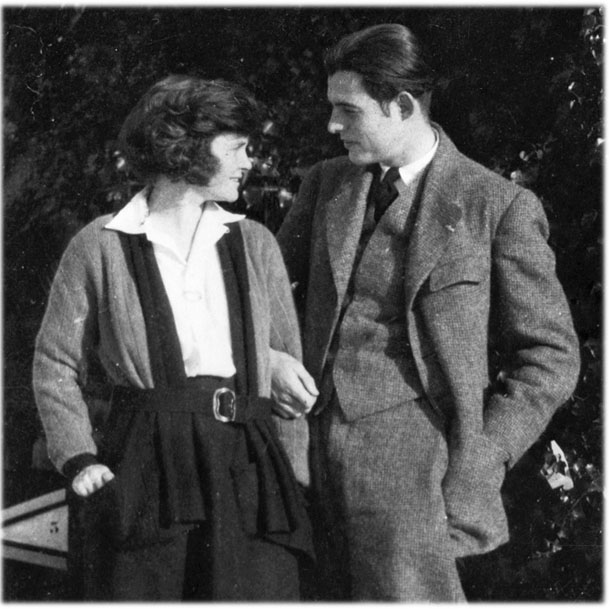
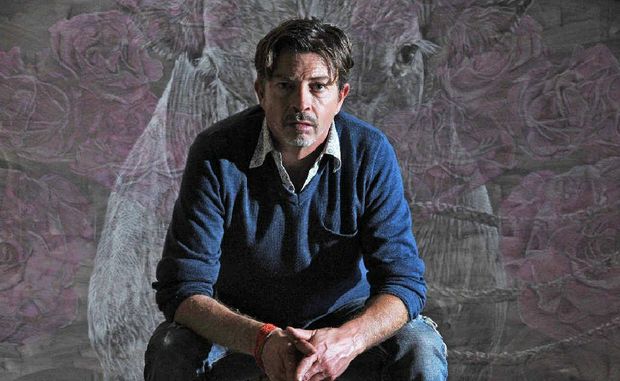
Florence and the Odious, Odious Man

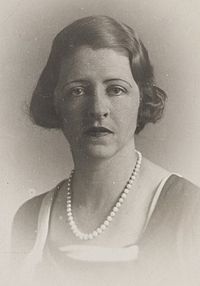
It was a small gallery – pictures of women from long ago. Some were clothed, most were not. But it was a portrait that caught the eye most – a portrait in close-up that was the first I clicked on to enlarge. Above the set of images was the name Robert Wilson Shufeldt. I bookmarked it, as I do anything I discover in the ether that may have the potential of a bit of a yarn to it. In theory the plan is always to return later. When I eventually did so, with this image, just recently and dug a little deeper, I was quite amazed at what I discovered.

Robert_Wilson_Shufeldt_06

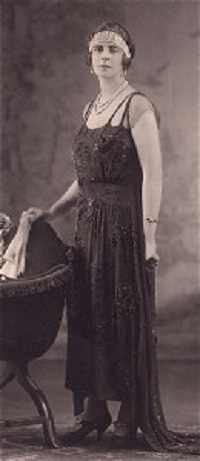
More often than not I find dead-ends, but this small beginning produced a gothic tale worthy of Hollywood – although it did take a little finding. There is, though, sadly no proof, one way or the other, as to whether the portrait was her. Perhaps the ‘colouring’ is right, but maybe this was of a younger woman? But, by the end, I had it fixed in my mind that it was of the heroine of the piece – that it was Florence.

There are quite despicable excuses for humanity in our own digital age, mostly male of course, who think it is fine to place private photographs on-line of former partners/wives/girl-friends/one night stands/whoever naked, or in compromising positions, for others to gawk at – predominantly male too. But if you think this is a thoroughly modern phenomena – think again. Robert Wilson Shufeldt was at it too – but obviously not in the same way. Here’s his story – and that of his victim – the remarkable Florence.

Google Robert Wilson Shufeldt and most references are for this fellow’s father. He has the same appellation (of course) – and was more historically famous than his son. He was an admiral on the Union side in the war that tore the nation apart. But Robert junior is there if one looks carefully. Delve deeper and his whole miserable existence can be exposed.

He was a bright lad, was Robert. He grew to become a Renaissance man of sorts – but with none if the enlightenment usually associated with that accolade. He was an ornithologist and it was his study of the avian species that led him to Florence. It has even been reported that he was the man who dissected the very last specimen of passenger pigeon on the planet – and what a sorrowful story that poor creature’s demise is. As well, this fellow was a renowned osteologist (expert on bones), myologist (of muscular systems), museologist (of museums and their systems) and ethnographist (of people and cultures). And he dabbled in the photography of the nude – purely for scientific purposes, you understand.

Robert_Wilson_Shufeldt_17

The younger Shufeldt was born in 1850 and spent the Civil War serving on one of his father’s vessels. In 1872 he enrolled at Cornell University, studying medicine. On graduation he joined the army and RWS went on to serve as a surgeon in the Indian Wars. It was at this time he commenced collecting. From that point on and throughout the remainder of his life he put together a vast trove of biological specimens, but eventually started to specialise in denizens of the air. Human anatomy also became his forte. Over the course of his career he published over a thousand books, articles and papers on a widely diverse range of subjects. One such was entitled ‘America’s Greatest Problem – the Negro’. He was, not unusually for the time, in the firm belief of the racial supremacy of whiter peoples. Determined to assist in proving that notion he took to exhuming the skeletons of North American Indians – something that we know from our own island’s bleak history wasn’t so unusual for the time either. For all these fine works, or so they were considered, RWS was appointed to the august post of Honorary Curator of the Smithsonian Institute.

RobertShufeldt

But it was with his private life that Shufeldt, inadvertently, made his greatest contribution to society. His outrageous behaviour so shocked the powers to be at the time that it changed the way the American legal system viewed the rights of women and increased the move away from them being regarded as mere chattels of their husbands. Agonisingly slowly, the march for equality in the eyes of the law was starting to commence around that time – Shufeldt assisting it to get traction.

The scientist was wedded three times, firstly to one Catherine Badcock. Back in that period, when divorce was frowned on, many unscrupulous men, on finding their married situation holding them back in any way, would conspire to have their unwanted appendage certified as insane on the flimsiest of excuses. The next step would see these unfortunate souls installed in a lunatic asylum. That was Catherine’s fate. She had no means of fighting back so she took an also not uncommon path – she committed suicide. Why Catherine displeased her hubby I was not able to discern – but there seems no doubt she was very much the wronged party.

While all this was occurring Shufeldt continued his writing, with his ornithological work bringing him into contact with Maria Audubon. Now any twitcher worth his/her salt would recognise that surname. John James Audubon, Maria’s grandfather, is god to American bird-lovers. Shufeldt was a member of the Audubon Ornithologists’ Union (AOU). He and Maria published papers together in its journal. She was a spinster – thank heavens that term is disappearing from our language. Her sister, forty-two year old Florence, was also a reluctant member of the spinsterhood.

And so Maria bought sister Florence and RWS together. Being the type of self-aggrandising person he allegedly was, it would be quite a feather in his cap, excuse the pun, to be wedded to an Aubudon. He wasn’t really serious about her for, as soon as the nuptials were over, he was having it off with the home help, Scandinavian Alfhild Dagny Cowum. He wasn’t at all subtle about it, assuming he’d sort Florence out later if she presented any problems. He obviously didn’t know his new wife at all well. Two months into the marriage she was suing for divorce on the grounds of adultery – an unusual and brave step for a woman to take back then. Initially Robert thought all this mattered little. Being a man (of sorts) of his times, he took it as gospel the notion that the male of the species was entitled to affairs on the side. It was only to be expected of a fellow as virile as he. And normally this would be the case – but Florence was not as much a woman of her times as he took for granted. She would not be subjected by him. She was persistent and she never gave up. It was a long, tedious, demeaning and convoluted process she had to endure to see justice – but she fought bitterly to attain it. She was bold enough to convince court after court to see it her way. This, despite all the mud that her husband could throw at her; despite the despicable act he perpetrated when the mud didn’t stick. In the midst of all of it he did find time to take his mistress as his third wife. Florence gave him the wherewithal to do that – not that in any way is he deserving of any form of sympathy. She was also vital in his fall from grace.

What was shocking were the lengths Shufeldt went to to get his own back on Florence, once his wife was granted a divorce by the Maryland courts. It shocked him to the core that it was ruled he also was required to pay alimony. In the usual manner of men back then, with a rare adverse decision going against them, he simply took the common step and filed for bankruptcy. The thinking was that would put paid to any financial call she could have on him. He hadn’t figured, though, with his former wife’s determination to prove that this ploy was patently unfair. After all, he was still receiving a perfectly fine pension from the US army – surely she had a right to that, if indeed he was in dire monetary straits. She very much doubted this to be the true. She took her case all the way to the US Supreme Court – and in doing so took on the US Army as well. Compounding her problems there were the boffins at the AOU who were concerned what the impending scandal would do to their organisation’s standing. They took legal means to try and get her to desist. She refused. All this caused great publicity but again, with the bit between her teeth, she was unswerving in her campaign for her rights – and she ultimately prevailed. The loophole of bankruptcy was closed and the precedent had been set to apply that judgement to all future women in similar circumstances.

Now, what of the link to the abhorrent practice of placing intimate images on-line of women who have had the effrontery to displease their men folk in some way? Well, it was what Shufeldt published during these proceedings that caused him to lose all sympathy from those in positions of judgement. It was considered that he had well and truly crossed the line – even for that misogynist era.

It was not unknown for him to publish nude photos of women in his various scientific writings. His book, ‘Studies of the Human Form for Artists, Sculptors and Scientists’, was full of them. But when ‘On Female Impotency’ came out and it transpired that the nudes enclosed within were of his wife Florence, all hell broke loose for the slime-ball that was RWS. Supposedly a piece in the guise of being ‘scientific’, he wrote of a woman who had left a physician, who shall remain nameless, describing this anonymous wife as ‘…immoral, hysterical and not a virgin when she married.’ He also submitted that, shockingly, said woman also possessed the blood of a mulatto – a clear reference to the great bird-painter’s own mother. This outraged the AOU and the Smithsonian – they disowned him immediately. This only caused a fit of pique from Robert S who promptly marched up to their doors demanding all his specimens back. What a cheek they had not taking his side!

So what do we take out of all this? Probably that there is nothing new under the sun in this world. That it rebounded and the odious man received his just desserts is a plus. Hopefully that can happen to most of Shufeldt’s present day equivalents. All of this unseemly carry-on took it’s toll on the poor possum’s health. Most of his final years he was to be found brooding and wheezing in various sanatoriums before he did the planet a favour by dying in 1934.

It took years and years for Florence to obtain her legal win with, as a spin off, ever so slowly she assisted in setting in motion the creaky wheels of justice to make life more tolerable for the women of her time. She is worthy of greater recognition for this – and I still cannot help but wonder if that portrait that so intrigued me is indeed of her.

Robert_Wilson_Shufeldt_06

I’ll leave the final word to one of her supporters during her lengthy ordeal, Elliott Coves, who wrote – ‘Dr Shufeldt is morally a cancer – the most vilest and most depraved wretch I ever met. His former wife had committed suicide in an insane asylum to which his brutalities had consigned her. The horrors of poor Florence Audubon’s situation I never saw surpassed.’

That Jimmy – Will He Ever grow Up

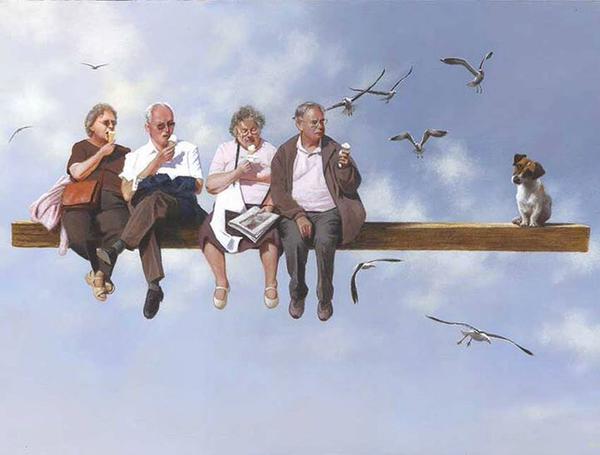
A rabbit perched on the shell of a giant snail; a group of Brit excursioners – they could only be Poms given their attire – floating through the air on a wooden plank, counter-balanced by a cute doggie; oarsmen rowing their way through a sea of denim or, this scribe’s pick, a super, super cuddly ted with boy and dog. It’s all the dreams of childhood before reality quells.

lawlor03

It’s the planet as Jimmy Lawlor imagines it. ‘His paintings are so delightfully executed that he confirms the beauty of countryside life, but he picks his nose with his nationality brush and pokes fun at the constructed Ireland.’

The Irish surrealist was born in Wexford in 1967 and now lives in the pluvially glorious west of the country. Here the Atlantic gales sweep in and the sea has created a landscape like no other – a place where the whiff of a leprechaun can still be noted if one sniffs its wind-blasted hedgerows. It’s a perfect for a chronicler of the absurd such as Lawlor. He aims at the child in all of us – and hopes the child never becomes us.

My first whiff of him came via an art-savvy friend on Facebook – and I had to discover more. This seemed particularly the case as I now have a granddaughter whose take on the world and all its wonder has reawakened mine.

lawlor02

Lawlor reportedly mourns the disappearance of the old ways of the Emerald Isle. It too has become a member of our generic globalised environment, but his paintings keep something of the whimsical spirit of the Irish alive – a race who can still, on occasions, snub

lawlor01

their nose at the political correctness so rampant everywhere. They can observe and lampoon the stupidity of, through Guinness tinted goggles, the big knobs in charge. One just has to cite, to discern that, the calibre of their comedic talent for taking the mickey. Such like is placed on canvas by Jimmy L. His works are now sought after world-wide, demonstrating we’re still not quite ready to let go the traditions of Dali and the type of adventures of the mind he indulged in. I love the magic in the contemporary version’s art.

jimmy lawlor

To my mind each painting asks for a story to be constructed around it. Here logic perhaps takes second place to imaginings. I can’t wait for Tessa Tiger Gordon to tell her Poppy what is going on in some of these daubings by a painter prepared to sit whales in giant goldfish bowls; or produce traffic cones, with wings on, over the quiet unsuspecting byways of his homeland.

Jimmy Lawlor’s website = http://www.jimmylawlor.com/

Affairs=Murder for Woody and the Blue Room

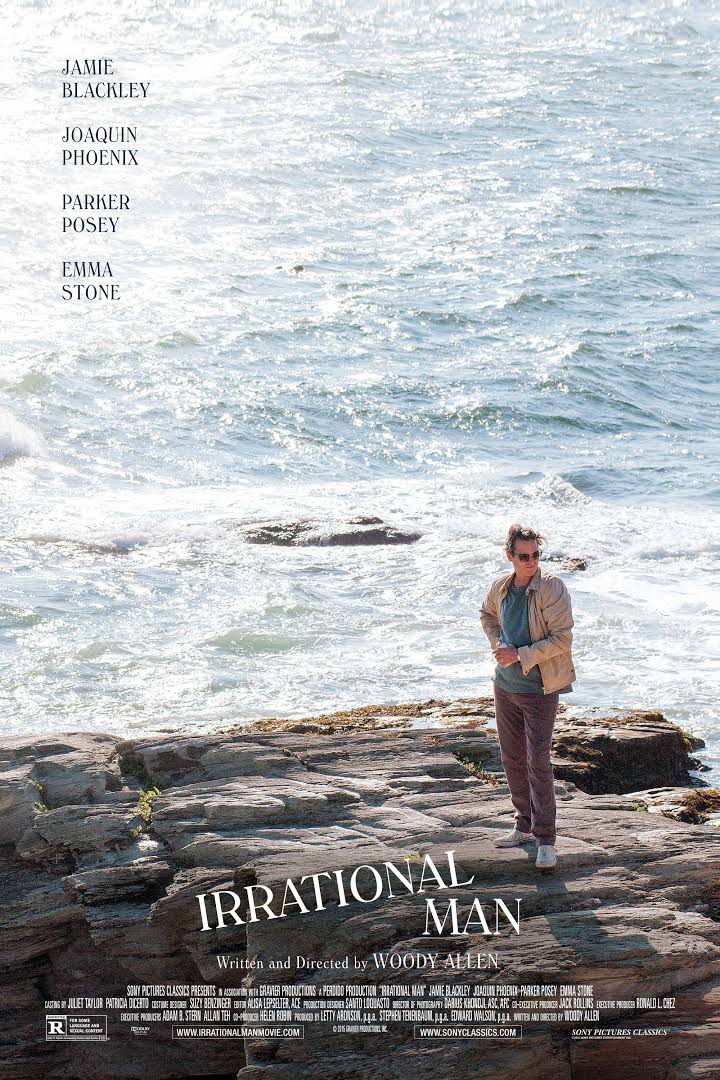
It was worth more that two and a half, Paul Brynes – it was! Granted, one could still argue it wasn’t a patch on classic Allen – no where near ‘Annie Hall’, ‘Manhattan or, more recently, ‘Midnight in Paris’ and the marvellous Cate Blanchett vehicle, ‘Blue Jasmine’. So the reviewer from the Age is correct in that regard, but still, that rating – well it was miserly for what was nonetheless an amiably entertaining film. But the critic made a point about his distaste for ageing male Hollywood stars playing against much younger actors as their love interest and there’s another case of that here. I concur wholeheartedly with this view. It does get on one’s pip, I must admit. That is not just jealousy speaking – it’s so unrealistic in most cases. But at least it’s not Woody himself as the romantic lead, as in the past on occasion. Emma Stone does a fine job as the more junior of the two ladies who fall in lust with the dissolute Abe Lucas (Joaquin Phoenix), newly arrived on campus as the bad boy of the philosophy department. To give him some credit he did reject the none to subtle advances of the student initially – but that was possibly only because, at that stage, he was struggling with his libido. All that grog wouldn’t have helped. We know he was a dud in the sack because of his impotent display with the older Rita (Parker Posey) – a far more suitable, age-wise if nothing else, match for him. And it has to be said, his colleague’s wife is a far more sensual, interesting woman than Stone’s Jill Pollard.

irrational man

Phoenix does look as though he’s kinda sleep-walking through his role in this the auteur’s latest. It’s as if life’s party has petered out for his character – that is, until an overheard conversation puts the pep back into his step. He’s contemplating murder you see. There’s renewed vigour in his classroom and bedroom performances – enough to be finally tempted by Jill.

irrational man01

It’s not great, is ‘Irrational Man’, but it’s nowhere near the waste of money Allen at his worst provides. The two women, for my particular dollar, steal proceedings – especially the lustful, lustrous Posey – why on earth don’t we see more of her up there on the big screen? In the end the villain gets his just desserts – both of them. I did feel the climax needed a tad more teasing out – to me it seemed out of kilter with the rest of the offering. In truth, Paul B, I’d give it one more complete star – but you did allow that other critics have been kinder. Even an average Allen, in my view, is far superior to most of the dross Hollywood produces these days. Long may we cherish him, despite all his hang-ups and misdemeanours.

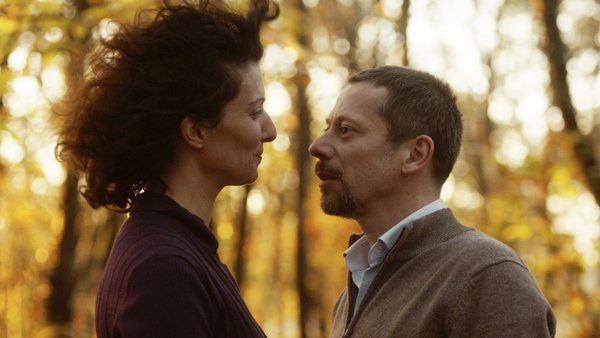
Now how could the Blue Room have resisted a movie entitled, well, ‘The Blue Room’? And yes, a blue room certainly features throughout – but mainly, as well as exceedingly erotically, in the opening scenes. Delphine (Léa Drucker) and Julien ( Mathieu Amalric), both married, escape to this upstairs room to conduct their passionate affair. She hangs a towel out the window when hubby, who works downstairs as a chemist, is absent. Directed by the lead male, he also bucks the trend and places his privates on display – why should it be expected only of the women? What the viewer eventually realises, as the hanky-panky disappears from the screen, is that really the film is a police procedural, for the aforementioned cuckolded chemist has been murdered. Which of the pair did the deed – or were they in collusion? That is the point of the exercise. We learn that neither party are being completely honest with the investigators, or in court, through witnessing the back story – red herrings there are a-plenty. The convoluted evidence presented at the duo’s trial left me completely confused as to how the jury arrived at the verdict they did. But we do know, by the time this is reached, that one of the pair is decidedly out of love/lust with the other – and the direct opposite applies. One decidedly also has a screw loose.

blue room

‘The Blue Room’ has enough Frenchiness to keep this customer satisfied. Again, though, as with ‘Irrational Man’, it didn’t completely captivate. I would have been happier if I were as certain as to whom was the guilty party as the members of the public sitting in judgement. However, as it was hard to feel anything for either of the lovers being held for the despicable act, in the end the verdict didn’t matter much. Maybe they both received what they deserved.

blue-room

I really wouldn’t make it a priority to see either film before their respective runs end, but as for viewing one or both on some other platform – the ‘in’ word these days it seems – one could do a great deal worse, as I have in recent days, than these two offerings.

Official trailer ‘Irrational Man’ = https://www.youtube.com/watch?v=hP8mPkyBntw

Official trailer ‘The Blue Room’ = https://www.youtube.com/watch?v=ieb9AbLl1_k

Molly Fink

It is a glorious name, Molly Fink, isn’t it? And a pretty special name too, given that its owner had an incredible time on this planet. And she had a connection to this island – her mother being one Elizabeth Fink, nee Watt, from Tassie. She married Wolfe – Wolfe Fink – a Channel Islander who practised law in Victoria and was a noted Shakespearean authority.

Molly was born, to the above, in Melbourne back in 1894. They named her Esme Mary Sorrett Fink – but she was always Molly. She went on to have an even grander appellation attached to her. She became the rani of Padukota. Later in Molly’s life she became a habitué of the French Riviera where, on certain occasions, she could be spotted, dressed to the nines in Chanel, walking her pet tortoise along the seafront. With its shell encrusted in diamonds, whenever the little creature would flag on its excursion, from her handbag, Molly would produce the most delectable of asparagus tips with which to revive it. In between her growing up on the Yarra and the tortoise towards the end she had quite a story to tell, did Molly. Let me present you with it.

Molly_Fink

Now some of us are familiar with another Australian abroad in the wide world at the same time as Molly. I refer to Sheila Chisholm – that amazing woman from Oz who outraged Buckingham Palace by taking young Bertie Windsor in hand and teaching him a thing or two about the delights of the fairer gender. He fell head over heels in love with her, but caused such consternation to the Firm that they quickly found unsullied, so they thought, eighteen year old Elizabeth Bowers-Lyon for him to woo and wed for the good of the country. We’ll hear more about young Lizzy anon. Maybe she wasn’t so pure – with a Tasmanian to blame. I do wonder, though, how the course of history could have been changed if Bertie had stuck to his guns, as with his elder brother? It was reading an article on SC that I encountered the name Molly Fink as another Down Under sheila who became embroiled with a royal around the same time, but with a more satisfactory, for a while, outcome. And this girl’s journey was no less fascinating than that of Sheila C’s with the capital S. A name like Molly Fink just yelled out for further investigation.

Molly grew up in the suburbs of Melbourne and, on attaining her ‘coming out’ in local society, quickly became the talk of the town for her beauty. Golden-haired with dazzling blue eyes, she had an ‘…oval, ivory-skinned face…’ and ‘…pouting pomegranate lips.’

Her life commenced its uniquely curious journey when, in 1915, she journeyed north to Harbour City. Up in the Blue Mountains – at the Majestic Hotel in Medlow Bath to be exact – the nineteen year old found a glorious male specimen also taking the air at that resort for the well-to-do. He was the dashing, cricket-mad Marthandra Bhairava Tondiman, who also happened to be Indian royalty. He was the rajah of the southern sub-continental principality that was to later become part of Molly’s official title. That was in April – soon, as with Sheila and Bertie, they were totally enamoured of one another. But their out come was far more romantic if none-the-less fraught. Nobody stopped them and by August in that year of war they were married in a Sydney registry office.

After the unadulterated bliss of an American honeymoon, the real world started to hit back at the besotted couple – the real world back then not quite so ready for a ‘mixed marriage’ of such import as in more enlightened times. This soon became obvious when the rajah took his rani home.

molly_cecil

There are mixed reports about how the inhabitants of Pudukota reacted to their nominal ruler bringing home an Aussie missus – and a Catholic to boot. The ordinary people were bewitched by her, so it has been said, but the palace movers and shakers were mortified. They began plotting. With their diabolical scheming they found an ally in the British authorities. The latter assumed, being an antipodean, she could only be a gold-digger. There was no evidence at all this was fact, but that didn’t stop them. It was decided poisoning was a good option and the now pregnant Molly was fed doses of oleander. The rajah was a wake up to this and spirited her to a safe haven away from court. His wife duly produced the wished for heir. But, because of his mixed heritage, it was proclaimed that young Martanda Sydney would never sit on an Indian throne.

The rajah was not about to desert his Aussie belle on news of this. He figured the best way to deal with it was to escort her back to Oz. He’d determined to seek restitution from King George and he would state his case from Sydney. Having had issues with unsuitable matches for his own sons, George was not inclined to give this minor Indian prince much of a hearing. That was seemingly the sealer and Molly never set foot in her hubby’s homeland again.

In the Emerald City the couple cut a swathe through the high end of town. The rajah was heavily into the sport of kings. One of his steeds won the Grand National to entrench them as darlings of the turf. Molly became bosom buddies with Ada Holman, the Premier’s wife and an interesting woman in her own right – stay tuned. But the rajah was getting antsy for what was rightfully his. By 1919 he had deduced he’d do better stating his case from London, so Molly agreed to pack up and head for Old Blighty.

As the twenties wore on, though, it was obvious that their cause was dead in the water, but in recompense the British government did award the couple a healthy stipend. 1922 saw them quite taken with the French Riviera so they moved to Cannes. Here friendships were formed with such notables as Cecil Beaton and Anita Loos. Sadly the exiled rajah died in 1928. His Molly, at the time described as a ‘…very generous woman, madly extravagant.’ decamped back to London where, bejewelled and glittering, she attended all the right parties and performances. She also became a frequent visitor to the US and across the Channel.

molly f

Her story continued on with more twists and turns as the world again plunged into conflict. This saw her stranded in NYC with, oh dear, no access to her fortune on the other side of the Atlantic. And, quelle horreur, she was obliged to take a job. It was in an up-market fashion house so it wasn’t too much of a strain. She also involved herself in raising money for the war effort. This caused the FBI to come calling – they had proof she was embezzling much of what she inveigled out of the society types she consorted with. Eventually it turned out they couldn’t make the charges stick, so as soon as VE Day was celebrated, back to London she scampered. Tellingly, her son, the would-be rajah, later served time in Sing-Sing for stealing jewellery.

With her looks fading, the fifties witnessed her becoming reclusive, surrounded by her pekingese dogs and a certain tortoise. She became estranged from her son due to his criminal activities and sought solace in the bottle. In 1967 she donated all her worldly goods to the British public and in November of that year she was claimed by cancer.

Molly Fink – such a ‘common’ name. But, even with that handicap, she escaped the snooze of Melburnian suburban torpor to live a life large, mainly on the opposite side of the planet, Even with that name, she should not be forgotten. Hopefully a better wordsmith than I will bring her out of the shadows and place her in the same light as her contemporary, Sheila Chisholm, has been in recent times. I wonder if they ever met? I wonder what they would have made of each other?

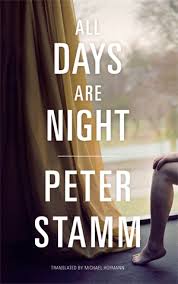
All Days Are Night – Peter Stamm

How do they do it? It would take some gall. Of course there are a few with salacious intent – but the rest seem genuinely to work from a higher motive. Sometimes money will change hands in the negotiations. If that’s the case, why not simply hire from the plethora of models seemingly willing to offer that same service for a fee? But for many that would defeat the purpose. Some consider those who make a living from it not ‘real’ women. One cannot get to the ‘essence’ with a hireling – they are all false. It would show up in the image or on canvas. For some it is the purity that they are after and for that they need to also convince that they are pure in intent. They rely on citing their artistic resume. Some would allow husbands/partners/boyfriends, perhaps even mothers no doubt, to be present – but again, does this sully the intention? We, of course, can come at it from the other angle – why would a woman – or man for that matter – agree to do what is being asked of them? But it does happen – some organise it simply by handing out flyers with a proposal, but others, like Hubert Amrheim, simply approach a subject, suitable for his purposes, outside railway stations or cafes and puts it to them face to face. In his novel, Swiss author Peter Stamm looks at the motivation from both those sides – from the artist’s perspective asking the individual to pose nude for him back in his studio, as well as from one of his subjects prepared to disrobe for him. But, imagine it, walking up to a woman and asking her to take her clothes of for you.

all days

Hubert A is able, successfully, to do just that. Mostly he has negative responses – even rude ones – and that is to be expected. But there are enough positive ones to make his project viable. Once back in his studio he photographs these compliant women naked doing mundane household duties – ironing, brewing coffee, making the bed. Examining the dozens of photographs he takes of each volunteer, he only selects for transferring to canvas those containing the pure essence he is seeking. It works. The results are in demand and he garners enough fame/notoriety so that Gillian decides to interview him for her television show. She finds him distant, austere even – not quite what she expected. But she’s intrigued. There’s not much life in her marriage to Mattias, so she contacts Hubert anonymously just to see where it leads. Where it leads is first to a coffee – but eventually, very reluctantly, the artist agrees to her desire to pose for him. But you see, being a famous face, she isn’t ‘real’ in his view. He has similar misgivings about photographing her sans clothing. The photographs don’t reach down into her ‘essence’. She is disappointed by this and it’s followed by an attempt at seduction – not by him, but the reverse. He immediately gives her her marching orders, but she succeeds in obtaining her images off him. Mistake. Hubby discovers them, is disgusted and goes ballistic. This ends up with Matthias dead and her face so smashed up she is now unrecognisable as a celebrity. Her television days are over. Much later, with a new face, Gillian – now Jill, has moved on to an existence as an entertainment coordinator at a cheesy alpine resort. Here she has a chance encounter with Hubert. He’s in town, having moved on from his nudes, to stage an exhibition at a local gallery. Trouble is – he has a dose of artists’ block – which eventually leads to him unravelling. Guess who becomes his carer? A relationship of sorts flares between the pair with never short of interesting results.

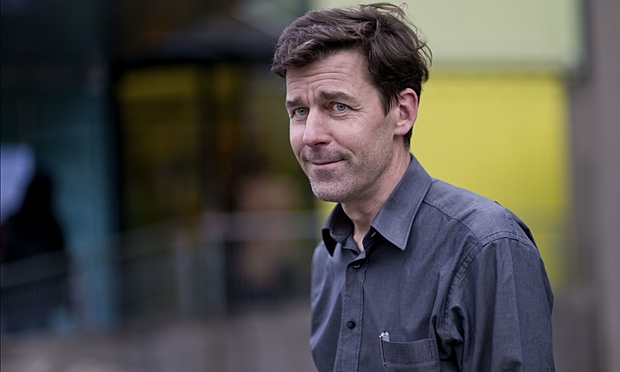
And that is as good a description as I can provide of this slight, in terms of page numbers, tome from Mr Stamm without giving too much away. He was the first wordsmith from his native land to be short-listed for the Man Booker so, despite the obvious possibilities, this offering from him is quite literary. It is a gem, in my view. Despite its brevity, it is beautifully structured and written. ‘All Days are Night’ still ticks all the boxes as a page turner. Opening with Gillian/Jill gradually emerging from a coma as a result of Mattias’ meltdown, Stamm first puts the back-story in place, then fast-forwards, in the second half, to the re-connection between the two main protagonists. Excellent stuff.

Peter-Stamm-009

Peter Stamm

Earlier this year I attended a showing of a local artist’s collection of nudes. I talked to the dauber for a while, but never bought myself to ask him how he found such a stunning array of subjects, prepared to disrobe for him, in a smallish place like Hobart. Did he need to go out into the Elizabeth Street Mall to find ‘real’ women in order to reach their ‘essence’ through his gifts with a paint brush. This book set me wondering about that question I refrained from asking again.

Two Australias

There’s no greater contrast in our land than between sun-bedazzled Sydney, on its harbour, to sun-blistered Broken Hill, on its slag-heaps where the bush gives way to the desert. As well, there’s also no greater contrast in our land as between the denizens who populate those two burbs. Our premier city has its fair share of suited and befrocked sophisticates as befits the cosmopolitan metropolis it has become. Contrast that to the knock-about, laconic blokes and sheilas of Silver City. And there’s no greater contrast between the pair of movies we have under the microscope here – Brendan Cowell’s ‘Ruben Guthrie’ and Jeremy Sims’ Outback road trip, ‘Last Cab to Darwin’.

last cab

Both, in this scribe’s view, have their faults But, overwhelmingly, both were highly respectable offerings in terms of quality. The cinema going punters thought otherwise, though. For an Oz effort the former wasn’t a complete disaster earning good dollars during its run – in the hundreds of thousands. But LCTD creamed it at the box-office with earnings now up above the three million mark and climbing. Although most of us reside in a coastal necklace of large cities, from ‘Dad and Dave’ to ‘Crocodile Dundee’ to ‘Last Cab’, give us a good yarn about bush yokels and we’re suckers for the taking. The Outback, don’t you know – that’s where the true-blue Australia is.

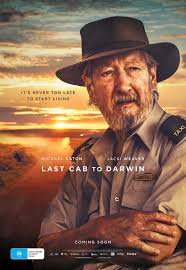
Ruben Guthrie is an ugly man, not a likeable fellow at all – and that’s perhaps the problem. Australians have adored Michael Caton ever since he added new phrases to our lingo in the magnificent Aussie battler tale of ‘The Castle’. The promise of another fine turn from him bought us to the multiplexes in our droves. We weren’t disappointed. He is superb as a guy at death’s door. He doesn’t want to do the hard yards to an unseemly, painful demise and who can blame him? In the period the movie is set the Northern Territory legislature had just introduced a law permitting us to put ourselves, legally, out of our misery – to have the same option as we would bestow on a well loved pet. For a nano-second, before Howard and his cronies decided it was their right to play god as pollies are wont, a government finally had the courage to stick its nose up at the far right and do the humane thing. It didn’t last long, did it? But it will happen, eventually.

As Rex couldn’t face a cruel death he, being a taxi driver in the Outback NSW town, took one last fare – himself. He’s off to Darwin in the hope of a gentler exit. What eventually transpires; the characters he meets en route and a stellar performance from the lead makes this such a rewarding experience – a beaut effort at the genre our local industry does best. No need to be all arty-farty. Leave that to the countries that excel in that. It won’t bring the average joe in. Stick to what we know and our film-making can be viable. This is one that’s all heart, with an ending that will make one leave with a smile – despite its subject matter. We can only hope that a few of our leaders view it and at least contemplate allowing us a choice in the way we would like out time to be bought to an end. Once upon a time we were the land of the fair go.

last cab01

There is a grim outcome for Rex, the cab driver, but there’s much joy to be had with Sim’s product here. The supporting cast are particularly fine, especially Nigali Lawford-Wolf and Mark Coles Smith. Jackie Weaver’s role, despite some critical displeasure, is okay as the euthanasia-ing, proselytising doctor. The aforementioned jack-of-all trades, Cowell, has a brief cameo and the other John Howard features. Even Bristle (Brian Taylor) gets a guernsey.

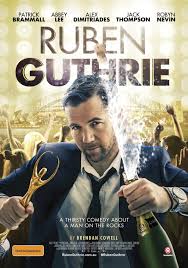
And the ‘…thirsty comedy about a man on the rocks’? It is also worth a bo-peep when it comes along on some small screen platform or other. Ruben is an A1 party animal, with Sydney’s hedonistic lifestyle giving him an immense playground in which to indulge himself in a sea of grog and other ingestibles. He possesses a palatial home, a European model as prime squeeze and he’s killing it in his advertising job. Trouble is – his life choices are also killing him. Eventually he wises up and sees the need to go on the wagon – but can he prevent himself from slipping off at the first whiff of a martini olive? It’s a journey he has to take – one that is never short of interesting as he battles his demons and as with Rex’s bull-dust adventures, there are interesting companions to meet en route. With competent performances from Robyn Nevin and Alex Dimitriades, as well as from the doyen, Jack T, who also puts in an appearance – plenty of life left in that old dog – the film is well served by its supporting cast. As is well documented about Brendan C’s own life, the film, as well as the play from which it derives it roots, is pretty much autobiographical. The question then is why didn’t he just play himself? Perhaps it was too close to home, but nonetheless Patrick Brammall is a perfectly adequate substitute – an actor starting to make a mark after his performance in ABC’s ‘Glitch’. He is initially convincing as a drunk out of control, before events conspire forcing his character to reassess himself as a person.

ruben guthrie

Worthy also of mention is the lovely work Sarah Blasko has done with the soundtrack (she must be just about due for another album). I liked ‘Ruben Guthrie’ As it was chosen to open this year’s Sydney Film Festival, I am patently not alone. But the people who really count – those lining up for tickets at the box office – well, they largely bypassed it.

ruben guthrie02

As LCTD did for euthanasia, so RG does for binge drinking. At the conclusion of the latter offering Ruben has to make a snap decision that so many in similar situation also have also had to face. Unfortunately, in the instance that Rex so poignantly highlights in his trip to the Top End, for those in similar circumstances today there is no choice now on offer. We have a bit of maturing to do as a nation.

‘Last Cab to Darwin’ website = http://www.lastcab.com.au/lastcab.com.au/Home.html

‘Last Cab to Darwin’ trailer = https://www.youtube.com/watch?v=VdzkJL37db8

‘Ruben Guthrie’ website = http://rubenguthrie.com.au/

‘Ruben Guthrie’ trailer = https://www.youtube.com/watch?v=iyaE_L3TghI

New Boy – Nick Earls

I remember ‘After January’ so fondly. Back then I thought the author was a new voice in the world of YA literature. It was a voice full of sunshine and zest from up in Mangoland to warm us all down here on an island much closer to the southern pole. Of all the hundreds of books I purchased in that year of 1996 for my school library, I chose to read that. Impossible to read them all, so there must have been something, perhaps on the back blurb, that attracted me to this new writer on the block – but I’ve been in Nick Earls’ thrall ever since. I’ve devoured every example of his word-smithery ever since.

Now Earls has successfully graduated to writing for adults as well. Graduated? That may imply that with the older the age-group as intended audience, the greater the skill set required. I prefer to think it operates in reverse. Not easy these days to engage with the younger brigade – but he does – and does it so well.

With ‘New Boy’, Earls is aiming at the late primary/early high school years – and he has produced a complete charmer. All the fun in it gave me much happy lol-ling.

earls1

It’s partly based on Earls’ own experiences as, recently arrived from Northern Ireland as a kid, he’s thrust into the hurl-burly world of an Australian school. There is the shock of the new for him, as well as for his classmates whom, he hopes, he’ll eventually get a handle on.

And it’s much the same with Herschelle in his book – with a name like that, even though it’s shared by a champion Protea cricketer (he’s from South Africa), he’s behind the eight ball from the get-go.

He was one of the cool kids back in Cape Town, but at this new place he’s grouped with the nerds – because he can only find a library habitue to befriend. Teachers and librarians all know these guys – invariably lovely students, but ones who also find the rough and tumble of the playground an alien experience. And Max is no exception – Earls has a most attractive character in this creation. He takes Herschelle under his wing – but soon his loyalty is sorely tested. You guessed it – there’s a bully involved.

Before he enrolled our pre-teen hero was quite gung-ho about going to school in Oz. He’d been on-line to a site detailing the subtleties of the lingo, as it’s spoken Down Under, to ensure he’d be hip. What could possibly go wrong then? Well the answer is plenty – ensuring a truckload of confusion and mirth. A kaffir lime causes all manner of outrage from the new arrivals to our shores. He resolves to rid himself of all Afrikaans-speak to become more at one with the locals – with mixed results.

Earls pushes the ‘difference’ angle for all he’s worth. The resolution of a few of scenarios the author conjures are hardly realistic in the world of teaching. This would all be over the head of the target audience so it matters little, doing little to detract from the sheer joy of the offering.

In my last years as a pedagogue I taught the age group the author has no doubt already entranced with ‘New Boy’. I know for a fact that I’d be ordering it in as a class set. It contains so many issues that one would initiate a teaching programme around – but the book never gets far away from just telling a terrific yarn to place a smile on the dials of young and old. Who knew that being asked to bring a plate along to a barbie would cause so much consternation for Herschelle’s mum – and the author’s?

earls_top_cropped_230x250

Author’s website = https://nickearls.wordpress.com/

Those Stairs

Trite and slight – it was a little film. I daresay nobody will have it on their list of the top ten for the year. This cinema lover certainly won’t either. It was eminently predictable with the two leads just going through their paces, producing the same shtick they’re renowned for. They have been doing it for decades now. It’s ending is a cop-out, but which of us probably wouldn’t make the same decision, given the circumstances – that is, to try and put off the inevitable just a while longer. There’s the corny sub-plot of a cute dog at death’s door and creating a sense of unease, there’s a terrorist on the loose in the neighbourhood. Hopefully it’s not too much of a spoiler to mention that nothing untoward happens to shatter the slumbery pace of this light effort from director Richard Loncraine.

five-flights-up-poster

Respected critic Philippa Hawker recently did a puff piece to promote the film, which in truth hasn’t attracted a great deal of kindness from many of her colleagues in the print media. She describes ‘5 Flights Up’ as a ‘…love letter to New York, and to the importance of connections to place.’

Alex and Ruth have aboded in the same Brooklyn apartment for most of their married years, but are now of an age, despite their love of home and the area they live in, where a change is of the essence. They cannot imagine hauling themselves up those stairs in their elevator-less building for much longer. They must engage in the process of finding somewhere else to live before their health collapses due to the strain of it all. Enter the vicissitudes of buying and selling real estate, represented by motor-mouth agent played irritatingly (on purpose) by Cynthia Nixon. She gets on the couple’s pip, not to mention the audience’s. Alex (Morgan Freeman) knows in his heart of hearts he should move, but is in denial. Voluble Ruth (Diane Keaton), is the mover and shaker of the two, worried about her hubby’s – well-being. He’s already had a scare. Obviously their union doesn’t raise a ripple these days, but back when they hitched it was unusual to say the least – as well as frowned on by many. They came together when Alex engaged her to pose nude – he’s an artist you see – just starting out back then, but now with some repute. She wanted to know why he chose her from however they did such a thing in the pre-on-line perusal age. There were many prettier girls listed she coyly claimed. ‘Because you’re real,’ was his response. That hooked her. The younger Ruth is beautifully played by Oz actress Claire van der Boom.

5 flights

And, for my money, there are few actresses who have graced our screens more beautifully than Diane K over the years. Remember how we all fell in love with her in ‘Annie Hall’. In her close-ups now there is the obvious weathering of age on her gorgeous features, but none-the-less she’s still a stunner. Long may she remain so.

5 flights02

And of course Morgan Freeman is simply irreplaceable in our world. In his next film he’s teamed with Alan Arkin, Michael Caine and Ann Margaret. Can’t wait for that.

But Ms Hawker is correct. New York, away from the Statue of Liberty, skyscrapers and street canyons, is charmingly portrayed. The city has never featured as a place pulling me to visit, but after ‘5Flights Up’ I could be tempted and I know I’d spend all my time in the land of Alex and Ruth. For all its faults, the offering is a loving homage to the real Big Apple and its real people.

Official web-site = http://www.focusfeatures.com/5_flights_up

The Paris Wife – Paula McLain

Once upon a time I read them – the monumental names of the preceding one hundred years. Hardy, Fitzgerald, Steinbeck, Greene – why, I even tried to get through ‘Ulysses’. And, of course, I read him – Papa Hemingway (the book in review tells how he received that appellation). But once I started devouring the fiction of my own times, eventually realising that was far more to my taste, the classics withered. It’s been decades since I picked one up – but I keep promising myself I will read ‘Gatsby’ just one more time.

Turning the pages of ‘The Paris Wife’ put me in mind of one of Woody Allen’s better movies of his later period, ‘Midnight in Paris’. Here the Owen Wilson character travels back in time to meet all the great men and women reshapers of modern culture; those who hung out there in that burb in the twenties. They populated the boulevards and Left Bank garrets, mixing in the intellectual ferment that would hopefully extend the boundaries of their artistic talent – when they weren’t carousing on the effects of various fermented beverages. This tome has them all too – Pound, Fitzgeraldx2, Stein and Joyce – amongst others. ‘Paris Wife’ is the story of Hemingway’s rise to prominence during his first marriage to Hadley Richardson.

the-paris-wife

This product from American writer Paula McLain was a popular success in her home country, topping the NY Times best-seller list. The critics weren’t so crazy about it though – one calling it ‘…cliche-ridden…And it moves ploddingly.’

We view the great wordsmith through Hadley’s eyes, so we do not really get the answer as to why a young man about town would choose to marry an older woman, variously described as unfashionable, set in her ways, conservative, thick – in both senses of the word – and tediously dull. Perhaps it was the stipend that came with her hand? They were together for six years – the Paris years. But when the bright and flapperesquely vivacious Pauline Pfeiffer crossed Hem’s path, her days were numbered. Evidently Hemingway himself portrayed Richardson in his writings in a much more positive light than she was in reality. It would be interesting to compare the two takes. It’s so long ago that I read his memoir ‘A Moveable Feast’. Maybe I will revisit it one day. The reason for his kinder approach could be that it would be too much for his quite immense ego to have been associated by marriage with such a dullard.

hadley and hem

Anyway, as we have already ascertained, Paris was the place to be for any aspiring writer, so off the wannabe novelist and Hadley scampered to the City of Light as soon as the necessary readies became available. There are no great revelations in in McLain’s semi-imagined account and it has probably been done better elsewhere. After all, Hemingway’s personal life has been chewed over for decades. But, for this scribe, the novel was always readable – it was far from the supposed ‘plod’ ascribed to it.

The author herself has had a few collections of poetry published, as well as her own memoir (Like Family; Growing Up in Other People’s Homes’). Her freshman novel was ‘Ticket to Ride’; her latest tells the story of aviator Beryl Markham. The author had a tough upbringing, being fostered out at an early age after the early departure (thus the memoir) of her mother and the criminal activities of her dad. At age twenty-four she enrolled in a class of creative writing, was hooked, found she had talent and away she went. ‘The Paris Wife’ obviously required a fair dollop of research and the book doesn’t shy away from Hadley’s shortcomings. But it’s hard not to kinda like Hemingway’s put upon spouse and we know the outcome of it all before we start. Her second marriage, to foreign correspondent Paul Mowrer, was far more successful.

Patently she was not up to the pace of life the great writer engaged in once he started to garner some fame. She was outshone by all his new found friends as they dashed back and forth across Western Europe – sometimes with her and their child Bumby in tow, sometimes not. There was, as McLain portrayed her, a certain steadfastness to Hadley that saw her stick to her husband for as long as possible as he, incrementally, became more selfish, flighty, fragile and besotted with the feminine allure of the literary groupies that started to hang off his every utterance.

‘The Paris Wife’ is definitely worthy of consideration for any wishing to delve back into those times, but also for something that is easily digestible. Throw in ‘A Moveable Feast’ and ‘Midnight in Paris’ – that would be all you’d need to get a handle on an era that will probably never be repeated.

paula mclain

Paula McLain website = http://paulamclain.com/

The Songstress and the Dauber

‘I love Angus like a blood brother…’

She was doing it tough, was Abbe May. The Bunbury born singer was in trouble. Mid tour, the musician had, in her own words, ‘…a stress seizure…I went from being high functioning, calm, collected, creative, optimistic and athletic to lethargic, depressed, anxious and easily panicked.’ It hit her for six, instituting unwelcome changes, not only mentally, but physically as well. She made it through, but it took courage, the support of family, a loving partner – and Angus.

Angus McDonald, a painter residing in NSW’s stunning far northern coastline township of Lennox Head, has been plying his calling successfully for over two decades now. As an artist, he states he ‘…continually seek(s) to understand more about the world through …(his) art than I already know and use that to build a story of my practice.’

Abbe-May

It’s no accident that his capturing of Abbe, for canvas, has gained nearly as much publicity as the magnificent painting of Michael Caton by Bruno Jean Grasswill in this year’s lead-up to the Archibald Awards. Travel through the ether to the Art Gallery of New South Wales’ website and check out the 2015 finalists – see which entrants take your eye. The Caton certainly did mine – we are probably attracted to figures we know – and it won the Packing Room Prize. But second to that it was McDonald’s take on Ms May. What a searing, revealing portrait.

abbe

Now, despite my pride in being reasonably up to date with today’s music, I’d only vaguely heard of Abbe May – proving I am perhaps deluding myself that I am in touch. But that is beside the point. Reading the singer’s back story on-line of what went awry in her world around the same time as she sat for the artist, it is easy to see that her recent struggles are reflected in his portrait.

Abbe’s affliction had seen her being admitted to hospital on several occasions as her immune system broke down. During this period she struggled to leave her house for any reason. Making eye-contact, at times, with others was beyond her.

Yet there is far more to the end-product that McDonald presented to the Archibald judges than her bout of mental illness – it doesn’t, by any means, define the picture. The singer tells ‘…, his insight and talent allowed him to see what I was feeling at the time…,I don’t find this portrait confronting…A friend could still see me and want to celebrate me. It shows in his portrait and I am eternally grateful.’

angus

I wanted to discover exactly why McDonald chose her as a subject or whether it was the reverse that applied. I was unable to ascertain that information although May describes him as a friend, as well as one of her favourite artists. She also relates that he appeared in her life just at the right time.

The painting moved me the first time I laid eyes on it on that web page. Reading its provenance only increases it specialness. At a time when the funding of the Arts is under threat due to the machination’s of one of Abbott’s ministers – a problem when a peon gets hold of the purse strings – the painting is a reminder of the power of art. It points to how it is so essential to have a vibrant cultural hub at the heart of any civilised nation. It is so vital to our communal health and well being, just as Angus’ rendering of her was to Abbe May’s.

Angus McDonald website = http://www.angusmcdonald.com.au/

Abbe May website = http://www.abbemay.com/

Abbe May YouTube = https://www.youtube.com/watch?v=Iq0yBgHlW6s