Category Archives: Book Reviews

Hunger – Roxane Gay

It’s a word, well, two actually, that should be chucked in the dustbin of unpalatable and unnecessary labels that consign added punishment to people who have been and still, in some cases, are sadly classified and defined by their connotations. Think ‘coloured’, ‘spinster’, ‘retarded’. Should the same happen to one so often cited as the epidemic of our modern society – ‘obesity’, with its big brother/sister, ‘morbid obesity’?

Roxane Gay, author of the remarkable ‘Hunger’, prefers the term ‘woman of size’. It, or ‘man of size’, has a better ring about it, doesn’t it? When beautiful daughter handed me this book I didn’t then realise its creator was the same person towards whom, back in May this year, an insensitive Mia Freedman (of Mamamia fame) caused a brouhaha by putting in the public domain Ms Gay’s list of requirements, on her part, to allow for the smooth running of an interview. Naturally the requirements were weight related. Related to Roxane Gay’s weight.

With ‘This is Us’ on our televisions screens this year, scooping awards right, left and centre, often it is Chrissy Metz’s role as the weight-challenged (???) Kate Pearson that is the most talked about around the office water station. With it and Ms Gay’s book, the world is seeing this issue from the point of views of women of size, rather that society’s hither too unfavourable perception of them. ‘Hunger – A Memoir of (My) Body’ is the literary equivalent of ‘This is Us’. Both Chrissy/Kate and Roxane get us to see modern life in a new light, with the restrictiveness it imposes on their ilk – the physical all too often leading to a negative impact on the mental.

The now accomplished wordsmith’s own journey commenced with a shocking act of sexual violence, impacting on her before she even reached her teenage years. As a result, to this day, her life has been an extremely taxing one and despite her latter day success, she still has her battles, as the Mia F incident pointed to. Prior to this book, recognition for her has also come from previous publications ‘Bad Feminist’ and novel ‘An Untamed State’.

The shame she has felt over the years should have been soul crushing – indeed it was at many stages. The shame forced her to try and hide or disguise a body she couldn’t control. It was the shame of it and the horrible transforming event of her youth that has so marked her attitudes towards sex, towards men and her love/hate relationship towards food. That a few good men and women have entered her life and loved her has been a salve to some extent, but she remains fixated on the one particular boy who so betrayed her at her most impressionable time of life. It is hard to imagine anyone ever coming to terms with such a repugnant act being perpetrated on one’s body. Being able to write about it, in such a brave and open way, hopefully has assuaged the damage somewhat. In ‘Hunger’ her chapters are short and sharp, succinct and often hard-hitting. That being said, it is an easy read even if, at times, the reading isn’t easy, if that makes sense.

Which brings me to the ‘…glaring, harsh, often cruel’ (her words) way reality television compounds the issues for those suffering with being what the producers thereof obviously consider as vastly over-weight. One of her best serves in this book is saved for ‘The Biggest Loser’ and its spin-offs, such as ‘Extreme Makeover: Weight Loss’, ‘Fit to Fat to Fit’, ‘My 600lb Life’ and ‘Revenge Body’. All this small screen dross only serves to encourage the trolls of this world who seemingly rejoice in inflicting as much pain as possible on women of size in their visits to social media. They also reinforce the view ‘…that self-worth and happiness are inextricably linked to thinness.’ The shows simplify an issue that is bound up in so much more than ‘how could these people allow themselves to get into the shape they’re in?’

Also revelatory is how so much this planet, despite the so-called epidemic, is not geared up to cater for those with larger bodies. Gay relates that even going out for a meal with mates is fraught with traps such as whether the seating can bear her weight and of course, the unpleasantness of other diners with their stares and tut-tutting over the amount of tucker she has on her plate. There’s also the ignorance of the fashion industry and retailers who rarely cater for women of size with anything remotely wearable, in stylish terms. This despite given these days a large amount of their demographic is plus sized. Attitudes are changing, but at glacial pace.

No, ‘Hunger’ is not a fun read for light entertainment, but it such an enlightening one. Kudos to Gay for having the courage to be the one enlightening us – and let’s hope the mass of humanity can become kinder to men and women of size.

Ms Gay’s website – http://www.roxanegay.com/

Drought in Oz, Drought in Maine The Dry – Jane Harper The Stars are Fire – Anita Shreve

Australia is the land of drought, but one doesn’t usually associate the far north-eastern state of Maine, in the US, with that climatic affliction. But a dry spell, with serious consequences, occurred in the autumn, or should I say fall, of 1947. The land became tinder arid, seeing forest fires break out, soon raging beyond control. 200,000 acres of the state burned, whole towns and half of Arcadia National Park were lost, as were the lives of sixteen souls. 2500 were rendered homeless. The events at Shreve’s Bar Harbor, in ‘The Stars are Fire’, put me in mind of the happenings at Dunalley, in the south of my island, only a few years back. In fact, the scenario the author conjures of the ’47 conflagration with the Holland family sheltering on the beach bought back the iconic image of a mother and her children, attempting to escape from the flames in armpit deep water, under the little Tassie town’s jetty. That family survived; as did Grace Holland and her little ones, but only just. The effects of the drought and the resulting wildfires are, though, the main focus of the novel. Throughout we wonder what happened to her ‘difficult’ hubby. He was on the other side of the town fighting back the flames. Gene was last seen walking towards them as his colleagues fled. Naturally everyone assumes he perished, but no body was found. So Grace gets on with her life as best she can. A caring doctor and a mysterious piano man enter her orb as romantic possibilities – and then the unthinkable happens.

As with all Anita S’s output, ‘The Stars are Fire’ is immensely readable – it should be, she’s been successfully at it for long enough. It’s just not one of her best – it does stretch for plausibility as we wait for what most suspect will come to pass – and it does. That doesn’t mean it rings true.

Sadly Shreve is battling cancer and not for the first time. She trusts she will again beat it, but she was unable to travel to promote this, her latest work. She has been a reading staple of mine for decades so fingers crossed she survives to write on.

Jane Harper, in contrast, has just one novel to her name – but what an impact it has had. It’s won awards, been optioned by Hollywood and published (or about to be) in, at last count, twenty overseas countries. It’s truly a rip-snorter. It is perhaps not the greatest example of wordsmithery going around, but it is a yarn this reader couldn’t put down from get-go to last paragraph. One reviewer likened it to Peter Temple’s ‘The Broken Shore’ or Garry Disher’s ‘Bitter Wash Road’ as this country’s great crime novel of recent times. As I haven’t read these, I’ll throw in Craig Silvey’s ‘Jasper Jones’ or, another stunning debut, Holly Throsby’s ‘Goodwood’. Both are set, like ‘The Dry’ in parched and thirsty country towns.

In Harper’s offering it’s Kiewarra, ravaged by an endless drought, with the local men and women on the land at their wit’s end about how they’re going to make it through till the rains come. One, Luke Hadley, guns down his wife and all bar one of his kids before putting a rifle to his head in a paddock. It’s thought to be a cut and shut murder/suicide – that is until city cop, Aaron Falk, turns up for the funeral of his childhood friend. He starts digging and it all doesn’t quite add up. As far as the locals are concerned he already has a cloud over his head. You see, he too was once a local and left town after another of his former mates, this time a girl, disappeared in mysterious circumstances. It again is a presumed suicide. Before long there’s a whole range of motives and possibilities concerning the two, perhaps in some way, linked events. Our jaded (aren’t they always?) returned policeman tries to nut his way through it all and eventually a culprit emerges, but it’s an enjoyably convoluted process. Just when you think he’s nailed it, up pops another prospective murderer. I must admit I didn’t pick it – but looking back there were clues dotted along the way.

This is a story well told and in Aaron Falk Harper has a protagonist worth a few more whodunits. Her sophomore publication, ‘Force of Nature’, due October ’17, again features Falk investigating the disappearance of a whistle blower. As for Harper, I reckon she will become a real force of nature herself on the Australian writing scene.

Anita Shreve’s website – http://anitashrevebooks.com/

Jane Harper’s website – http://janeharper.com.au/

Life in a Fishbowl – Len Vlahos

Wasn’t sure about this one. It’s a novel where one of the main characters, Glio, is an anthromorphised (whatever that means) high grade glioblastoma (thus the name) multiforme. In layman’s terms, a brain tumor. He’s (?) feasting on Jackie’s dad’s memories, eradicating them as he goes. Nope, it didn’t seem my cup of tea at all reading the back cover blurb. But, as my Katie recommended it – and she’s usually correct when it comes to what I will and won’t like in YA, I gave it a go. In the end I didn’t find ‘Life in a Fishbowl’ either ‘acidly funny’ or ‘heart-breakingly sad’ as said blurb promised I would, but my beautiful writerly daughter was right again. I did enjoy it, was through it in no time (for me) and that’s a sign of a good read.

And I’d like to say that I am quite jealous of this tome’s author. It’s not for being an American (he’s from Colorado actually) these days. Certainly not, but Vlahos not only has won kudos as an up-and-coming wordsmith for late teens, he runs a bookstore to boot – these are the bits that turn me green! Perhaps that’ll be how I’ll come back.

Now a review of ‘Life in a Fishbowl’ would seemingly give a great platform to rail and fume against the dire state of our respective nation’s reliance on the reality genre for much commercial television network programing. It requires the viewing public to become hooked on the humiliation, misery, stupidity or simply the lack of decency in others. It’s cheap and can be nasty. But I’ve riffed on that theme more than enough in recent times. In this book an unscrupulous tele-exec, Ethan, is at the centre, turning Jared Stone (Jackie’s father) and his final cancer-ridden days into television fodder for the masses in the most reprehensible manner. Jared, his mind unable to work too far into the implications of his decision to cooperate, does it to give his loved ones future security. Said family members reluctantly sign on too – they soon wished they hadn’t. Feisty Jackie immediately proves herself more than a match for the odious Ethan – he, for a time, bathing in the glory of producing America’s top rating show. But we all know he is going to come a cropper. In causing this, Jackie’s assisted by a Russian nerdy whiz-kid who soon transforms her into a darling of social media.

One review I read reckoned Glio was the character in this that ‘...shines through most vividly’ as he provides the family’s back-story whilst chomping away on the memories Jared treasures the most. To me this device was so far beyond reality I found it mostly annoying, but not to the degree it detracted from an otherwise engaging tale. There’s much to recommend Vlahos’ effort here, not-the-least of which is that it gets us pondering on the dilemma of assisted death. This is an issue our nation is well behind the eight ball on compared to other more humane and compassionate societies. Books like ‘Life in a Fishbowl’ could help direct change.

The penny dropped for author Len V, struggling to write a novel for his own generation, when his wife asked why his obviously very worthy YA manuscript had a forty year old main protagonist. His re-drafting of it produced ‘The Scar Days’ and its follow-up ‘Scar Girl’. For his next publication, working on how Trump has divided the US, he’s re-inventing the Civil War, moving it to the near future where the coastal states battle it out against Middle America – the east and west littorals voted Hilary, the centre the Trumpster. Fingers crossed it doesn’t happen in reality as Donald seems intent in causing enough mayhem elsewhere in the world.

The author’s website – http://www.lenvlahos.com/

City of Friends – Joanna Trollope

For 76 year old Ms Trollope it must be akin to an older woman hard at work with her knitting needles, constructing yet another sweater for one of her umpteen family members or friends to see him or her through another winter. It’s done with love, but she’s been doing it for so long, that old darling, now into her own autumn years, that it’s almost rote. But, such is her skill, no two sweaters are exactly the same – there’s enough to differentiate this one from the countless others. There’s no pattern book spread out in front of her, it’s all done in the mind and it is always genuinely welcomed by its new owner, as have all those that have come before it.

For this reader and fan, delving into this title, Joanna Trollope’s twentieth, is akin to enveloping oneself in that knitted sweater for the first time. The reader/wearer knows it was put together with immense affection for him/her and despite being of the same basic material, it is known it will be of immense comfort during the days that lie ahead until winter, or indeed the novel, is finished with. Trollope tomes are brim full of that comfort and are never a demanding read by any stretch – sorry, there’ll be a few puns en route here. There are always underlying issues to be mulled over, but nothing too taxing as her characters, give or take a few foibles here and there, are usually pleasant people to be with. Why, they could be me or you.

There’s not a wide variance, therefore, between Joanna T’s best and worst. ‘City of Friends’ would sit somewhere in the middle and yep, it is exceptionally snug and congenial. It is one that will welcome you back into its pages, keeping you happy and content as you make the journey from cover to cover.

The titular city is London. The friends are Stacey, a high flying exec with an equity firm; Gaby, an investment banker; Melissa, a management consultant and Beth, an author and expert on human relations in the business world. And it’s very much work that defines these ladies. But having known each other since they were trail blazers, entering the hitherto male domain of studying economics back in the day, they are starting to find that, just when life should be going swimmingly for them after all the hard yards, their forties are not exactly turning out to be all beer and skittles. One has to cope with a hubby receiving a promotion on the very day she’s given her marching orders. She is fired for requesting more flexible working conditions. Another of our ladies is about to encounter stormy seas in her relationship with her younger same sex partner. One, partner-less, has to cope with her son reuniting with his birth father. The fourth major protagonist has a crisis of conscience at the situation one of her mates finds herself in, the other being reliant on this pal to exit her from potential penury

As we have come to expect from this seller of over seven million copies of her books over the years, Trollope manages to weave it all together so seamlessly there’s not a stitch out of place. The world will change for several of the quartet as they spread their wings to embrace new directions, once various crises have been averted or even succumbed to at first, but then conquered.

Despite the massive strides women have made for their betterment last century and into this one, we all know it is still hardly a level playing field. No matter how well educated or successful, they still have to struggle, whereas the male of the species sails through. The sewing together of career, marriage and motherhood remains fraught and few manage to do it all without some personal cost to one at least of those areas of life. This is the plight that is at the nub of Trollope’s oeuvre. Given that, the males involved here are also mainly sympathetic beings, despite one in particular being a really silly drip. The only truly odious personage is female – a manipulator trying to drive one of our career girls out of her home.

Twice divorced Trollope has plainly had her own tangles in life, but we trust she can continue to ply us with these sweaters of novels as they are generally purlers. She has, for decades, been casting them off, these darn good yarns (I know, cringe-worthy puns she would never stoop to) for many years to come.

Ms Trollope’s website = https://www.joannatrollope.com/

'A Common Loss' 'Hold' – Kirsten Tranter

‘When you are introverted and the person with the head in the book you are the observer.’

In my head I have a rough bucket list for the years I have remaining – mainly consisting of places I’d like to see, or experience, before I die. I know most of that list will never be realised and I can’t say I’m losing a great deal of sleep over that fact. If they happen, great. If not, well, so be it. But I can guarantee one sojourn that would never be even remotely figuring on my wish list and that would be to visit Las Vegas. Imagine – Crown Casino a hundred times over. That would be my notion of hell. From what I can discern it is, more or less, a plastic, artificial, hyperactive 24/7 abomination in a desert wasteland. Reading Kirsten Tranter’s ‘A Common Loss’ only reinforced that view.

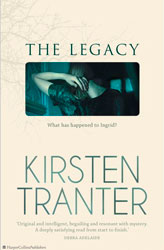
I read this bi-continental author’s first tome, ‘Legacy’, long after it was first published, more than a decade ago – and I was mightily impressed. It centred on the death of a young Aussie lass in the US; presumably a victim of the September 11 attacks. For some back home that explanation wasn’t quite enough, resulting in a Sydneyite devoting herself to a bit of sleuthing around NYC to find what really happened.

Tranter’s world had also been affected by death before the scribing of that novel, losing two souls she was close to. And death also features prominently in the two follow-ups to her novice product, ‘A Common Loss’ and her latest, ‘Hold’.

For this Sydney raised writer, now a resident of California due to her marriage to an academic tenured there, the death of a mate again forms the fulcrum to her sophomore publication. Unlike ‘Legacy’, which moved back and forth across the Pacific, this one is set entirely in Trumpland; for the most part in the gambling capital of the planet. Four friends, tied to each other from way, way back, are continuing on with their tradition of having an annual blow-out in Sin City. This year, though, it is a little different – they used to be five. The gel that held them together, Dylan, is missing – recently killed in a traffic accident. This also bought back memories of another near death experience for them involving an automobile bingle avoiding a deer – one that also was not quite as it seems. As it turns out, it’s just one of the issues the group have had that needed Dylan’s ability as a fixer to sort out. All these secrets do come back to bite the foursome on the bum as mysterious envelopes start to arrive during the Vegas stay. Seems Dylan had a few secrets of his own too. For Elliott, our narrator, matters are complicated by his developing feelings for the only female to be invited along on any of their reunions. She diverts him from his mates and from sorting out the major conundrum that arises.

It’s a sign of a competent writer that Tranter can maintain a connection with the reader despite the latter being unable to form any affection for a single one of the participants involved. In this there is a whiff of ‘The Slap’ about it, but despite her formidable wordsmithery, she doesn’t quite pull if off as well as Tsiolkas managed. The novel also dips it’s lid to Tennyson’s ‘In Memorium’. It would be an overstatement to say that ‘A Common Loss’ is as arid as the desert surrounding the city it is set in – Tranter is too good a writer for that, but of her three offerings, this would reside at the bottom of the pile – a pile that I hope will much heighten, given time.

To my mind ‘Hold’ made for a better product with a more accessible selection of protagonists. Here she returns to Oz to tell the tale of former artist Shelley who, three years previously, had lost her soul mate, Conrad. He went surfing one day and didn’t return. Now she and her new partner have just taken possession of a Paddington pad, semi-detached, as our heroine tries to put her past behind her. She soon realises that, despite a new man, she is still grieving for the loss of her former lover. Then two mysteries enter her life. Firstly she becomes drawn to a guy who so resembles Conrad it is uncanny. Then, on opening a closet, she notices a door which, after some difficulty, she manages to open. She is soon stepping into a secret room. It is just the place to provide her with a refuge – and a comfortable location to have her way with Conrad’s doppelganger. It’s all very intriguing. And where do her neighbours fit into the picture as far as the room is concerned and just how real, in fact, is her mystery man? And then there’s her new partner’s daughter, a stroppy teen, to worry about developing a relationship with.

The author is the offspring of esteemed poet John Tranter and a literary agent mother. Kirsten grew up surrounded by her parent’s friendship group of artistic types. She was shy and as time went on, she became increasingly anxious in dealing with social contact. As an adult she has had sessions of therapy, but as the opening quote suggests, she has also developed acute powers of observation which she puts to excellent use with her writing. Tranter is now a fine practitioner of weaving the written word into engaging narratives. ‘Legacy’ quickly established her credentials. That her more recent oeuvre has not quite matched her first up effort does not matter a jot. I will stick with her.

The author’s website = http://www.kirstentranter.com/

Kirsten Tranter, Author

Goodwood – Holly Throsby

I imagine Goodwood would be something like Bridport. These days, after my home location by the river down south, it is well and truly my favourite place on our island. That, my son, with his lovely partner and my mint new granddaughter, live there is part of the reason – but not all. There’s more to it than that.

Of course there are differences between the two towns. Briddy is a two pub affair, Goodwood has just a single to slake the thirst of the locals. The former comes alive during the summer months, but for the remainder is a sleepy place, like Goodwood year round. My son’s town sits on Anderson Bay, the fictional locale on a lake. But it’s the feel of these places – they’re welcoming and close knit. There’s neighbourliness like you do not get in suburbia or with inner city living. And there’s nothing much that happens that doesn’t reach the ears of the denizens of each. Most would reckon they had a fair handle on each other’s business – mostly a blessing, particularly when times get tough.

But over the course of a couple of weeks, back in ’92, all that changes for Goodwood with two local identities disappearing in quick succession – both seemingly without a trace. It’s up to the town’s copper, Mack, to sort it all out, find them or give some closure on both if the unthinkable has happened. What has become of Rosie, the gorgeous young lass who works at the fish’n’chippery; or of Bart, the local butcher – a jovial fella with a heart of gold?

Jean, our narrator, is looking back from the present to this tumultuous period for the town – events occurred that threw her young adult years out of kilter. She stumbled across a clue that she figured may have been linked to the whole business, but what to do, what to do? And not far away from Goodwood, to increase the tension, some backpackers have disappeared as well in a certain forest. We all know how that turned out.

Goodwood is the fictional creation of Holly Throsby who, up until its release, has been better known as one of our leading singer songwriters, as well as for being the daughter of much loved media personality Margaret. The novel was a project for Throsby while she was off the road expecting her her first child Alvy, now two. And the book really is a stunning debut and I am not alone in ranking it on the same level as Craig Silvey’s classic small town drama ‘Jasper Jones’ (can’t wait for the film of that title coming soon).

As with that book, Throsby’s in no way hurries to put the pieces together. Although the pace is leisurely it is a cracking read – for me a page-turner of the first order. Apart from the town’s mystery, there is much else on young Jean’s mind – her mother’s chest pains, just what exactly is her relationship with the lad who loves to stare at cows and then there is the new girl in town, Evie, whom she’s not quite sure about.

As with my Bridport, one of the main activities in the place is fishing – and this figures huge for a place like Goodwood as well. Both towns are full of eccentric characters and maybe a busy body or two, as with most communities of that size. And no doubt there are secrets to be found behind closed doors – but for the fictional town many of these are exposed by the jittery times after the disappearances as Mack starts to make headway with his investigations. Maybe the two are linked in someway.

I was pleased to read Throsby is now working on her sixth album. But even better news is that she’s making headway with her second novel. Shes really off to a flyer with ‘Goodwood’ and hopefully the longer form of writing will not remain for long the second string to her bow – as good as her music is.

Holly’s website = http://hollythrosby.com/

Full Bore – William McInnes

Crocs. I mean crocs as in footwear. Now here’s a fact about them you may or may not know. They are banned at my local casino here in Hobart. And that’s not the only place. Seems the local council responsible for keeping the natives in an acceptable state of dress have banned them in the little seaside resort of Bridport. How do I know? Well, my son told me so. I was visiting him and his lovely wife and we were preparing to saunter down the aptly named Main Street to the pub for a counter meal. When I emerged, casually dressed for the occasion, my son pointed to my comfy crocs and stated, ‘You can’t wear those down the street here Dad’. Well, who am I to flaunt what are obviously local regulations, so I quickly changed into sandals, which it appears the local governance have no objection to whatsoever.

So I guess there are those who are not as enamoured of crocs as footwear as I am – and author William McInnes. And it is thanks to him that I now have perhaps a handle on the origin of my love of them. He claims his comes from the fact that, back in the day, come summer, thongs were his main foot apparel – and that was the case for me too before age and common sense caught up with me. Here’s the man himself on the subject – ‘My love of thongs probably led to my affair with the much maligned crocs.
I love a pair of crocs; weird, clunky bits of foamy whatever they are, they were originally designed as a spa shoe. Well, that says it all. My mother called them ‘formal thongs’ and I have committed many footwear sins with crocs.
I wore them once to an awards ceremony, simply because I forgot to have them on. Too comfortable by half.
A word to the wise: they’re not very functional in wet weather, especially when you run out to the bin in early morning drizzle trying to catch the rubbish truck.
Slipping is an understatement. I went Torvill and Dean-ing down the footpath as if the bin and I were going for gold in the pairs figure-skating.

And like slipping one’s feet into a cherished pair of crocs, dipping into a new William McInnes memoir is like returning to an old mate who will give you value for money. As with ‘A Man’s Got to Have a Hobby’ and ‘Holidays’ before it, ‘Full Bore’ entertains with a cycle of yarns that are sometimes thought-provoking, sometimes poignant, sometimes full of love for fellow humanity and invariably chortle-inducing. These days, like my trusty (except in stormy weather) crocs, you know what you’ll get with this fellow and he delivers in spades.

His tales commence and finish in an auction house, as is entirely suitable as McInnes was once host of an ABC series with the moniker ‘Auction House’ (2012). A friend of mine happened to be producer of that series and relates that WMcI was a bit of a funny bugger to be around, with this sure reflected in his wordsmithery. I reckon my old Dad, had he still been with us, would have loved his yarns. Now my father was a dab hand at the old bush art of brewing billy tea and would have had a giggle at Will’s own dad’s attempt at the dying art – ‘He picked up the tea towel, carefully folded it over a few times and wrapped it around the billy’s handle and said casually, ‘Show you a trick to get a good cup of tea.’
My mother looked up from distributing egg sandwiches with a slightly anxious note, ‘Colin?’
‘I know what I’m about love.’ He stood, carefully, positioning his legs wide apart and staggering them slightly with his front leg bent at the knee.
‘Watch yourself,’ he said with a look at us, and then to himself, ‘Here we go.’ He slowly started to turn his stiffened right arm around in a full circle, and the steaming billy went with it.
‘Colin!’ my mother said again.
‘It’s right, don’t bend the elbow, that’s the trick!’ grunted my father. He kept rotating his arm and then for a bit of fun, I think, he went faster and faster. The billy became a blur.
‘Colin!’ my mother shouted.
‘It’s right!’ my father yelled back happily.
‘It looks like you’re about to take off!’
My father giggled and was about to speak back to my mother when something did take off – the billy.
‘Christ almighty!’ yelled my father and staggered forward in little steps, the handle of the billy still wrapped in the tea towel clutched in his hands sans the billy.
‘Lift off!!’ cried my mother and we kids ran screaming in all directions as the billy soared up into the air with a graceful arc; courtesy of the handle giving out at the bottom of one of my father’s great swings, and landed in the carpark with a thud as it spat tea everywhere.
After that tea-bags, and occasionally coffee, were taken on the picnics.’
I bet my dear old Dad would not have ever made such a schmozzle of it as Will’s father did in the early pages of ‘Full Bore’.

Further into the memoir there’s both poignancy for himself and his brother involved as their mother approaches death – ‘On one occasion I walked into her room and a sister on a pastoral visit sat beside her. I thought my mum was sleeping but the sister smiled up at me and waved a little and then said to my mother gently, ‘Iris, your son is here.’
My mother didn’t move.
‘Iris?’ said the sister again, just as gently, but a little louder.
I looked down at my mum, a big wonderful woman, not always perfect, sometimes shy and prone to quick judgement, but always there whenever any of her children might have needed her.
The woman whose arms had held me, whose voice had soothed me and whose love had surrounded me all my life, now diminished and stricken in bed.
‘Iris,’ said the sister again. ‘Your son.’
My mother’s mouth opened slightly and she said, ‘Is it the fat one or the stupid one?’
The look on the sister’s face I will always remember, it was all she could do not to laugh, a hint of a smile was there as she just as quietly and gently, while keeping her eyes on me, ‘I’m not sure, Iris.’
My mum’s head slowly turned and one eye opened and took me in and then she sighed. ‘Bound to happen, the stupid one’s gotten fat.’

I loved it when he got into the sharing of music with his daughter – something that I adore doing with my own treasured, beautiful, writerly one – My daughter said something. I didn’t hear. I kept driving and she said something again so I nodded.
Music began to play. The music from my daughter’s phone was booming through the car’s system. Music collected from her life. I drove along with traffic on the freeway…
The first three songs were all Beatles; she sang along with them. ‘Love Me Do’, ‘The Ballad of John and Yoko’ and ‘Revolution’. ‘This is really good, this one,’ she said as ‘Revolution’ howled away…
‘Really good,’ said my daughter, bopping away beside me in her school uniform.
Next was Florence and the Machine. Then a UK Squeeze song, ‘Another Nail in My Heart’. I sang along with her. She laughed and then clicked ahead a bit and it was dear old Mental as Anything with ‘If You Leave Me Can I Come Too?’ I laughed.
‘Your mum and I loved this song.’ I told her.
‘I know,’ she said.
Then a group I didn’t know.
I said this to my daughter and she laughed. ‘Of Monsters and Men.’
She clicked again and let me have a Dean Martin. ‘On an Evening in Roma’.
We sang along, the way her mother and I used to.
‘You can hear his smile,’ said my daughter.’

My daughter is about to have a rite of passage for every mother when, in a few weeks, our beloved Tessa Tiger, with much anticipation and excitement, will pass through the gates to her first school day. McInnes has that covered too – ‘I remember walking her up to school. She was wearing the big, green broad-brimmed hat that barely stayed on her head and, just before she walked into the assembly hall, holding my hand so tight I thought she might break something, she looked up to me and gave me a little smile.
Then she let go and disappeared into the lines of children who all looked like green-topped mushrooms in their big hats. I looked at my hand, at the marks her little nails had made and, by the time I was halfway back down the street the marks had disappeared and I felt a little odd. Not sad, but as if some part of my life was changing, as if something had left.’

At one stage he gets on to dead people – the ones that have left an imprint on our collective lives, such as the many who left us during the last twelve months. He riffed on the touchstones of further back such as John Wayne and Bing Crosby. But for William, perhaps the one who meant the most was fellow Aussie thespian Wendy Hughes who passed in 2014 – ‘As he stalked off down a tunnel to obscurity (in the film) Wendy Hughes gave a wonderful, unexplainable look of love and admiration towards him and said in her warm, lovely Australian voice, ‘He’s just old-fashioned.’
At the age of thirteen I thought her beautiful and smart and strong, and I hoped somewhere in my adolescent dreams that someday someone would say something like that about me… somehow that moment on screen buried itself deep in my mind. Perhaps it was the look she gave, perhaps it was the film. Perhaps it was just a moment.
At a friend’s party one New Year’s Eve (much later) I met Wendy Hughes. ‘Met’ is too big a word. We were both introduced as we headed in different directions.
Wendy Hughes. Nineteen seventy-eight was a long time ago by then, but when she turned to me and said hello, I just stared, a little in shock. And then said, like a loon, ‘Good evening.’
Wendy Hughes laughed and looked a bit surprised at the formal phrase, especially on New Year’s Eve.
My friend said, ‘You’ve got to forgive William, he’s from Queensland.’
Wendy Hughes looked at me, smiled, and said, ‘He’s just old-fashioned.’
I don’t mind admitting, I nearly cried.’

It’s all lovely, lovely stuff, like the extracts above. I admit I’ve used William’s own words to compliment his work in ‘Full Bore’ rather than my own praises – but I think it speaks for itself. So if you’re in the market for a bonzer yarn-spinner of the laconic Aussie variety you’d be hard up to better this guy. He can produce belly laughs and tears of sadness on the same page such is his magic. He has the knack. He makes the ordinary and everyday for those of us, lucky enough to live in this wonderful country, simply extraordinary.

I Don't Like Cricket, I Love It

‘Selection Day’ – Aravid Adiga and ‘The Rules of Backyard Cricket’ – Jock Serong

Once upon a time a tranny had a different definition – short for one’s transistor radio. In days of pimply yore I’d take my tranny with me everywhere. Usually it was tuned into Melbourne radio station 3UZ as it supposedly had the very latest in hit music. On Saturday arvos it would be the local 7BU when the game from West Park would be called, even if I was actually present at the ground. I often was, even in the foulest of weather, with sleeting rain and a gale blowing in from the west. But during the summer months the dial would be on 7NT, the Launceston ABC broadcaster, because 7NT had the cricket. At the beach, playing tennis or down the wharf fishing, the background would be McGilvray telling my mates and myself, in his authoritarian tones, about the action from the WACA, the ‘Gabba or the ‘G. Of course, back then it was only test match cricket. Did NT carry the Shield? I cannot recall, but probably not, as Tassie was still a long way off participating – and also it was well before the Packer schism that introduced ‘hit and giggle’. And don’t get me started on the travesty that is twenty20 – but I guess they both serve the purpose of introducing fresh punters to the game, some of them, hopefully, rising above the short attention spans required for those formats to the more cerebral world of the real game. Of course I jest, but back then I was addicted to test cricket. I have no idea why. My family weren’t remotely interested. Maybe it could have been from the enthusiasm of a pal, but I think it more likely it was the fact that, even as early as those far away days, I was an avid newspaper reader. For half a year cricket would dominate the back page of the Advocate, the local footy for the remainder of the year – yes, local footy, the VFL relegated to somewhere inside.

What ever the cause, by the time Simpson and Lawry were opening for Australia, I was hooked. I subscribed to a monthly cricket mag, purchased books on the history of the game and when not out and about with my tranny, I was fixated on a grainy black and white small screen of the ABC’s very primitive coverage of the tests – that is, compared to today’s whizzbangery and ultra-analysis). Yes! The ABC! Imagine cricket without the ads – what bliss.

So let us fast forward to today then. It’s all changed. It’s not that I have completely lost my love of it, it’s just the time it takes out of one’s life to watch a complete test as used to be the go for me. As my life span becomes shorter and shorter, it seems reprehensible to give up all these hours to focus on a game. My lovely Leigh is no fan, so it would never be a shared pursuit – me valuing so much my time spent with her. Now I simply follow it on a hand held device at intervals, turning to the tele if there’s an Aussie century or hat trick in the offing. Even my former habit of devouring the cricket reports in the Age has lessened. I always loved Peter Roebuck’s assessment of a day’s play, but now he’s gone. And on the airwaves, no more do we hear Kerry O’Keefe’s chortle. It all just doesn’t seem quite the same.

So when I was alerted (firstly by Leigh, secondly by said Age) to that fact of not one, but two, fictional tomes being published with cricket at their centre, off I went to Fullers to make purchases. Maybe, deep down, I was hoping they might reignite the spark in me.

Synchronised publishing dates were not the only aspect the two books had in common. Aravid Adiga’s ‘Selection Day’ and Jock Serong’s ‘The Rules of Backyard Cricket’ both featured the tales of two brothers, the first Indian, the second pair home grown. These cricketing wizards had immense talent as potential stars for their respective countries, but only one brother was seemingly in it for the long haul – the other being too wayward to knuckle down. The Indian book is very, well, Indian, putting the committed sibling to the fore; the Australian one focuses very much on the larrikin brother. Both publications had a fair bit going for them, but as to which won the test, it was the Aussie effort hands down.

And I’m not the only one to hit on the notion of casting my opinion on the two novels in the one piece. Katharine England had the same idea, writing in the Mercury’s Saturday Magazine. She describes ‘Selection Day’ as the ‘messier’ of the two – and I can only concur. She is one-up on me, though, as she has read the author’s other works, most notably the Man Booker winning ‘White Tiger’. She reckons this one is his least ‘coherent’ to date.

Both books start off with the cricketers as children, relaying their battles in the dusty parklands of Mumbai or the backyard of an Altona home. Manju and elder brother Kumar are motherless and dominated by their driven father. He insists that everything else should be secondary to perfecting their prowess with the willow as a means of escaping the poverty cycle. Eventually the boys are ‘sold off’ to an unscrupulous mentor who is attempting to produce India’s next Gavaskar or Tendulkar. The elder of the duo, although perhaps the most prodigious talent, eventually falls by the wayside, but Manju presses on in an attempt to be the chosen one come selection day. But he has another tedious issue to contend with and that is the nature of his sexuality. Will his attraction to another star in the making, this one of Muslim persuasion and attracted to the wilder side of life, be his undoing? And can he wriggle out from under the thumb of his dad and the shady business men who hope to make copious coin if success comes his way? And as in the case of Serong’s tale, somewhere on the periphery is the modern day cancer of the game that will not go away – match fixing.

In ‘The Rules of Backyard Cricket’ it is the younger brother who is at the core of the work of fiction. As it opens he’s trapped in the boot of a car heading, he presumes, to an isolated place of execution somewhere down the Geelong Road. The novel alternates between Darren Keefe’s improbable attempts to escape his predicament with a review of his career to show how he eventually came to be in that dire situation. I suppose, if you combine the more outlandish boganisms of Shane Warne and the talent unfulfilled of Glenn Maxwell, then you have some idea of what the younger Keefe is all about, that is, sex drugs and some rollicking good times. For older brother Wally, perhaps read AB or Steve Waugh – more stodgy at the crease, seemingly able to do what Darren cannot for all his gifts – to dig in in all aspects of life. Wally gets to wear the baggy-green and rises high – but tragedy strikes both brothers. Darrren loses part of his anatomy, which restricts his game, but Wally’s loss is far, far worse. As we follow this tale it seems both brothers are getting what they deserve – but there’s a twist. Hints to it are given sparingly by the author, it is true; but how the mighty fall.

Serong’s first publication was the award winning ‘Quota’. He’ll perhaps never reach the stratospheric heights of Adiga, but it was his rip-roaring yarn I far more enjoyed. It was also my first book of a mint new year whereas the Indian’s was like so many I read in ’16 – plenty of promise but ultimately disappointing – a bit of a slog. Serong’s I eagerly digested in a few sittings as I raced to see how it would all pan out.

So sadly the tests have finished for another year and the Big Bash is in full swing (poor pun – sorry) with the hit-and-giggle about to commence – ho hum. But battling those magnificent Indians in tests on their home turf is another matter. The Aussie won this little affair of the cricket books – I have my doubts whether our lads will do the same on the tour – but bring it on.

The Blue Room's Year in Books 2016

This year there wasn’t, to head my list, the stand-out tome like last’s year’s ‘The Illuminations’ from Andrew O’Hagan, ’14’s ‘Analogue Men’ (Nick Earls) or Richard Flanagan’s truly remarkable ‘The Narrow Road to the Deep North’ the previous year. Over the last 12 months I seemed to have embarked on many titles I really struggled to get through, but persevered with and found I really needn’t have bothered. Still, there were some gems that certainly gave me much pleasure. So here we go:-

1. The Road to Little Dribbling – Bill Bryson – a joy from go to whoa as Bryson makes his way around a Britain far different from the one he delighted us with his first journey to his later adopted homeland. As is his way, he ruminates on all and sundry en route and there are many laughs to be had as well. Thanks Nan.

2. Modern Love – Leslie Harding and Kendrah Morgan – this couple give us an engrossing account of life at Heide, the home and artistic retreat outside Melbourne of John and Sunday Reed. The inter-relationships between the various artists who lived there, before and after the war years, more reflect modern attitudes, thus the name, than the social morays of the period.

3. Another Night in Mullet Town – Steven Herrick – the master of the YA verse novel is in typical form in this short delight. As with his 2011 ‘Black Painted Fingernails’, he has yet again enchanted this reader with his skills in a book that deserves a much wider readership than its target audience.

4. Hope Farm – Peggy Frew – this, the author’s second novel, is set in the 80’s, garnering shortlistings for several Australian literary gongs. It deals with fraught lives in a hippie-like community.

5. Summer of ’82 – Dave O’Neil – his whimsical column is sorely missed from the Age, but this memoir, a more than adequate replacement, tells of a suburban boy on the cusp of escaping the ‘burbs. A delight.

6. The Strays – Emily Bitto – loosely based on the Reeds at Heide, this is a fictional delving into the lives of three sisters and an outsider who have a different sort of upbringing, due to bohemian parenting.

7. Archipelago of the Souls – Gregory Day – a troubled WW2 vet finds refuge and eventually love on a Bass Strait Island. The best of several Tasmanian-centric novels I read in 2016.

8. Sing Fox for Me – Sarah Kanake – set on a pluvial Tasmanian mountainside, this is a tale of family disharmony and tigers that lurk, just beyond the shadows.

9. When Michael Met Mina – Randa Abdel Fattah – two worlds collide in this multicultural YA love story that reflects much of the racial and religious divide of modern day Oz.

10. Words in Deep Blue – Cath Crowley – another charming YA product about finding real love and climbing out of an abyss of sorrow.

HMs – The Last Train to Zona Verde – Paul Theroux, The Boy Behind the Curtain – Tim Winton, Reckoning – Magda Szubanski.

Words in Deep Blue – Cath Crowley

…thanks to the booksellers – old and new – and thanks to the writers, without who, the world would be a terrible place, bleak beyond imagining.’

With these words Cath Crowley completed her acknowledgments for ‘Words in Deep Blue’ – and for a time this world was ‘…bleak beyond imaging,…’ for Rachel Sweetie. She’d just about given up on life after the death of her brother Cal.

Once upon a time she was in love with Henry, but he was in the thrall of Amy. Amy’s sort of keen on Henry, but only as a back-up. When school jock Greg shows some interest, she drops him like a hot potato. George, Henry’s sister, is entranced by an unknown letter writer (yes, old style letters. Yay) Could the mystery lad of letters be stolid Martin who definitely has the hots for her? Also there’s a parental relationship under strain, that of Henry’s dad Michael’s with his wife. As well there are musicians to factor in – Lola and Hiroko, who are having a tough time in their dealings with each other. Phew!

But Crowley, whose father’s death was in part the inspiration for this lovely tome, weaves it all perfectly. And yes, there is a Hollywood ending, but the journey getting there was a most engaging one.

Michael runs Howling Books, largely second hand, but with a permanent collection of treasures in a room designed as a place where letters can be left between the covers, as well as a garden for quiet perusing. Sounds delightful, but its struggling financially and the developers are circling. Some of the aforementioned characters are employed in the family business and are imbued with an intimate knowledge of the literary giants, past and present. And for them poetry is not a forgotten art.

As well as grieving for her father, Cath C wrote this fine fare as she was falling in love with the man she was soon to marry, so the book is imbued not only with sadness, but sees the effect that the love of those around her can have on Rachel as she climbs up from her abyss. In this she is aided by a change in location, working in the shop with Henry and a love of books. Amy and Greg provide the counter-points to the more nuanced personalities of the two main protagonists as the latter get their bearings in life ready to move on. I thoroughly enjoyed my time spent with them and was sorry to leave as they readied to take the next step.