Category Archives: Book Reviews

When the Night Comes – Favel Parrett

At some stage in the future the coming of age of the city I adore will be marked as being the opening of Mona (Museum of Old and New Art), that Disneyland for adults on a suburban peninsula jutting out into the Derwent. All of a sudden my little gem of an island, Tasmania, has become a destination for something other than wilderness and gothic history, particularly so its capital. The eccentric gambler’s cornucopia of delights has been so successful it is now the state’s number one attraction, a must for those into subversive art. Then, a mere few weeks ago, a Hobartian was adjudged the author of the best novel written in the English language for 2013. For a while, for those in the know, this isle in the southern seas has been hitting above its weight culturally, but now that has been certified globally by Lonely Planet magazine. Along with the recognition of the quality of our wines, ales, whiskeys and seafood, as well as other niche tucker, Tasmania has much to hang its hat on.

Are we able to claim Favel Parrett as part of this renaissance? She certainly spent much of her childhood under Kunanyi, with her first two books being set in the city flanking its hills, as well as further south.

The city Parrett takes us to in ‘When the Night Comes’ is yet to transform itself. Back in the last decades of the previous century Hobart was largely a backwater, lagging well behind its mainland counterparts in the major indicators of progress. Isla and her fatherless family unit are escaping troubled times on the big island, hoping for sanctuary in pre-yuppified Battery Point. Here housing is attained and a room rented out to Danish sailors from the ice-breaker Nella Dan – well, one in particular. This ship was a frequent visitor to Hobart, being the means of supply for the research stations down on the frozen continent. The one particular seaman was Bo.
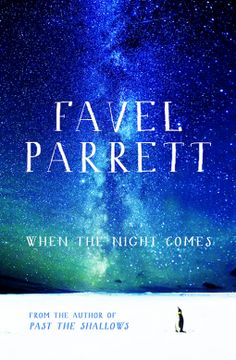
night comes

For a young girl struggling with a substantial relocation in her life Bo brings a certain colour to drab days – and to her mother. Through a child’s eyes we are not privy to the exact nature of that relationship, but by the end of the tale there is a sense that the Dane had to make a choice between to islands – his own in the Baltic or this one in another hemisphere.

This very different Hobart is also a major character. This is a town of watery, silvery winters and constant chill – not one of brightly sparkling summers for, at this time of season, the Nella D is facing the challenges of the Great Southern Ocean. The warmest months are the time of re-supply and change-over. The ship is also central to this tale and its controversial fate forms the climax of ‘When the Night Comes’.

nella

This tome has a defter touch than Ms Parrett’s novice offering; but this was very well received by the critics, attaining much gushing acclaim. For me this is a more mature effort, far lighter in tone. The author would seemingly have a springboard for a sound future as a novelist now that the tricky sophomore book has been negotiated.

For this reader there were some magic moments in this book. When a boy from Isla’s school is tragically killed in an accident, we are taken to the following day and the means by which the teachers coped with the situation. Having been through similar in my own career, the paragraphs concerning the heartbreak were truly moving. Paralleling this, there is a death on board the Nella Dan that has a profound effect on Bo. The still ticking dead man’s watch comes into his possession – ‘Shouldn’t a watch be more fragile that a man?’ There is the image of a long time traveller to Antarctica’s bases leaving it all on the Nella, knowing he’ll never see that land of awe, white-out and silence again. Then there were her vivid descriptions of a Macquarie Island that figures so poignantly in the saga.

These are all atmospheric passages from an author with the ‘write stuff’ to carve a solid career going forward – what a cliché; but nonetheless apt. The island she spins yarns of is my island – a place that, like Ms Parrett, can now proceed into the future with some confidence.

As well as Hobart, my home town of Burnie also seemed to be a regular port of call for the Nella Dan. I remember her being there, as do several of my acquaintances. I do wonder why? The ether has not provided an answer.

favel-parrett-420x0

Ms Parrett’s web-site = http://www.favelparrett.com.au/

Barracuda – Christos Tsiolkas

It’s just a little word – just four letters. It stars with a ‘c’ and ends in ‘t’. Why should such a small word be so off-putting to me, so abhorrent? I am a man of the world, aren’t I? Even after sixty years on this planet, this little word still makes me flinch. It makes me flinch when I espy it in print, or hear it uttered on-screen, in the street or, back in my teaching days – in the playground. The word itself has various meanings, but is rarely used in a positive context. It’s a word of anger, in the real world usually fouling out of the mouths of the articulately challenged as a put down. I could never write it in my scribblings – I have enough trouble using the f-bomb.

barracuda

But there are no inhibitions with either word with Tsiolkas in ‘Barracuda’ He uses them with abandon; with pungent frequency right from the get-go. And he soon had me recoiling with distaste. Now don’t get me started with the sex in it. That it was between men of the homosexual persuasion had me coming over all squeamish. I insert a coda here that I am all for gay marriage and all that – but please spare me having to read of or see their intimate activities. I even have to turn away from the tele when two men have a pash!

But, being an avid review reader, I did know what was coming. I’d put off taking the plunge for a while, seeing the book sitting up there on a shelf in my man-cave, seemingly saying to me, ‘You thought ‘The Slap’ was the best book written in the first decade after the turn of the millennium, so you really do need to read me – my masters follow-up.’ So, against my gut instinct, I did. I am proud of myself – I made it through to the last page – but very little pleasure was had in doing so. Whereas ‘The Slap’ grabbed me and held me from go to whoa, despite just about every character being quiet detestable – ugly people leading ugly lives. ‘Barracuda’, to me, was just plain boring – when I wasn’t tut-tutting about that word. ‘The Slap’ did have its detractors too, but I thought it was magnificent – and it’s visual interpretation was pretty damn impressive as well. Praise be they don’t do one of this.

If anything there were more positive beings in this novel than in his previous, even if they all seemed to have a flawed side still. As for the hero, he only grew on me when Tsiolkas introduced a softer aspect to his character once he was through with the tumultuous ride he had during his teen and young adult years. It’s only when he meets cousin Dennis that the book fleetingly came alive for me. This occurred on a pretty wretched family trip to Adelaide, but sees our hero take Dennis under his wing. His cousin has an acquired brain injury – but is by far the author’s most sympathetic creation in this offering. The fulcrum of the novel are the travails of Danny Kelly, in his own mind, destined to be an Olympic champion in the pool with the natural talent he possesses. This, though, isn’t your typical tale of sports-person from the boondocks conquering adversity and attaining a shower of gold. No, Danny succumbs pretty quickly as he hasn’t the mental toughness such success requires. He is partial to major meltdowns, one such landing him in the clink. For most of the first part of the novel the whole world seems agin him. It’s only after he reaches his lowest point does there seem some hope of scaling back up to some sort of redemption – though never to the glittering heights he once imagined for himself.

To be frank most of it was pretty turgid going. There’s no doubt Tsiolkas possesses unquestioned talent, just like his protagonist, but, unlike with ‘The Slap’, it just doesn’t gel here for me. The narrative flip flops also became pretty tiresome by the conclusion – too smart by half is Mr Tsiolkas in this regard, methinks. I do love to look forward to time with a book, but I was constantly returning to this reluctantly. Admiring an author is one thing, liking what he/she produces is another.

tsiolkas

The Guardian on Tsiolkas = http://www.theguardian.com/books/australia-culture-blog/2014/may/25/christos-tsiolkas-do-the-first-draft-orgasm-and-start-editing

Balancing Act – Joanna Trollope

I once had a shirt. Back in the day I ‘owned’ this shirt – denim, with brass buttons – that I loved to wear. Its material had been softened by years of detergent washings and it fitted me to a tee. Of course, back then, I was leaner; tauter too. I figured in that shirt I looked as good as it was possible for me to look. Really, though, I had no fashion sense in the old century – still don’t in this new one. I have no idea who purchased it for me as I rarely buy clothes for myself, but I wore it for years till it came apart at the seams. It felt comfortable. It felt good – it suited me just fine. I could be myself in it.

It was Joanna Trollope’s new offering that set me thinking about that shirt I wore and wore and wore. Her new book has that same comfortable feel about it. You know what to expect and she rarely lets you down. That shirt never let me down. She might write to a type of formula but it works. When she departs from it – well, she sort of comes apart at the seams too. With ‘Balancing Act’ she’s on song.

balancing act

It is a novel of generational change – something those of us of the baby-boomer years know something of. As we hand over to X, Y and even Z, we have to find a new way forward for ourselves. Sometimes in doing so we may come a cropper, but it can be exciting too.

But that is not what Susie Moran is all about – handing it over. She is so blinkered she cannot see that the world she so once had a handle on has now changed markedly – what worked in the past is so passé in the new ways of doing life stuff. Yes, she’s extremely successful, her pottery business is the bee’s knees and still popular with the public – so if it ain’t broke…. She was deserted as a child by a mother and father who ran away to Africa rather than raise her, but she single-handedly took over the family business. This she re-energised and became quite the career woman, despite finding the time to produce, but not raise herself, three daughters. This she left to her laid-back, jobbing-musician hubby, Jasper.

The daughters have now all grown up and are involved in the business. Cara and her partner Daniel run the financial side and are constantly on the look out to change the way it’s all done – arousing Susie’s intractability. Ashley, married to relief teacher Leo, is involved on the marketing side and is struggling with the work/home balance. The youngest, Grace, is into design and is struggling with a prat of a boyfriend in the self-centred Jeff. They, in the past, have all deferred to Susie when it comes to the crunch, but the worm is about to turn. They are tiring quickly of the ‘balancing act’ – they want to break free. It only needs a trigger.

It comes when an old man returns to the fold and he’s most unwelcome – Susie’s long lost eighty-plus father, Morris.

Trollope, as always, is entirely at home with these sort of events as she charts the various protagonists’ courses to the ultimate confrontation and denouement. It’s all so effortless for her and she takes us, her readers, along for an enjoyable ride, turning the pages eagerly till we discover how it all pans out for the Morans.

As long as she sticks to what she knows, Trollope will never set the literary world on fire. But, on the other hand, it is important to also keep one’s legion of loyal fans buying your next product – and largely she does. There’s no pyrotechnics with her narratives – it’s just good writing that sits comfortably, that feels just right. It’s writing that suits me just fine – the same as that old blue denim shirt of mine.

trollope

Ms Trollope’s website = http://www.joannatrollope.com/

The Lives of Stella Bain – Anita Shreve

We’ll be submerged in it. Just when we will think it’ll be safe to come up for air they’ll hit us with another fictional or factual offering on the unpleasant, inhumane events that happened one hundred years ago – as if we haven’t enough of those in our present-day. I’ve no doubt this’ll continue right up till the eleventh hour of the eleventh day of the eleventh month, 2018 – and possibly beyond. As far as this scribe is concerned, it was all done and dusted so long ago. And yes, the Aussies involved were heroic in proving their mettle in combat – but please, let us move on. As for it seeing our nation ‘coming of age’, that is just so much piffle. That occurred fourteen years previously. If you want a battle to mark it, look, as Paul Keating did, to Kokoda. He had it right. At least then we were defending home soil and not fighting somebody else’s war. For me, the ‘One Day of the Year’ is more than enough ‘celebration’. Tasmania’s late, esteemed governor certainly had the role of that right too.

So, for four long years, on our small screens and in the print media, we will be subjected to it. Most of it will be patriotic, possibly jingoistic mush – such as the ABC’s current ‘Anzac Girls’. I watched the first episode. It was indeed sudsy slush. Maybe some of the other offerings will be more worthy – but I think Peter Weir’s ‘Gallipoli’ says all that needs to be said and will never be bettered, so they’ll probably pass me by.

A print tale on the events is Anita Shreve’s ‘The Lives of Stella Bain’. I read Ms Shreve as a matter of course. She is a versatile and normally engrossing writer – if a tad uneven. As a take on what it was like to deal with the shattered results of the insanity that was trench warfare, this view of it leaves the aforementioned production in its wake. That being said, I still found the first half of the tome, concerning Stella Bain’s (not our heroine’s real name) convoluted war service a slog, to tell the honest to goodness So this is not Anita S’s finest effort, but it did become more palatable as we moved to the post-war period of her story.

stella bain

In the latter part there was a court battle over the custody of her children. Then she faces a return to Britain to confront a number of issues that will not go away and we then move into Hollywood territory. These later stages I zoomed through – it became quite compulsive reading. It told us much about the attitudes of the age about the place of the fairer gender in society and under the law. It tells of of the treatment of the often shells of combatants who did not come back from the great conflict unscathed in body or mind, as well as giving an insight into the early gestation of the study of mental disease.

Little did she know it, but Stella and her ilk were at the forefront of the transition into equality for her sex. Because of her pluck she was placed on something approximating the same footing in so many ways as the male of the species. Her admirable resilience in fighting against the absurd legal mores of the times only serves to remind that this battle still needs to be won.

As the novel ends, Stella and her hubby sit down to work out how long it will be into the future before ‘…the last soldier of the Great War is dead?’ They figure it out pretty well. I remember the Anzac Days of my youth when a bevy of these survivors marched at the head of the parade. Later on, we saw them struggling to wave from cars – and then they were gone. Now that process is repeating with the veterans from the second conflict. My own father participated in that, but sadly has long departed. In both wars tremendous courage abounded with the call to arms. But the realisation soon came about the true nature of killing your fellow man. Now, sadly, this week, here we go again. We have a prime minister seemingly itching to commit young Australian men and women to another messy and probably unwinnable war in a foreign land. When will we ever learn?

anita

The author’s website = http://www.anitashreve.com/

Two Wolves – Tristan Bancks

I could never quite see the attraction of those two enduring Aussie soaps, ‘Neighbours’ and ‘Home and Away’, although if you have the climate the Poms have to put up with I can see a reason for their adoration of them – a daily dose of Oz sunshiney-ness (yes, I know – not the right spelling. I just prefer the word that way) would bring light and colour to their dun world. It is, though, undoubtedly true that the twin mainstays of our early evening programming have provided an excellent breeding ground in the basics of acting for many who have gone on to wider fame nationally – even internationally – in the movies and music. Some have become household names – you know them! I don’t have to list! – as well as fodder for the celebrity rags.

One who has taken a road less travelled for ex-soapies is Tristan Bancks. He is now starting to attract attention as a wordsmith for younger people. He has tried his hand, post his role as Tag O’Neale in HandA, at all manner of vocations, including directing and anchoring tele shows here and in the UK. I suspect it is as a writer that he’ll find his forte. He surely will on the basis of ‘Two Wolves’. This is his latest and perhaps his most polished of now a very worthy list of titles, including ‘My Life and Other Stuff I Made Up’, ‘Mac Slater Cool Hunter’, ‘Galactic Adventures First Kids in Space’ and the ‘Nit Boy’ series (about a kid with the worst case of nits in world history). Most of these are seemingly designed to tickle the juvenile funny bone, but the content of ‘Two Wolves’ is decidedly no laughing matter. It would have many a young fella, as well as perhaps a lass or two, on the edge of their seats. I wish it was around in my teaching days.

This habitué of Byron Bay is right on the money with this novel. It measures up to his goal of producing a ‘…fast paced work appealing to youngsters.’ – with something here to inspire as well. There is excitement and suspense on every second page as Ben Silver and feisty little sis Olive try to find a way out of the pickles they get themselves in. You see, Ben, just entering teenagerdom, has a father who is – let’s not mince words – an out and out dropkick. What I do like about this nasty pasty, as horrid as he is to his long suffering missus and kids, is that, despite his depicableness, nary an expletive exits his mouth, no matter how much he does his block. Brainless bogan that he is, he doesn’t need the f-bomb to get his point across loud and clear. This would have been a temptation for many more ‘cutting edge’ practitioners, but thankfully Bancks doesn’t succumb.

two wolves

The author has used, as a basis for his storyline, recent headlines about bank malfunctions, awarding surprised customers instant wealth. Most, of course, would do the right thing – despite the ‘big fours’ crusade to rip off its customers to the max – but a few souls have taken the money and run. Such a twit is Ben’s old man. With his family going bush in response and the cops hot on their trail, the young man, who has desires to be a law enforcer one day, has some decisions to make – does family or right come first. What happens is our ever resourceful hero tries to tread a fine path between the two – a path that becomes increasing fraught as the book proceeds apace. In all this Ben is mentored by Sam Gribley, with those who are au fait with children’s literature knowing all about his own battles on his side of the mountain. He’s a good lad to have in your corner.

This book would be the perfect offering to dish up to a class approximating the age of the main protagonist. Ideally, presenting it to a cohort of boys would achieve the best results. In the past I have found selecting class novels quite onerous as it is far easer keeping girls under the thumb than boys, so usually gender bias is skewered the latter’s way for peace – and I was guilty of that myself . I was aware of doing so and tried to make up for it in other ways ensuring, for example, most of my short stories, read aloud, had girls at the helm. Olive, as resilient as she is, because of her age, doesn’t cut the mustard here.

The ending is a ripper as Bancks’ pulls out all stops to have our hero, after all he went through, finally have to face his nemesis in a final showdown. This novel possesses much that is life affirming and is simply a thoroughly good read. I enjoyed it immensely and I am sixty plus!

tristan

Tristan Bancks’ website = http://www.tristanbancks.com/

Analogue Man – Nick Earls

I do miss Neville H. He’s my mate. Between us we could happily, contentedly feel like ‘…analogue men in a digital age.’ He’s still my mate, my best male mate. I just don’t get to see see him as often as I would like. We met aeons ago – shared a school uniform and a local footy team. His only downside is that he’s Collingwood through and through – and I cherish the ‘poo and piss’, as he repeatedly calls them – Hawthorn. We did uni together – shared digs at a residential hall – married our sweethearts and commenced our teaching careers. Then we moved to different locales, gained new mates, parted from our spouses and lost touch. Eventually he returned to my town, we reconnected, reviewed our pasts and made ready for the autumn years. Mine involved a beautiful woman from Hobart, his one from Thailand. I moved south to be with my Leigh – and now, sadly, I miss my mate.

I miss our Friday nights – together, us two ‘analogue men’, throwbacks to when it was all less complicated, less busy. The digital age has made our lives so full of crap. I tried to comprehend it and largely failed. He gave less ground than I. We’d sit around the table at 15 Lane Street, telling tales large and fantastical. I’d cook him tea, we’d sink a few reds. Then we’d get onto politics – always dangerous. He was rabidly Green, my beliefs of a lighter hue – but I couldn’t bring myself to vote for anyone else. Then we’d settle down to watch the footy – except if the Hawks were playing. Then we’d make it another night. But if the Maggies were on and they lost, it would always be the fault the ‘white maggots’. But this was a put on, an aberration for Neville H has more humanity in his little finger than Tony Abbot in his whole being. He looks out for the downtrodden and repressed – he’d give them the shirt off his back. I am extremely content with my new life by the river in Hobart Town and I trust he’s found similar in our old stomping ground up north. We will continue to get together on occasions, but there’s no regularity now. I wouldn’t swap what I have here by the river, but I do miss those Friday nights with Neville H.

That’s why I enjoyed Nick Earls’ take on it all in ‘Analogue Men’ so much. Reading it was akin to those Friday nights with Neville H, getting gently to the ‘Mr Wobbly’ (in joke) stage and talking, talking, talking. Earls’ central protagonist, Andrew Van Fleet, is about to enter the autumnal years – the years yours truly and Neville H inhabit (with some joy I might add). We know our pomp is substantially behind us, but like Andrew, reckon we’re not completely kaput. We have all downsized – although Neville H reverted to up-sizing a while ago – he’s had a second wind. Van Fleet has been a high flyer, but like many who have realised the digital age has taken away their lives, he has opted for a quieter existence on reaching the cusp. He wants more time with family – his missus Robyn; his offspring, Abi and Jack. And then there’s his dad out there in the granny flat – ailing in his late dotage, but once a legend in in his own lunch-box on the local radio airwaves.

analogue men

And that’s what Andrew VF takes on – a managerial role in a radio station – as if that’s going to lead to a quiet life! It’s here he comes face to face with another legend in a terminal decline – albeit one of a different ilk – Brian Brightman. Once the king of the wireless in Brisbane, his star has long fallen- but he still battles on at the bottom of the ratings chart, trying to compete with the shock jocks and the new shiny hip kids on the block. He has a patter that has seen better days, often getting him in deep shit he is so out of touch with political correctness – or is he? Andrew soon finds he is drowning – he’s beyond his depth and now he just can’t swan away to NYC or HK on a business caper. There’s also family conundrums a plenty to deal with. Then comes the ill-conceived plan to combine both and solve all issues in one knockout blow. It involved minding BB at a comedy festival down on the GC, paralleling that onerous responsibility with a family holiday. It spells disaster – it was.

Earls has created some characters for the ages with this. From the two kids with digital apparatii hanging off every appendage to a constipated bulldog – he is back to the rare form of his earlier novels that bought so much Mangoland sunshine to a chillsome Tassie winter.

Of course Neville H and I never reached any great heights in our professional careers – which does not mean we weren’t successful at what we did. There is, though, in AVF a soul I can relate to. Luckily I do not have to compete with all that plurry technology as much with these days of retirement bliss. I loved this book. At times I laughed till the tears were streaming. All the trouble Andrew had with his buttocks is priceless. Sure the climax involving a shark and an errant tongue is a tad over the top – so weird it just may be a possibility (except in fiction) – but even with this I was happy to be taken along for the ride. So thank you Nick Earls. For a short time perusing your offering I was around that table again with Neville H, fixing up the world, with not a digital device in sight. Your book, Mr Earls, did that for me – even if it made me miss Neville H even more.

earls

Nicks Earls’ website = http://nickearls.wordpress.com/

The Black War – Nicholas Clements

In my latter years I shied away from it – I really did. The history needed to be taught – in fact, it should be a compulsory requirement in our island’s schools. But working with the Aboriginal community to improve the outcomes of indigenous students (one of the most enlightening and enjoyable aspects of a forty year career), I discovered there were divisions within their number over the story that needed to be told and so, from the classroom perspective, I became wary. I stuck to the big picture, the narrative over the whole of the country, conveniently ignoring that of the local peoples. I am now out of the loop, so to speak, so I am not sure if attitudes have changed – softened in recent times. I firmly believe no Tasmanian child should depart the process without a firm understanding of the clash between two cultures on this state’s historical frontiers.

‘The Black Wars’ is a fascinating, often troubling book. Clements has been courageous. He doesn’t shy away. Some of the factual accounts of what actually happened during the period covered does not make for pretty reading. With this whole, decidedly sorry saga, there are two words that have always troubled me – the notion that what happened out on the backblocks during this time was a ‘war’ – the notion that the result was a conscious policy of ‘genocide’. As for the former, the raw figures are minuscule compared to the great clashes of the last hundred years and it always seemed to me that the skirmishes that went on would be better described as a ‘conflict’. But when Clements boils it all down to percentages, then a different hue is cast on the events. It transforms the data. The military involvement he illuminates was also much larger that I had previously envisaged. As a result, ‘war’ now sits more comfortably.

black war

Certainly there were calls for ‘extermination’ as the ‘war’ rolled over from the 1820s into the next decade – and on the North West Frontier on into the 1840s (it intrigued me that the final recorded skirmish of it occurred in the Table Cape area, the very region I spent the final years of my time teaching). During these years, as Clements so vividly describes, the fear and loathing on both sides of the ledger for the other were palpable. For a time the colony was nigh on paralysed by the atrocities committed by ‘white’ and ‘black’ and the terror that ensued. In some sectors of the settler community hotheads did call for the Aboriginals to pay the ultimate price – and there is no doubt of what, by the end, the latter were attempting to do. Of course their goal was futile and they knew it as their attacks went from targeted to indiscriminate. Never was it otherwise that the odds were stacked in favour of the invaders. The problem with all this is that, out in the remote rural areas, officialdom had little control – and the brutal background of many of the ‘white’ transgressors in these locations meant there occurred scenes of unmitigated inhumanity. This could not be tolerated by the native warrior chiefs – they were forced to retaliate in kind. It is worth remembering that, in the period just before the conflict heated up, Van Diemans Land had only just recovered from the debilitation caused by unrestrained bushranger gangs.

Clements, after placing what he intended to do with ‘The Black War’ in context, looked at it largely on the ground rather than in the halls of government. Using the reasonably considerable contemporary accounts to be had – at least on the invaders’ side – he successfully places the reader squarely in the middle of it all so he/she feels the desperation increase for both parties as no solutions to it, other than those of a violent nature, could be found. No soft gloves were used here by the author, as even the nobility of the ‘black’ cause gave way to heinous slaughter of the innocents – as well as the deserving.

Circling around all this was the work of George Augustus Robinson – once the hero of the times (as well as in the era of my own education), but these days more of a divisive figure. It’s his copious journal keeping that has largely provided Clements with the Aboriginal take on the events. The saddest, most heart wrenching data of all involves the incredibly small numbers that he retrieved from the bush as the last of the warrior groups surrendered. The settlers were incredulous that so few caused so much mayhem towards the end. For me much of the territory Clements wrote on was known in an overall sense – albeit not the gory detail. What really came as a surprise was how much of a shambles the notorious Black Line was. I knew how badly it failed, putting that down to the ingenuity of those they were attempting to ensnare. Largely, though, it was the complete mismanagement of the grand strategy by the authorities, as well as the lack of real enthusiasm by the settler/military participants once they had to do battle with the vagaries of a Tasmanian spring in a wild terrain.

Logically sex would have had to have been a factor in all this – the bulk of ‘white’ maledom wasn’t getting any, at least of the ‘legal’ variety, as a result of a substantial gender imbalance. Here the ‘blacks’ could provide a source for alleviating that need. In the main this was foul, unforgiving sex. The ‘gins’ became little more than slaves if captured, often ending their use with a bullet to the head – and the crass class that inhabited the fringes of ‘civilization’ liked their prey to be as tender in years as possible. Ugly, ugly stuff – at its most barbaric out on the Strait’s islands. It is this frontier that Clements suggests is worthy of a deeper examination in a future tome – only, at this stage, he isn’t prepared to write it. This is largely, I would think, for the same reasons that I wasn’t prepared to take what I knew into the classroom. He claims ample documentation for what went on is available and not all of it puts the blame squarely on the side of the colonials. Clements noted that Aboriginal women were used by their men folk as bargaining tools – in some cases readily prostituting their females to gain favour, tucker or other wares.

With ‘The Black War’ Clements complements others working in the same area such as Boyce and his mentor, Henry Reynolds. I would strongly suggest that this book be an insisted read for any educator intending to take our island’s dark history to his/her students. With his research you would also think that the so-called ‘history wars’ have well and truly been put to bed.

To complete this appraisal, here are two interesting facts that the author brings to our attention. The first was that the initial Tasmanians never attacked during the night when the spirits abounded, whereas their enemy usually preferred the cover of darkness to slaughter our first inhabitants in their camps. Secondly, contrary to expectation, although the killing of livestock by the ‘blacks’ was common, what they speared and waddied out of existence was never consumed.

clements

Clements’ tome is a fine achievement, with the author greatly impressing at the recent launch of ‘The Black War’ in Hobart. I had the pleasure of sitting next to his mother at the event and she was justly proud of her son. His work is revelatory to say the least.

From The Australian = http://www.theaustralian.com.au/arts/review/beyond-black-and-white/story-fn9n8gph-1226895004177?nk=8fe21f338350b1ee60e8806adeac7887

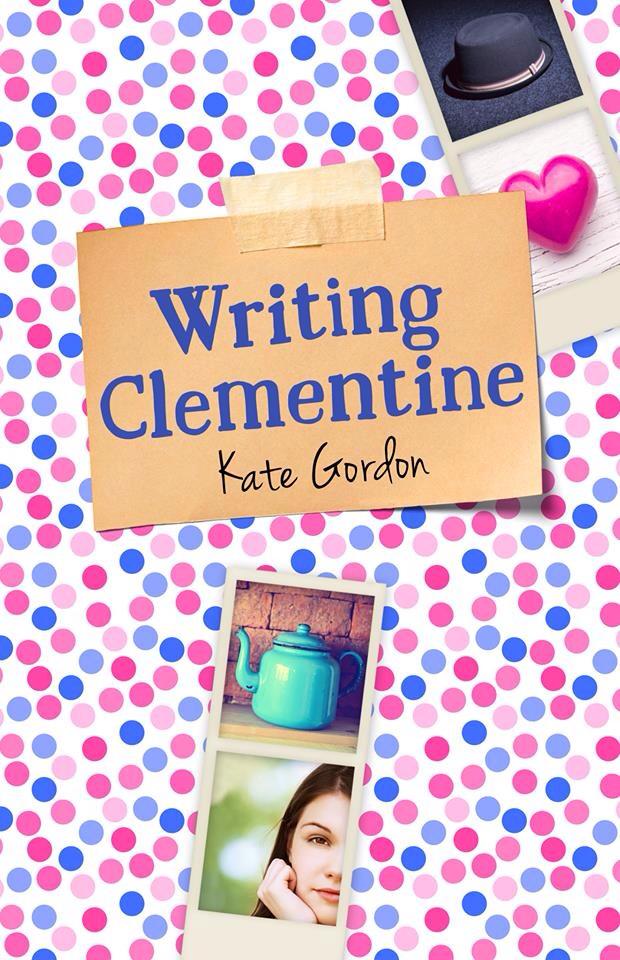
Writing Clementine – Kate Gordon

I am Burnie born and bred. Most of my life has been spent living in the town – my working life in teaching its youngsters and those of its satellite communities. Most of my time there I hankered to be somewhere else – but I was patient, knowing the town might have its limitations – but its people were wonderful. My retirement does indeed see me in another place – but in my mind I am still Burnie. I write Burnie Tales – it’s what I write about the most. About the lives of the people, like me, in someway still connected to the town. These are stories that are ‘…sometimes truth, but mainly fiction’. Few will ever read them. I plonk them on my blog and send them off to mates and family who have expressed some liking for them – but they are mainly written for me. Composing them is therapeutic – it makes me happy, content with life, my Burnie Tales.

And here’s a Burnie tale of three girls, three best of friends, growing up and going to high school in my home town. They weren’t the most popular trio of their cohort – but they weren’t the most unpopular either. As they journeyed through their senior years and on into college, to the cusp of adulthood, they shared so much. This included their passions for boy bands and Spice Girls, the Adelaide Crows and Hawthorn Hawks, as well as ultimately, the more perplexing matter of the opposite gender. They were there for each other when times were tough, as they sometimes could be. There were family issues and heartbreaks in love. But they celebrated with zest each others’ successes – of which there were more than a few. Most of all, the best bit, was that with these three girls goodness emanated from every pore of their being. It was my good fortune to share teaching duties with two of them at Yolla District School where I watched with delight as they grew into consummate, caring professionals in their chosen vocation. Children of all ages pick up on goodness – and these two had that quality in spades. This characteristic has also assisted them in becoming gorgeous mothers to beloved offspring. What happened to the third you may ask – what did she become? Well, she became a writer – and a bloody good one.

Burnie is, has always been, a town set on improving itself. Today it is a far cry from the place the citizens of far ‘sophisticated’ locales took delight in pillorying for its industrial ugliness. But those factories gave employment. Now they are gone and even if the town is far more ‘liveable’, something of its soul has been lost in the process. Especially now, as we have a federal government doing its level best to make life in communities such as Burnie even more untenable, people are being forced to desert it in order to make a living. And Burnie people are such good people. Sure it has its fair share of drop kicks and the much derided bogans like every community, but generally the resilient bunch that keep the town’s spirit going have done an amazing job. Burnie keeps bouncing back from adversity. It is sad, though, that it remains tougher to call Burnie home these days. So those remaining stick together; they support each other through the hits they take, but can party like mad when there’s a celebration to be had at a milestone of life passed. The Burnie people I know do their level best to be good citizens. It’s this inherent goodness that Kate Gordon, the author in the previous threesome, writes of in her marvellous saga of what its like to be young and in such a place. Kate knows the town facing Bass Strait so well. She is one of its daughters as well.

writing clementine

In ‘Writing Clementine’ there are also three friends with goodness at their core – Clem herself, Chelsea-Grace and Cleo. They are not facsimiles of the aforementioned threesome – in fact mostly different apart from the fact they they were also neither the most popular nor the most shunned. They’ve been tight for so long – ever since their junior years. But now that they’ve reached Grade 9 fissures are starting to show. Boys, and all the attendant angst they cause, have entered the scene. Clem starts to feel on the outer, has issues with her body image and starts to gravitate to a new kid on the block, the quirkily attired Fred. He is another outsider as she is starting to perceive herself to be. Fred – the Fred Paul – of that weird cape, opens up to her one of the area’s best kept secrets, the Burnie Steampunk Society.

In a town like Clemmie’s there’s precious little for a teenager to do if one isn’t into sport or riding in noisy cars interminably around the main drag. Kids have to invent their own fun and Kate Gordon, the BSS is a glorious invention, befitting the town’s heyday of steam emitting factory chimneys. Through making their own entertainment, Clem starts to find her place out in the world. Fred Paul is as supportive a boyfriend as an emerging lass could have and Gordon has constructed him perfectly. He’s the antithesis of the school jock Clem had so much trouble with on the banks of the Cam. He is, in contrast, an odious creation – but not an unrealistic one as misogyny is alive and well still in our schools, despite our educators best efforts.

Then there is our heroine’s family. There is a delightful dad, still gyrating to Jimmy Buffett with his daughter after all these years. He works from home, in contrast to his equally caring wife who labours long hours, but is still very much an involved figure. Both her big sister Soph and elder bother Fergus have issues – which Clemmie does her level best to solve for them. Neither prove easy challenges and here the author delves further into the negatives of teenage-dom – body image and depression.

Nothing becomes too dire though. Overall the novel possesses a lightness in tone. The target audience will find it a page turner. It is a book full of joy and hope – a welcome relief to some of the depressing fare that is dished up to our young people in some of the doom and dystopian gloom on the market. In fact, ‘Writing Clementine’ is a tad like a Jimmy Buffett song – sure there are bad bits, but the world overall is a pretty magic place so get out there and enjoy. Both JB’s parrothead whimsy and Kate Gordon’s novel will make you feel joyful. The offering is clever in its structure as it is written in the form of journal entries from Clem to one of her teachers – and here lies my only minor quibble. Coming from my background I would have enjoyed more of Ms Hiller’s feedback to her. But that is just being plain picky – I know. It’s the teacher coming out.

Over the years there have been so many beautiful young ladies I’ve taught like Clem – not popular, not unpopular – just unsure of their place in the world. Perhaps they may even harbour Kate Gordon’s and Clem’s deepest, darkest secret – a decidedly uncool love of country music. How I’d love to be in the position now to hand this book over to them all with the words, ‘Here, this will help. The hero is just like you. Heed its message of ‘never be afraid to swim against the tide’ and you’ll be okay in the world. The world will go easy on you.’ This is the adage I’ve always attempted to convey in my teaching, but Ms Gordon can do it so much better in the power of a book. In its considered way ‘Writing Clementine’ will have this sort of impact on all who read it – and they will grin broadly afterwards. The author knows her young readers so well.

I was fortunate to attend the launch of this lovely book at the wonderful Fullers in Hobart one vile Tasmanian winter’s morning. But with the support of those assembled, despite the lashing rain outside, Katie G, soon had her rapt audience following her every word, sharing the emotion of bringing her book of ‘…sometimes truth, but mainly fiction’ out into the world. Those who know her well understand that recent years haven’t been entirely easy – but surrounded by the love of those who patently adore her, as well as being cheered on by her amazing Tessa Tiger, she has come out the other side with a work that will bring Buffettesque summer sunshine-y smiles to all those who purchase and read. Later in the year she’ll take ‘Writing Clementine’ home to the region of the state that first nurtured her and it. The equally wonderful ‘Not Just Books’ in Burnie will host its northern launch, with a mini-tour of local schools involved as well. People attending, in that part of the world and reading ‘Writing Clementine’, will recognise much about what makes their community so special in the book – those people, like myself and the author, who are Burnie born and bred. Good on you Katie girl.

kate gordon02

Kate Gordon

Kate Gordon’s website = http://www.kategordon.com.au/

The Husband's Secret – Liane Moriarty

I know around when it happened. I know precisely where it happened. I was staying at that old stalwart, the Victoria Hotel on Little Collins Street. It was some time in the early Nineties. For whatever reason, I was staying on my tod. I cannot recall if it was during the same visitation as that other embarrassing occurrence happened. Of course the ablutions were down the corridor from the room. Of course I stupidly went to my morning bath just clad in undies, t-shirt and thin white hotel towel. Of course, after my cleansings, I realised that I had locked the door-key in the room and of course, that required a visit, in that form of undress, downstairs to the front counter in order to gain assistance. And of course I had to join a line of punters checking in/out. I doubt if the other event would have happened that same morning – two shocks to the system would have been simply too much.

I loved breakfasting in Melbourne cafes – still do. And there was an excellent one a couple of doors up from said hostelry – sadly not surviving into this century. As I settled in with my copy of the Age and a cappuccino, I noticed there was a ceiling mirror immediately above my head. And staring back at me was a large bald spot – a large bald spot that was mine! I had no idea that I possessed such a thing. Nobody had told me I had one. I was appalled for a while – quite shaken. I know I spent the rest of the trip, as well as for sometime afterwards, continuously patting the top of my head – as if that’d make it go away. I thought, over and over, ‘How can that be? When did that happen?’ In the end I just accepted it, it was something I could live with – and life went on as normal. It certainly didn’t send me into a mental nosedive. I didn’t get, as a result, an attack of the ‘Peter Pans’, unlike poor Will.

‘I got my hair cut, right? And my normal guy wasn’t there, and for some reason the girl held up this mirror to show me the back of my head…I nearly fell off the back of the chair when I saw my bald spot. I thought it was some other bloke’s head. I looked like Friar Bloody Tuck. I had no idea.’

And Will confessed to his wife that it was at this point it all started – that downward spiral into his personal attack of the ‘Peter Pans’. Very soon after he decided he was in love with his missus’ best mate, causing Tess to flee from Yarra City to her mum’s in Sydney – and so it all began.

Meanwhile, a Coathanger City housewife discovers a mysterious letter from her hubby while ferreting around in the attic. And nearby, Rachel, still grieving for the loss of a murdered daughter, discovers she now has to grieve the departure from her life of a grandson. One of the mentioned characters has had to coop up inside him, for decades, a horrible, horrible secret – and Rachel thinks she knows who is responsible for her Janie’s unexplained death. Is it the same person? That answer is the nub of the fascinating ‘The Husband’s Secret’.

husbands secret

In truth this is probably not a bloke’s book, so for me it didn’t quite live up to the hype displayed on the front and back covers. But Liane Moriarty is a canny, canny writer in several ways. The novel is quite clever in the manner the back histories of the three main protagonists are interwoven until, in the end, it becomes one story. The decisions made by some of the characters, towards the finale, could be chewed over for hours, I suspect, in a book club forum. And, although it is clearly set in Oz, she has somehow made it mid-Atlantic in tone – thus topping the best seller lists in both the UK and US. Each time I read an Aussie place name I was jolted back to the fact that the setting was indeed home-grown – so more power to her authorly capabilities.

A couple of aspects did jar for me. The epilogue, going into forensic detail about Janie’s demise, just messed up an otherwise believable narrative strand and certainly didn’t enhance it in any way. A pet peeve of mine are also authors who have to give the reader the death-throe thoughts of a victim. Again, going back to the day Janie died, added zilch.

But with a million plus in sales and translations into multiple languages, Ms Moriarty sure takes the reader on some ride with this. It wasn’t quite the page turner I expected – this being measured in how long I take to get through a tome – but in no way did I regard reading it an onerous task – quite the contrary.

The Australian market is so small that even some of our most gifted struggle to make a living at their craft. Getting a book out there involves a huge amount of often underpaid work – so full credit to the author to have had the immense success she has out in the wider world – and that is reason enough to find out what all the fuss is about by garnering your own copy.

liane

Ms Moriarty’s website = http://lianemoriarty.com.au/


Zak and Mia, Elise and Didier

For any family having a loved member afflicted by cancer is nightmare enough – having a young person battling their own body for survival, for those that love him/her; well that is beyond intolerable. It is one of the cruellest cuts life can impose. John Green’s ‘Fault in Our Stars’ is the fictional exposition of such heartbreak, winning hands down at the moment in top ten lists everywhere. In print form it has touched hearts all over the globe, with it now hitting the big screen as well. Critical reviews of the latter have been mixed, but I defy anyone to read the book and not be affected. But coming close to the above has been a tome and a movie I’ve cast my eyes on in recent weeks. So in order of perusal, let’s have a bo-peep at each offering.

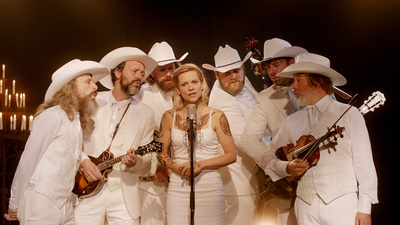
Take a bit of ‘Once’, a smidgeon of ‘O Brother, Where Art Thou’, a dash of ‘I Walk the Line’, as well as a splash of ‘Blue Valentine’ and you sort of get the idea of the acclaimed Belgian indie I had the pleasure of watching from director Felix van Groeningen. Coming together over blue grass music is an unlikely pair. She’s into tattoos in a big way – he’s a beefy, hairy bear of a man; a musician in a band that’s pure Appalachian of the Flemish (Walloon?) variety. Their union produces a daughter, Maybelle; they raising her in pure alternative bucolic splendour. But it eventuates that all is not well with their cherished offspring just as she reaches school age. It is heartbreaking – can the relationship survive the impositions this revelation imposes on their tightness as a unit? They try to use the music to take away their pain. When the band launched into Townes van Zandt’s ‘If I Needed You’, well that just finished me off big time. I was reaching for my hankie to dry away the tears.

breakdown.

It is structurally a very clever movie. To view it requires having one’s wits about to keep track of the time shifts. Also the band’s climb to fame is very subtly done so as not to overshadow the devastating events of its main narrative. It was nominated for a best foreign movie Oscar at the most recent awards, understandably missing out to that Italian gem, an over-the-top classic, ‘The Great Beauty’. The more minimalist ‘The Broken Circle Breakdown’ is, though, a treat of a film even if, at its core, it is just so, so sad. For me it is one of the year’s best – there have been so many of those in 2014 and we are only half way through.

.broken_circle_breakdown_3

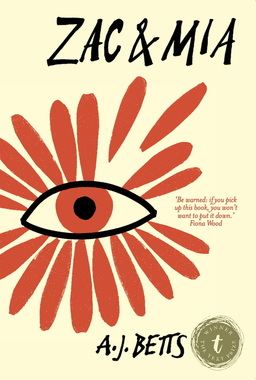
Although I initially viewed AJ Betts’ YA novel, ‘Zak and Mia’, as an inferior Aussie attempt to cash in on Green’s best seller, on reading it soon came out of the shadow of the American’s book. The latter grabbed me from the get go, although my enthusiasm had waned a tad by the end. With ‘Zac and Mia’ the reverse occurred. It perhaps won’t reach the stratospheric sales of its predecessor, but it certainly is no derivative clone. It is a magic book. By the time Mia reaches Zac’s family farm I was hooked and didn’t put it down till I finished it. The two characters – one a feisty party girl, estranged from her mother; the other a country lad with a mum doting on him. Both have cancer and meet whilst undergoing treatment. The last hundred pages I completed as the sun came up over Bridport, again wiping away my tears, this time with my bedsheets. Like the movie – just so, so sad.

zac and mia

The disease and Lady Gaga bring these two together, but they are strange bedfellows, if you’ll excuse the pun. She goes on the run, thinking if she gets as far away from WA as possible her problems will resolve themselves. He is more pragmatic, concerned about his longevity, trawling the net to discover his odds at any given point. They fall into ‘love’ almost without realising it, but their cancers also drive them apart. Can there be the happy ever-afters for our brave protagonists as Betts skilfully builds towards a conclusion?

The author did her time in a hospital ward treating sufferers of the big C, so she knows what she’s on about. As the novel rolls on we get the impact of the events on the two very divergent mothers involved, as well as meeting Zac’s inspiring aunt, with her own story of survival. It is all rounded off beautifully by the author in a way that reaches deep into the reader’s humanity.

aj betts

AJ Betts

Thank you darling daughter for recommending such a gem, one she considered was odds on for a CBC award, had the publisher remembered to list it. Thank you also to all those savvy film critics who enticed me to the State Cinema for that superior Belgian weepie.

Trailer for ‘The Broken Circle Breakdown’ = https://www.youtube.com/watch?v=3a50DJkCxqw

AJ Betts’ website = http://www.ajbetts.com/