Category Archives: art and photography

Potato Starch Miracles

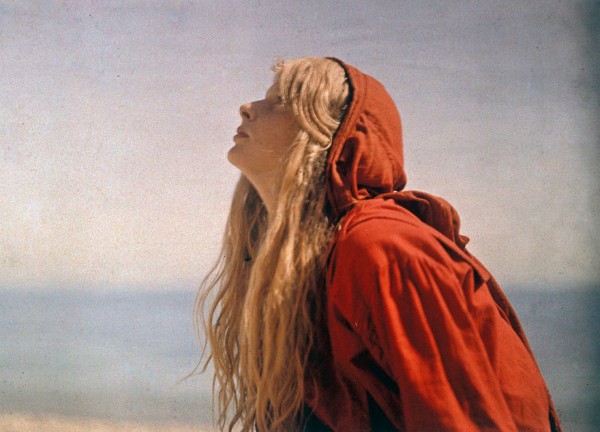
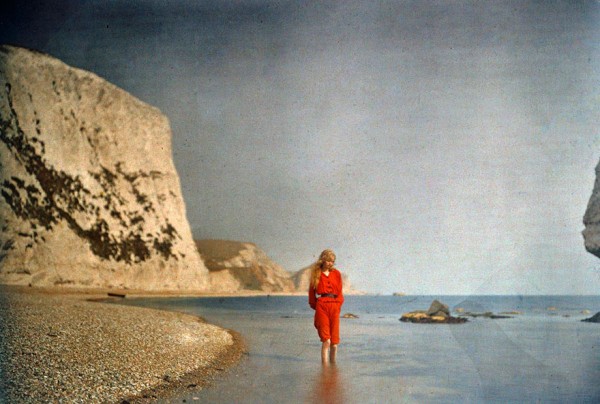
The unknown girl in red still haunts many. It’s been deduced she wasn’t his daughter, so exactly who could she have been – a relative, a friend’s daughter or just some damsel he found with a group of others on the shingle of Ludworth Cove, Dorset? For some reason it’s been passed down that her name was Kristina. But whoever she was, Kristina has become a potato starch mystery.

christina6-19113 o'gorman

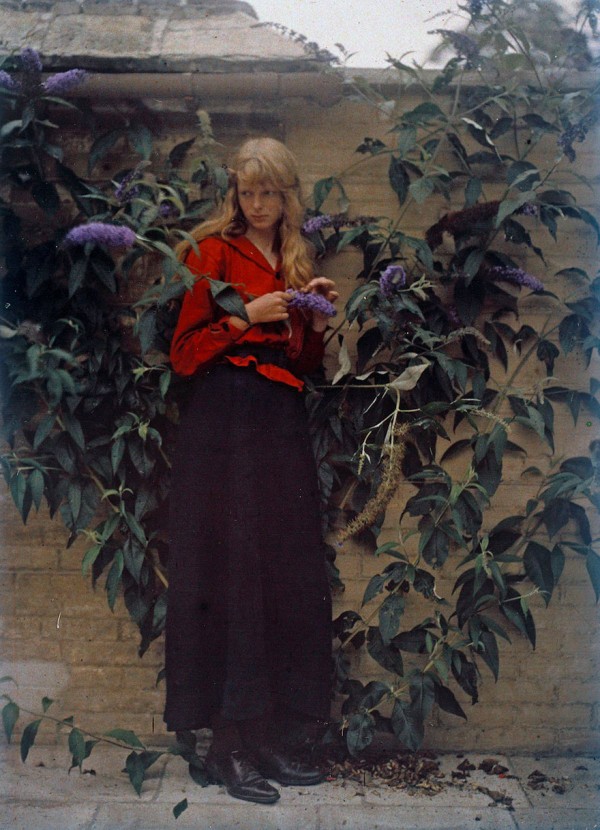
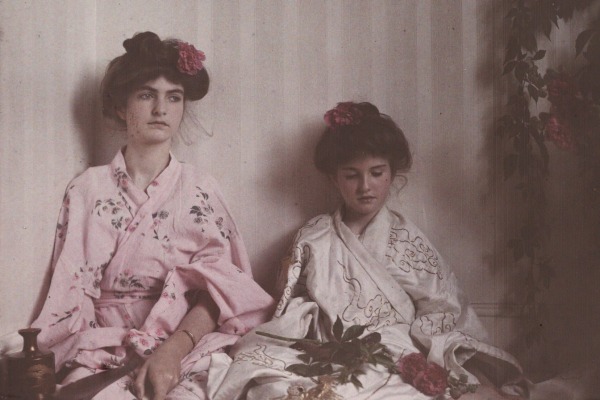
Around the same time as she was captured for eternity, in the year before the Great War, Etheldreda Laing was also using the same relatively new process to take photos of her two girls, Janet and Iris. She did so in the gardens and on the rolling lawns of her family home near Oxford – Bury Knowle House. Between the two photographers, we have some of our earliest surviving colour photographs – they are potato starch miracles.

eltheldreda laing01

The two photographers concerned were both amateurs, but like many throughout the history of the art/hobby, they became obsessed by it. Both were fortunate to be well off enough to service their passion in days when it wasn’t as cheap or as ubiquitous as it is now. A couple of plates for this challenging process would equal a day’s average wage. But with it photography pushed the envelope into territory that was difficult to master, but one that produced stunning results. Amazingly though, the key ingredient in the ability to take and make these surprising images was something very humble and everyday – potato starch. A microscopic amount of the root vegetable was stained red-orange, green and blue- violet. Then this was used to provide a filter for light to pass through. When a photographic plate was inserted the light would react with the plate’s chemical emulsion to make images appear naturally coloured. Not simple by a long shot and thus it took skilled practitioners. They are ethereal, the results, redolent of days gone by, but exquisitely still exhibiting the eerie freshness of just having been taken yesterday. The process was called Autochrome Lumière, invented, as the second part of the name would indicate, by the same two French brothers responsible for giving us moving pictures.

eltheldreda laing02

Audrie, as Etheldreda was known to family and friends, must have given birth to two very patient daughters, given the time needed to be still for a successful picture to be created. She had been playing around with the colour process since ’08, but it took her years to get the hang of it. The use of it had virtually died out by the twenties, given its complexity. Colour film itself, as we who were born before the digital age would be familiar with, only came into being in the mid-thirties. Gone then was the necessity for the earlier unwieldy means. But potato starch had its place in the history of the art form – what amazing and intriguing photos it made possible!

eltheldreda laing03

Laing was a trained artist before photography took hold of her. She married lawyer Charles in 1895 and moved to the nineteen acre property appearing in the images. In 1898 the first of her two children entered the world, followed by number two in 1903. So enamoured was Audrie of her camera that she had a dark room constructed on site for her hobby. She took to the autochrome method early and is now recognised as one of its greatest success stories.

Originally photography was thought to be an unsuitable pastime for genteel womenfolk because of all the messy chemicals involved. But by the turn of the century it was considered ‘developed’ enough to to be respectable for the fairer gender. But for women it was still not the done thing to go wandering around with camera in hand snapping willy-nilly, so subjects were normally family members – thus Janet and Iris were constantly prevailed upon to satisfy their parent’s fixation. Take a gander at the photographs on-line – to my mind they are remarkable, given their provenance.

Etheldra-Laing-autochrome-Iris-bench

Audrie later became a noted painter and developed a new fascination with miniatures when that became fashionable. But she still continued camera-smithing throughout her life as a side-interest. She passed away in 1960, aged eighty-eight.

At forty-two Mervyn O’Gorman was considered a bit of a dandy. He was also, undoubtedly, a person of stature. When he died in 1958, at age eighty-seven, it was written of him that he was ‘…a man of agile mind and Hibernian eloquence.’ In 1913 he was married and one year on would be serving in Flanders Fields, reaching the rank of lieutenant-colonel. We know a great deal about him, but little about the strawberry blonde posing afore his camera in that cove before awfulness took over the world. What was Kristina to Merv we wonder? He and his much older wife produced no offspring.

The determined souls who have sought to solve this riddle can only point to one census record of a Kristina O’Gorman around the time – the 1911 count registers an eleven year old Irish lass by that name. A relative perhaps visiting England? She was photographed in a group, so she was no lone random he picked up on that day. It could all point to the fact she was known to him – especially as she also posed for his camera at other locations. That she was in a group on a beach suggests rejecting the notion she was a hired model.

christina3-girl in red 1913 mervyn o'gorman

The muted tones of her surrounds in the images allows the reds of her various items of clothing to really stand out, to be incredibly distinctive. O’Gorman’s portraits of her possess a timelessness that ensnares your eye – and you cannot but wonder about her, although some dismiss the need to find out her story. They maintain that we should be satisfied that the reproductions of her have found their way down through time for us to marvel at. She has been described as the true embodiment of the pre-Raphaelite ideal. – and I’d like to think that O’Gorman, for that reason, saw her potential in that group out for a day by the briny. Assessing her suitability, he asked her guardians permission, under supervision, to capture her for posterity.

christina7-1913 o'gorman

As to the other questions about her, part of me would like to know more, but another hopes she will always remain a mystery to tantalise lovers of beautiful images down through time. And to think that her youth will remain eternal is the result of adding to a mixture just a minute smudge of potato starch.

Harry King of the Posters

One of the joys of summer in Hobart, for me, is to wander around the CBD, or down in Salamanca, when a cruise ship is in. Both locations are abuzz with folk sporting lanyards around their necks, often communicating in foreign tongues and on occasions, asking yours truly for directions or tapping into my local knowledge. I always ask after their provenance and how they are finding us. The word on all their lips seems to be MONA.

Tasmania, particularly down here in the south of our state, is receiving a spike in visitor numbers – not only are more and more ocean liners plying their way to us but airlines are lifting their flights in to cope. Even in winter the recently completed Dark MoFo had the joint hopping and filling hotel beds in the off season. All this is on the back of one visionary man, David Walsh, who is giving our city an edge over its rivals. He continues to plan as big as kunanyi to enhance the burb of his birth.

kelly 02

I remember another time when similar occurred and that was in the early days of Wrest Point, opened in 1973, during my uni stint. As the only casino in Oz the punters flocked in and our former backwater came alive. Then other places caught on and we returned to our slumber.

We are on the cusp of something special, or so it seems. Yet there are also a small group of the well heeled and/or rabid environmentalists who oppose any fresh, innovative ideas to keep the ball rolling. The Battery Point elite, ten in number I believe, have successfully prevented community and tourist access to part of our glorious foreshore because they have cash and therefore, they believe, rights above the rest. Arguments over a cable car to Mount Wellington and a light rail drag on. Even Walsh’s newly proposed tower had its naysayers. All this in tough economic times when our young cannot get jobs!

Ours is a very special place and so alien to the rest of Oz which can focus on beaches, sun, large cultural hubs and the wide open outback. There have been a long line of state government campaigns to attract national and international audiences – some have worked, some have been abysmal.

kelly

But let us go back to more innocent times and the first concerted effort on the part of our isle in the southern seas to lure the mainlander to the sublime attractions here. It seemed a no-brainer that the natural wonders to be discovered should tease numerous souls to sail across the Strait. Of course, back then, there weren’t the millions to sink into the multi-media campaigns of today – it was all done on a smaller scale. But it was still seen that our enticements needed to be given a helping hand.

So was it Governor Sir James O’Grady, back in 1926, who set it all in motion with these words?:- ‘I sometimes think that Tasmanians – living in their beautiful surroundings, enjoying their ideal climate, revelling in beauty upon beauty until some of them forget that it is beauty at all – do not realise the bountiful gifts that they have.  I can tell them – and I am glad to do so – that Tasmania is a scenic wonderland without rival, a tourists’ paradise without peer, a holiday Island that has no equal in the Southern hemisphere.  Let your friends of the other States know about these things.’

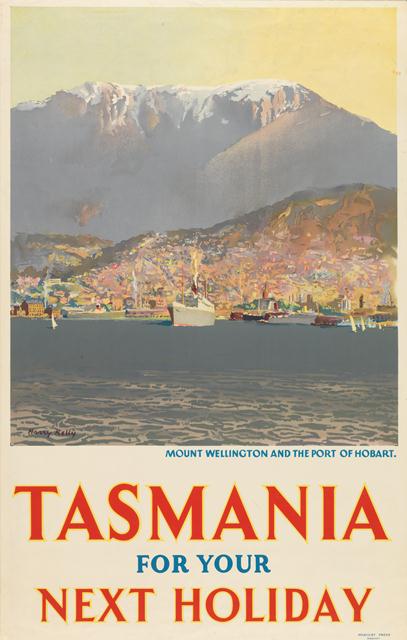
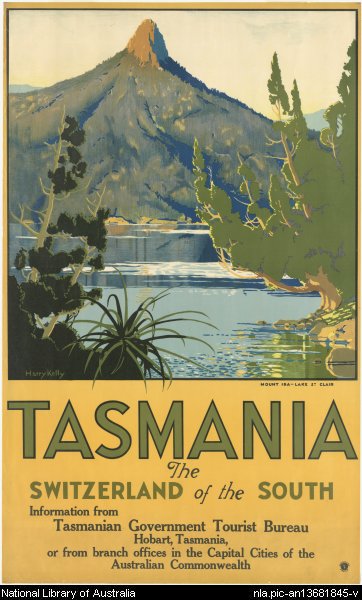
His comments appeared in the Mercury in September of that year. By November, ET Emmett, head of the Government Tourist Bureau, had commissioned one Harry Kelly to design a series of posters to spruik our island as a serious destination for the Australian tourist pound. What Harry produced are treasured as a pinnacle of advertorial art, with his product having a serious impact in an era way before television and the World Wide Web.

Harry K was a Gallipoli veteran, a resident of Kempton and prominent in local artistic circles. Because of his talents Cadbury at Claremont came to employ him as their art director. Later on he was prominent in producing recruitment posters during the war years, as well as garnering other advertising work.

kelly01

For his efforts in promoting our Tassie, he was duly praised in an edition of the Hobart newspaper in 1929 – the island was about to find out that it needed every penny it could muster from whatever source:- Tasmania is to be congratulated on the excellent posters that are being designed and printed within the State at the present time for the Tourist Bureau.  The one-sheeters advertising the tourist resorts are works of artistic merit.  The London underground railway has become noted for the series of artistic posters produced to advertise its various lines, and these have been so constantly sought for framing purposes that they are now sold to the public as well as used on hoardings. Two recent paintings by Harry Kelly, the Hobart artist, showing Lake Marion and a trout-fishing scene are worthy artistically of inclusion in such a fine series as that produced by the London underground. Among the Australian States Victoria has produced by far the most striking series of tourist posters but if Tasmania maintains the standard of its recent posters Victoria’s supremacy will soon be challenged.

Gaze on his work promoting the city under Wellington, the wilderness and the lure of the trout – it is still impressive, even in this era of digital complexity.

Recently I was able to view a selection of them in the flesh at the State Library – I refuse to address it under its new branding – and it can still be found around the traps as souvenir items in the form of post cards. Harry Kelly was a pioneer in the promotion of our beloved island and should not be forgotten by history.

Yoli's Cards

I am enamoured of cards as much as I am of writing letters. And of course the two can be combined – I love sending off missives to my mates. I probably somewhat swamp them with my predilection, but my friends are a tolerant mob and hopefully I am forgiven. Out and about I keep a whether eye open for greeting cards that enchant the senses – but, dear me, they’re getting expensive these days. They are now around the seven dollar mark for many of the nature that I prefer. That price is difficult to justify when they are purchased in the number that I like to. Some of the best can be found in our local book emporiums – Fullers, Dymocks and the Hobart Book Shop. Not so long ago I was down in Salamanca, enjoying autumn sunshine, when outside the doors of the last listed store I espied arrayed a number of boxes of cards – good cards – some at three dollars a hit, others at a wonderful single dollar. I was soon into them like a moth to the flame. Since then, each time I am in that part of the world I pay the bookshop a visit and to my delight find that those boxes are regularly refilled with fresh designs – although, now with the chill winds of winter blowing, they are housed inside. Even more to my budgetary pleasure a new sign has appeared. They have been further reduced in cost. One can now choose ten beauties for the former cost of one, a mere seven bucks!

And that’s how I discovered artist Yoli Salmona. Occasionally one finds an image that particularly captures the attention and holds it. And rifling through the described boxes one Sunday morning, I found such-like from her.

Yoli-pic

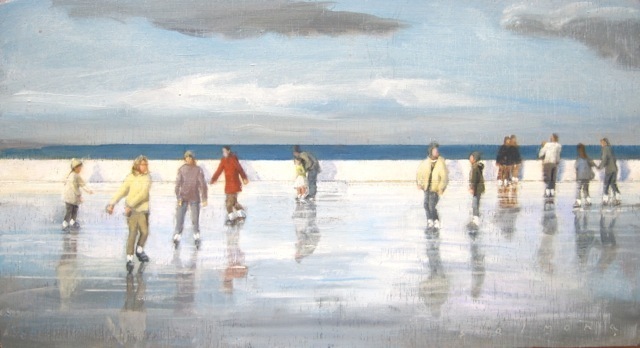
The card featured a summery-clad gentleman gazing out across a yacht-splattered Sydney Harbour, from a colonnaded balcony, towards the Bridge and Opera House. On returning home I endeavoured to track down that image on-line to no avail, but I did discover a little about the card’s producer and some more of her offerings. One that intrigued, from talented Yoli, was entitled ‘Bondi on Ice’. This was mainly because it was so at odds with the usual images we get, in spades, of the iconic strand. It’s a winter scene. Instead of golden sand and a dazzlingly azure sky, we are confronted with muted pastel heavens and a shivery, silvery beach. Instead of bikinied gals and budgie-smuggled lads, we have have a line of figures clad more for the bite of winter here on my island in the southern seas. And – look closely – are there skates on their feet?

Bondi_on_ice_study_-1349670291m

Like many of our best daubers, Ms Salmona hails form foreign shores too. In her case it’s France. Her initial training was in the field of fashion design and before the relocation to Oz, in 1986, she had plied her craft in Los Angeles and Tunisia, as well as Paris. A new country bought a change of tack as the markets for her previous oeuvre dried up with the tough economic times in the nineties. She turned to oils as her new medium and was soon garnering success. Many of her works continue to be taken up by card companies world-wide and she exhibits frequently. Yoli S has also won several prestigious awards. She teaches portraiture in Sydney and the latest string to her bow are what she terms ‘floor canvasses’ – having her product printed on rugs. So I invite you to check out what Yoli Salmona offers on-line and if you share my predisposition, you may even find her on a local card-of-quality rack at a vendors near you. I agree with her sentiment that art, such as hers ‘…can enhance the experience of everyday living through pleasure addressing our senses or a particular aesthetic, and our sense of humour.’ She did that for me one morning down at Salamanca.

Yoli Salmona - Rendezvous_avec_B

A gallery of Yoli’s works = http://www.absolutearts.com/portfolios/s/salmona/

A Model Story

Let me take you back to an eve before the turn of the century. No, not the last one – not the one most of us witnessed. It’s to the one before that – the night the nineteenth century became the hundred years the same number of us were born into. It’s to London we’re going, to Hammersmith to be exact – although some of the tale is set around Picadilly Circus, about eleven clicks from the small terraced house in Musboro Road West. It’s a cosy two up and two down with latrine/laundry out back in the tiny yard. That night, on the other side of the globe, gas lights cast an eerie pall. Light snow is flurrying around together with the smuts of factory detritus. If we peer into the front room of the tiny abode we are able to discern a figure haloed by firelight, seated in an ancient, faded lounge chair, covered in blankets. He has a woolly cap pulled down low and a bristling; grey-stained moustache can be discerned. This overhangs a mouth clenching a briar-pipe, exuding a thin spiral of tobacco smoke upwards. The face is deeply lined; his hands, clutching at the blankets, indicate they have rarely been idle with their callouses and grimy nails. Beside him there is a bottle containing a dark liquid – more than likely porter. This old fellow is obviously a man of working class tastes, although the room is far from gimcrack. There are items that look as though they may even be of some value today, especially a few works on the wall that could be from artists of fair repute. Beside the porter bottle is a small framed photograph in sepia. It’s of a much younger man, handsome and virile in appearance. The old fellow in the glow looks warm enough and seems to be dozing. He doesn’t know it yet, but this man will live on till the second year of the Great War, will soon see the death of his old queen and see out her son, the new king, as well. Finally he’ll witness the cream of his nation’s manhood march off to the killing fields of Flanders.

angelo colarossi_by_julia_margaret_cameron

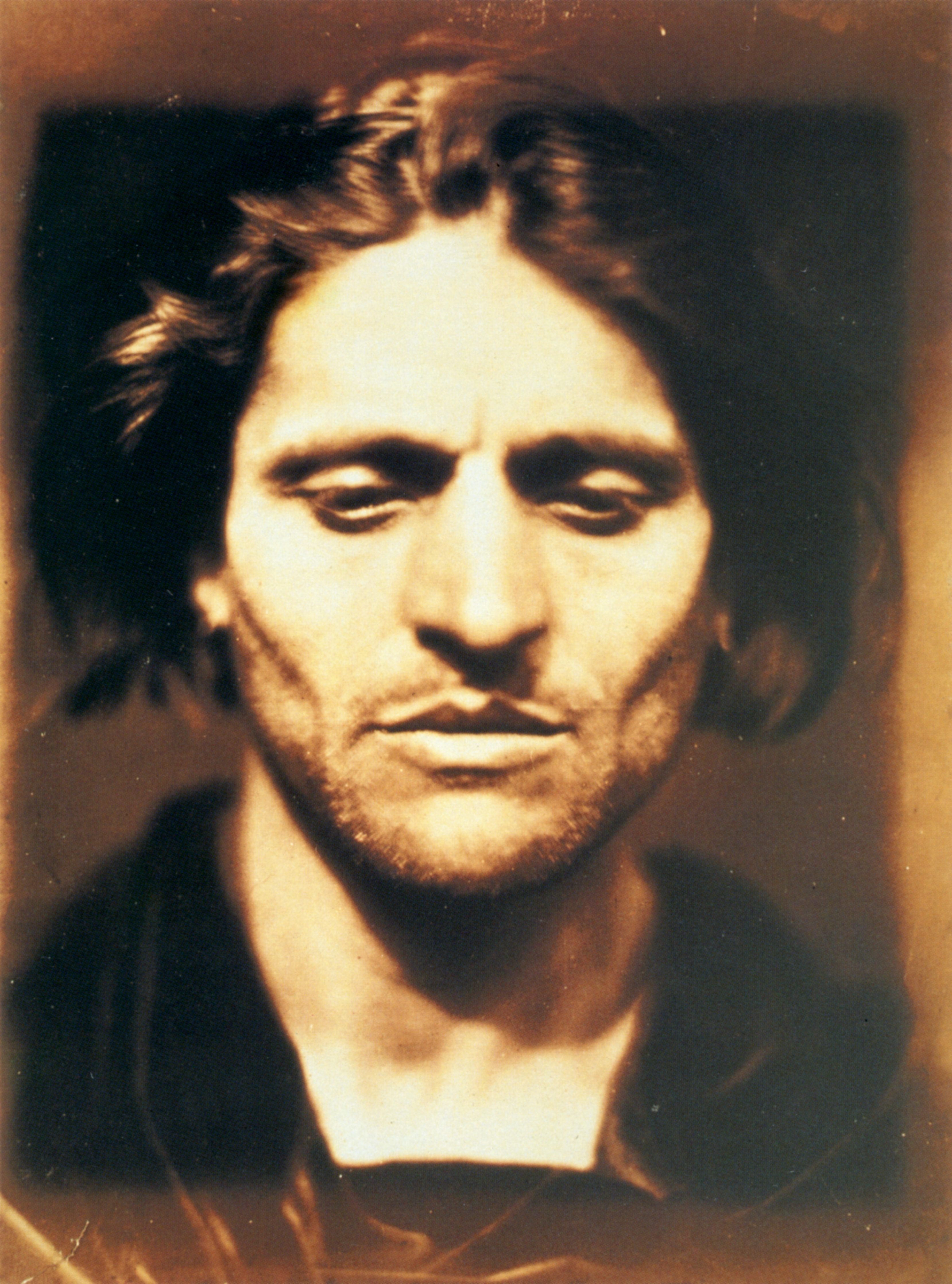
Look and see – his eyes are indeed closed, but he will stir and take another puff, or a sip of the ale from time to time. He will also routinely check his fob, pulling it out by its chain from under his coverings and squinting at it in the dim light of table-side lamp. He wants to see in the new century – he vowed he would; he’s determined to. He nods at the watch – still a while to go so he returns to his reverie in the gloom. First he turns to the small sepia image and yes, we can note a sigh and slight smile for it is a reflection of his own manhood from a long time ago – a time when he was considered the go-to person for all the artists in the area if they wanted a sturdy soul to pose for their works. Some went on to be recognised as amongst the Victorian era’s greats.

colarossi01

If we could now penetrate into the workings of Angelo Colarossi’s mind, we could read the nature of his thoughts as they worked their way back through the recent and not so recent past. They would inform us of the day he’s just experienced – one he regards as singularly memorable. On a daily basis he does keep himself busy. He is still called on to stretch canvas and help out odd jobbing in artists’ studios, with occasionally there being the need for an older man to pose – but these days he has largely lost his knack for stillness. Around the Hammersmith markets he can be seen still lending a hand to various stall-holders and it all adds up to keeping him going. His surviving offspring chip in too – but today was a period of freedom from his labours with it being the last hurrah of the old century. His son, also Angelo, came calling, with a young lass in tow to introduce. Four years on Angelo Junior would marry his belle and provide Mary Anne and he with more little ones to add to the ever increasing brood. When he thinks of how many there’d have been if all his own had survived a frown clouds his face. Still, six did and he’s mighty glad of it. His Mary Anne was sturdy of hip, but this sweet slip of a girl has the waist of a wasp so he can’t believe, when the time comes, how she will ever manage. His own Angelo is also so slight he marvels how he and his beloved wife ever came to produce him. But his father did give him one of his own great talents – his own knack of stillness.

That very day the foursome had travelled by omnibus and on foot to view the result of this talent – to look at it once more – at his son, Angelo Junior, high in the sky over Picadilly Circus. He’s atop the memorial to Lord Shaftesbury. His slim, undersized son is up there, perched on tip-toe, one leg extended back, with bow in hand. None that day would know that later generations would name his likeness Eros. Few models could have posed so agonisingly for the length of time required as young Angelo, not even, the elder one suspects, his father back in the day. But he managed to do so as the sculptor, Mr Gilbert, hacked away at the stone that would provide the moulding for the aluminium-cast final work. The artist intended it to signify mythical Anteros, the god of requited love, but the populace were soon to be convinced it was of his more lustful brother.

Piccadillycircus1896

The man by the coal fire reflects on the stories of various sittings he had told that day, once they had retired to a tea house near the Circus for refreshments. At first the four had talked of the marvels of the age – the noisy horseless carriages that were starting to appear on the byways and the planned extensions to the Underground railway. It had reached Hammersmith some years back, but the son had yet to convince his father that it was safe to travel on. The younger man lovingly chided him for his stubbornness on the matter. The boy related how he had read somewhere that now everything had been invented that possibly could be and the old man nodded in agreement. Little was he to know that, in the second decade of the century about to dawn, his son would be helping to construct heavier that air machines to fight a terrible war.

The father and son regaled the young lady with the tale of how they had posed together for a painting by Mr Leighton of the sea giving up its dead. The son spoke of his times modelling for Mr Waterhouse and the senior family member his own times with Mr Sargent and Mr Millais. He told of the occasion he had to pretend to be wrestling a python for Leighton, how the sculptor had rolled up a mat for him to hold to represent the reptile. He always received a goodly laugh at its telling.

f-leighton-and-the-sea-gave-up-the-dead-which-were-in-it

The wee lass had then queried how her beau’s father had became an artist’s model in the first place. Angelo Senior by the fire, checking his timepiece one more time, had responded by returning right back to the start, to his Italian childhood. He came into the world in the town of Picinisco cradled in the picturesque Val di Comino, through which the road from Rome to Naples passed. His family were suffering financial setbacks and one brother had already struck out for London. He established himself as an artist’s model, amongst other things and was soon successfully encouraging Angelo to join him. Between that and working in the markets the pair were soon making ends meet. To further increase his skills, Angelo learnt how to stretch canvasses and he became a fair carpenter as well. He was part way through this tale when he noticed that his wife was beginning to fade and was nodding off – she had heard all this so many times before. Her husband did have the gift of the gab. Checking his fob he realised the afternoon was getting on, so he decided that it was time to say his farewells and get Mary Anne back to Hammersmith.

The son of Italy, in that faded chair we observe in the lamplight, twitches back to reality, pulls out his timepiece and observes there is still an hour and then some to go with his vigil. He upends his bottle of porter and takes a healthy glug, pulls at his pipe several more times and then casts his eyes again towards the little photograph. There was one story he hadn’t told that afternoon – the strangest, most wondrous of all.

jmc

For a while he had assumed she was mad this short, squat woman he had been taken to pose for on the Isle of Wight. Tennyson, the old man marvels – it had been the great Lord Tennyson who was responsible for him being there. By that only just flicking flame on the last night of a century the old man shakes his head at the grand times he once was privy to, but none surpassed those few days at a residence called Dimbola Lodge off the southern coast. Tennyson was neighbour to this woman – a very strange woman obsessed with a new art. He reflects on how these days it is so commonplace for folks to go to a studio to have their portraits taken by a professional operator. There are post-card sellers on every corner in his city, plying their pictures of great sights and the latest music hall stars. He knows for a few extra coins, a nudge and a wink most of those vendors could produce, from a secret place, some purely for a gentleman’s pleasure as well. But back then all that was in its infancy.

It was Mr Millais going down to the Isle to stay with his friend, the poet, that was instrumental in it all. One day Tennyson took him across the lawns to meet the woman and she insisted that he sit for a photographic portrait. He remarked to Angelo later what a complicated process it was. He had become bored and unthinkingly adjusted his position for greater comfort, only to have her admonish him most sternly. Eventually a successful image was obtained – but like all the rest he’d observed taken by her, it had a certain fuzziness. He still liked it, mind, but it was not like the precise images he’d seen up in London. Back then Angelo had no knowledge what was involved in making these likenesses – but he was soon to find out. When Millais commented on its lack of clarity to the woman she immediately took umbrage and started blaming him for being so twitchy.’Nobody around here can sit still for more than a minute,’ she bemoaned to the artist. It was here that Mr Millais informed her that he knew a man who certainly could – that she needed a professional sitter. That, of course, set the train in motion. The woman sent her man up to London to make the necessary offer – and before he knew it he was taking the steam packet to the island. He reflected on his first meeting with her – there were no ‘how do you dos’ or offers of tea – she just told him that it would all have to come off. He chortles at the memory. He had posed nude on several occasions and had assumed she was instructing him to dispense with his clothing – but soon it became clear that it was his moustache that would have to be foregone. Apart from it he was clean shaven, but she then pronounced her Iago would have to have stubble – therefore she would require him to stay until an amount she considered sufficient grew. She alerted him to the fact she would pay him handsomely if he followed her instructions to the letter. In the end it wasn’t as handsomely as he would have hoped, given all she expected, but it was sufficient to make his trouble worthwhile.

julia_margaret_cameron_lord_tennyson

Tennyson by JMC

A few days later she declared he looked ‘Arab enough’, as she phrased it, for her purposes. In the meantime, he had come to know how odd her existence was on the island. She seemed to survive on air, so besotted with her image making was she. Her ageing husband simply spent his time wandering around in a greasy dressing gown muttering to himself. Angelo Colarossi took repast of basic victuals alone in his room, but was invited to tea and cake when the poet came calling to meet his friend’s recommended sitter and to inquire how it was all going. The woman seemed as abrupt with him as everyone else and soon wandered off to attend to other matters. He, though, found the Lord a most agreeable conversationalist – they found themselves very easy in each other’s company.

Came the day of the sitting she explained that, for the image of Iago, she required him to don a rough cloak and have his eyes downcast – certainly not staring at the camera. It took some time for her apparatus to be organised to her satisfaction and some time more for her to capture him with a blinding flash – that was the term she used, ‘capture’. She then stalked off to her chemicals to do her ‘developing’. When she graced him again with her presence she actually smiled. ‘That will show my colleagues in the London Photographic Society.’ When he asked what she meant by that comment, she informed him that, when she went up to the capital to attend meetings to critique each other’s product, they looked down their very long noses at her work, advising that, being a woman, she couldn’t hope to be as skilled in the difficult processes required as they were. And worse, they refused to include her in their exhibitions. Then brandishing a small copy of his image she exhorted,’This will show those feeble fools! You have given me something of character and clarity. I dare them to mock your magnificent likeness! Thank you Mr Colarossi.’

Before his departure the next morning Angelo Colarossi received two gifts. Tennyson sent over a slim volume of his poetry inscribed with the wording, ‘To the man who makes an art of stillness.’ And Julia Margaret Cameron herself presented him with an ‘Iago’, complete in gold-leafed frame. Both items he treasures to this day. For he was young back then. And with the small memento he can not only remember, but see the man he once was.

He often wonders what became of her – of Mrs Cameron. He once heard from an artist friend that she had decamped the Isle and headed for the Orient to pass her final days, but he knows no more. And as we take our leave of Angelo Colarossi, in his small abode, we see that indeed the midnight hour has has finally arrived. He stands and stretches, takes the little image in his hand and stares at it for a few seconds. He then replaces it on its chair-side table, bends to dampen down the fire before heading to the stairs and his Mary Anne.

In truth our Angelo still has much to look forward to in the new decade that has now arrived – and beyond, till a war takes its terrible toll. There will be weddings and more grandchildren to celebrate, visits to view the windows of great new stores such as Mr Selfridges’, moving pictures to marvel over and he will see men taking to the skies. Why, in the years to come, there will even be women agitating over the right to vote.

ellen terry_by_Julia_Margaret_Cameron

Ellen Terry by JMC

As we move back through the decades to our own time we can only wonder what Angelo would make of the value of that tiny image today, let alone the others she took in the ten short years of her obsession. Nowadays we observe the portraits of the famous Julia Margaret Cameron ‘captured’ – with their lack of focus that we contrarily regard as part of their allure. Think of the names – the poet laureate himself and Robert Browning; artists Sir John Everett Millais, Dante Gabriel Rossetti and Sir Edward Burne-Jones – and even the remarkable actress Ellen Terry. As well there are her interpretations of historical scenes and romantic imagings from the works of Shakespeare. There are also a rare few from her time in Ceylon where she and her husband journeyed to on self-imposed exile. There she passed away in 1879. All this legacy was taken by her in a few short years from the 1860s on. In our digital age they are so ethereal – so dated by our standards, yet ‘Iago’, methinks, could have been snapped yesterday. Thousands gaze at her work in great galleries – books are devoted to her and the world has access to her portraits at any time of day on-line. Julia Margaret Cameron is now rightly regarded as a pioneer of an art form and for a woman’s place in the world.
Don Draper and the Artist from Oz

At time of writing, all across America, in lounge rooms and in bars, farewell parties/wakes are being held. By the time these words make it to blog we’ll know how it will end – whether it’s with a bang or a whimper? As the final episode makes its way down the digital pipelines of the nation and is devoured, goodbyes will have to be said to the characters that have become part of the social fabric of the land. Goodbye Dan Draper. Goodbye Joan Harris. Goodbye Roger Sterling. Goodbye Pete Campbell. Goodbye Peggy Olson. Goodbye….

don d

There are some shows that are so good we just don’t want to let go of them – shows that, like good wine, as they progress through the various seasons, the viewing public never looses its taste for them. In recent times, from the US we have seen that in small screen productions like ‘The Sopranos’, ‘West Wing’ and perhaps ‘Breaking Bad’. Internationally there’s the behemoth that is ‘GofT’. ‘Vikings’ and ‘Borgen’ are on my personal list. But I really have a problem with final seasons. I find it very difficult to bring myself to watch their terminal runs. I have a list of these – ‘Californication’, ‘Boardwalk Empire’, ‘True Blood’, ‘Weeds’ – it’s such a wrench to think there’s no more Hank, no more Nucky, no more Sookie and Bill, no more Nancy Botwin. Therefore they remain unviewed on my DVD shelf. But I reckon none of these will be as difficult to say adios to as Don and the crew. Don Draper, there is no doubt, is one of the great flawed characters ever created for any medium – as flaw is tipped on flaw as the show progresses through time from the late fifties into the seventies, so we become ever more in his square-jawed thrall. As well, Christina Henricks has sashayed into our lives, displaying all the glories of the fuller figured woman and bringing her ilk back into vogue. We have the icily detached January Jones as the first Mrs Draper and those of us who watched will never forget the second’s (Jessica Paré) serenading of her philandering hubby. It was a great ‘Mad Men’ moment to rival the day the ride-on mower was let loose in the offices of Sterling Cooper Draper Pryce.

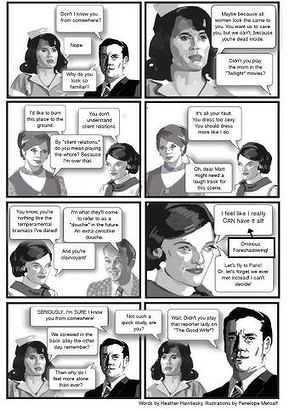
There’s an Aussie artist who doesn’t even particularly like ‘Mad Men’, but nonetheless is garnering fame because of the show. She reckons Don and his male colleagues in the advertising firm are all complete tools. But soon she, too, will be out of a job. For years she has been exhibiting on the Melbourne arts circuit with her architectural canvasses, described as a cross between Howard Arkley and Edward Hooper, as well as her portraiture. The latter have been lauded as, for the viewer, registering ‘… encounters beyond the frozen moment.’ (Robert Nelson). Track along to her website and see for yourselves.

penelope metcalf

On a recent trip to the Big Apple the Yarra City painter caught up with her good mate, US writer Heather Havrilesky over coffee and talk got around to the possibility of a joint project – one’s art, the other’s words. That sort of thing is possible these days, despite the duo living an ocean and continent apart. How on earth they managed to come up with their take on ‘Mad Men’. It’s a pen and ink comic strip surmising each episode of the seventh and terminating season? Perhaps, as the meeting wore on, they were partaking of something a tad stronger than coffee, but come up with that notion they did. Through the writer’s connections they eventually spruiked the plan to the folks at New Yorker magazine and they took it on for their web version. It’s popular, but of course its longevity has been limited. Will the pair move onto something else? They’ve already discussed ‘GofT’, but with its complexities of plot and myriad characters it’s unlikely they’ll proceed that way. Penelope Metcalf has declared that her own beloved ‘Parks and Recreation’ is out of bounds. We’ll stay tuned.

mad men metcaffe

They would feel, no doubt, as I do – nothing soars quiet like ‘Mad Men’ – like it or loathe it, one cannot discount its influence. It will leave a hole and it will be intriguing to see what, if anything, comes along to create the same long-standing buzz. If I cannot quite bring myself to watch the aforementioned’s last suites of episodes, how will I cope doing it for the show I love the most? It’s just so hard letting go.

Penelope Metcalf’s website = http://www.penelopemetcalf.com.au/

Columnist Ruth Ritchie’s response to the demise of Mad Men = http://www.watoday.com.au/entertaining-kids/tv-and-movies/tv-review-jingle-all-the-way-for-sad-mad-admen-20150520-gh4z5n.html

De Lempicka, The Last Nude and Ms Abel

She ‘...set down her drawing board, and leaned forward. When I felt her hair wisping against my face again, I inhaled sharply. When she kissed me I sighed….I had never kissed lips so soft. She stood and lifted the scarf off me. Her eyes were like silver. ‘Oh?’ she said, holding the scarf in the air, the pale chiffon with its darker, wet bull’s eye. I closed my eyes, abashed. I couldn’t open them. I heard Tamara set her rings deliberately on the table before she said, ‘What’s going on here?

I know where there are a couple of stands of them in the city – one in the foyer of the State Library, the other at the entrance to the Long Gallery, Salamanca. It was at the latter I spotted those particular cards as I mounted the stairs to see an exhibition. I instantly recognised the artist’s work on them – or, at least, I thought I did. ‘I wonder why they’re advertising de Lempicka,’ I thought to myself.

Avant postcards are in similar stands at numerous locations all around the country. They give notice of upcoming events or, more excitingly for me, feature the work of artists and photographers trying to get their name out there into the public domain. As I reached for a handful of the cards I’d spotted, I soon saw they weren’t an example of the oeuvre of the artist I had in mind, but the work of another entirely. You could see, though, this painter was under de Lempicka’s spell, as I have been for some time now.

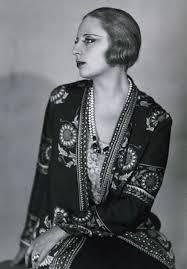
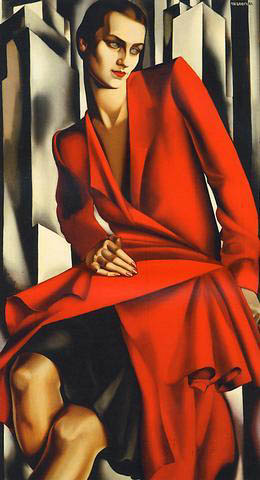
Think paintings that best represent the art deco style and more and more art fans think of the ‘baroness with the brush’, Tamara de Lempicka. She was the most fashionable portraitist of her generation. Celebrities lined up to be painted by her, but the Depression saw her popularity wane, only to be revived in the final three decades of the last century and into our new millennium. She is well and truly back in vogue, her daubings instantly recognisable and these days, ubiquitous.

de lempika

The artist was born Maria Górska in Warsaw in 1898. She was of Jewish background surrounded by wealth. The future Tamara de L attended boarding school in Switzerland and during her formative years lived in a variety of places, including the French Riviera and St Petersburg. She spotted the man she intended to marry at age fifteen and did so three years later – Tadeusz Lempicki. He wanted her for her money – not a recipe for success.

Come the Revolution and the couple were forced to flee to Paris, minus a significant proportion of their assets. Here Tamara gave birth to her daughter Kizette and became immersed in the bohemian life of the city, soon entranced by Picasso and the Cubists. She took to the brush to try and make a crust – something her layabout hubby thought beneath him. She was a quick worker, soon finding a populist approach to her renderings – one that would readily sell, it turned out. After 1925 she was exhibiting all over Europe and was charging top dollar for her portraits to boot. She fell in lust with many of her sitters. Even the notorious Gabriele D’Annunzio came under her spell, although it seems he failed to bed her.

She owned the Roaring Twenties like few others. If Gatsby was the male epitome, she was the female. She mixed with Cocteau and Gide, Collette and Sackville-West. She was also flamboyantly bisexual, neglecting not only the wastrel Tadeusz but also her daughter. She soon had a rich man as both her patron and sugar daddy. Travelling to the US was also on her agenda – here she fell in with de Kooning and Georgia O’Keeffe. Later on she married her older suitor, Raoul Kuffner, thus gaining her title, Baroness. With the advent of the second great war her star had well and truly diminished but, undeterred, she kept painting, trying out new styles to an unresponsive public. She also moved permanently to America, paralleling a move into prickly old age. The end saw her residing in Mexico where she died of a stroke in 1980. Her ashes were spread on Popocatepetl. She did live long enough to see her work reassessed by the artistic trendsetters, who declared that owning one or more of her works definitely put you front and centre amongst the in-crowd. These days her collectors include Madonna, Jack Nicholson and Barbra Streisand.

de lempika02

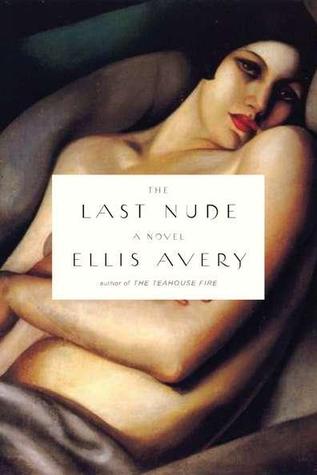
The opening paragraph of this scribbling is taken from ‘The Last Nude’ and are the initial sentences to a description of a lesbian coupling between the painter and one of her models – what follows is very saucy indeed. Ellis Avery’s novel is based on the main facts of the great woman’s life, but the gaps are filled in by supposition. The work received, on publication, rave reviews and several prestigious gongs in the United States. Reading the four pages of recommendations that prefaced the story in the book, as I perused it in a Melbourne bookshop, I felt I must be in for a real treat and rushed to the counter to purchase. I enjoy novels that do add made up substance to fact, plus it was about a favourite heroine, so what could go wrong?

AveryEllislast nude

Although I did manage to finish it, I really had to force myself to turn each page and refrain from skimming. I found it dirgeful, the writing uninspiring. Sad to say that the only time it came alive was with its few erotic passages – not enough to keep this customer satisfied. But it obviously struck a chord in America – so much so that Lempickaphiles can take a tour of Paris around its featured sites!

The major part of Avery’s offering is taken from the point of view of Rafaela Fano, an escapee from tight American strictures, enjoying the freedom the French capital affords. But she finds it struggletown too, even despite the seventeen year old’s willingness to use her body to achieve her ends. Life changes markedly when she is discovered by de Lempicka who offers to pay her to pose. Soon it is posing minus garments, apart from a well placed scarf – and before too long the two are intimately exploring each other’s body parts. As time proceeds both end up having much else on the boil as well, with the result that, at times, the plot and who was who lost me. I just wasn’t interested enough in all their scheming and machinations. The final part features the portraitist in her old age, contrary and cantankerous, with some her and Rafaela’s back story filled as bonus. The Washington Post describes ‘The Last Nude’ as ‘A compulsively readable novel.’ I found it anything but.

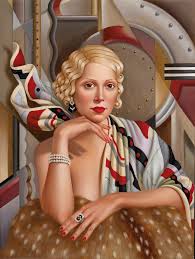
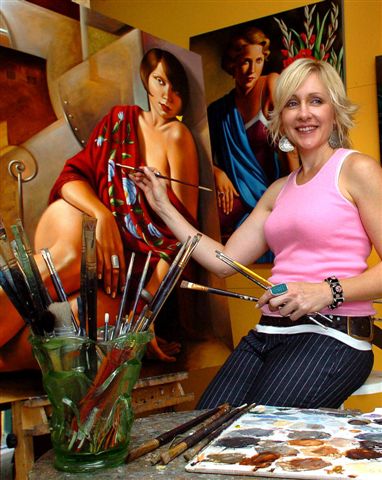
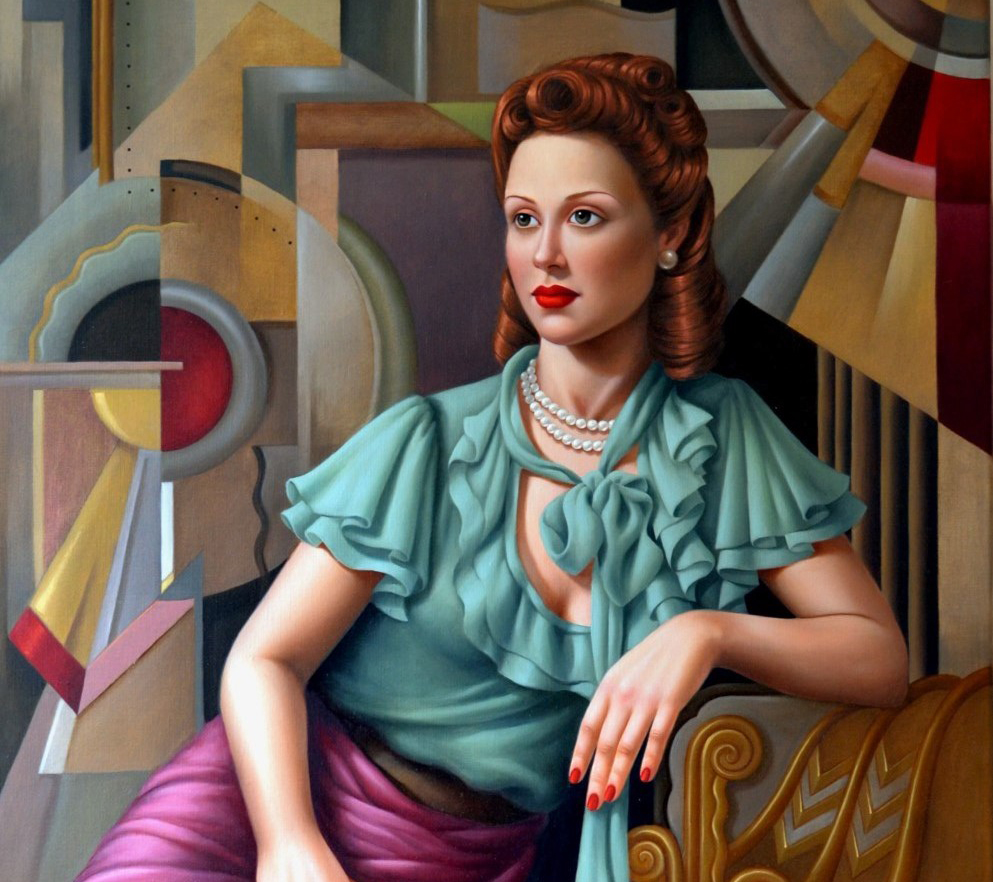
But the positive spin-off is that I discovered the postcards and through them, at the top of the stairs in the Salamanca Arts Centre, Catherine Abel. The card I initially took to be a de Lempicka was in fact Abel’s ‘La Femme en Soie’, an example of her expertise from only last year. It features a cool blonde, presumably from the Flapper Age, peering out at the viewer, draped in striped silk (soie), bejewelled and enticing. Up in the ether I found much more to like from this artist who readily admits the debt she owes to the daubing baroness, as well as to Picasso, Braque and Dali. This Australian has indeed honed her experience by travelling to Paris and has been a finalist for the Archibalds. She describes her infatuation with de Lempicka by likening her to ‘…the teacher I never had.’ It was seeing the Baroness’ masterpieces during her overseas sojourns that inspired her to attempt to paint for a living. As well as Abel’s figurative work, there are still lifes and landscapes to be viewed on-line. But its certainly her stunning capturings of the feminine form that stand-out, as is the case with her role model. So if you too fancy the work of the icon of the twenties, check out her modern day acolyte. Beware – for, as with de Lempicka, some of her product is NSFW.

abel la femme catherine

So the disappointment of the book has been offset by discovering a new artist to follow the progress of with interest. And if for me Avery’s book didn’t capture the spirit of T de L, Catherine Abel certainly does.

abel01

Gallery of Catherine Abel’s work = http://www.catherineabel.com/

Gallery of Tamara de Lempicka’s work = http://www.tamara-de-lempicka.org/

Ellis Avery Website = http://ellisavery.com/

A ‘Last Nude’ tour of Paris = https://americangirlsartclubinparis.wordpress.com/2012/01/25/the-last-nude-a-literary-tour-of-paris/

Of the Madame and the Eye of the Granddaughter

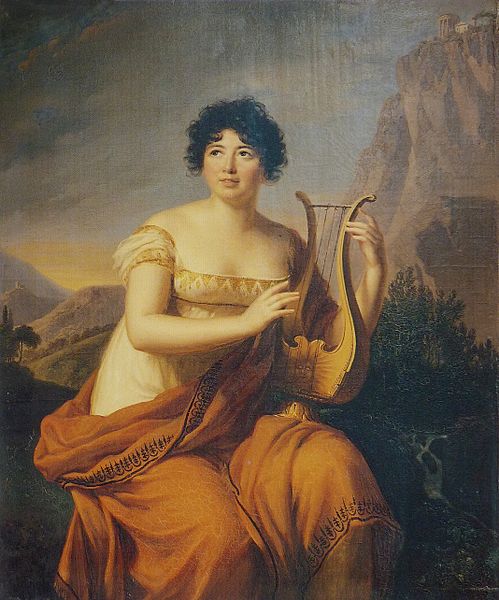
Madame_de_Staël by  Firmin Massot

As you may judge from Firmin Massot’s portrait, Germaine de Staël (that’s the abbreviated version – her title in full is Anne-Louise-Germaine Necker, Baronne de Staël-Holstein) was not conventionally beautiful for those times or even ours. But she had a certain something – call it charisma, call it money, call it intelligence, call it needfulness, call it notoriety – it all came with her territory. She was always in the news, such as that was in those times, getting up the nose of the powerful. She took on Napoleon and saw him off. Her views on liberalism, divorce, the superiority of the British and German character and the virtues of Protestantism didn’t make her flavour of the month in Catholic France. In the end her ruffling of feathers saw her banished from the place. But despite this, or maybe because of it, she attracted men like moths to a flame. And she didn’t like letting go once she got her clutches in – all of her conquests were expected to tend to her sexually for life. It was not uncommon for her to have five live-in lovers on the go at once. These men were writers, philosophers, soldiers – even the occasional statesman. Her voraciousness in the bedroom became legendary, but it was through a granddaughter’s eye that I discovered her – out there in the ether.

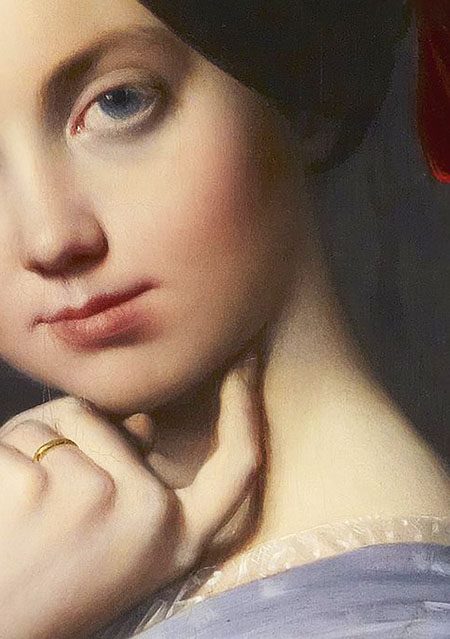
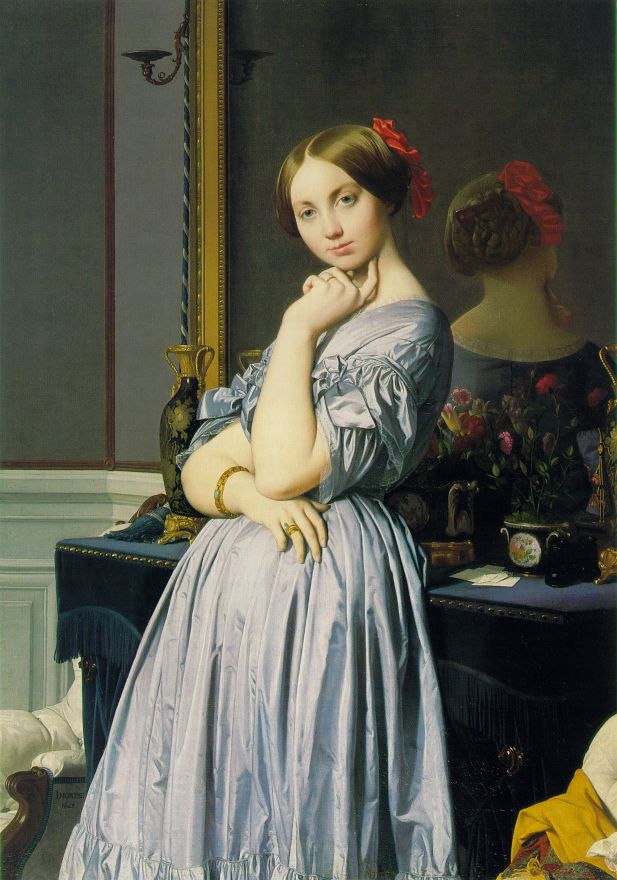
There is what I consider to be a stunning Facebook page, that I am constantly exploring, called the ‘Musetouch Visual Arts Magazine’. It caters to those of us, probably the most of us, who are partial to timeless feminine beauty – and associated objects. On this day it was merely a segment of a work of art that caught my attention. There was a blue-irised eye framing a dilated pupil, with what I took to be a come-hither look. There was an abundance of alabaster skin and a finger crooked enticingly under chin. A folded digit wore a narrow gold band. There was the hint of a garment of blue satin. I had to know more.

 comtesse d'haussonville

From the fine print I established her name and a link to her portrait in full. The subject was Louise, Princesse de Broglie, Comtesse d’Haussonville – what fine titles these ladies possessed back then – and she was the granddaughter, the information was quick to point out, of Madame de Staël. I had vaguely heard of her, so I determined to investigate her more fully once I was done with Louise.

These days the granddaughter, if she has any fame at all, it is as the woman gracing a glorious Ingres’ 1845 rendering. Louise was born in 1818, married off at 18 to a member of the French Academy, thus, as with her grandmother, ensuring she moved in rarefied circles. Though she never achieved her ancestor’s high station in history, Louise was no slouch, publishing several tomes, most notably a biography of Byron. She devoured books herself, regularly attended the opera and was inspired by her acquaintance with Chopin to master the piano. She was also a dab hand with the paintbrush. And reportedly, she was down to earth and most approachable for a woman of her standing in society.

And as for the painting itself – well neo-classicist Ingres (1780-1867) was a perfectionist and prepared with numerous sketches of the lady before he committed to canvas. Even so, the great man considered this to be a side-project and kept interrupting its completion to attend to what he considered greater works. This was not aided by Louise’s travels combined with, to Ingres, an unfortunate pregnancy. The artist completed his first sketch for it in 1842 when the sitter was just 24. The whole shebang was not completed till three years later. It was immediately a hit with Louise’s family and her set – it is now regarded as one of the master’s masterpieces. If one reads the art-wank, the pose can be traced back to Roman times with ‘…the chin supported by the hand, the gaze that looks not so much at us but through us (so much for my come-hither assertion), the look of a privileged and uninterrupted abstraction.’ (John Russell, New York Times)

louise-de-broglie-

Much of what was on-line referred to the painting and not what I was I was really interested in – the woman herself – so my thoughts returned to the grandmother. Why was Louise’s relationship to her noted by every commentator I read under Google’s banner? She must be worthy of a look. Judging by my opening paragraph, she certainly was.

Massot (1766-1849) was certainly no Ingres, but this Genevan dauber was operating around Lakes Geneva and Lausanne at the time de Staël was in residence there, so he was the best to be had. The Madame invited him to attend to her villa and stay awhile in 1794. Were they lovers, given her proclivities? That is not recorded, but we do know that the following year Firmin, aged 28, took a seventeen year old as his bride. But, given the era, we cannot read too much into that. Interestingly, he and his subject were exactly the same age as she too was born in 1766.

Her father was a finance minister to Louis XVI, her mother an icily formal leading light in the salons of Paris with little interest in her daughter. Young Germaine grew up simply besotted with her father. At twenty she was married off to a Swedish diplomat, allowing her to attain the de Staël-Holstein part to her appellation. It was a loveless affair – he got his kicks elsewhere as did she in spades. He rarely shared her boudoir with only only one offspring being produced. She was frequently pregnant to other lovers but the good man was always by her side to keep up appearances out in public. She produced another four children in amongst miscarriage and stillbirth. The most intense relationship of her life was with Benjamin Constant, a Swiss writer who hung around her for twelve tumultuous years, most spent spatting with de Staël. He based his best known novel, ‘Adolphe’, on her.

As her hubby was ambassador during the Revolution, her diplomatic immunity enabled her to survive the Terror unscathed. To Germaine’s credit she was instrumental in organising the flight of many royalists away from the blades of Madame Guillotine. Many of these aristocrats were to join her in exile in Switzerland when her outspoken views enraged the Little Corporal. Even in a foreign country Napoleon’s spies kept watch on her, so dangerous was she perceived to be to the state. Her husband’s death did not slow her down as she remarried, this time to an Italian soldier twenty years her junior. On the demise of Bonaparte she returned to Paris but could raise little enthusiasm for the Restoration. By now she was addicted to opium and in 1817 all her excesses caught up with her. She died in her sleep of a stroke.

Her writing, of course, lives on – even recently, for the literary purists, coming back in vogue. Her best known publication is 1802’s ‘Delphine’. It was a huge success when it hit the stands, telling of a beautiful woman who sought happiness through love. Unfortunately its popularity caused the Emperor to read it. He was singularly unimpressed by the outbreak of feminism it contained, so it contributed to her banishment. These days her works are viewed by those in the know as from ‘…the struggle of an exceptional intellect trying to the transcend the social and creative constraints imposed on women of her time.’

These were two remarkable women, Louise and the Madame. One’s beauty will live forever due to the efforts of a great artist, the other’s creativity and zest for life will ensure history remembers her. And, as I cast my own eye back over that sublime image that first attracted me to their tales, I wonder what either would make of the advances of their gender in our own century – not that misogyny has been completely eradicated. I am sure, though, they would be rightly gobsmacked. They helped set the scene.

Exhibition – Essie's Dad

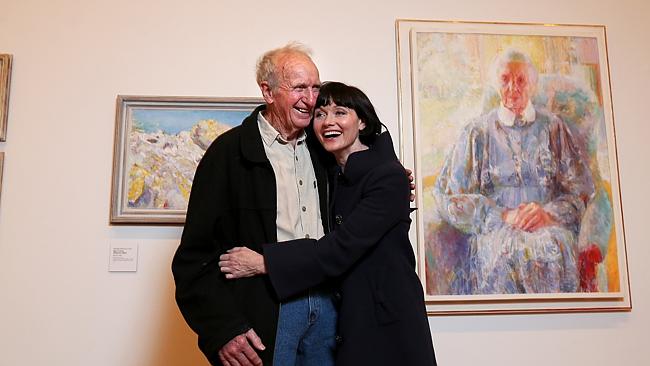
You notice it as you drive up Sandy Bay Road and come to stop at the lights where this thoroughfare intersects with Davey Street – or, then again, maybe you don’t. It’s kind of muted, as befits the period in which it was made, with 123,000 Italian glass tiles. It took him two years to create it. When it was finished, in 1960, it was an early harbinger of the symbol that went on to be now instantly recognisable as that representing the organisation for which the mural was laboriously pieced together – our ABC. It’s on the street-face of the building that once housed Hobart’s vibrant branch of Auntie – vibrant until Abbott and his cronies finally gutted it in the state by dispensing with its long standing current affairs show. These days 5-7 Sandy Bay Road is the home of the Conservatorium of Music, still flanked by that mosaic, now over fifty years standing. It is a tribute to the artist who painstakingly put it all together – Essie’s dad, George Davis.

dais and essie

Essie, of course, is the locally produced star of stage, small screen and international film – most prominently, in recent times, as the lead character in ‘Miss Fisher’s Murder Mysteries’ for none other than the ABC – another season coming soon. Essie was with her old man at the opening of an exhibition in tribute to George at the TMAG late last year. Present, gracing the walls, were his original designs for that mural.

Our city once more turned to George Davis after the 1984 fire that almost led to the destruction of Hobart’s shining symbol of its colonial heritage – the remarkable and irreplaceable gem that is the Theatre Royal. If you have reason to visit this wonderful little centre of our burg’s cultural life, look up to its dome and note the ten composers featured there – restored by Davis after the almost fatal inferno.

GD, in his early days, was a student of Jack Carrington Smith, head of the Tasmanian School of Art from 1940 till 1970 – a local legend. Early on Davis’ skills were recognised, so much so that the state government awarded the youthful dauber a travelling scholarship, to London, to further hone his talents. There are some works from this early UK period on show. On his return George took up various contracts with governmental organisations, these taking him to places such as Macquarie Island – on the Nella Dan no less – and remote islets of the Furneaux Group. He then sketched and put to canvas scenes, particularly of the wildlife, he witnessed at these isolated locations.

davis blueeyes_lg

George Davis is a bit of a throwback to another era and one can discern this by the exactness of his sketching – he was/is a meticulous practitioner. He was also a popular portraitist – there is nothing flashy or eye-catchingly ostentatious about his work, either, in this regard. It’s all calm and precise – just as his mosaic. It’s the type of art you’d maybe notice on the wall in one of the offices of the ‘Mad Men’ alumni – designed to not only to enhance but fit in, not to steal the show by shouting back at you.

In truth, my visit to the Tasmanian Museum and Art Gallery was for another reason – to view the cricket memorabilia, from the likes of Boon and Ponting, open for display there to celebrate the World Cup games soon to get under-way across the river at Bellerive. That, when I entered, was all tied up with its official opening – so I beat a hasty retreat and soon found myself lost in George Davis’ world. I stood, looking at his loving sketch of his daughter, so pleased that, in the end, he had waylaid me for an hour or so with his albatross chicks and penguin skulls. Matters cricket can wait for another time.
EssieDavis

Exhibitions – Nudes and Landscapes

It was not the deliberate visit many others were. I like exhibitions at Salamanca’s Long Gallery, visiting them reasonably often, with the neighbouring Sidespace also featuring as well due to its proximity. On this occasion, adored granddaughter needed a pit stop, which just happened to be opposite the latter viewing space so, whilst waiting, I wandered towards it.

Initially, standing on the outside looking in, I took what hung there to be photographs, so realistic they were from that distance. Suitably enticed, I entered the space and was surprised to discern the stunning nudes were wrought, so deftly, in pastel.

Stephen Firth completed these exceptional renderings, of an array of wonderfully local models, between 2011 and 2013. He’s an architect, resident in Hobart for some forty odd years. He has been participating in life drawing classes for thirty of these – and clearly has honed his skills to a very fine degree. I was impressed. Such a collection of naked or scantily clad feminine flesh could appear confronting on first take, but there was nothing salacious about what was on offer to the eye with this the artist’s second exhibition. What I espied there, in that gallery, that day I’d best express, in words, as being just simply beautiful.

firth09

As the artist was in residence and with the bulk of Hobart’s population either at the Wooden Boat Festival nearby, down at the docks, or at Salamanca Market immediately below, his exhibition was hardly drawing a bumper crowd at the time of my presence. The Long Gallery was also devoid of an attraction and I asked Stephen if this was affecting his own prospects for sales. Her reckoned that was possibly the case, but as something was due on show next door in the oncoming week he was hoping it all might improve. Although I didn’t query him on it, I did wonder if his choice of subject matter may also be be a limiting factor – even in this day and age. In an ideal world I would have added a red dot for my favourite, but there’s no surfeit of wall space in my household. He’d sold a couple of works on his opening night and professed contentment with that. I thought, at around the $1500 mark, they were good value for those with space (or cash) to spare. I went on to ask a couple of questions to which he responded in artists’ speak, but it was clear he was serious about what he hoped to achieve by having his models make ‘…eye contact with the viewer.’ He praised the virtues of the Conté crayon as his medium and I congratulated him on his skill with them.

My conversation with Stephen Firth then moved on to the last showing at the Long Gallery where, again in my dreams, I would have been making purchases to grace the walls of Lovell’s Riverside Gallery.

Our beloved island, as well as producing beguiling subjects for figure studies, can trade, as well, on its unique natural panoramas – panoramas that are attracting overseas snappers to our southern shores as well as giving the local brigade ample subject matter. Held from the 22nd of January till the 5th of February, ‘Island Light’ was curated by prominent camerasmith Wolfgang Glowaki and featured the alumni of the local landscapists’ scene – such names as Mathew Newton, Dennis Harding and my personal favourite, Luke O’Brien. As well as those I was already well familiar with, there were a whole array of up-and-comers whose work, well, lit up the walls on the day I visited. Mr Firth was of the same opinion that with Arwen Dyer, Kip Nunn, Joshua Vince et al, the legacy of Olegas Truchanas and Peter Dombrovskis is well in hand. With the opening of Wild Tasmania, replacing the old and perhaps tired Wilderness Gallery, around the corner, as well as with tourism booming, the future for these gifted people being able to turn a buck would seem considerably enhanced. Glowaki himself has a new publication worth checking out – I am particularly partial to his macro work.

Banksia-flowers,-Mt-Field

Eventually precious granddaughter, with parents in tow, returned and so I departed Mr Firth and his engaging ladies. I followed up by examining his web site, readily available to all those not adverse to slightly NSFW material.

All this led me on to reflect on Kirsty Pilkington who has melded together both aspects mentioned above – she’s bought her nudes directly in contact with the Tasmanian landscape. Her ‘Bare Winter’ series – in book, card and print formats – has been around for some time – the tome gracing my own bookshelves. She also is a dab hand at animal photography, having a popular range of product in that genre also available.

bare winter

I wonder if Stephen Firth has any notion of publishing his nudes in book form. Those struggling for wall space would be a ready market – his nudes are every bit as appealing to one’s senses as the island’s glorious natural sea and land vistas. I trust he gained many more attendees to his exhibition in the days after I attended and made a few more sales to make it all worthwhile. His labours certainly gained my attention. Long may he render our womanhood in such an appealing manner. And long may the Salamanca Arts Centre attract us to diverse and stimulating artistic showcases. It is a valued adjunct to TMAG and MONA, helping make to our magical city an artists’ haven with increasing clout.

Stephen Firth’s website = http://www.stephenfirthartist.com.au/

Luke O’Brien website = http://www.lukeobrien.com.au/

Wolfgang Glowaki website = http://wolfgangglowacki.com.au/

Kirsty Pilkington website = http://www.kirstypilkington.com.au/