All posts by stevestevelovellidau

The Blue Room's Year in Books 2014

This year has been all about Richard Flanagan who bought my island to the world’s stage, along with a Chinese President’s visit, accolades in various travel publications and the continued pulling power of MONA. Not only can we provide the freshest quality produce imaginable, give any visitor unforgettable experiences, but Flanagan showcased the literary talent that resides on this isle in the southern seas. His remarkable page turner, ‘The Narrow Road to the Deep North’, inexplicably missed out on the land’s premier award, the Miles Franklin, to a competent but far lesser tome. His incredible offering then went on to leave all competition in its wake, winning just about every other gong going, culminating with the planet’s most esteemed prize, the Man Booker.

It is significant that three of the tomes listed below also have strong connections to Tasmania, with the authors, either now or in the past, residents here. Some of the publications awarded below had their coming out into the world in previous years, but have only been caught up with by this reader in the last twelve months. All should still be readily available. As always this scribbler welcomes similar considerations from any other peruser as at this time of year many in the media, as well as on-line, are producing similar.

10 – The Dirty Chef (Matthew Evans) – the SBS personality gets down and dirty at his farm, on the outskirts of Cygnet, after having a gut-full of notoriety in the big city.

09 – Rescue (Anita Shreve) – this somewhat uneven popular writer comes back to form with a tight, intriguing effort.

08 – You’ll Be Sorry When I’m Dead (Marieke Hardy) – a regular on ‘The First Tuesday Book Club’ for Auntie, this feisty lady pulls no punches in this revealing memoir.

07 – Balancing Act (Joanna Trollope) – the grand dame of the aga saga writes to a formula, but it’s one that keeps her legion of followers loyal and she is on form here.

06 – Zac and Mia (AJ Betts) – Australia’s YA answer to the phenomena that is John Green and gives him a run for his money.

05 – The Black War (Nicholas Clements) – this youthful Tasmanian academic has the final say in this sobering account of the terrifying frontier conflicts of early Van Diemen’s Land.

04 – When the Night Comes (Favel Parrett) – the ever difficult sophomore novel proves a cinch for this promising practitioner with a tale of a Danish/Tasmanian connection that involves a ship rather than a princess.

03 – One Summer in America (Bill Bryson) – a remarkable American author spins remarkable yarns of a brief period in his nation’s story.

02 – Analogue Men (Nick Earls) – for those of us battling with with the vast changes the digital age has wrought, Earls’ comedic tome tells us we are not alone as it invokes chortles of recognition from those of us of a certain age.

01 – Writing Clementine (Kate Gordon) – this charming YA novel tells it as it is growing up in the author’s (and this scribe’s) North Western homelands, with a bit of steam-punk thrown in for good measure.

writing clementine

Also enjoyed and worthy of mention were ‘Sarah Thornhill’ by Kate Grenville and Charlotte Woods’

Kate Gordon’s Top Ten Books = http://www.kategordon.com.au/blog/2014/12/29/top-ten-books

Australian authors select their favourite books of the year = http://www.smh.com.au/entertainment/books/australian-writers-pick-the-best-books-of-2014-20141126-11u9m7.html

'Royal Affairs' – Leslie Carroll; Mistress – Matthew Benn and Terry Smyth; 'Loving Richard Feynman' – Penny Tangey

For the last week or so I’ve been up to my armpits in mistresses and been taken on most enjoyable rides. They were spread over three books, I hasten to add. Please excuse the excruciating puns – I should be ashamed of myself!

In two of the tomes the authors have dumbed down history to give rollicking accounts of various notorious tumblerers in the hay and the havoc they caused. These ranged from some very savvy gold-diggers to others as ditzy and thick as the proverbial. Some even found love with the objects of their attention. Some were secret – only exposed in later decades, others became infamous within their own lifespans. With some, it ran in the family. Some even changed the course of history. With the third listed title, the impact of a mistress on an everyday family is fictionally examined.

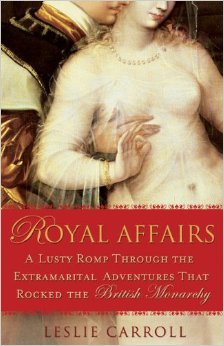
The lurid enticements, promised on the cover blurb for ‘Royal Affairs (Leslie Carroll), are not exactly forthcoming between the covers. Perhaps readers influenced into purchase by them would be disappointed at the lack of interior titillation. But what may be discerned instead are fine accounts of history-shaking trysts written in modern colloquialese that sets a fast pace, interspersed with brief first hand accounts in the language of the perpetrators’ times. The reader is never bored. Initially I thought I’d skip those connections that have been done to death by various forms of modern media – the dalliances of Henry VIII, Mrs Simpson and Edward VIII, Charlie and Di – but so well does Ms Carroll explore their machinations they also were not to be missed. From Henry II’s bedding of Rosamund de Clifford to our future (presumably) king’s Camilla, I discovered so much history I was completely unaware of. In this offering are the mistresses synonymous with temptation – Anne Boleyn, Nell Gwyn, Lillie Langtry and Mrs Keppel – but there are also a host more creating waves, from ripples to tidal, in their own times – many largely forgotten. We are informed of the randiness of Charles II – who had one mistress installed in the chamber immediately above his bedding room – and one immediately below. Then there was the weird sex life of George 1 with his much lampooned (during his reign) twin grotesques, a decidedly gay king (or two) and an obese lesbian monarch who only craved up close and personal affection. And, well, was she really the Virgin Queen? There are any number of (bodice) ripping yarns that would make for terrific television series along the lines of ‘The Tudors’ and ‘The White Queen.’ Full credit to Carroll for presenting them in such a lively, entertaining manner.

royal affairs

With ‘Mistress’ we come to home soil. In a series of vignettes authors Benn and Smyth take the reader through the history of Oz and the impact mistresses have had, not so much on the nation’s ‘affairs’ – although there are those, but more those that have intrigued the general populace of our big land. Sometimes these lay ‘uncovered’ for decades, only being exposed to light once the protagonists had passed on. Others screamed at us from the tabloids virtually the day after the next affront occurred. Again, with this tome, there are the usual suspects – Juni and Blanche, for example, from our own times. As well, though, there many others whose amorous deeds were largely unknown to me. I discovered that the execrably wretched and now definitely unmissed Liberal pollie Sophie Mirabella, was/is just as repulsively grasping in her personal life as she was in her public. Surely, though, the most fantastical sheila of all in these revelatory stories of sexual abandonment was one Mrs DL Gadfrey who cut a swathe of wantonness through expat Sumatra during the staid 1950s. She was on a quest to find an unfortunate lover, who had jilted her, by getting uproariously drunk and dispensing with her clothes at the drop of a hat. In the end her quarry was forced to take to the jungle to escape. He’d rather brave tigers than this furiously bonkers force of nature. It’s in this book that you’ll hit pay-dirt by discovering how a flirtatious Filipino maid initially tempted, then snagged, our richest man and discern exactly who was that legendary ‘girl in the mink bikini’.

royal affairs - benn

For a couple of their yarns the duo of authors drew a long bow, such as with Lola Montez and the adventures of Mick Jagger in his Ned Kelly heyday. But this is a fluffy summer read and who cares if we’re a little lax with the definition of what it takes to be a mistress in Ozland. This title doesn’t enthrall to the same degree as the previous, but it still is of interest and certainly brings back some scandalous memories.

And the two publications do overlap. Firstly there’s good time Aussie antipodean Kanga Tyrone who almost entrapped our Charles. And then there was the remarkable lass who knocked the future George VI for six – Sheila Chisholm. She was introduced to Bertie (as young Georgie was originally known) by one Freda Dudley Ward, an early paramour of elder brother David, destined to be, briefly, Edward VIII. When ‘The Firm’ discovered what was going on – well it either had to be the luscious colonial woman or his duty to his country? Poor Bertie was in a bind. He chose the latter, the ‘Queen Mum’ was hastily found for him to wed and the type of scandal that later enveloped serial-offender David was averted. Our thwarted Oz game-changer then moved on to Rudolph Valentino, putting him in a tailspin as well.

The story that I’ve always found the most interesting, in matters involving out of wedlock shenanigans, is that of the two sisters and PM Chifley. It must have been a very cosy arrangement in that little Canberra motel he preferred to the Lodge – and which one was by his bedside when he left this mortal coil? ‘Mistresses’ throws no new light on that, though. Billy Snedden’s death in the saddle, so to speak, is referenced, as is that of the highly sexed INXS front-man who led our Kylie astray, as well as assorted others. There are ‘Underbelly’ gangster molls and bushranger ladies as well within its riches when the book branches into the nation’s plentiful pantheon of crime figures.

As opposed to the above, we discover little about the mistress at the core of the delightful ‘Loving Richard Feynman’, a YA novel from a few years back by Penny Tangey. It’s known that the culprit is a work colleague of Catherine’s father’s and a professor of German. Her dad conducted his flings with her when he was out of town at conferences – the town being Victoria’s Kyneton. Catherine keeps a journal of her inner most thoughts that only we and the eponymous dead physicist are privy to. You see, the young lady in question is a science nerd who has taken one of the participants in the Alamo Project as her hero, despite his flaws- discovered whilst reading about his deeds and views. Tangey’s tome is brim full, as we might expect, of teenage angst, but the writer handles it in such a light, gossipy way that it never becomes dire in the slightest. I ripped through it on a day of reflection about atrocious deeds done in a Sydney cafe and a Pakistani school. On completing it, I felt much better about the world – it lifted my spirits no end.

royal affairs - loving rf

Following one’s romantic heart or, conversely, lustful inclinations, can often get one knee deep in the proverbial – whether one is famous, rich or just plain ‘normal’ as with Catherine’s dad. It’s often espoused that humankind isn’t designed for monogamy, but I wouldn’t necessarily adhere to that premise. However, whether one engages in the extramarital or keeps squeaky clean – certainly reading about the pickles others entangle themselves in following those two aforementioned impulses certainly adds to the spice of life.

Leslie Carroll’s Web-site = http://lesliecarroll.com/

Penny Tangey’s Web-site = http://pennytangey.com.au/

A Gallic Bucolic Charmer

List them – they all roll off the tongue. There’s Sophie Marceau, Emmanuelle Béart, Cécile De France, Marion Cotillard – just to get one started. The doyen is, of course, the magnificent Catherine Deneuve, still continuing along in fine form on the screen. Then there’s this scribe’s particular favourite – the sinewly sensuous Charlotte. Gainsbourg. These luminous ladies light up the silver screens of art house movie venues all around the world with their chic, their Frenchiness, their certain something Hollywood damsels have never been able to replicate. They are rightly revered in their homeland and I revere them as well. And there’s another who has been strutting her chops for decades now and illuminating many a movie with her porcelain beauty – the ageless Isabelle Huppert. Often noted for roles where she plays icy cool, in ‘Folies Bergere’ she glows with inner warmth.

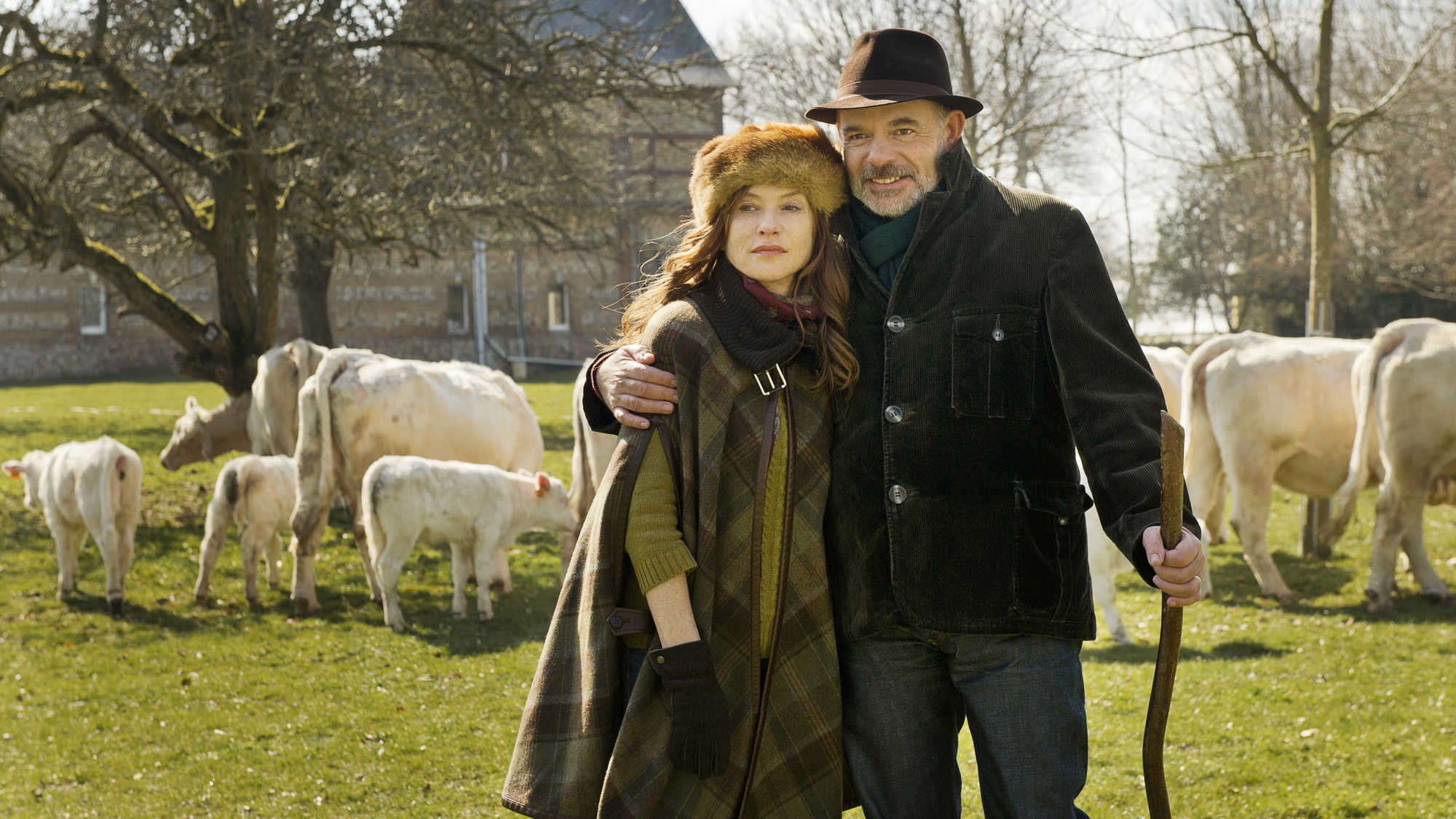
There is an old adage that an affair can have a positive impact on a marriage – refresh it, liven it up. I suspect that in at least ninety-five percent of cases that is not the case, but Brigitte (Huppert) is bored, in a rural rut. Hubby Xavier (a fine, nuanced performance from Jean-Pierre Darroussin) is about to discover if that old saying it true for his stale relationship. These long term marrieds run a stud for those exquisitely hefty bovines, the charolais, in the French countryside. He is your typical ‘hide your feelings at all costs’ rustic. But Brigitte stands out with her millinery, as well as being, at around the fifty mark, still a beauty, a head turner – except for that pesky skin complaint on her chest that simply will not go away no matter how many exotic unguents she applies. She meets a younger slick city type at at local party she is cajoled to attend, with the result that horizons suddenly expand. Can he be the catalyst to lift her out of that rut? Using the treatment of her eczema as her excuse, Brigitte becomes cougar. She heads for the City of Light to track down her quarry in his own environment. When that does not exactly go to plan, she substitutes a Danish dentist (Michael Nyquist of ‘As It Is In Heaven’ and ‘Dragon Tattoo’ fame).

fb01

By now Xavier senses a rat and followers her to the sinful city, engages in a bit of detective work and spots her with her new beau. He knows by her body language she is not partaking in an innocent encounter. He doesn’t confront – he will bide his time. Eventually she’ll have to return to the farm, but what then? Can it really all be the same again?

There are some stunning scenes in this – several that will particularly linger. The couple’s son has eschewed inheritance of the farm to indulge his passion for circus skills. He is at odds with his father over this, but when Xavier surprises with a visit to where he trains it is revelatory. As it is when Brigitte finds evidence that she has been sprung. Her reaction displays just what an actress the venerable Huppert is!

fb02

And we also discover if smothering a nasty rash in passionate kisses can be a cure for the complaint. Well then, does our heroine truly find that it is never too late to live a little? Do there always have to be negative repercussions for bedding someone out of wedlock? I saw this French charmer in a week when a cafe siege and the slaughter of innocent children dominated the news. This sublime movie truly made me feel better about the planet. It will put you in a better place too.

Official Website = http://www.palacefilms.com.au/foliesbergere/

Not Much to do with the Clash

You’ll remember him if, like this scribbler, you’re of a certain vintage and back last century you had any form of relationship with the cinema. And he’s still lookin’ good – most dapper in all white Arab garb. He still has that sparkle, a certain glint in the eye. He’s now a venerable octogenarian, but back in the day he was something special – Alexandria’s great gift to the world. He shone in such movies as ‘Lawrence of Arabia’, ‘Funny Girl’ and more recently, ‘Monsieur Ibrahim’. But for this film tragic he remains the centrepiece of a triangle of love as two luscious beauties of the time, Geraldine Chaplin – who I felt was far decidedly more luminous than her rival – and Julie Christie vied for his character’s affections. I remember the iconic scenes – the train in the snow, the battle charge and the sheer desperation of being in Russia on the losing side during its revolution. ‘Dr Zhivago’, hitting our screens way back in 1965, was and still is a classic. The same could be said for Omar Sharif. He is wonderful as the ghost in ‘Rock the Casbah’.

rock-the-casbah01

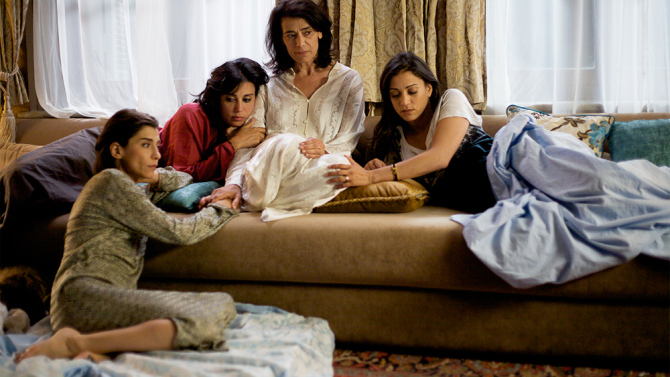
And again, in this movie, he is surrounded by a bevy of stunning women as a family comes together for a funeral. Sofia (Morjana Alaoui), a reasonably successful actress based in LA, flies in to join her sisters Miriam (Nadine Labaki) and Kenza (Lubna Azabal). Also present are the bereaved mother/wife (Hiam Abbass) and a feisty grandmother. It is illuminating watching the Islamic way of burying their loved ones as the Hassan cohort grieve for patriarch Moulay. This French/Moroccan effort is pure Hollywood as kin, friends and servants gather to point score and settle old insults – prior, during and after the internment. But within the family there is a secret that threatens to turn relationships awry. As well, an old, explosive affair is rekindled and there’s also the proverbial black sheep to be thwarted.

rock-the-casbah

It is all run of the mill stuff in narrative terms – there are no surprises here. It’s the gorgeousness and charisma of these women that will engage the audience. They certainly charmed me in the way Ms Chaplin did all those decades ago. Despite an exotic locale on show and practises foreign to us Westerners, this movie demonstrates that some features of the human condition are universal. These are strong, resilient ladies – all of them. In secular Muslim communities such indomitable creatures still run the show. As in our society, the menfolk are no match. Director Laila Marrakchi infuses the proceedings with a rich glow; his lenswork assisting in giving his offering immense warmth. Who knows how many more times Sharif will grace the world’s screens? ‘Rock the Casbah’ is worth a view for this alone – the added excellence is a bonus.

RocktheCasbahPoster2

Trailer for ‘Rock the Casbah’ = https://www.youtube.com/watch?v=Zud2_-im5aM


WAG

It was delicious to be out on deck after all this time. The rolling waves were finally abating, the skies were clearing and I was feeling refreshed. For so long we had been confined to the suite of cabins my employers were allocated for the duration of the voyage. Since our departure from Southampton sea-sickness had wracked the SS Peshawar, the vessel taking us home to Australia. My own stomach had roiled as a result, but many were far worse off – bedridden even. So, really, I had little to complain about as I went about my duties These mainly consisted of keeping the children entertained in such circumstances. Naturally exuberant, there was little space for their usual carefree shenanigans. They had displayed great self control during trying times in a constricted space. How those cramped poor souls below decks had survived the effects of the ferocious spring storms, for eight long days and nights, was beyond me.

That day was the first occasion we, as a party, could safely walk the decks to take the sea air. Sir William and Lady Janet had dressed in their best to promenade and I had difficulty keeping the little ones in check as all they wanted to do was scamper about. The sun was showing its face for the first time on the voyage and I took the liberty of wearing a veil to protect my complexion, as was the fashion back then, even if the tropics were still a way off. The adults in our group were all feeling quite languorous, the after effect of many sleepless nights. Then, all of a sudden my employer became quite animated and started gesticulating to a lone man staring out to sea, shouting to him and calling him over. As the stranger turned to investigate who was causing the commotion I lifted my veil, placing it atop my hat so I could better discern the cause of Sir William’s out of character performance.

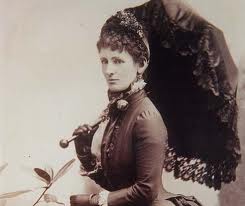
florence mFlorence Morphy

I wonder who it will be? Which Australian will bowl that first bouncer of the summer’s test series against India? As our team attempts to recover from the awful event that has shattered the early days of the season and tries to gear up to face the visitors, our national sport is in dire need of a happier story. Thanks to a recent discovery under the roof of a girl’s school in Kent, England, here’s one that will put a smile back on the face of any cricket tragic/romantic at heart.

Over all our years together he would tell me many, many times it was that lifting of the veil. It did him in. He told me he was smitten from that moment on, remaining so for the rest of his years on our good earth. Something tells me it will not be too long before I join him; not long before I share that space alongside him in our Kentish churchyard.

It transpired that the gentleman in question did indeed know Sir William and he hurried over to shake his hand. He cut a very fine figure indeed. He possessed a most handsome moustache, pleasantly dark features, wonderfully twinkling eyes and was kitted in the most fashionable manly attire for travel on the high seas. I was most taken with him. He greeted us colonials with a deep bow, then tipped his hat to Lady Janet as he was introduced to her, followed by shaking hands with each of the children – making them feel very important indeed. When my employer came to me this elegant chap took my hand and raised it almost to his lips – as if I too were a person of some note, not merely a lowly governess. Sir William and our new acquaintance, we were informed, had moved in the same circles in London society during our long stay there. I knew Sir William Clarke was a devotee of the game of cricket as he had built an impressive ground back at Rupertswood, the family residence at Sunbury, on Melbourne’s outskirts. So it was no complete surprise to me that the young gentleman, who I took to be around my own age, was introduced by the older man, in a voice of some gravitas, as the captain of the English touring party. His team were en route to play some games against our antipodean cricketers. He was Ivo Bligh. I only partially listened to the discussion the two had about recent events in the sport as I was pre-occupied with the little ones, but there seemed to be much jocularity to do with Grace’s team being beaten. Mr Bligh told us all that it was his solemn duty to go to our shores and bring back some ashes that Grace managed to lose. What I did discern, though, was that each time I looked towards the two men, Mr Bligh’s eyes seemed to be on me. I also realised that his distraction from his conversation, by me, was not going unnoticed by Lady Janet. With her perceptiveness a propitious seed was sown.

In a dusty attic in the roof space of a girl’s school in deepest Kent some renovating workmen discovered a trunk full of attire from a bygone era. The only item that was not clothing was a thin manilla folder containing a dozen or so sheets of lined foolscap paper, covered in a shaky, spidery scrawl. They passed it on to one of the masters at the school, who duly took it to the local historical society to see if it was of any relevance for their records. On examination it turned out to be first draft of some memoirs. After close reading it was realised that, yes, what was so painfully scrawled was of import, but not so much to local history. As will be discerned from the following extracts, it was of considerable significance for the sport we love.

ivo01Ivo Bligh

As the weather continued to improve our party encountered Mr Bligh and his fellow cricketers many times, not only on the promenading decks, but in the ship’s staterooms as well. Although I never spoke a word to him during these encounters, I felt his eyes return to me over and over again. At one stage, as an entertainment, the ship’s officers challenged the sportsmen on board to a tug-of-war. When Mr Bligh took his turn he seemed to injure his wrist during the exertions. It was a few evenings later that the Clarkes were due to sit at the captain’s table for dinner. To my delight, Lady Janet informed me I would be accompanying them on this special occasion; that a suitable young lady from below decks had been hired to put the children to bed for the night. In my careful preparations for the dinner I had the feeling that, for me, this night would be auspicious, maybe even a turning point. I had little inkling, though, just how momentous it would prove to be. To his dying day my dear Ivo claimed he took no part in the arrangements at that high table, but on being seated I discovered my place-card was sited along side his. My suspicions fell on Lady Janet, but when I politely queried her on a later occasion, she feigned no knowledge.

From the commencement of the meal Mr Bligh was most attentive, seemingly wanting to know all about my life at Rupertswood, my employer’s country estate. I noticed that the poor man’s wrist was tightly bound and asked if it was healing. As I did so, I unthinkingly laid my hand on his arm. Mr Bligh then reached for my hand and raised it, this time fully to his lips, proceeding to kiss it most fervently. He didn’t seem to care who was watching. I duly noted that Lady Janet again had not missed the unexpected display of affection from a gentleman barely of my acquaintance

It was at that instance I knew. This fine vision of British manhood would become important in my life. As the night wore on we talked and talked, almost oblivious to those around us. Mr Bligh seemed to consume a goodly amount of wine to the degree that, by the time dessert was served, he seemed to be somewhat agitated. He finally leaned in closer to my side and whispered in my ear, ‘I simply must see you again at he earliest convenient opportunity.’

Doing so was not easy – he had his duties and I had mine. But in Lady Janet I soon found I had a discreet ally. The morning after our meal, at high table, she took me aside and indeed asked if there were ‘feelings’ developing between myself and Mr Bligh. I replied in the affirmative. She told me she thought that news was wonderful, continuing by asking if she could be of assistance in ‘helping the relationship along’, as she put it. I confided to her my admirer’s final request to which the good Lady replied that I was to leave it to her – she would see to a suitable arrangement. After that it became quite easy to organise our assignations. Lady Janet became an effective conduit between myself and the man who was quickly winning my heart. There could be no suspicion attached to her passing on notes between myself and Mr Bligh as this was done entirely in Sir William’s presence. If he was privy to what was occurring I had no way of knowing.

By this means we communicated throughout the remainder of the voyage and we gained enough time together for a true fondness to develop between us, albeit it with precious little privacy. Still, by the time we rounded the Cape of Good Hope and set forth into the Indian Ocean we had shared embraces, kisses and confessed our fealty to each other. I also knew by then he was a man of some means – was regarded as a future leader of men, off the sporting field as well as on it. By then he had truly become my very dear Ivo.

The SS Peshawar’s journey to Australia was not without incident. Off the coast of Ceylon the boat collided with the barque Glenroy. English paceman Morley was so injured he took very little part in the games on colonial soil and died soon after his return to his home country.

ivo02

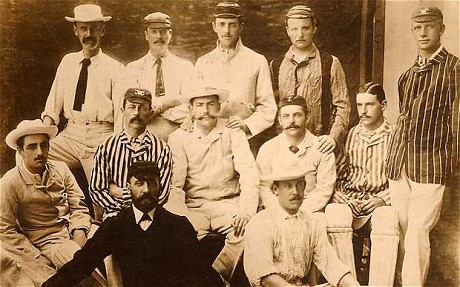
The English Touring Team

As our battered craft docked at Port Adelaide Ivo and I knew the time was not far off before we would be forced to be parted. He had ceremonies to attend in the South Australian capital, as well as some matches to play against the locals. Our party, meanwhile, would carry on to Port Phillip. By now Lady Janet was very much out in the open as my co-conspirator in managing time with Ivo. Prior to disembarkation she saw to it that our suite of cabins were empty well before time so my beau and I could say our farewells unseen. It was there that I felt for the first time the ardour of Ivo’s longing for me. Although I was determined to remain chaste till my wedding day – be that with he or some other suitor – his physicality had a powerful effect on me. I found myself swooning on more than one occasion.

Wonderfully, the first two test matches between the MCC and the combined antipodean team were to be contested in Melbourne. My good lady saw to it that Ivo was a constant presence around Rupertswood, when his schedule permitted. By then, as a result of our times spent in each other’s close company, he knew all there was to know about me, down to my inner most thoughts. He was privy to the fact that my father, John Morphy, had migrated to Victoria and in 1836 met and married my mother, Elizabeth Styles. He knew my childhood was spent in nearby Beechworth. I came into the world in 1860, soon making the discovery I already had six siblings preceding me. But I was very fortunate in being quick with my letters and adept at the keyboard. He knew that, with the latter, I had achieved some modest local fame, to the degree that the Clarke’s took me on as their children’s governess and music teacher.

By our time in Sunbury it was no secret that Ivo and I were unofficially betrothed. His form in the first two tests was wretched. But this did not seem to worry him. As he told me, he was there to captain. This he carried out very professionally, but the word was out – rumours appeared in the press insinuating his mind was far more on me than hitting a leather ball with a bat. That Christmas, prior to those matches getting under way, was the most thrilling of my life till that date. For days on end my Mr Bligh did not have to rush away and we started making plans to spend the remainder of our years together.

England lost the first official test at the MCG with Bligh scoring a duck and six. In the second confrontation the MCC prevailed, but Ivo again didn’t trouble the scorers. Then the English team moved to Sydney where two further encounters against the Australians were played. The first had its fair share of controversy, but the visitors were victorious. A final match was hastily cobbled together and was of an experimental nature. It wasn’t considered official, thus the Bligh’s cohort had achieved their aim – that of capturing the ashes to take back to the mother country. Revenge had been exacted. Of course, at this stage the games between Australia and England were not played for anything tangible – only bragging rights. The famous urn did not exist – but all that was about to change, with Florence Morphy and Lady Janet Clarke soon seeing to that. And the story has an unexpected twist that has only just come to light. For this we return to those thin pages scrawled by a woman who knows her time is short.

Saying farewell to Ivo, if only for a brief time, I found heartbreaking. He had to proceed to Sydney where there was the deciding clash to lead his team in – and that then turned into another match as well. It all caused me much anguish and distress. Would he come back to me as promised? Would he meet someone up there he found more to his liking than I? I didn’t know my Mr Bligh well enough to know that, when he gave his word, nothing would sway him from keeping it. After Sydney was done with he returned immediately, as vowed.

As departure neared, on his stay-overs at Rupertswood he had by now taken to sharing my bed, although we made some attempt to be discreet. But really he seemed not to care who knew we were breaking convention and who didn’t. Of course Lady Janet was privy to this development and gave me some advice to prevent insemination, but Ivo was, till the end, considerate of my desire to remain intact till our wedding night. I found other means to service his needs. And he mine. We had planned our nuptials to occur the following summer, with Ivo returning home at some stage in the autumn. The treasured man wanted to remain with me as long as possible.

ivo03

Lady Janet Clarke

Before the team left our shores, Lord and Lady Clarke decided to invite them all for one last gathering at Rupertswood. This occurred over the Easter period. A very fine meal was laid on and some humorous speeches made. This evening, though, has gone down in the annals of cricketing history far more because of a small token presented to Bligh and his departing team.

A few days before the announcement of the English visitors’ final festivities at the Clarke’s stately abode, Janet came to me with a devious plan. Yes, she was now Janet to me. I was forbidden to prefix ‘Lady’ to her name, in any situation, for she stated she now regarded me no longer as an employee but one of her closest friends. I was both touched and astounded. I also knew she was delighted with the role she played in creating our love story – that between Ivo and this daughter of a soon to be federated Australia.

In her hand she carried a small urn and was soon drawing my attention to it. When I inquired what she intended to do with it, a wide smile engulfed her face. She told me, in hushed tones, of her plan. It involved burning some cricket bails and placing the ash in the tiny container. They would represent those ashes the men were always finding humour in. They would now take on form. ‘But,’ Janet continued, ‘as I will be presenting this to Mr Bligh, I think it is only appropriate that we burn something more intimate as well. Something to wrap the bails in – something he can only associate with you, his darling love. Something that signifies the union that is about to occur between an English gentleman and a beautiful colonial rose. Do you think that would be a good idea? Only you and he would know that the urn contains the other item. I will not let that cat out of the bag – ever. Now, do you have a notion of what we could use?’

ivo04

Rupertswood

I did indeed. It didn’t take me long to produce an item for Janet. Of course, what else could it be apart from that very veil I lifted from my face on that fateful sea voyage? The act I was engaged in when he first espied me – and I him.

On February 9th, 1884 Florence Morphy and Ivo Bligh wedded at Rupertswood. On the death of his elder brother, in 1900, Ivo Bligh became Lord Darnley and he and Florence took up permanent residence in Cobham Hall. The little urn, which the lord of the manor considered a personal gift, knowing full well what else it contained apart from the ashes of a bail, became a fixture on a mantelpiece in the family seat’s library. Ivo passed away in 1925. Two years later Florence, Lady Darnley, presented the urn to the MCC at a function attended by a young tyro from Australia, Don Bradman. Florence later joined her husband, by being buried in a plot beside him, in 1944.

It was not until 1998 that the elderly daughter-in-law let slip in an interview to a magazine what else was burnt, along with some bails. What else was also placed in a minuscule urn, on that occasion, over a hundred years previous.

So, as our national team prepares to take the field in Adelaide for what will not doubt be an emotional return to combative cricket at the highest level, we can reflect on this happy story and the fact we are not too distant from another Ashes campaign. The tiny piece of pottery is now worth a small fortune and is far too fragile to travel from its home – but the story of its gestation is indeed a remarkable one. It was borne of love, the type of love that in recent times a nation has bestowed on Phil Hughes. May the battle begin.

'Game Day' – Miriam Svede versus 'The Family Man' – Catherine Harris

‘Best not to bring wives and girlfriends to this party,’ advises Laurie (their coach) with a grin as he hands out the details….Or they won’t be your wives and girlfriends no more.’

It is difficult to imagine a coach of an AFL football team giving such advice to young men in the modern era, but, according to Catherine Harris in ‘The Family Man’, this was still happening as late as the 2006 season after her hero – Harry Furey – and his team won the premiership. But whilst the idiocy of and potential for public relations relations disaster that is Mad Monday still lingers (but for how much longer?), nothing, I guess, would be impossible. The event the players were given the aforementioned advice about was a ‘sportsmen’s night’ – an alcohol fuelled ‘entertainment’, complete with a second rate stand-up cracking gags of dubious taste and inebriated dicks encouraging young, in one case very young, dancers to, ‘Show us yer tits.’ Not much, to my mind, sporting about that! At the particular evening in question an unspeakable, but unquestionably newsworthy, act occurs that is at the core of Harris’ debut novel.

Now it seems that the Weekend Australian’s book critic, Ed Wright, had the same notion as I for the December 6 edition of his newspaper – to read (and in his case review) two local writers attempting their first novels. Both chose the unique Australian brand of footy for this and – perhaps surprisingly – both are female. Brave? Well it shouldn’t be, should it? There is no earthly reason in this day and age why writing about a man’s sport should be the prerogative of just the lads. We’ve long moved on from that notion, even if the club Harris references is still seemingly in the neolithic period when it comes to attitudes towards women. Age columnist Caroline Wilson has been writing on our great game to stunning effect for years, albeit not in fictional form.

Mr Wright is a tad more positive about Harris’ project, as well as Miriam Sved’s ‘Game Day’, than I. It must be said, though, that there is not exactly a deluge of novels about our sport to compare them with. Wright cites ‘Salute to the Great McCarthy’ and ‘Deadly Unna’, but for my money the pick to date is Paul Carter’s ‘Eleven Seasons’ from 2012. The reviewer is correct in his assertion that ‘Game Day’ is the better of the duo, and I did like the way Sved structured her tale of a year in the life of a footy club. She took a number of major and minor players and examined their impact on the team’s campaign for a flag – coach, potential star, injured recruit, team doctor, team groupie and so on. There’s Luke Campenous (do we read Wayne Carey), a centre-half with a golden boot, but boorish to the max off-field. It’s all mildly intriguing stuff. The author’s prose is also somewhat better than Harris produces but, nonetheless, I found myself not being won over by it to the same degree as Wright.

svede

Game Day CVR SI.indd

Reading the above, though, was not the same league of struggle I had with ‘The Family Man’. Perhaps it was the title that put me off. My team, Hawthorn, prides itself on being the ‘family club’, but the events of the ‘sportsmen’s night’ were anything but family orientated. But then, as with the recent unconscionable indiscretion by a young Hawks wannabe, unseemly acts can gain adverse publicity for even the most squeaky clean of operations. I suspect, as does Wright, that Harris is attempting a fictional take on Anna Krien’s ‘Night Games’. Is the supposedly toxic culture of St Kilda in recent times her model? Gary Ablett Senior would be a dead set for Harry Furey’s dad, disgraced former champion Alan. Harry carries with him, through the off-season, the terrible truth of what really happened on that night and his role in it. His participation, we discover, is not quite what we may have expected. But really, I had lost interest long before that. Her over-wrought, at times over-ripe, writing style, didn’t really set the appropriate tone. I persevered as I wanted to achieve my aim, but was relieved when I finished that last page.

FamilyCatherine

There is no doubt both these authors have potential in the industry and our local publishers are to be given credit for continuing to put into print those who aspire to a career as a wordsmith. Hopefully these two can be supported enough so a more successful sophomore novel may be produced in due course.

In the same column that these two tomes were given the treatment by his critical, but fair eye, Ed Wright also passed judgement on Kylie Ladd’s ‘Mothers and Daughters’. It was a very positive review and this author stuck to traditional fare for writers of her gender. I won’t say it – I simply will not. Deep down I admire Harris’ and Sved’s guts for having a go in, if you like, foreign territory.

Ed Wright’s reviews = http://www.theaustralian.com.au/arts/review/from-footy-to-feelings-in-the-latest-australian-fiction/story-fn9n8gph-1227145074323